Literature Literary Criticism of Prose The Individual and
- Slides: 53
Literature: Literary Criticism of Prose The Individual and Society
Elective Paper - Paper 3 The Individual and Society Characters and Setting
• Concerns (surface through presentation of Characters) – Interpretation / Interpretative Analysis • Methods – Ways characters are presented; Stylistic Analysis
Essay of Literary Criticism Introductory Paragraph All essays of literary-criticism are necessarily argumentative – you are arguing a point of view – your literary critical perspective In the introductory paragraph • You will state your interpretation / interpretative perspective; Thesis / Central Framework of Ideas
• Eva’s internal narrative point of view; Shifts in Eva’s angle of narrative perspective • Eva’s mode of diction and syntax; Tone / Voice • Eva’s choice and form of imagery and symbolism; critical significance and effects; • Eva’s use of humour and irony
• The epistolary form allows readers to understand Eva better through her diction and syntax. • A letter format seems to be from a mother’s point of view
• Presentation of Character (Characterization) and Character Relationships • Eva-Franklin Relationship (Wife-Husband)
• Eva-Kevin (Mother-Son relationship)
• Eva is presented as a pragmatic individual and pessimistic mother. • Eva is very strongly attuned towards individualism. However desires for conformity also pervades the narrative.
The novel Canada by Richard Ford The opening sentences of the first chapter of the novel, Canada, (2012) by the contemporary American novelist, Richard Ford • It opens in the year 1960 in Great Falls, Montana, a frontier town in USA; (Time & Setting) • Dell Parsons, the protagonist, and the narrator – now a retired English teacher, is looking back on his younger days with a kind of bemused detachment on the unlikely events that unmoored him from his ordinary life and pitched him into an uncertain future;
• The narration is meticulous in its recreation of period details; • Throughout, Dell Parsons’ calm and measured voice suggests someone not so much damaged, as detached.
For literary-stylistic analysis First, I’ll tell about the robbery our parents committed. Then about the murders, which happened later.
Opening sentence of Hawthorne’s The Scarlet Letter A throng of bearded men, in sad-coloured garments and gray, steeple-crowned hats, intermixed with women, some wearing hoods, and others bareheaded, was assembled in front of a wooden edifice, the door of which was heavily timbered with oak, and studded with iron spikes.
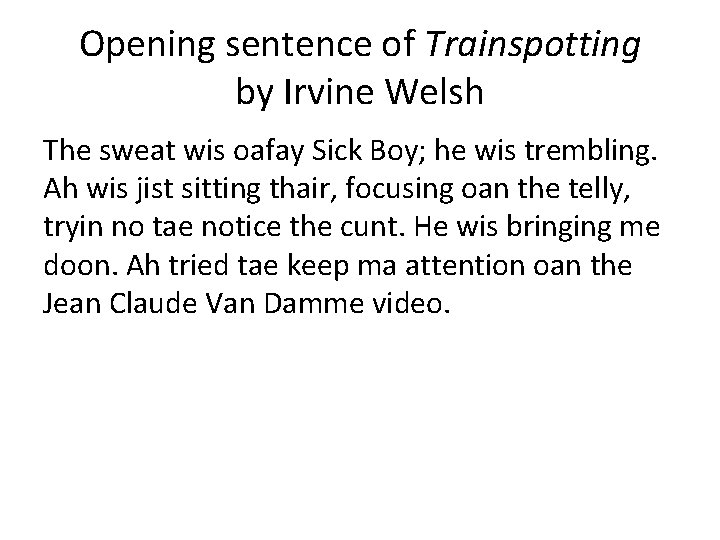
Opening sentence of Trainspotting by Irvine Welsh The sweat wis oafay Sick Boy; he wis trembling. Ah wis jist sitting thair, focusing oan the telly, tryin no tae notice the cunt. He wis bringing me doon. Ah tried tae keep ma attention oan the Jean Claude Van Damme video.
Avoid comments such as • The writer uses diction to tell us his parents committed a murder and robbery.
Avoid comments such as • The narrator begins by telling us his parents are not really good people through the use of diction such as ‘robbery’, and ‘murders’.
Literary Critic, Theo Tait, The London Review of Books Re- the novel Canada by Richard Ford – • The opening sentences encapsulate not just the novel’s events, • but also its mood and style • The balance of sensational goings-on with ruminative, rueful delivery; • These sentences surprise – with the powerful effects that can be wrung from plain prose (plain language).
Literary Critic, Michael Dirda, The New York Review of Books • Such sensational words, • even presented with matter-of-fact understatement, • will grab anyone’s attention (effect);
Dirda then makes this observation • But on the surface – these sentences seem to be revealing too much; • Arguably wrecking the novel’s plot;
But is too much of the plot really being revealed? Dirda then proceeds to note and point out • The use of the pronoun “our” instead of “my” – • Subtly signaling that this is, in some way, going to be a story about siblings; • Notes also – that Ford’s narrator dances over whether the robbery is successful or not; • Furthermore, the narrator carefully avoids saying - who is murdered by whom;
Part of the Narrative Technique • We come to know at the beginning that the robbery and the murders will take place; • But when? • And how? • And what will happen subsequently? • So as readers – we attend, we observe, and we prepare for the inevitable;
Some background on Richard Ford as a Writer / Novelist • Ford in his interviews has emphasized the great care he takes over the subtleties of the sound and sense of words; • And that nobody looks longer at his words than he does, • Or calculates more precisely their effects; ~~~~~~~~~~~~~~~~~~ • So readers should also look and read again!
Dirda further comments • While the characters in Canada spring to life through their distinctively individual voices – • Ford tends to shy away from using prolonged conversations (extended dialogue); • Instead, he lavishes his most intense attention on description of his characters and locales; • What of Hawthorne’s presentation of his characters in this regard in The Scarlet Letter?
Focus on Dialogue in the Novel • Literary criticism of fictional prose – with a special focus on Dialogue; [Aside] • When comparing literary texts of fictional prose (Novels or Short Stories) and works of Drama – we see they both have one element in common • Both genres make use of dialogue;
Reading and Responding to Dialogue • Conversation is an important element in fiction, as it is in real life; • One of tests of quality in a novelist is the skill with which dialogue between characters is presented; • In reading dialogue – we as readers – we come to feel particularly close to the ‘reality’ with which the novel is linked; • When characters are talking, the reader is in the position of a silent listener – following the conversation like an eavesdropper;
Dialogue and Intervening Commentary • However, a novelist cannot rely solely on the words his characters speak in fictional dialogue; • (Which is what they would do – in a play); • There is a need to include the narrator’s commentary to indicate how the words are spoken (manner) • And it is that gives the mood and tone of the conversation; the dialogue is amplified through the voice of the narrator; • And narrator’s commentary is used to describe both the deeper effects made by the conversation on the characters and something of their motivations;
Life is full of Complications; Literature reflects this! • For most characters in most novels – there is a complication; • We do not get objective accounts of them (in the manner of expository non-fiction writing); • We see characters presented to us only through the eyes of whatever the POV character is at that moment
Methods of Dramatizing Characters’ Emotions Four modes of conveying emotions of characters Methods of dramatizing characters’ emotions: • • Action / visceral techniques Dialogue Bodily sensations Characters’ thoughts
• Dialogue is conversation — Characters talking to each other; • Dialogue dramatizes a character’s inner complications; • And their conflicts of views and values; • Dialogue brings us closer the characters and their conflicts;
• The most dramatic moment of a novel usually combines dialogue, scene setting, and other elements of fiction;
Dialogue in Fictional Prose • Fictional dialogue – even in moments of high emotion – differs from “real-life” dialogue • By being shaped and designed by superb artistry through compression, selection of significant details, understatement, or emphasis, in order to give us an insight into the characters; • Dialogue in fiction – usually contains as much or even more subtext than it does text
• An inexperienced writer would present his / her characters’ values, choices, and conflicting desires by simply telling us about them; • But fiction depends on dramatization – on showing; • not exposition, or mere telling as in a case history; • Readers need to feel they are witnessing a story unfold;
• Dialogue in novels needs some intervening narrative to present scenes • and to connect these scenes to other parts of the novel’s plot structure / design; • Such as the use of description; commentary; • Dialogue alone can rarely constitute a scene in a novel;
• For a character to talk – there must be a point to be conveyed; it must matter; • Must be realistic – characters should have a distinct voice – distinctive level of diction – some characters speak in fragments; others in complete sentences; others in slang; others in dialect; others in standard English; some with fashionable others with idiosyncratic vocabulary • Reveals his / her region, class, education, style of thinking – logical, impulsive, spiteful, capricious etc
• Can range from straight dialogue, without any interpretation between the lines and a lot of exposition between them; • Varied dialogue – using a combination of direct and indirect addresses; • The narrator sometimes tells us how what was said is said; • At other times – the narrator implies and shows indirectly; • With his choice of detail, between the lines of dialogue – the narrator can express his attitude toward a character;
• Sometimes the more important part of dialogue takes place in body language • And in the exposition between the lines; • In a scene with dialogue – the words may run contrary to the general meaning of the scene; • Good dramatic dialogue tends to be multi-layered – so that in addition to body language and direct meaning – there is another parallel meaning to what is being said;
Text of next prose extract in context • In Kazuo Ishiguro’s novel The Remains of the Day – the central character - Stevens - is presented as having a conflict of values; • A butler at a great English country house in the 1930 s, he is not much given to introspection • Or outwardly giving free rein to his emotions; • However, he is under stress – his father, also a servant – has just died upstairs - while a great dinner is taking place in the dining room; • Stevens has just been informed of his father’s death by the housekeeper, Miss Kenton
From The Remains of the Day by Kazuo Ishiguro “Dr. Meredith has not yet arrived. ” Then for a moment she lowered her head and a sob escaped her. But almost immediately, she resumed her composure and asked in a steady voice, “Will you come up and see him? ” “I’m very busy, just now, Miss Kenton. ” “In that case, Mr. Stevens, will you permit me to close his eyes? ” “I would be most grateful if you would, Miss Kenton. ”
She began to climb the staircase, but I stopped her, saying, “Miss Kenton, please don’t think me unduly improper in not ascending to see my father in his deceased condition just at this moment. You see, I know my father would have wished me to carry on just now. ” “Of course, Mr. Stevens. ” “To do otherwise, I feel, would be to let him down. ”
• What two values are in conflict with each other here?
• Through the dialogue we see how Stevens is torn between two values: • Love and duty toward his father And his work duties as a butler; • His father’s death matters to him; • The dialogue reveals this; • It is more effective to have Stevens talk directly about his complicated turmoil;
Thoughts in Dialogue to Indicate Personality Whether depicting calm thoughts or incoherent thoughts Techniques for dialogue? • Compression; interjections; ethnic words; regional phrasing; profanity; understatement; breaking point, and emphasis; • A character’s “breaking point” – a dramatically effective use of dialogue – requiring both the pressures on him, and a breakdown of his previous self-control;
2011 GCE ‘A’ Level Elective Paper The following passage is taken from the novel The Doves of Venus (1955) by Olivia Manning. Ellie, the main character, lives in London. She has come home for Christmas to stay with her mother who runs a small restaurant on the south coast of England. Write a critical commentary on the passage, relating its concerns to key features of the topic ‘the Individual and society. ’
Scene Setting and Scene Structure What? • Concerns / Complications / Issues / Themes through presentation of characters; How? • Structural and Narrative Methods of Presentation / Techniques Why? (Why is it presented this way rather than…) • Effects / Purpose / Intention
Dialogue in The Scarlet Letter For example • Dimmesdale and Chillingworth in Chapter 9 p 107 Revealing or concealing one’s sins – sinful deeds • Note how the dialogue dramatizes Dimmesdale’s internal conflict pertaining to his views and values • Chapter 10 p 114 – p 116 • Central part of the Conversation resumes p 118 – p 120
Q 2 (a) ‘Among many morals which press upon us from the minister’s miserable experience, we put only this into a sentence: — “Be true!” • To what extent is the central concern of the novel reflected in these words?
Prefacing quotation of Q 2 (a) From the final chapter – • Chapter 24, p 224
• The virtue of Truth – of telling the truth • Conscience • A man burdened by a secret p 109
‘our godly New England’ p 57 “Speak to the woman, my brother, ” said Mr. Wilson. “It is of moment to her soul and therefore, as the worshipful Governor says, momentous to thine own, in whose charge hers is. Exhort her to confess the truth!” Chapter 3 p 62
I, your pastor, whom you so reverence and trust, am utterly a pollution and a lie! – p 125
Chapter 11 p 127 -128 To the untrue man, the whole universe is false, —it is impalpable, —it shrinks to nothing within his grasp. And he himself, in so far as he shows himself in a false light, becomes a shadow, or, indeed, ceases to exist. The only truth that continued to give Mr. Dimmesdale a real existence on this earth, was the anguish in his inmost soul, and the undissembled expression of it in his aspect.
Chapter 17 p 168 By means of them, the sufferer’s conscience had been kept in an irritated state, the tendency of which was, not to cure by wholesome pain, but to disorganize and corrupt his spiritual being. Its result, on earth, could hardly fail to be insanity, and hereafter, that eternal alienation from the Good and True, of which madness is perhaps the earthly type.
Chapter 18 “O Arthur, ” cried she, “forgive me! In all things else, I have striven to be true! Truth was the one virtue which I might have held fast, and did hold fast through all extremity; save when thy good— thy life—thy fame—were put in question! Then I consented to deception. But a lie is never good, even though death threaten on the other side! Dost thou not see what I would say?