
Literary Criticism is a way of viewing or

- Slides: 10
Literary Criticism is a way of viewing or interpreting literature by using different lens (perspectives) 5 types of Literary Criticism covered in ENG IV: § Reader Response Criticism (Unit 1) § Cultural Criticism (Unit 1) § Feminist Criticism (Unit 2) § Marxist Criticism (Unit 2) § Archetypal Criticism (Unit 2)
Review: Reader Response § Individual Response to Reading a text § Reader’s background, experiences and knowledge are used to gain comprehension § Interpretation of text relies only on the reader Example: “My Papa’s Waltz” can be interpreted as a poem about a fun romp before bed between father and son, or as a poem about child abuse.
Review: Cultural Criticism § Elements of a particular culture must be considered when interpreting a text § A culture’s religion, values and prevailing issues must be understood in order to gain meaning from the text Example: The presence of two religions in Beowulf is explained by the fact that Christianity was slowly replacing the pagan beliefs of the Anglo-Saxons.
Feminist Criticism § Cultural issues due to “patriarchal” society (dominated by man) *Sexual stereotypes/place of woman and man in society *Issues that prevent women from achievement *Recognizes that society views women as being “other” to man
Example: Applying Feminist Criticism to Cinderella § Girl is waiting to be “rescued” from her horrible life by the handsome prince *shows women are the weaker sex and depend on men for everything (man is dominant and woman is subordinate) § “Good girl” is beautiful and “wicked girls” are ugly *shows that a woman’s worth is only in her beauty, or lack of beauty
Marxist Criticism § Economic Power Who has money? Who does not? Money=happiness § Class Conflict Dominant class controls the subordinate class/subordinate class accepts the control
Example: Apply Marxist Criticism to Cinderella § Cinderella must do all chores and wait on stepmother and stepsisters hand foot *Shows the oppression of the lower class by the upper class § Cinderella desires to marry the prince and live “happily ever after” *Shows the need for the lower class to join the ranks of the upper class in order to be happy
Archetypal Criticism § Archetypes are universal (widely recognized) symbols that are present in literature, myth, songs and film These include: § Archetypal characters § Archetypal symbols § Archetypal situations
Example: Apply Archetypal Criticism to Cinderella § The wicked step-mother and step-sisters terrorize Cinderella *Archetypal villains § The handsome prince rescues Cinderella by marrying her *Archetypal knight in shining armor § Cinderella has to be rescued from her life *Archetypal damsel in distress
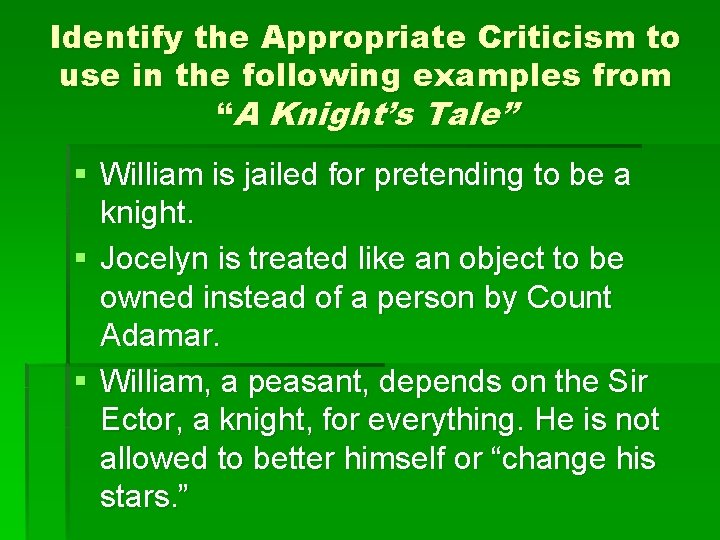
Identify the Appropriate Criticism to use in the following examples from “A Knight’s Tale” § William is jailed for pretending to be a knight. § Jocelyn is treated like an object to be owned instead of a person by Count Adamar. § William, a peasant, depends on the Sir Ector, a knight, for everything. He is not allowed to better himself or “change his stars. ”