Linguistics Literature The Sri Lankan folktale Language in

- Slides: 12
Linguistics & Literature The Sri Lankan folktale Language in Society Prof. R. Hickey SS 2006 By Sandarenu Kumarasamy Hauptstudium LN
Introduction The use/utility of language in the written and oral literatures of the world, could be generally termed as the spectrum of literary-lingustics. ➢ This presentation will however concentrate on the use of lanugage in verbal art folktales. ➢ By comparing and contrasting characteristics of folktales in Sri Lanka (Ceylon) narrated in two South Asian languages: Tamil and Sinhala. ➢
Functions of verbal art: ● Entertainment The display of skill ● Praise of a patron, or censure of an enemy ● The promotion of cultural values and morality ● The expression of mutual experiences ● Recording of historical events, or laws, or tenets of religion ● Communication with supernatural beings ● The control of the physcial world by magical means ● Healing ● Performing customs etc. ● Folklore
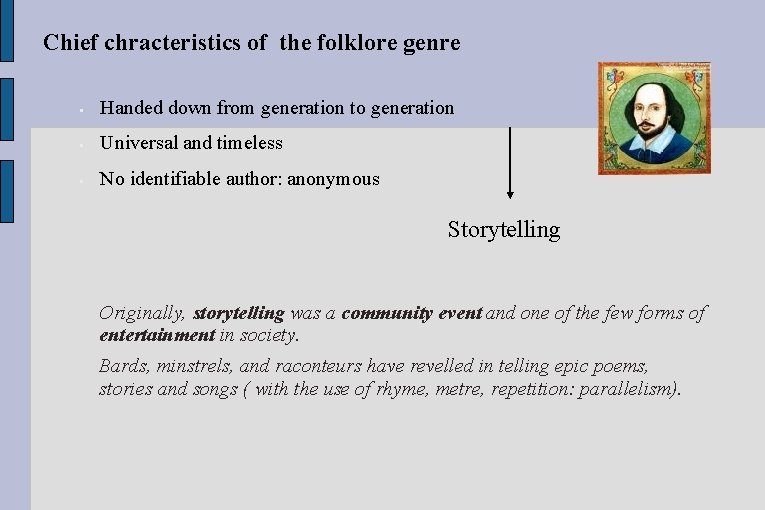
Chief chracteristics of the folklore genre Handed down from generation to generation Universal and timeless No identifiable author: anonymous Storytelling Originally, storytelling was a community event and one of the few forms of entertainment in society. Bards, minstrels, and raconteurs have revelled in telling epic poems, stories and songs ( with the use of rhyme, metre, repetition: parallelism).
A narrative genre: types of folktales Fables Myths Legend The umbrella thief
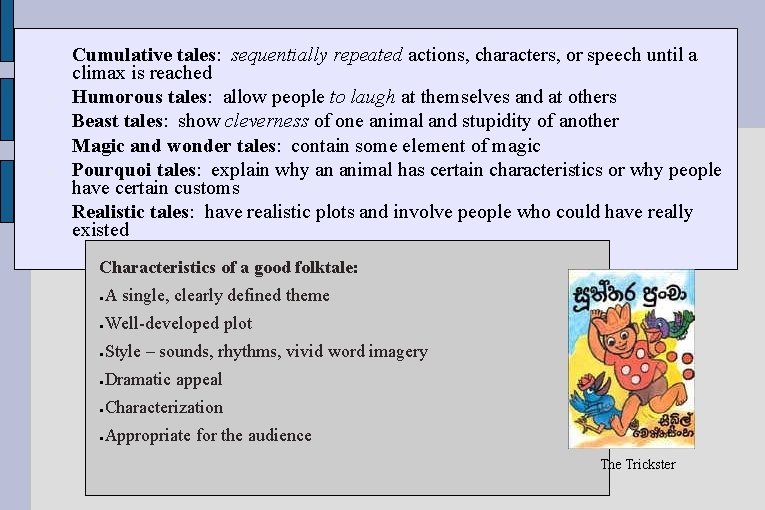
Cumulative tales: sequentially repeated actions, characters, or speech until a climax is reached Humorous tales: allow people to laugh at themselves and at others Beast tales: show cleverness of one animal and stupidity of another Magic and wonder tales: contain some element of magic Pourquoi tales: explain why an animal has certain characteristics or why people have certain customs Realistic tales: have realistic plots and involve people who could have really existed Characteristicsofofa agoodfolktale: Characteristics A single, clearlydefined theme A●single, theme ●Well-developed plot ●Style – sounds, rhythms, vivid word imagery ● Dramatic appeal ● Characterization ● Appropriate for the audience Dramatic appeal Characterization Faithfulness to the source Appropriate for the audience The Trickster
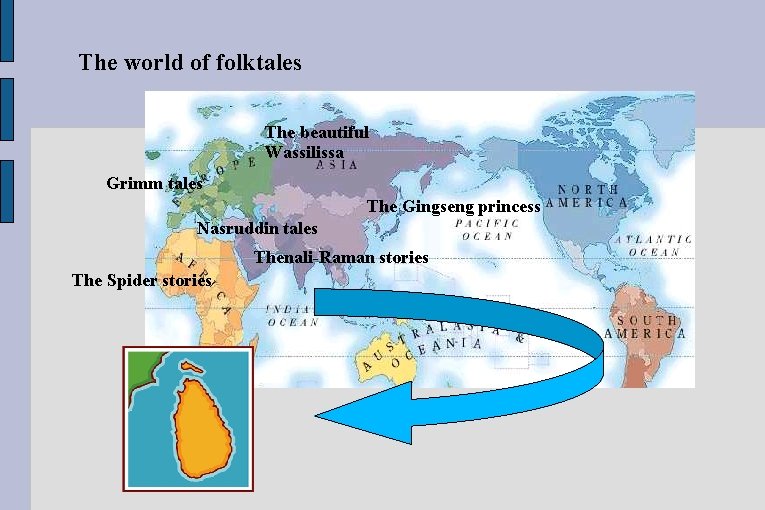
The world of folktales The beautiful Wassilissa Grimm tales The Gingseng princess Nasruddin tales Thenali-Raman stories The Spider stories
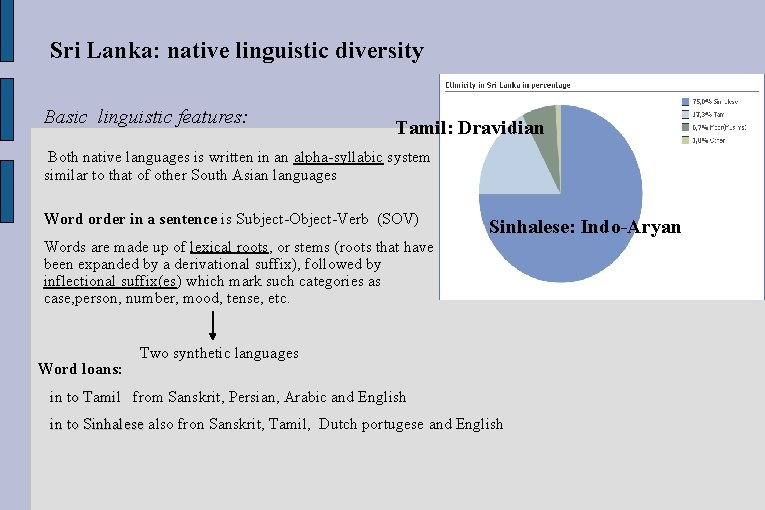
Sri Lanka: native linguistic diversity Basic linguistic features: Tamil: Dravidian Both native languages is written in an alpha-syllabic system similar to that of other South Asian languages Word order in a sentence is Subject-Object-Verb (SOV) Words are made up of lexical roots, or stems (roots that have been expanded by a derivational suffix), followed by inflectional suffix(es) which mark such categories as case, person, number, mood, tense, etc. Word loans: Sinhalese: Indo-Aryan Two synthetic languages in to Tamil from Sanskrit, Persian, Arabic and English in to Sinhalese also fron Sanskrit, Tamil, Dutch portugese and English
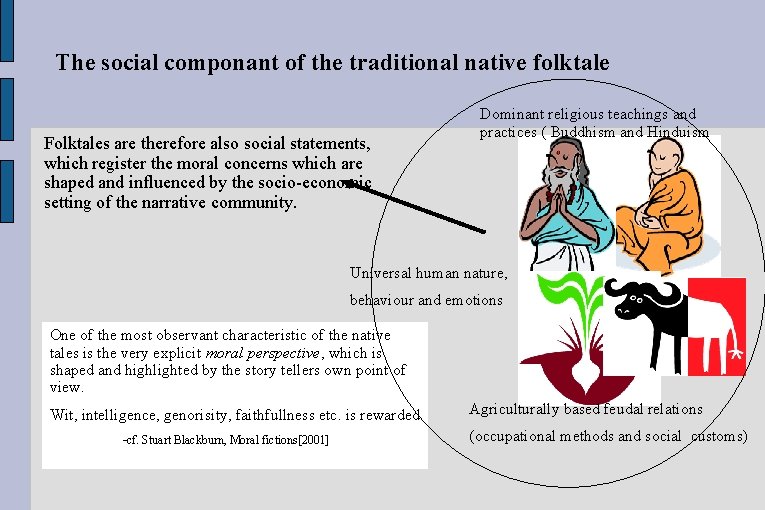
The social componant of the traditional native folktale Folktales are therefore also social statements, which register the moral concerns which are shaped and influenced by the socio-economic setting of the narrative community. Dominant religious teachings and practices ( Buddhism and Hinduism Universal human nature, behaviour and emotions One of the most observant characteristic of the native tales is the very explicit moral perspective, which is shaped and highlighted by the story tellers own point of view. Wit, intelligence, genorisity, faithfullness etc. is rewarded. -cf. Stuart Blackburn, Moral fictions[2001] Agriculturally based feudal relations (occupational methods and social customs)
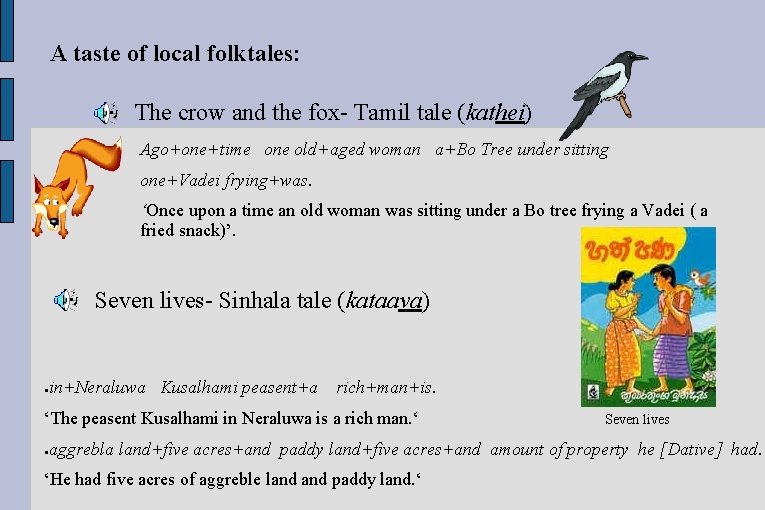
A taste of local folktales: The crow and the fox- Tamil tale (kathei) Ago+one+time one old+aged woman a+Bo Tree under sitting one+Vadei frying+was. ‘Once upon a time an old woman was sitting under a Bo tree frying a Vadei ( a fried snack)’. Seven lives- Sinhala tale (kataava) ● in+Neraluwa Kusalhami peasent+a rich+man+is. ‘The peasent Kusalhami in Neraluwa is a rich man. ‘ ● Seven lives aggrebla land+five acres+and paddy land+five acres+and amount of property he [Dative] had. ‘He had five acres of aggreble land paddy land. ‘
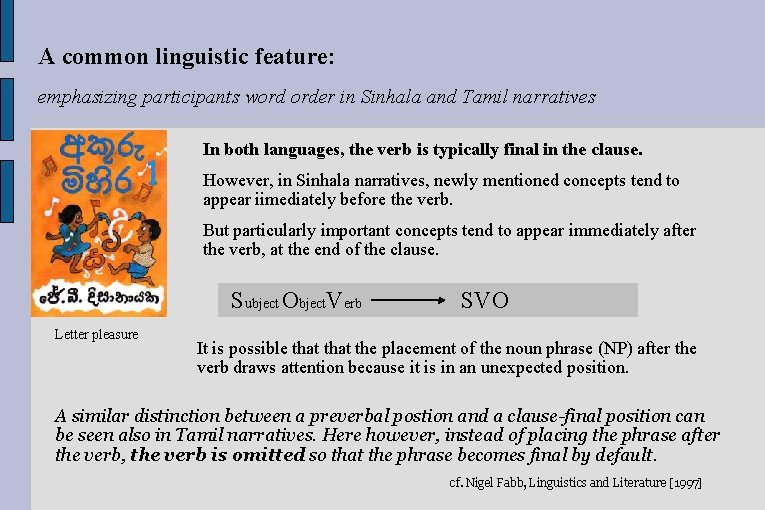
A common linguistic feature: emphasizing participants word order in Sinhala and Tamil narratives In both languages, the verb is typically final in the clause. However, in Sinhala narratives, newly mentioned concepts tend to appear iimediately before the verb. But particularly important concepts tend to appear immediately after the verb, at the end of the clause. Subject Object. Verb Letter pleasure SVO It is possible that the placement of the noun phrase (NP) after the verb draws attention because it is in an unexpected position. A similar distinction between a preverbal postion and a clause-final position can be seen also in Tamil narratives. Here however, instead of placing the phrase after the verb, the verb is omitted so that the phrase becomes final by default. cf. Nigel Fabb, Linguistics and Literature [1997]
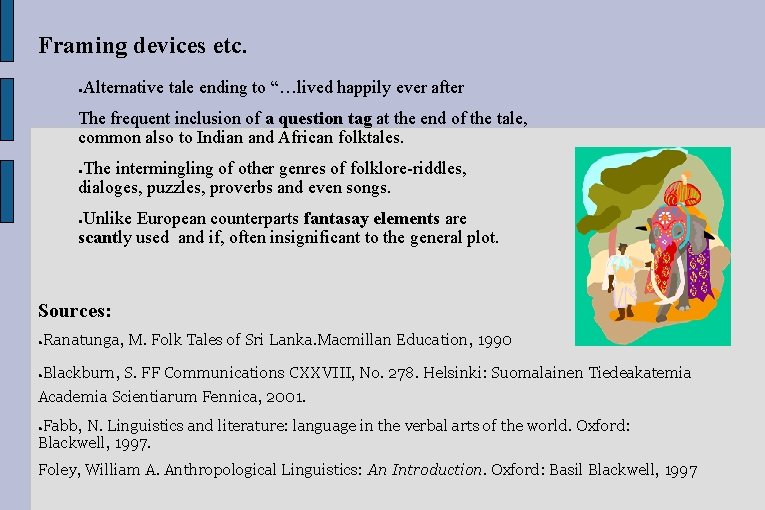
Framing devices etc. ● Alternative tale ending to “…lived happily ever after The frequent inclusion of a question tag at the end of the tale, common also to Indian and African folktales. The intermingling of other genres of folklore-riddles, dialoges, puzzles, proverbs and even songs. ● Unlike European counterparts fantasay elements are scantly used and if, often insignificant to the general plot. ● Sources: Ranatunga, M. Folk Tales of Sri Lanka. Macmillan Education, 1990 ● Blackburn, S. FF Communications CXXVIII, No. 278. Helsinki: Suomalainen Tiedeakatemia ● Academia Scientiarum Fennica, 2001. Fabb, N. Linguistics and literature: language in the verbal arts of the world. Oxford: Blackwell, 1997. ● Foley, William A. Anthropological Linguistics: An Introduction. Oxford: Basil Blackwell, 1997