Limitations of the fire assay system when dealing




- Slides: 19
Limitations of the fire assay system when dealing with jewellery containing platinum group metals. Dippal Manchanda MSc, CChem, CSci, FRSC Technical Director & Chief Assayer
Protection of caratage (fineness) integrity is vital • ISO 11426 – Fire Assay Method. Where a caratage control system is in use, we, the ‘Assayers’ rely on this technique to determine gold content of jewellery alloys. • Accuracy of ISO 11426 is considerably high for a simple matrix (Au/Ag/Cu/Zn type). Accuracy may be compromised if Platinum Group Metals (Pt, Pd, Rh, Ru, Ir, Os) particularly when Platinum (Pt) and/or Iridium (Ir) are present in the alloying material. Reason: When standard ISO 11426 method is followed, PGMs are not removed during cupellation and parting, and are thus weighed as gold, causing serious errors in the assay results. • • The protection of caratage (fineness) integrity for gold jewellery is of paramount importance if consumer confidence and trust is to be maintained in jewellery products. A loss of confidence would impact negatively on gold demand in this dominant market sector. • India is a 22 ct market and Platinum/Iridium rarely finds it’s way into 22 carat jewellery then why does this subject is relevant to Indian gold market. Lets understand the problem first.
Powdered additive as a ‘gold substitute’ • Recently, attention has been drawn to the use of an anonymous powder additive as a ‘gold substitute’ in gold jewellery alloys which has subsequently been identified as iridium, one of the PGMs. The presence of iridium in jewellery alloys presents two problems: • Firstly, its identification, during fire assay process, is difficult unless you have highly trained eye; and if it remains undetected then it will be weighed as gold and the product will contain less gold than that reported by the fire assay method. • Secondly, conventional refining processes, unless carried out by experts who understand the technicalities, do not eliminate iridium from metal scrap refining, resulting in even bullion becoming contaminated with iridium.
Why iridium? • As iridium is significantly cheaper (2. 6 x) than gold, their use to degrade jewellery has substantial cost benefits to the producer, if remained undetected. • Many assay laboratories in India do not have access to the more sophisticated analytical techniques required for detecting and measuring iridium content in jewellery or gold bullion, so it has largely remained undetected. • If this issue is widespread, which I assume to be the case as it has been widely reported by Indian newspapers, then there is a need to educate the Indian gold industry, particularly assayers and refiners by providing technical information otherwise the integrity of jewellery products and bullion will be severely affected. This is one of the two objectives I would like to achieve today.
Assaying of gold when platinum is present • 60% of jewellery traded in the Western world is white in colour. As gold is naturally yellow, the white colour is achieved by bleaching using nickel, palladium, platinum, zinc, silver etc. • Younger generation in India is now developing taste for white gold jewellery so sooner or later these elements will find their way into Indian jewellery & scrap. • If high levels of platinum or palladium are present in gold alloys then these metals will not be fully removed (especially platinum) by the conventional fire assay method. In such situations these metals will be weighed as gold causing a serious error in the results. • If platinum is present in the gold alloy, there is a need for a robust method in order to arrive at the most accurate results. How to analyse gold in high platinum alloy? This is another objective I would like to achieve today.
Objective 1: Analysis of gold in a jewellery alloy containing high platinum.
Analysis of gold in high platinum alloys (Fundamentals) • For satisfactory separation of platinum from gold-platinum alloys by the parting assay method, these three metals (Au-Ag-Pt) must be present in certain well-established ratios, and in some cases the parting operations must be repeated. • A small addition of copper before cupellation may prove advantageous as it helps to avoid the retention of lead by the bead left on the cupel, prevent spurting / spitting and make bead malleable. • Sample weight also influences the separation of platinum. The amount of sample taken for analysis should be between approximately 80 mg and 120 mg and it should always be weighed on a high sensitivity analytical balance, preferably 0. 001 mg sensitivity. • When platinum content is high (>10%) then a high cupellation temperature (1150°C) is recommended to prevent freezing of bead and to remove lead so far as possible.
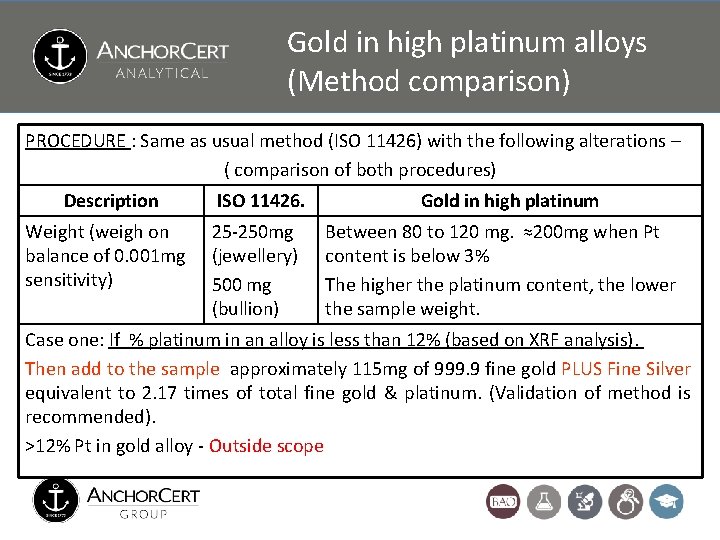
Gold in high platinum alloys (Method comparison) PROCEDURE : Same as usual method (ISO 11426) with the following alterations – ( comparison of both procedures) Description Weight (weigh on balance of 0. 001 mg sensitivity) ISO 11426. 25 -250 mg (jewellery) 500 mg (bullion) Gold in high platinum Between 80 to 120 mg. ≈200 mg when Pt content is below 3% The higher the platinum content, the lower the sample weight. Case one: If % platinum in an alloy is less than 12% (based on XRF analysis). Then add to the sample approximately 115 mg of 999. 9 fine gold PLUS Fine Silver equivalent to 2. 17 times of total fine gold & platinum. (Validation of method is recommended). >12% Pt in gold alloy - Outside scope
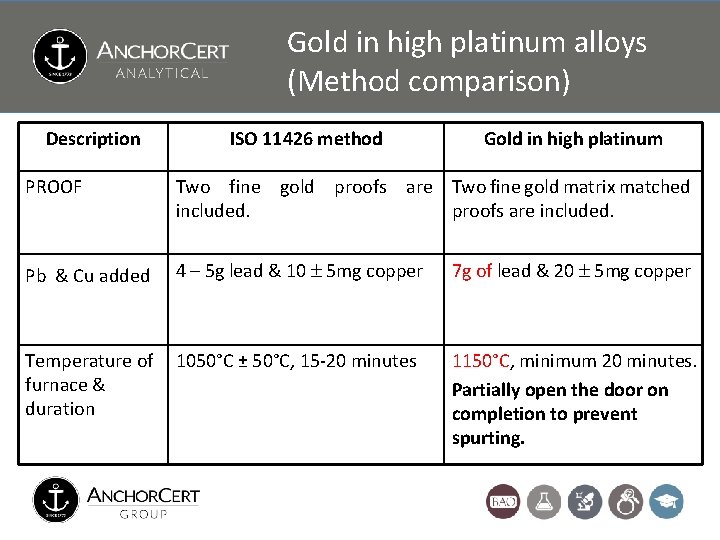
Gold in high platinum alloys (Method comparison) Description ISO 11426 method Gold in high platinum PROOF Two fine gold proofs are Two fine gold matrix matched included. proofs are included. Pb & Cu added 4 – 5 g lead & 10 5 mg copper Temperature of 1050°C ± 50°C, 15 -20 minutes furnace & duration 7 g of lead & 20 5 mg copper 1150°C, minimum 20 minutes. Partially open the door on completion to prevent spurting.
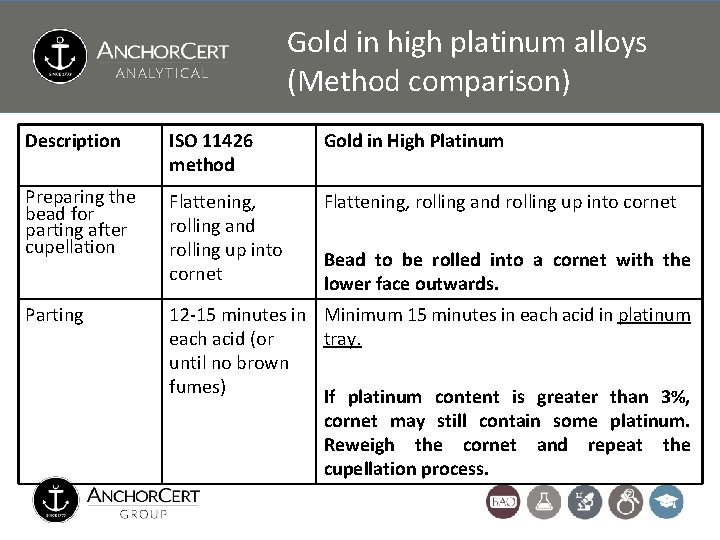
Gold in high platinum alloys (Method comparison) Description ISO 11426 method Gold in High Platinum Preparing the bead for parting after cupellation Flattening, rolling and rolling up into cornet Flattening, rolling and rolling up into cornet Parting 12 -15 minutes in Minimum 15 minutes in each acid in platinum each acid (or tray. until no brown fumes) If platinum content is greater than 3%, cornet may still contain some platinum. Reweigh the cornet and repeat the cupellation process. Bead to be rolled into a cornet with the lower face outwards.
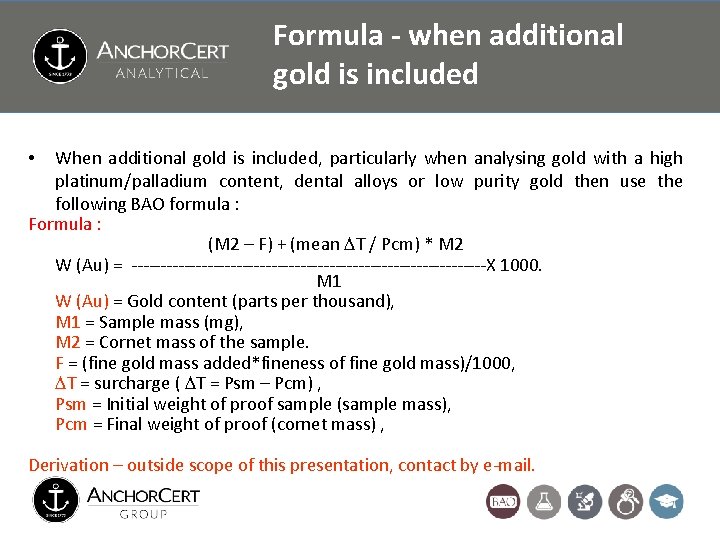
Formula - when additional gold is included When additional gold is included, particularly when analysing gold with a high platinum/palladium content, dental alloys or low purity gold then use the following BAO formula : Formula : (M 2 – F) + (mean T / Pcm) * M 2 W (Au) = -------------------------------X 1000. M 1 W (Au) = Gold content (parts per thousand), M 1 = Sample mass (mg), M 2 = Cornet mass of the sample. F = (fine gold mass added*fineness of fine gold mass)/1000, T = surcharge ( T = Psm – Pcm) , Psm = Initial weight of proof sample (sample mass), Pcm = Final weight of proof (cornet mass) , Derivation – outside scope of this presentation, contact by e-mail. •
Objective 2: Assaying of gold and its alloys in the presence of Iridium, Ruthenium & Osmium.
Iridium adulteration • A literature search clearly shows that the presence of iridium, ruthenium and osmium in gold alloys affects the accuracy of gold results when analysis is performed by the fire assay method, but little progress has been made by worldwide gold industry to overcome this problem. • Iridium, which is also regularly added as grain refiner (< 0. 05%) is not fully removed during cupellation and parting processes and ultimately weighed as gold causing serious errors in the assay results. • We understand that iridium is being deliberately added to gold melts and therefore to subsequent products to increase the apparent fineness. • Going by newspaper reports this practice is spreading and increasing.
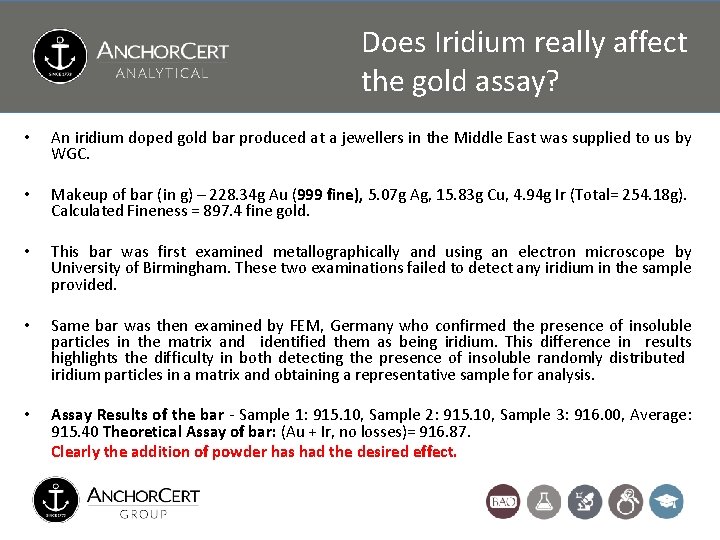
Does Iridium really affect the gold assay? • An iridium doped gold bar produced at a jewellers in the Middle East was supplied to us by WGC. • Makeup of bar (in g) – 228. 34 g Au (999 fine), 5. 07 g Ag, 15. 83 g Cu, 4. 94 g Ir (Total= 254. 18 g). Calculated Fineness = 897. 4 fine gold. • This bar was first examined metallographically and using an electron microscope by University of Birmingham. These two examinations failed to detect any iridium in the sample provided. • Same bar was then examined by FEM, Germany who confirmed the presence of insoluble particles in the matrix and identified them as being iridium. This difference in results highlights the difficulty in both detecting the presence of insoluble randomly distributed iridium particles in a matrix and obtaining a representative sample for analysis. • Assay Results of the bar - Sample 1: 915. 10, Sample 2: 915. 10, Sample 3: 916. 00, Average: 915. 40 Theoretical Assay of bar: (Au + Ir, no losses)= 916. 87. Clearly the addition of powder has had the desired effect.
Does a procedure exist to detect iridium? • A number of techniques are available to measure iridium content in gold alloys accurately but all these techniques require sophisticated instruments such as ICP-OES etc. • Not all precious metal testing labs / Hallmarking Centres in India have access to such instruments so there is no point discussing such methods here. • Hence, there is a need for a straightforward method which is less dependent on such expensive instruments and a technician with little technical knowledge should be able to perform it with a high level of accuracy. • All assay labs /Hallmarking Centres have fire assay testing facility. Why not adapt this technique for the determination of iridium content in gold alloy. • Separating iridium from gold cornets by simple dissolution in aquaregia is the best possible option to measure iridium content in the original sample.
Separation of iridium by Aquaregia method • After weighing the cornet, digest in dilute freshly prepared aquaregia (1 aquaregia, 5 water) where by gold is dissolved and iridium remains as an insoluble residue. • Carefully collect the residue using Millipore filtering apparatus, wash with dilute aquaregia, DI water and subsequently by dilute ammonia. Dry at 80°C, ignite the residue in a 2 ml alumina crucible at 600°C starting with a cold furnace. • The weight of iridium deducted from the weight of the gold/iridium cornet gives the gold present. • The residue will also contain traces of any rhodium or ruthenium that may be present, but amount is usually very small. Osmium, if present in the original material, is practically completely eliminated by volatilisation during cupellation. • Recovery rate of iridium by this method (cupellation followed by aquaregia dissolution) is between 85 % to 90%. Although cornet contains 90% to 95% iridium. Nearly 10% - 15% of total iridium present in the sample get lost during cupellation, parting and ignition.
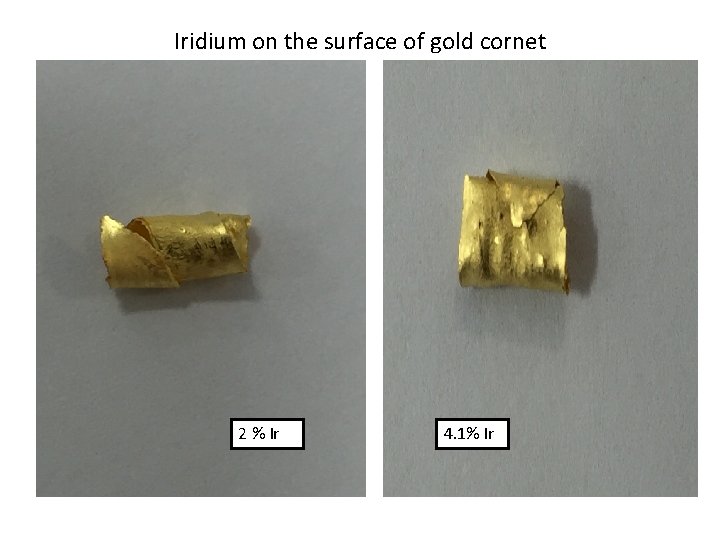
Iridium on the surface of gold cornet 2 % Ir 4. 1% Ir
Indian gold industry – Way Forward What Indian gold industry should do in the future – • Indian gold industry/ WGC should support a research program to develop a test method to produce a true gold content when iridium or other PGMs are suspected to be present in gold alloys. This method should be sufficiently simple so that technician with little technical knowledge should be able to follow it easily. This may involve supplementary techniques and /or adaptation of the fire assay technique. • Industry should also consider how current gold refining techniques can be adapted to ensure elimination of iridium and other PGMs from contaminated scrap. The process should be simple enough for small-scale jewellery producers to follow without any extra investment. • This research should be shared with one and all by producing an information booklet, detailing the assay procedures and refining options when PGMs are present in gold alloys and gold scrap to enable gold jewellery producers to take appropriate action.
Any Questions… Dippal Manchanda MSc CSci CChem FRSC Technical Director & Chief Assayer ANCHORCERT ANALYTICAL 1 Moreton Street Birmingham B 1 3 AX ENGLAND Dir: +44 (0)121 262 1052 Mob: +44 (0)7595709714 www. theassayoffice. co. uk dippal. manchanda@theassayoffice. co. uk