Lessons learned from Cultana Pumped Hydro Project EIANZ
- Slides: 20
Lessons learned from Cultana Pumped Hydro Project EIANZ Annual Conference, 4 -6 November 2019
Lessons learned from Cultana Pumped Hydro Project • Challenge of Australia’s changing National Electricity Market • Introduction to pumped hydro energy storage - Australian site options • Cultana Pumped Hydro Project – overview and impact assessment • Key lessons learned - To progress Cultana Pumped Hydro Project - For future pumped hydro projects - For environmental impact assessment 2
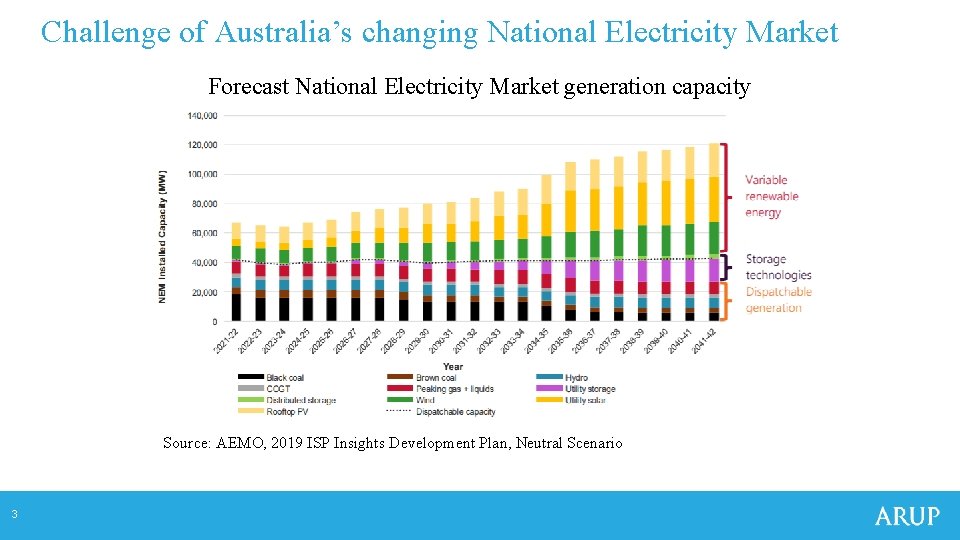
Challenge of Australia’s changing National Electricity Market Forecast National Electricity Market generation capacity Source: AEMO, 2019 ISP Insights Development Plan, Neutral Scenario 3
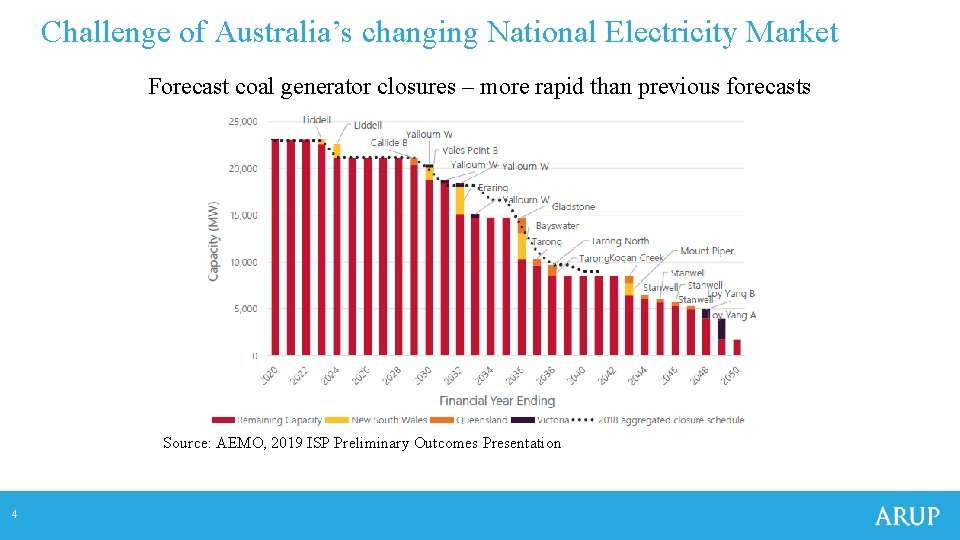
Challenge of Australia’s changing National Electricity Market Forecast coal generator closures – more rapid than previous forecasts Source: AEMO, 2019 ISP Preliminary Outcomes Presentation 4
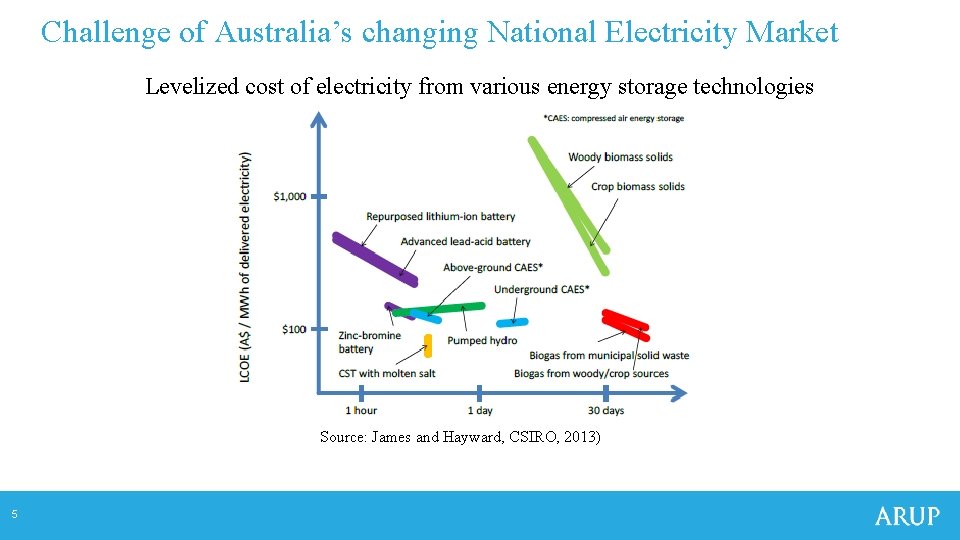
Challenge of Australia’s changing National Electricity Market Levelized cost of electricity from various energy storage technologies Source: James and Hayward, CSIRO, 2013) 5
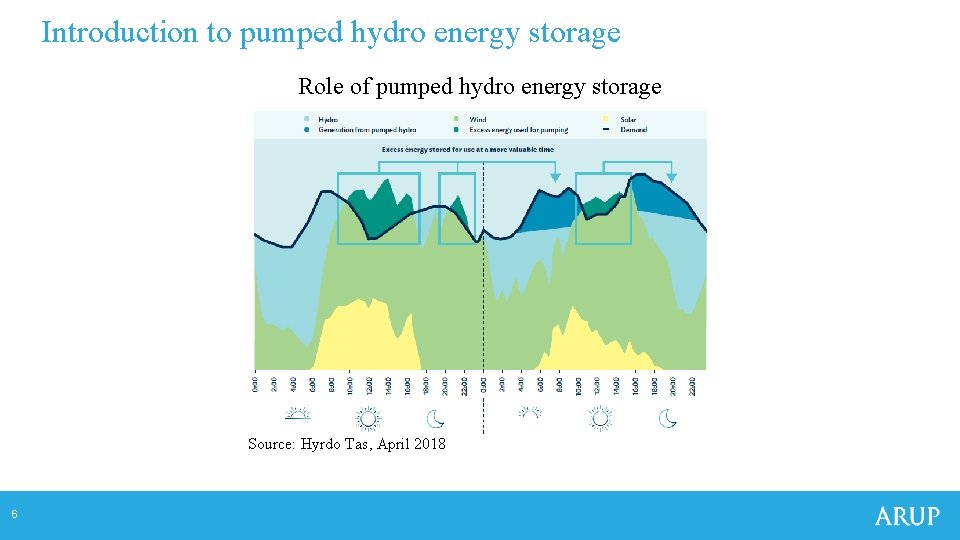
Introduction to pumped hydro energy storage Role of pumped hydro energy storage Source: Hyrdo Tas, April 2018 6
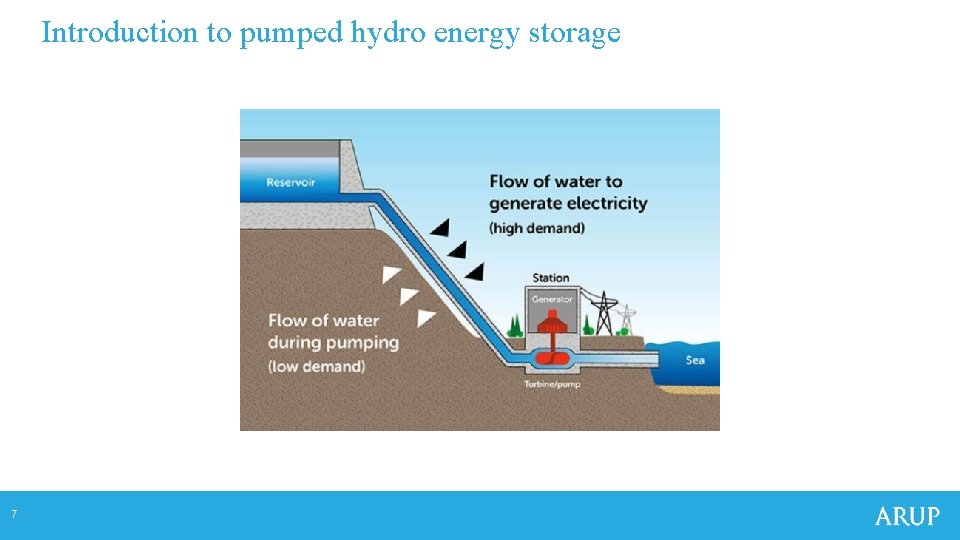
Introduction to pumped hydro energy storage 7
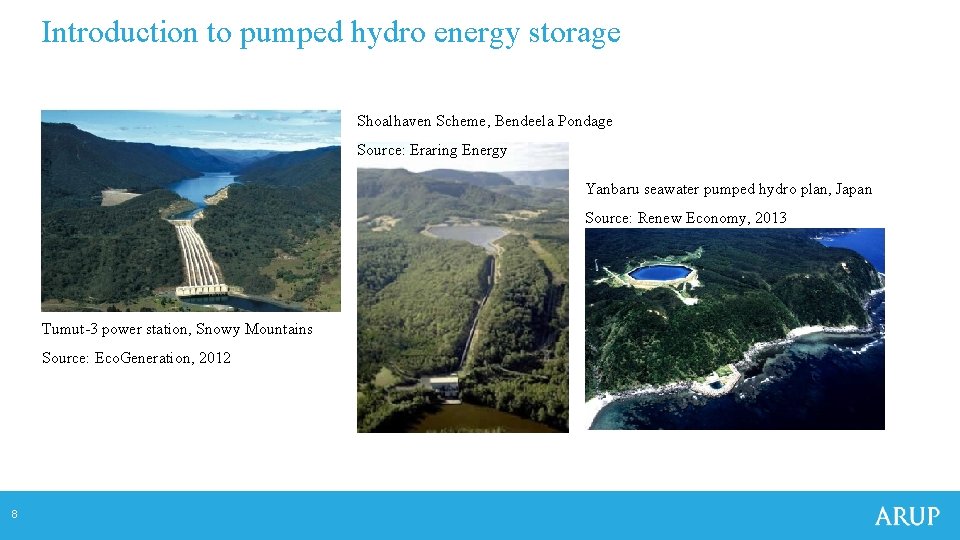
Introduction to pumped hydro energy storage Shoalhaven Scheme, Bendeela Pondage Source: Eraring Energy Yanbaru seawater pumped hydro plan, Japan Source: Renew Economy, 2013 Tumut-3 power station, Snowy Mountains Source: Eco. Generation, 2012 8
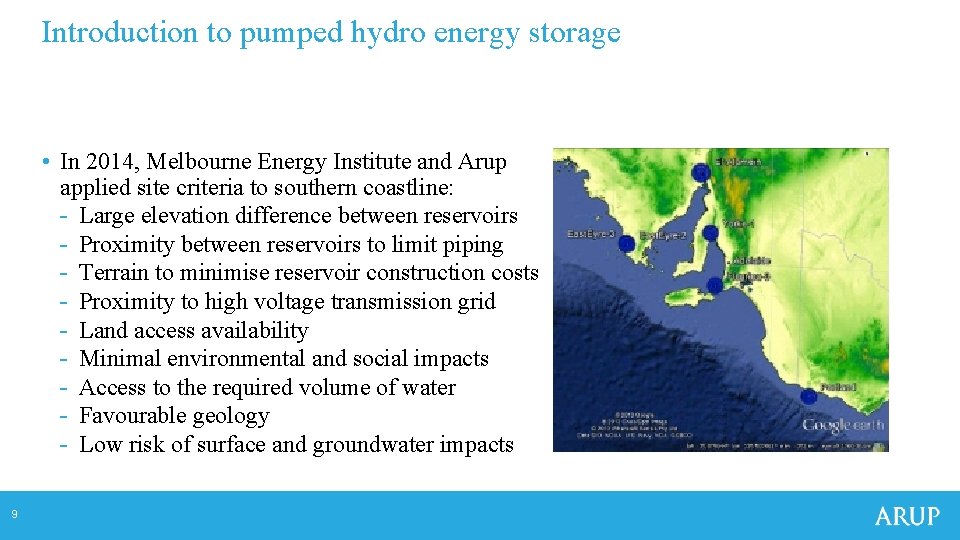
Introduction to pumped hydro energy storage • In 2014, Melbourne Energy Institute and Arup applied site criteria to southern coastline: - Large elevation difference between reservoirs - Proximity between reservoirs to limit piping - Terrain to minimise reservoir construction costs - Proximity to high voltage transmission grid - Land access availability - Minimal environmental and social impacts - Access to the required volume of water - Favourable geology - Low risk of surface and groundwater impacts 9
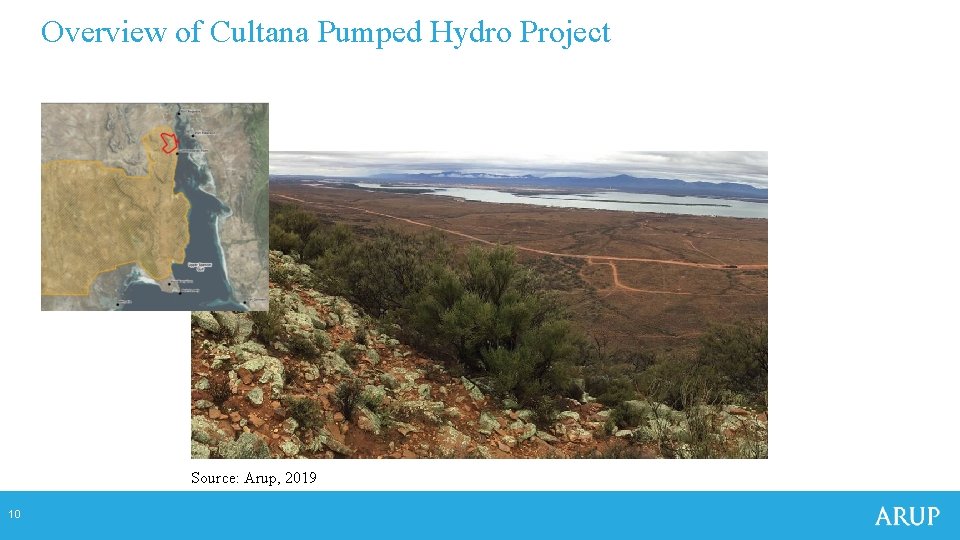
Overview of Cultana Pumped Hydro Project Source: Arup, 2019 10
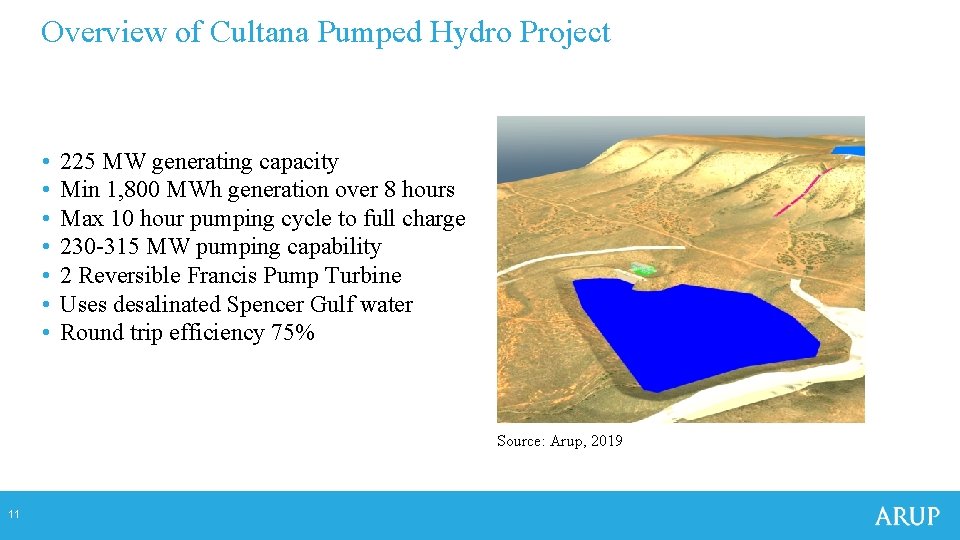
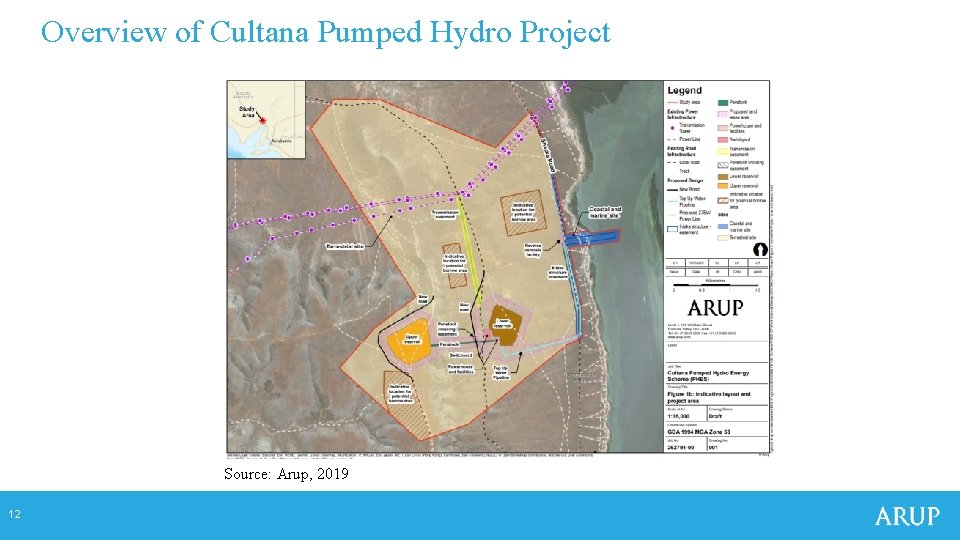
Overview of Cultana Pumped Hydro Project • • 225 MW generating capacity Min 1, 800 MWh generation over 8 hours Max 10 hour pumping cycle to full charge 230 -315 MW pumping capability 2 Reversible Francis Pump Turbine Uses desalinated Spencer Gulf water Round trip efficiency 75% Source: Arup, 2019 11
Overview of Cultana Pumped Hydro Project Source: Arup, 2019 12
Impact Assessment – Cultana Pumped Hydro Project Environmental risk assessment • Project used an activity-based semi-quantitative environmental risk assessment to analyse risk. This was collaboratively workshopped with the project team and specialist technical advisors • This process highlight that pumped hydro is essentially a novel application of conventional technology and construction techniques • This allowed risk to be readily analysed and project activities to be proactively planned to avoid, minimise and manage potential adverse impacts 13
Impact Assessment – Cultana Pumped Hydro Project Key environmental risks – terrestrial site: • Aboriginal heritage - Potential impact to heritage sites and culturally sensitive landforms - Response – engaging with the Barngarla Determination Aboriginal Corporation to assess and manage potential cultural heritage impacts, and address Native Title requirements • Human hazard and risk - Potential for flood risk from dam break - Response – project assessed in accordance with long-established ANCOLD guidelines for design, operation and maintenance of water storage facilities 14
Impact Assessment – Cultana Pumped Hydro Project Key environmental risks – terrestrial site (cont’d): • Land use and planning - Potential land use impacts that compromise Defence capability during construction or operation - Response – engaging with Department of Defence to ensure land access agreement appropriately manages current and future land use requirements • Spoil management - Potential impacts from large volumes of material during construction - Response – Contractual requirement to manage spoil in accordance with the South Australian Guideline for stockpile management 15
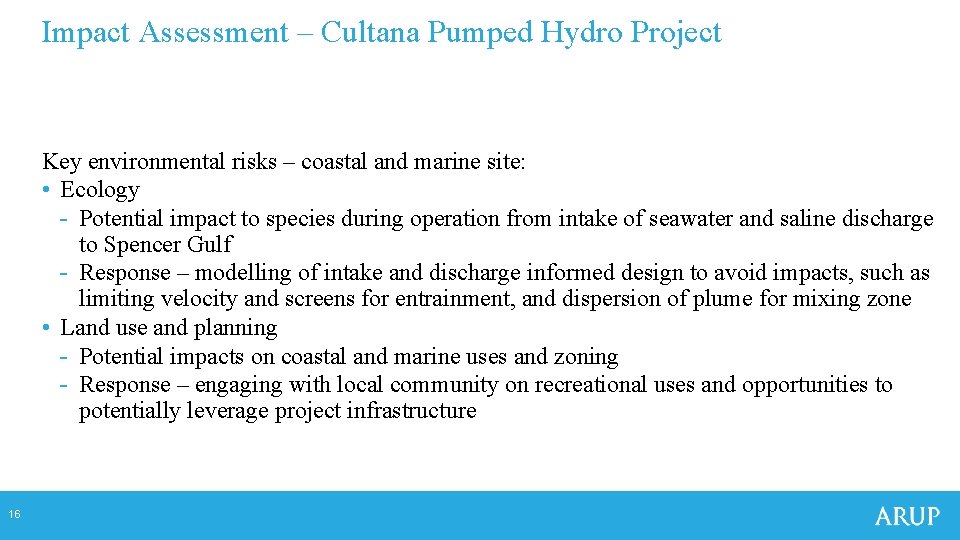
Impact Assessment – Cultana Pumped Hydro Project Key environmental risks – coastal and marine site: • Ecology - Potential impact to species during operation from intake of seawater and saline discharge to Spencer Gulf - Response – modelling of intake and discharge informed design to avoid impacts, such as limiting velocity and screens for entrainment, and dispersion of plume for mixing zone • Land use and planning - Potential impacts on coastal and marine uses and zoning - Response – engaging with local community on recreational uses and opportunities to potentially leverage project infrastructure 16
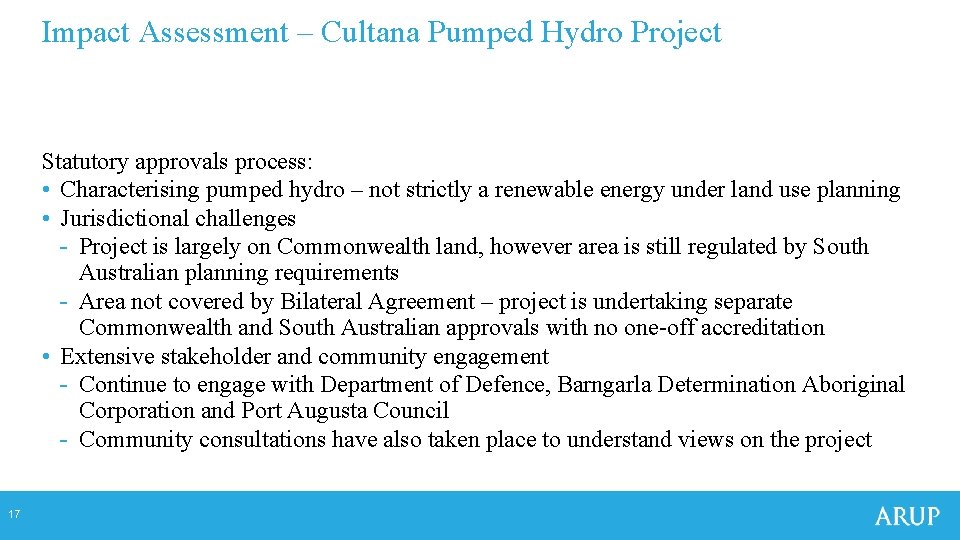
Impact Assessment – Cultana Pumped Hydro Project Statutory approvals process: • Characterising pumped hydro – not strictly a renewable energy under land use planning • Jurisdictional challenges - Project is largely on Commonwealth land, however area is still regulated by South Australian planning requirements - Area not covered by Bilateral Agreement – project is undertaking separate Commonwealth and South Australian approvals with no one-off accreditation • Extensive stakeholder and community engagement - Continue to engage with Department of Defence, Barngarla Determination Aboriginal Corporation and Port Augusta Council - Community consultations have also taken place to understand views on the project 17
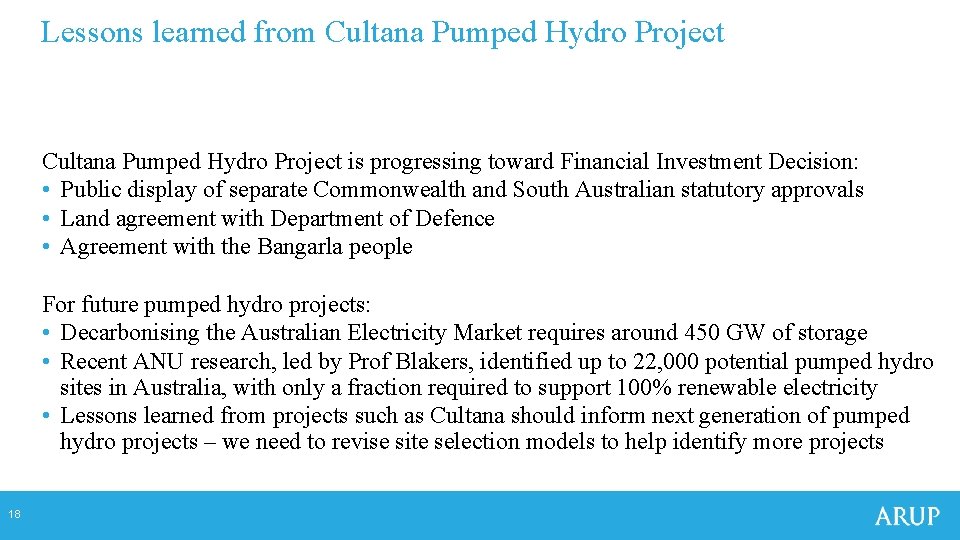
Lessons learned from Cultana Pumped Hydro Project is progressing toward Financial Investment Decision: • Public display of separate Commonwealth and South Australian statutory approvals • Land agreement with Department of Defence • Agreement with the Bangarla people For future pumped hydro projects: • Decarbonising the Australian Electricity Market requires around 450 GW of storage • Recent ANU research, led by Prof Blakers, identified up to 22, 000 potential pumped hydro sites in Australia, with only a fraction required to support 100% renewable electricity • Lessons learned from projects such as Cultana should inform next generation of pumped hydro projects – we need to revise site selection models to help identify more projects 18
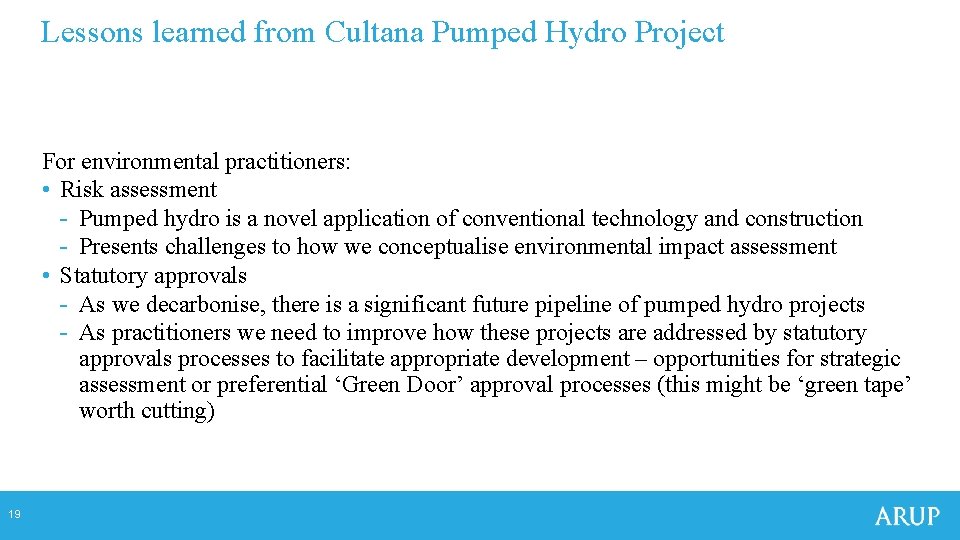
Lessons learned from Cultana Pumped Hydro Project For environmental practitioners: • Risk assessment - Pumped hydro is a novel application of conventional technology and construction - Presents challenges to how we conceptualise environmental impact assessment • Statutory approvals - As we decarbonise, there is a significant future pipeline of pumped hydro projects - As practitioners we need to improve how these projects are addressed by statutory approvals processes to facilitate appropriate development – opportunities for strategic assessment or preferential ‘Green Door’ approval processes (this might be ‘green tape’ worth cutting) 19
Lessons learned from Cultana Pumped Hydro Project • Thank you • Questions? 20