
Optimization of a diodepumped cesium vapor laser DPAL


- Slides: 18
Optimization of a diode-pumped cesium vapor laser (DPAL) Guofei An, You Wang* SOUTHWEST INSTITUTE OF TECHNICAL PHYSICS CHENGDU, SICHUAN 610041, CHINA
Overview Introduction Theoretical Analyses Results and Discussions Conclusion
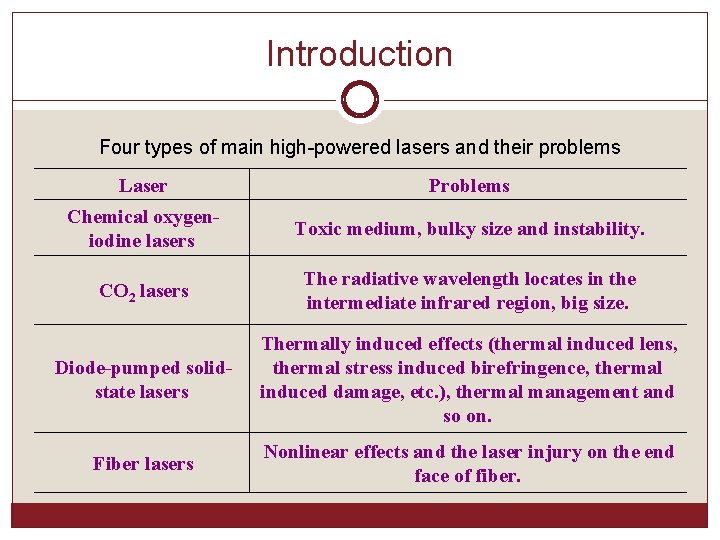
Introduction Four types of main high-powered lasers and their problems Laser Problems Chemical oxygeniodine lasers Toxic medium, bulky size and instability. CO 2 lasers The radiative wavelength locates in the intermediate infrared region, big size. Diode-pumped solidstate lasers Thermally induced effects (thermal induced lens, thermal stress induced birefringence, thermal induced damage, etc. ), thermal management and so on. Fiber lasers Nonlinear effects and the laser injury on the end face of fiber.
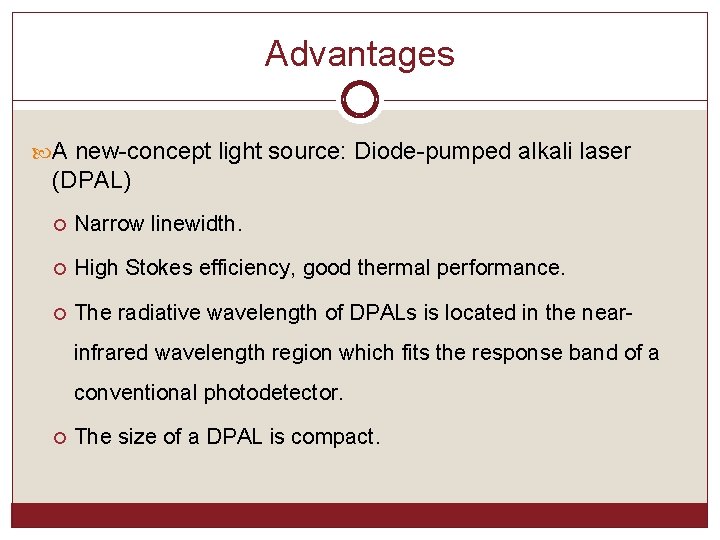
Advantages A new-concept light source: Diode-pumped alkali laser (DPAL) Narrow linewidth. High Stokes efficiency, good thermal performance. The radiative wavelength of DPALs is located in the nearinfrared wavelength region which fits the response band of a conventional photodetector. The size of a DPAL is compact.
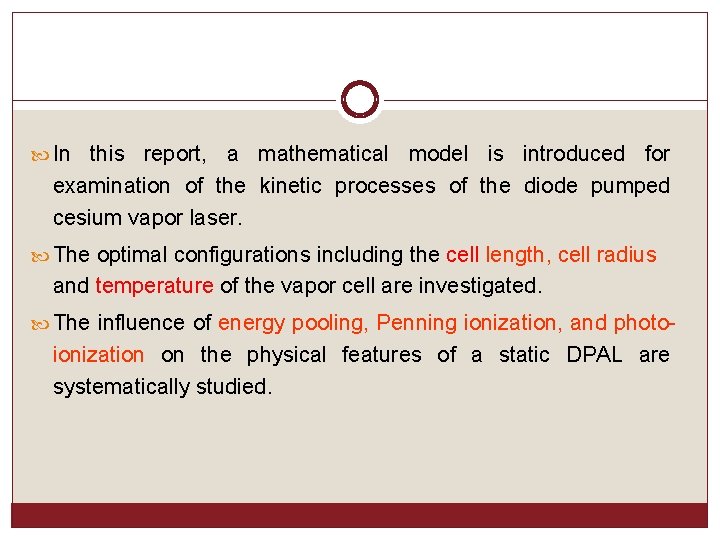
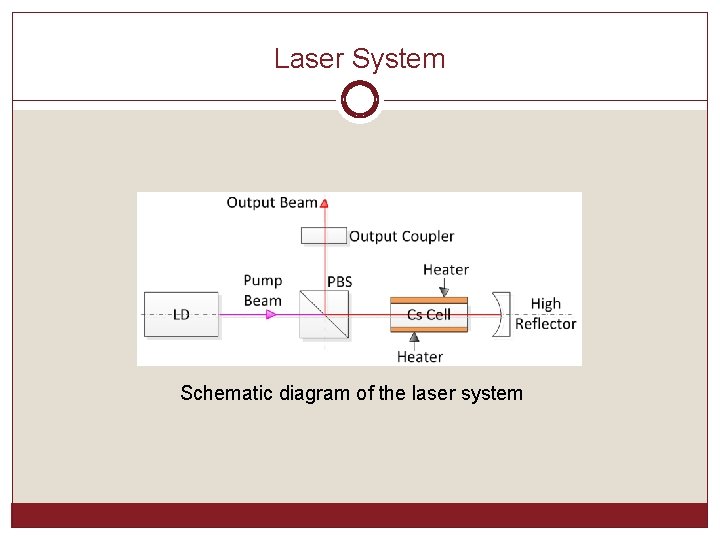
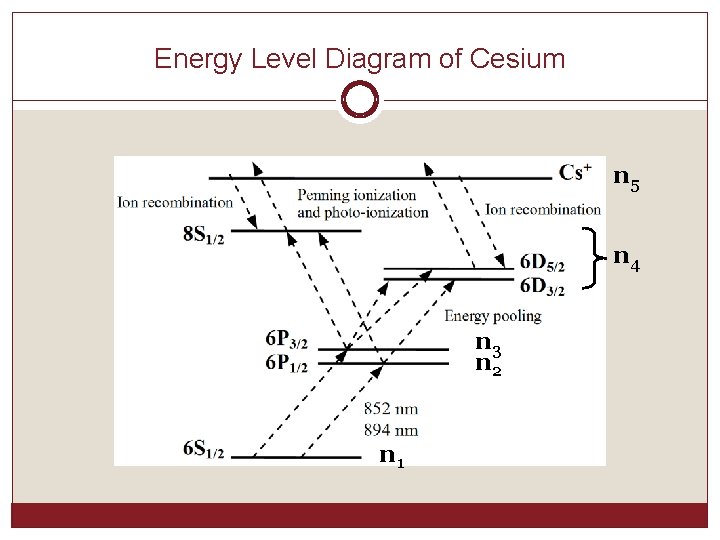
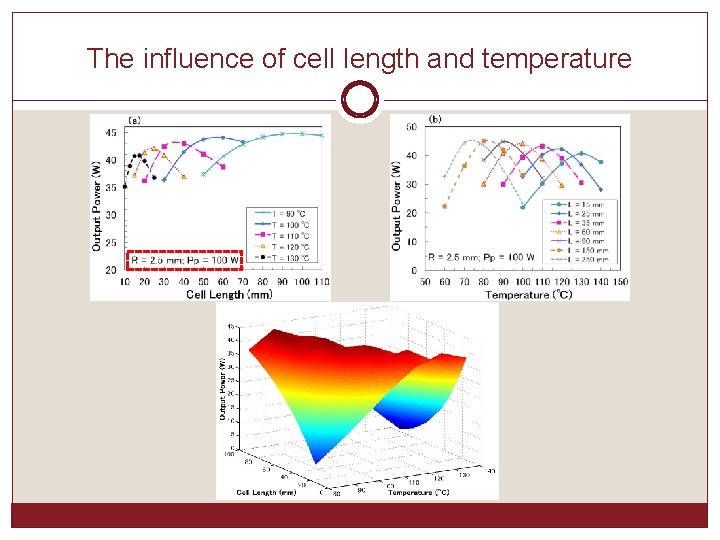
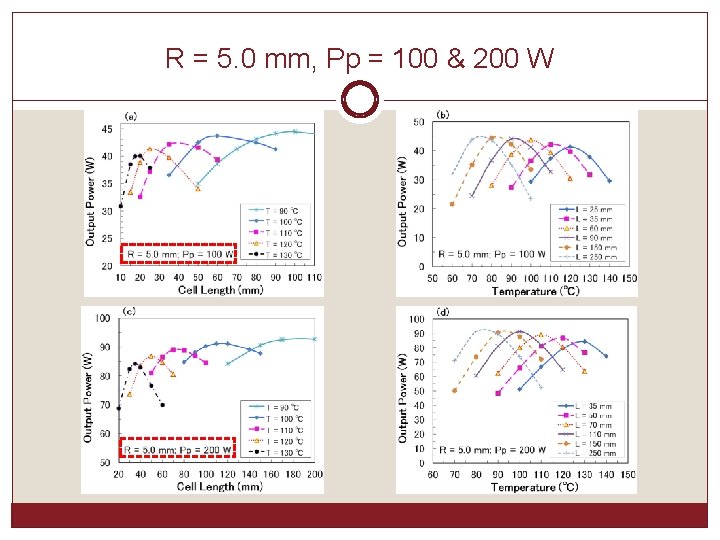
In this report, a mathematical model is introduced for examination of the kinetic processes of the diode pumped cesium vapor laser. The optimal configurations including the cell length, cell radius and temperature of the vapor cell are investigated. The influence of energy pooling, Penning ionization, and photo- ionization on the physical features of a static DPAL are systematically studied.
Laser System Schematic diagram of the laser system
Energy Level Diagram of Cesium n 5 n 4 n 3 n 2 n 1
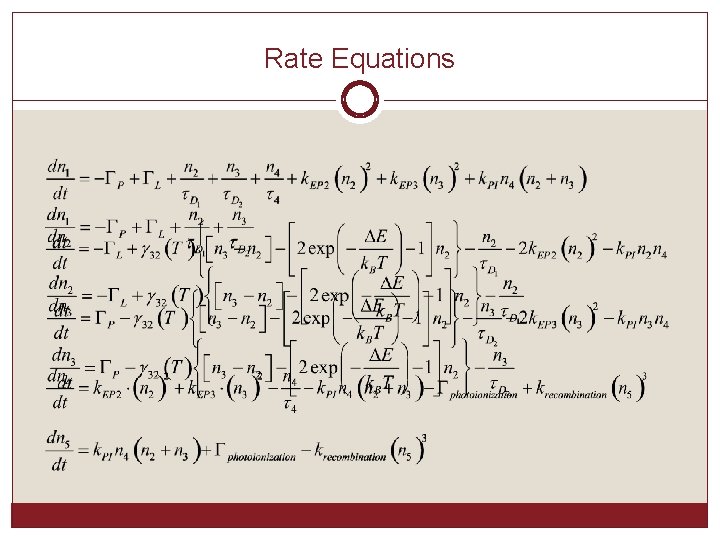
Rate Equations
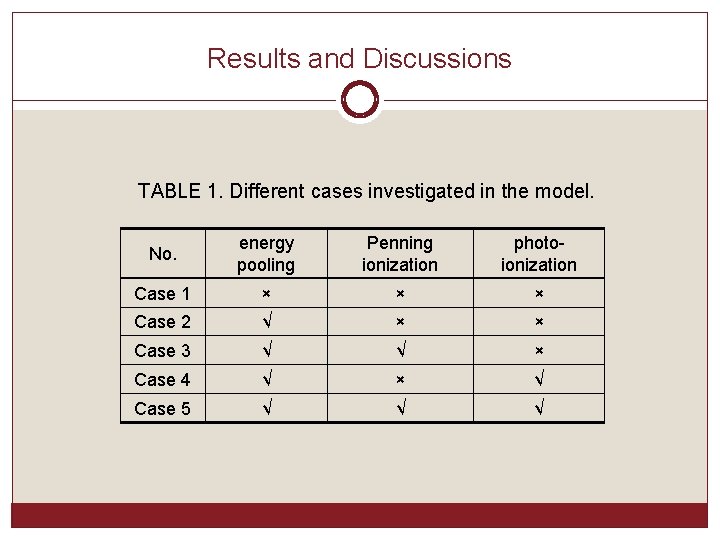
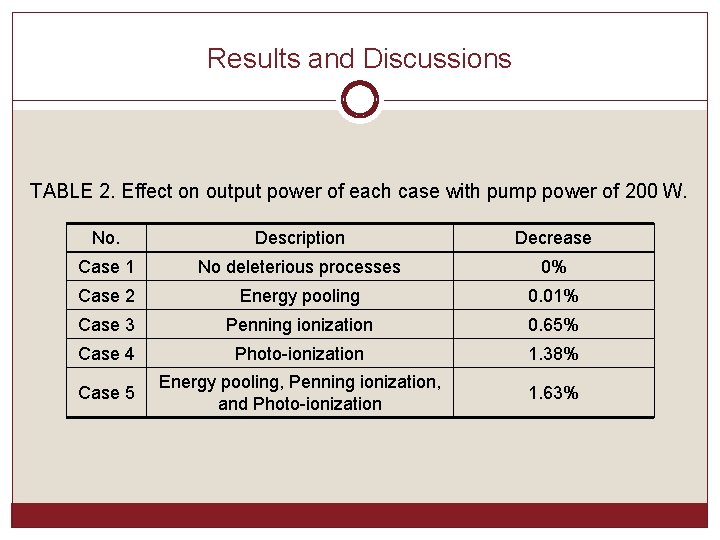
Results and Discussions TABLE 1. Different cases investigated in the model. No. energy pooling Penning ionization photoionization Case 1 × × × Case 2 √ × × Case 3 √ √ × Case 4 √ × √ Case 5 √ √ √
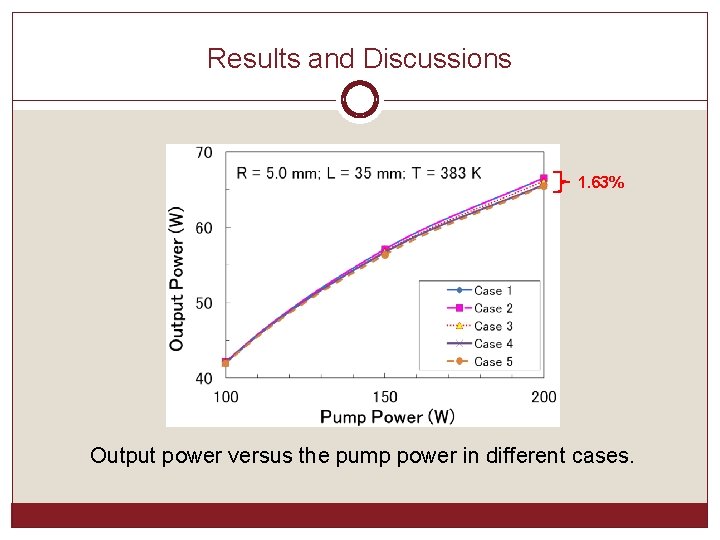
Results and Discussions 1. 63% Output power versus the pump power in different cases.
Results and Discussions TABLE 2. Effect on output power of each case with pump power of 200 W. No. Description Decrease Case 1 No deleterious processes 0% Case 2 Energy pooling 0. 01% Case 3 Penning ionization 0. 65% Case 4 Photo-ionization 1. 38% Case 5 Energy pooling, Penning ionization, and Photo-ionization 1. 63%
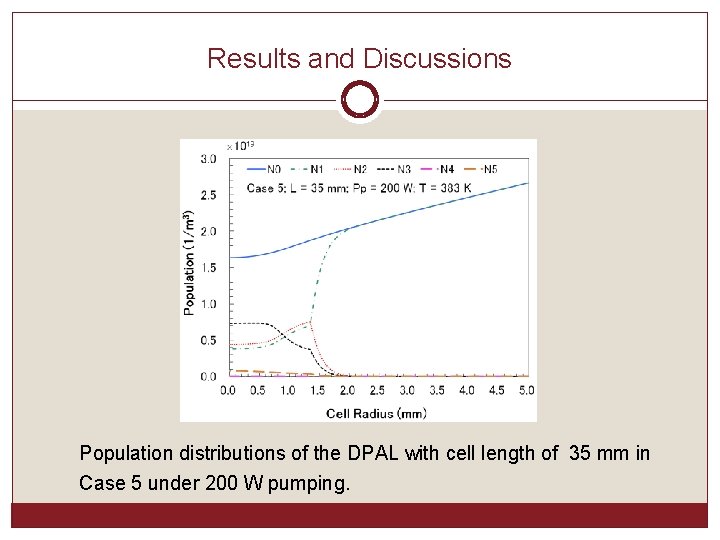
Results and Discussions Population distributions of the DPAL with cell length of 35 mm in Case 5 under 200 W pumping.
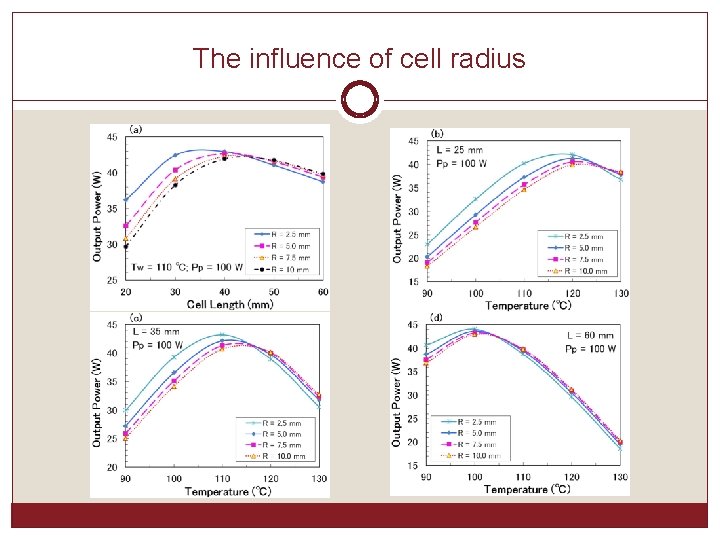
The influence of cell radius
The influence of cell length and temperature
R = 5. 0 mm, Pp = 100 & 200 W
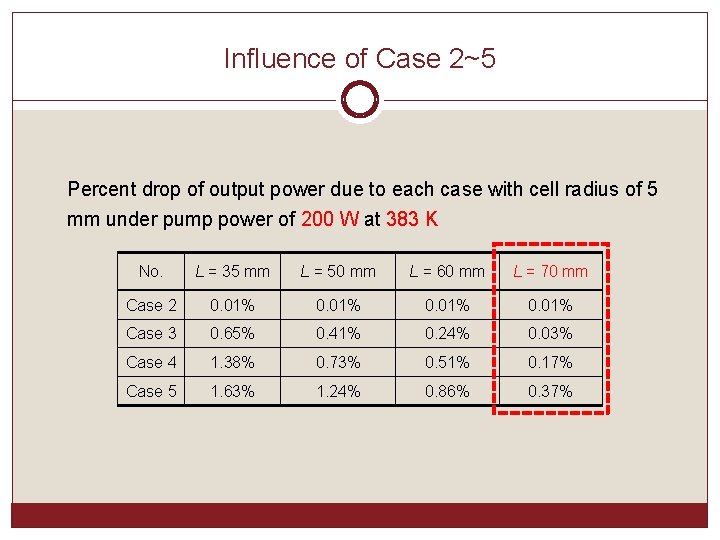
Influence of Case 2~5 Percent drop of output power due to each case with cell radius of 5 mm under pump power of 200 W at 383 K No. L = 35 mm L = 50 mm L = 60 mm L = 70 mm Case 2 0. 01% Case 3 0. 65% 0. 41% 0. 24% 0. 03% Case 4 1. 38% 0. 73% 0. 51% 0. 17% Case 5 1. 63% 1. 24% 0. 86% 0. 37%
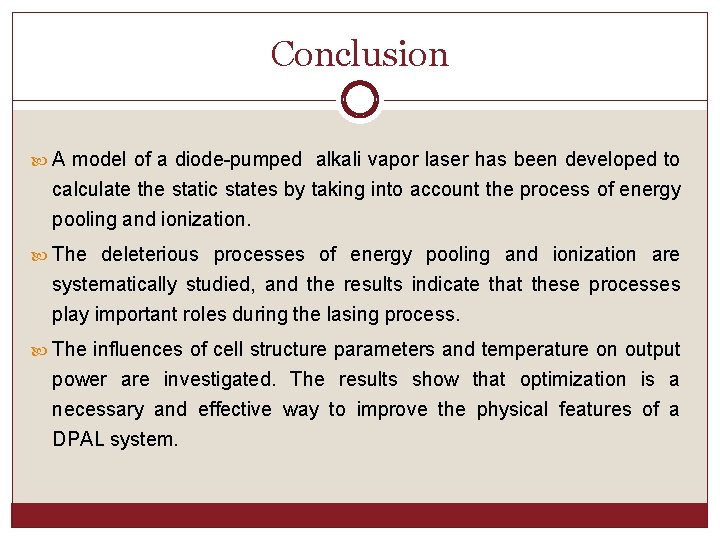
Conclusion A model of a diode-pumped alkali vapor laser has been developed to calculate the static states by taking into account the process of energy pooling and ionization. The deleterious processes of energy pooling and ionization are systematically studied, and the results indicate that these processes play important roles during the lasing process. The influences of cell structure parameters and temperature on output power are investigated. The results show that optimization is a necessary and effective way to improve the physical features of a DPAL system.
Thank you for you attention!