LESSON 2 Push and Pull Systems 06 January
- Slides: 40
LESSON 2 Push and Pull Systems 06 January 2014
Lesson Objectives Upon completion of this lesson, you should be able to: § § § Differentiate push, pull, and hybrid systems Demonstrate use of the Kanban tool Explain the function and benefits of a base-stock inventory policy Module 3 Lesson 2: Push and Pull Systems 2
Lesson Topics This lesson will cover the following topics: § § § Types of Production Strategies Kanban Base-stock Inventory Policy Module 3 Lesson 2: Push and Pull Systems 3
What’s In It For Me? If you understand push and pull type systems, you’ll: § Be able to tailor questions to the methodology the contractor is using, and § Understand where methodology’s risk will occur. Module 3 Lesson 2: Push and Pull Systems 4
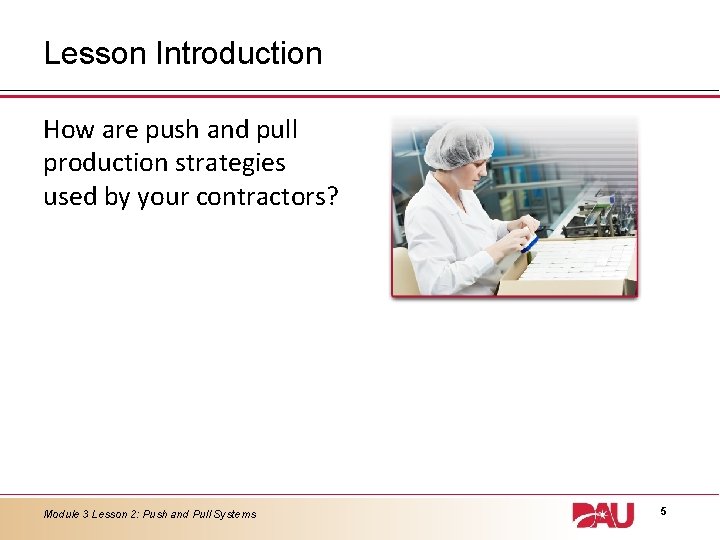
Lesson Introduction How are push and pull production strategies used by your contractors? Module 3 Lesson 2: Push and Pull Systems 5
TYPES OF PRODUCTION STRATEGIES Lesson Topics: 1) Types of Production Strategies 2) Kanban 3) Base-stock Inventory Policy Module 3 Lesson 2: Push and Pull Systems 6
Types of Production Strategies There are three general production strategies: § Push § Pull § Hybrid Module 3 Lesson 2: Push and Pull Systems 7
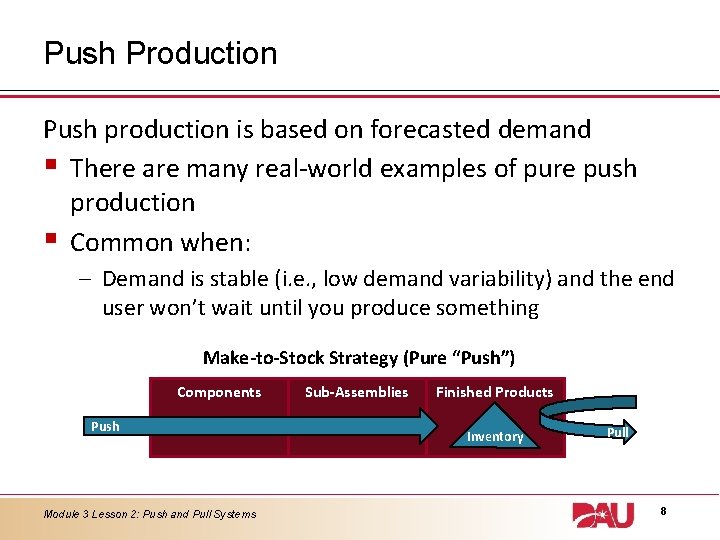
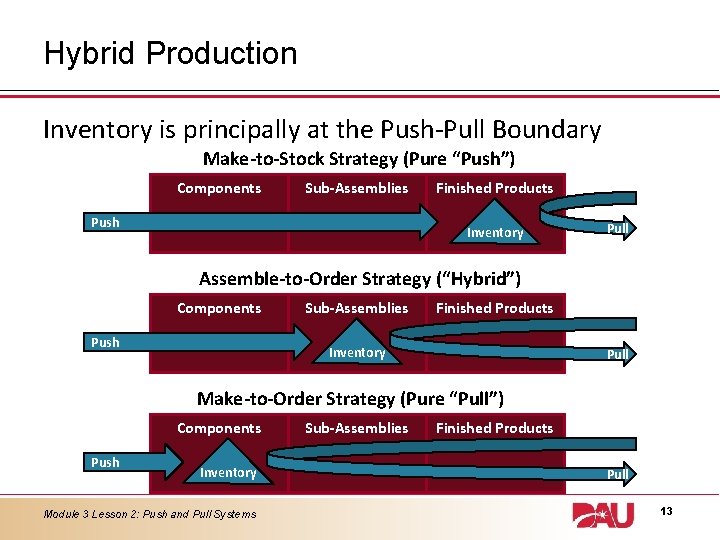
Push Production Push production is based on forecasted demand § There are many real-world examples of pure push production § Common when: – Demand is stable (i. e. , low demand variability) and the end user won’t wait until you produce something Make-to-Stock Strategy (Pure “Push”) Components Push Module 3 Lesson 2: Push and Pull Systems Sub-Assemblies Finished Products Inventory Pull 8
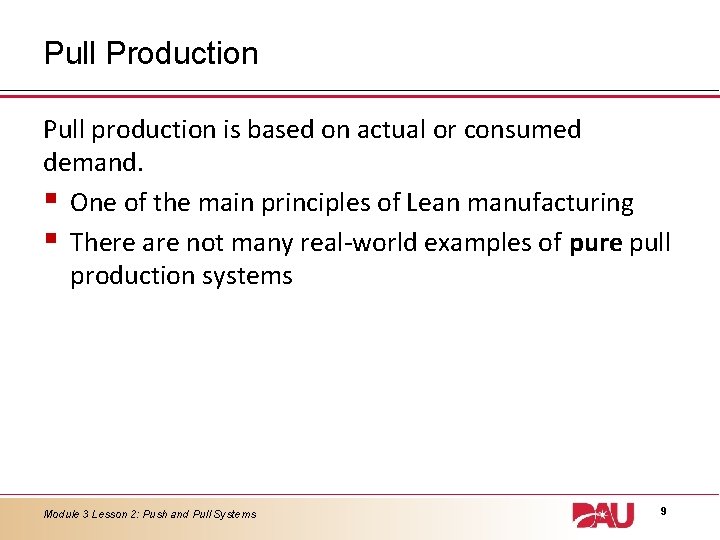
Pull Production Pull production is based on actual or consumed demand. § One of the main principles of Lean manufacturing § There are not many real-world examples of pure pull production systems Module 3 Lesson 2: Push and Pull Systems 9
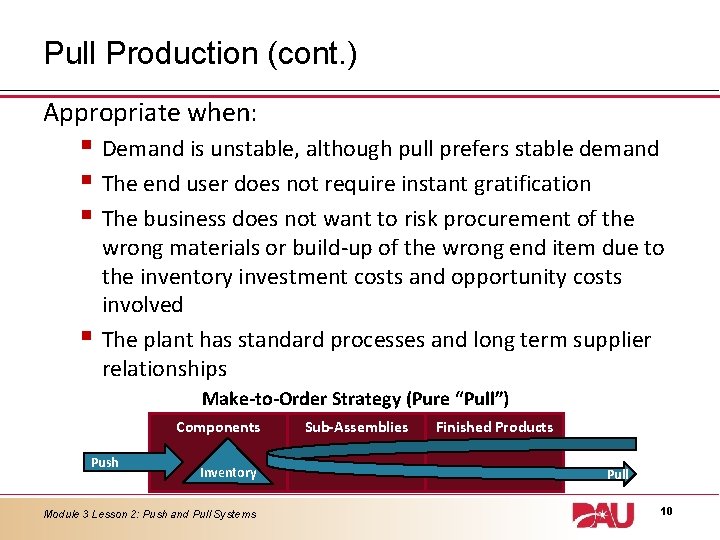
Pull Production (cont. ) Appropriate when: § Demand is unstable, although pull prefers stable demand § The end user does not require instant gratification § The business does not want to risk procurement of the § wrong materials or build-up of the wrong end item due to the inventory investment costs and opportunity costs involved The plant has standard processes and long term supplier relationships Make-to-Order Strategy (Pure “Pull”) Components Push Inventory Module 3 Lesson 2: Push and Pull Systems Sub-Assemblies Finished Products Pull 10
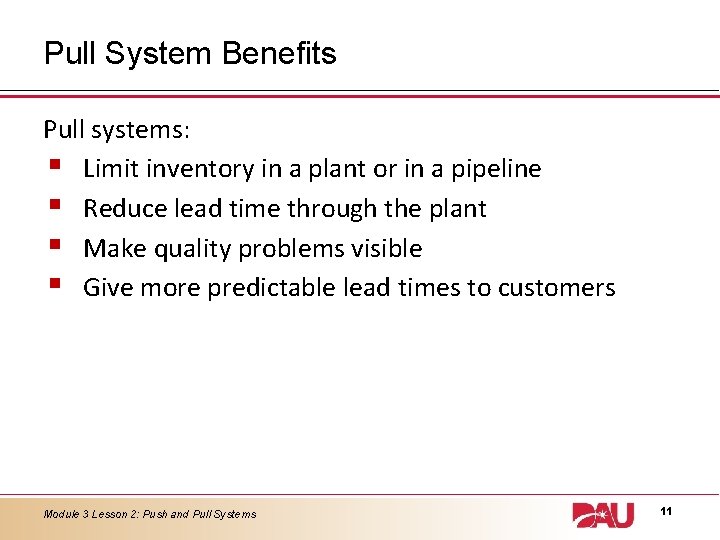
Pull System Benefits Pull systems: § Limit inventory in a plant or in a pipeline § Reduce lead time through the plant § Make quality problems visible § Give more predictable lead times to customers Module 3 Lesson 2: Push and Pull Systems 11
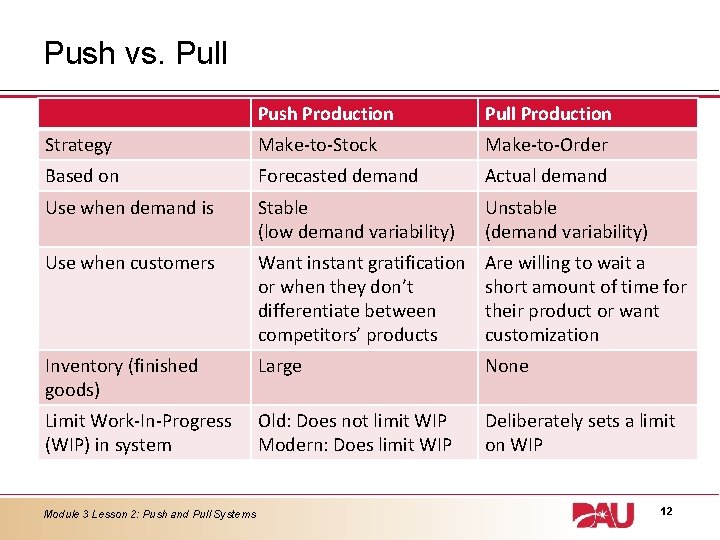
Push vs. Pull Push Production Pull Production Strategy Make-to-Stock Make-to-Order Based on Forecasted demand Actual demand Use when demand is Stable (low demand variability) Unstable (demand variability) Use when customers Want instant gratification or when they don’t differentiate between competitors’ products Are willing to wait a short amount of time for their product or want customization Inventory (finished goods) Large None Limit Work-In-Progress (WIP) in system Old: Does not limit WIP Modern: Does limit WIP Deliberately sets a limit on WIP Module 3 Lesson 2: Push and Pull Systems 12
Hybrid Production Inventory is principally at the Push-Pull Boundary Make-to-Stock Strategy (Pure “Push”) Components Sub-Assemblies Push Finished Products Inventory Pull Assemble-to-Order Strategy (“Hybrid”) Components Push Sub-Assemblies Finished Products Inventory Pull Make-to-Order Strategy (Pure “Pull”) Components Push Inventory Module 3 Lesson 2: Push and Pull Systems Sub-Assemblies Finished Products Pull 13
Question and Answer This type of production strategy is used when demand can not rely on actual numbers but, instead, has to be forecasted: A. Push system B. Pull system C. Hybrid system Module 3 Lesson 2: Push and Pull Systems 14
Question and Answer A contractor with an aircraft spare parts contract experiences large demand variability. The spare parts use materials and subassemblies that are common across other product lines and have a high probability of use. Which production approach should they use? A. Push system B. Pull system C. Hybrid system Module 3 Lesson 2: Push and Pull Systems 15
Exercise 1: Push vs. Pull Small Group Exercise § § § Find a partner or work in a trio Refer to Module 3, Lesson 2, Exercise 1 CMM 100_M 3_L 2_E 1_Exercise_FINAL. docx Read directions on the Push vs. Pull exercise Complete the activity; be prepared to share your responses Time allowed: 30 minutes Module 3 Lesson 2: Push and Pull Systems 16
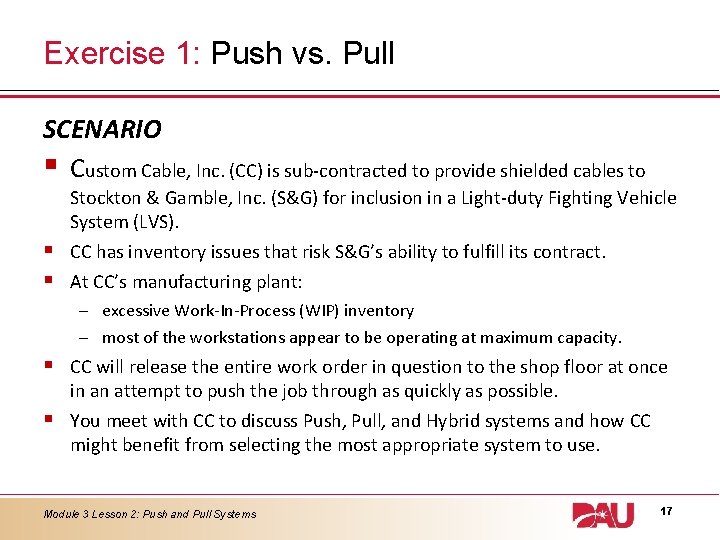
Exercise 1: Push vs. Pull SCENARIO § Custom Cable, Inc. (CC) is sub-contracted to provide shielded cables to § § Stockton & Gamble, Inc. (S&G) for inclusion in a Light-duty Fighting Vehicle System (LVS). CC has inventory issues that risk S&G’s ability to fulfill its contract. At CC’s manufacturing plant: – excessive Work-In-Process (WIP) inventory – most of the workstations appear to be operating at maximum capacity. § § CC will release the entire work order in question to the shop floor at once in an attempt to push the job through as quickly as possible. You meet with CC to discuss Push, Pull, and Hybrid systems and how CC might benefit from selecting the most appropriate system to use. Module 3 Lesson 2: Push and Pull Systems 17
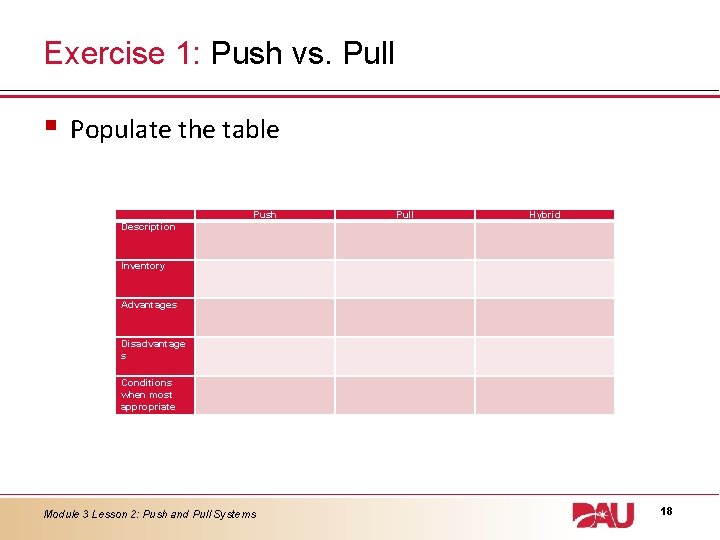
Exercise 1: Push vs. Pull § Populate the table Push Pull Hybrid Description Inventory Advantages Disadvantage s Conditions when most appropriate Module 3 Lesson 2: Push and Pull Systems 18
Case Study Activity Individual Activity § Refer to the case study’s Domestic Vehicle Ordering and Inventory Management System section (pages 3 -5) and The Scion Experience section (pages 14 -18) § Identify which production strategy is used to fulfill domestic orders for Toyota’s Scion § Be prepared to share your response Module 3 Lesson 2: Push and Pull Systems 19
KANBAN SYSTEM Lesson Topics: 1) Types of Production Strategies 2) Kanban 3) Base-stock Inventory Policy Module 3 Lesson 2: Push and Pull Systems 20
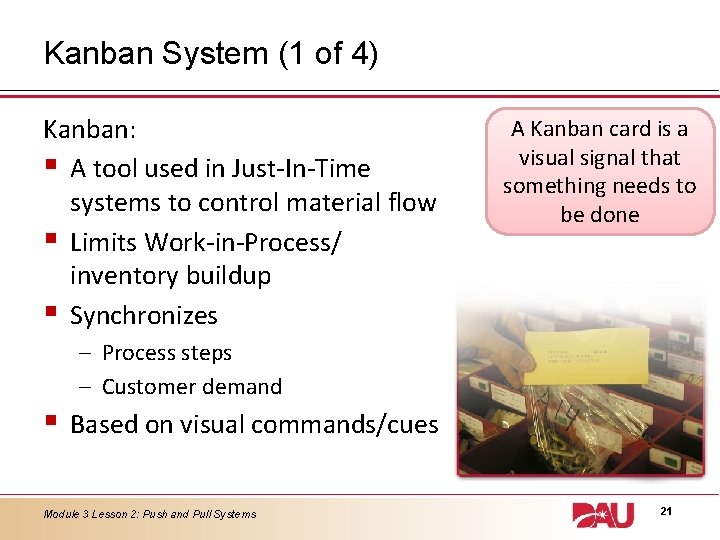
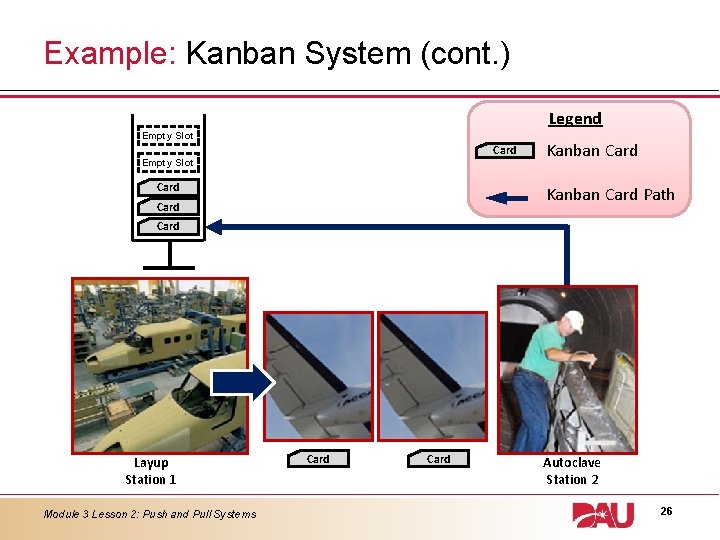
Kanban System (1 of 4) Kanban: § A tool used in Just-In-Time systems to control material flow § Limits Work-in-Process/ inventory buildup § Synchronizes A Kanban card is a visual signal that something needs to be done – Process steps – Customer demand § Based on visual commands/cues Module 3 Lesson 2: Push and Pull Systems 21
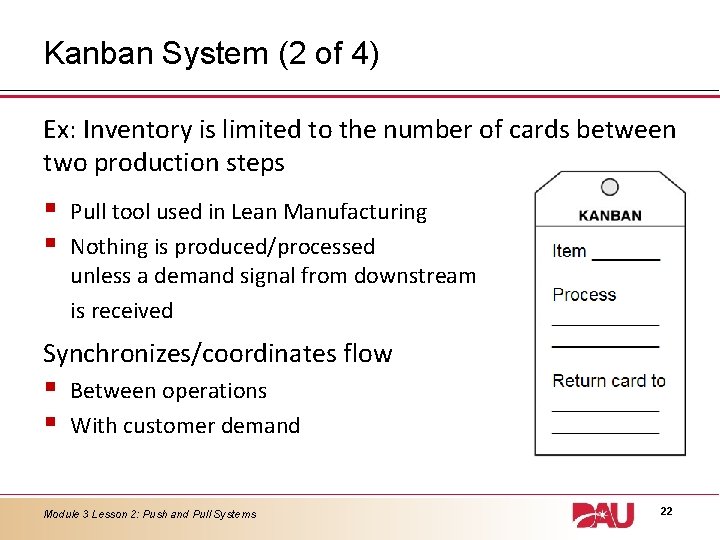
Kanban System (2 of 4) Ex: Inventory is limited to the number of cards between two production steps § § Pull tool used in Lean Manufacturing Nothing is produced/processed unless a demand signal from downstream is received Synchronizes/coordinates flow § § Between operations With customer demand Module 3 Lesson 2: Push and Pull Systems 22
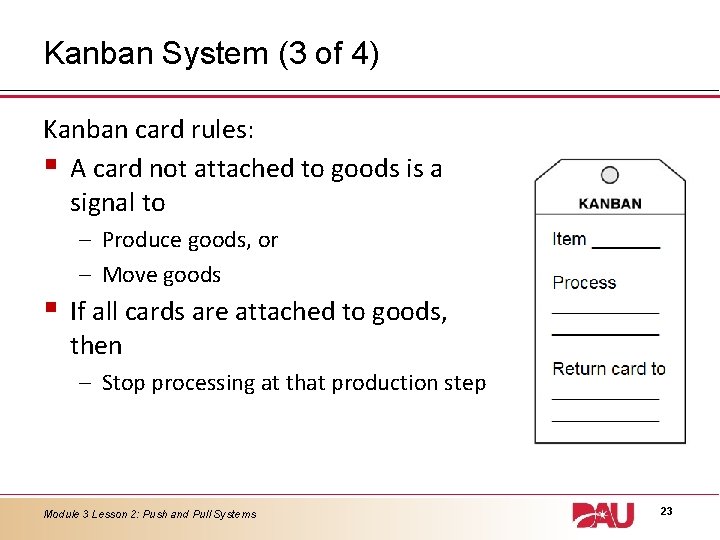
Kanban System (3 of 4) Kanban card rules: § A card not attached to goods is a signal to – Produce goods, or – Move goods § If all cards are attached to goods, then – Stop processing at that production step Module 3 Lesson 2: Push and Pull Systems 23
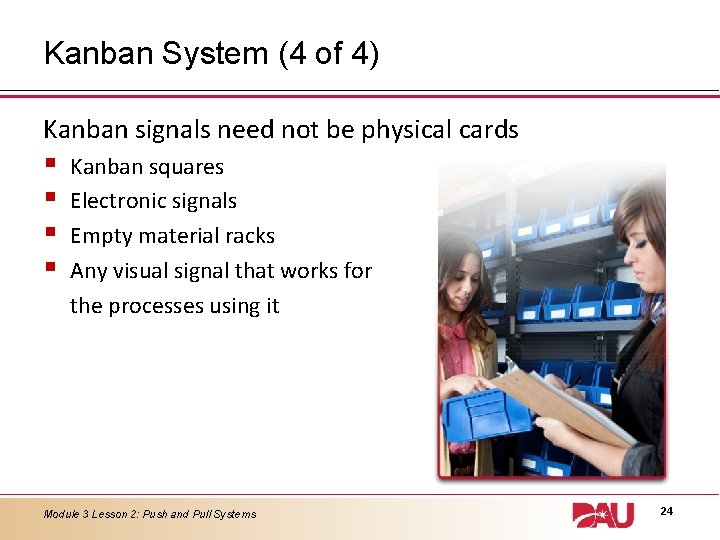
Kanban System (4 of 4) Kanban signals need not be physical cards § § Kanban squares Electronic signals Empty material racks Any visual signal that works for the processes using it Module 3 Lesson 2: Push and Pull Systems 24
Scenario 1: Kanban System Large Group Scenario § § § Refer to Module 3, Lesson 2, Scenario 1 CMM 100_M 3_L 2_S 1_Scenario_FINAL. docx Read directions on the Kanban example Complete the activity as a class Module 3 Lesson 2: Push and Pull Systems 25
Example: Kanban System (cont. ) Legend Empty Slot Card Kanban Card Path Card Layup Station 1 Module 3 Lesson 2: Push and Pull Systems Card Autoclave Station 2 26
Question and Answer Kanban is a tool used in this system: A. B. C. D. Statistical Process Control Six Sigma Just-In-Time Ishikawa Cause and Effect Module 3 Lesson 2: Push and Pull Systems 27
Question and Answer How does a Kanban limit workin-process inventory? A. Work is only released when all Kanban cards are attached to items B. Work is only released when a Kanban card is available C. Work is only released when new Kanban cards are added to the system Module 3 Lesson 2: Push and Pull Systems 28
Exercise 2: Kanban System Small Group Exercise § § § Find a partner or work in a trio Refer to Module 3, Lesson 2, Exercise 2 CMM 100_M 3_L 2_Exercise_FINAL. docx Read directions on the Kanban System exercise Complete the activity; be prepared to share your responses Time allowed: 30 minutes Module 3 Lesson 2: Push and Pull Systems 29
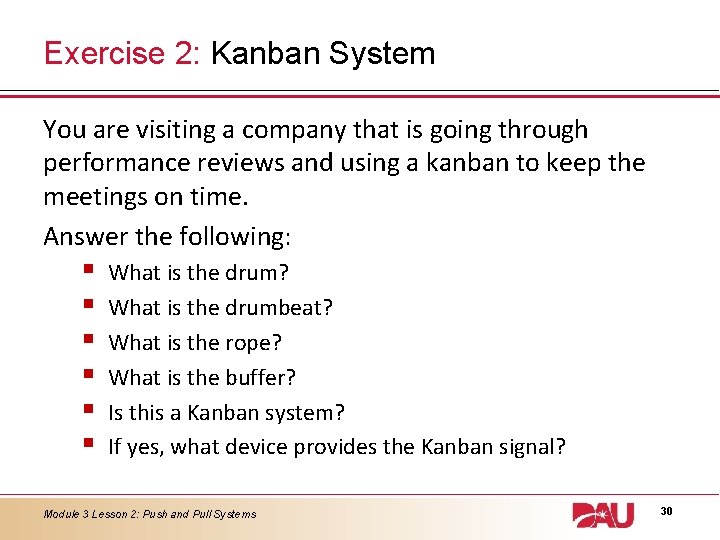
Exercise 2: Kanban System You are visiting a company that is going through performance reviews and using a kanban to keep the meetings on time. Answer the following: § § § What is the drum? What is the drumbeat? What is the rope? What is the buffer? Is this a Kanban system? If yes, what device provides the Kanban signal? Module 3 Lesson 2: Push and Pull Systems 30
BASE-STOCK INVENTORY POLICY Lesson Topics: 1) Types of Production Strategies 2) Kanban 3) Base-stock Inventory Policy Module 3 Lesson 2: Push and Pull Systems 31
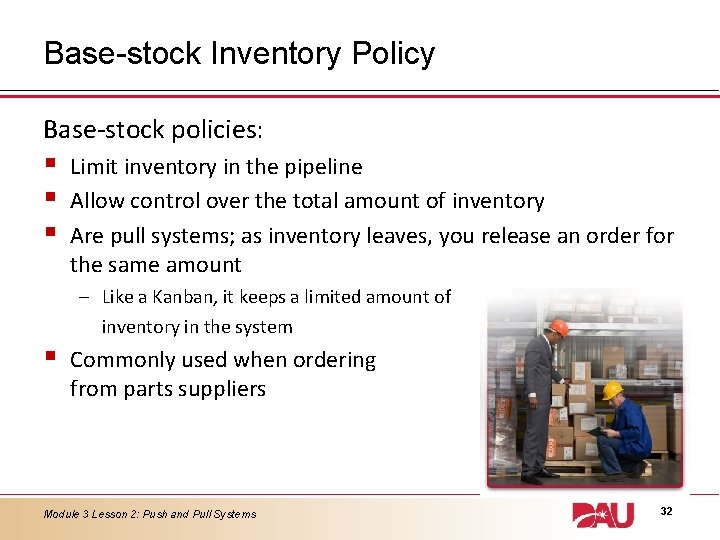
Base-stock Inventory Policy Base-stock policies: § § § Limit inventory in the pipeline Allow control over the total amount of inventory Are pull systems; as inventory leaves, you release an order for the same amount – Like a Kanban, it keeps a limited amount of inventory in the system § Commonly used when ordering from parts suppliers Module 3 Lesson 2: Push and Pull Systems 32
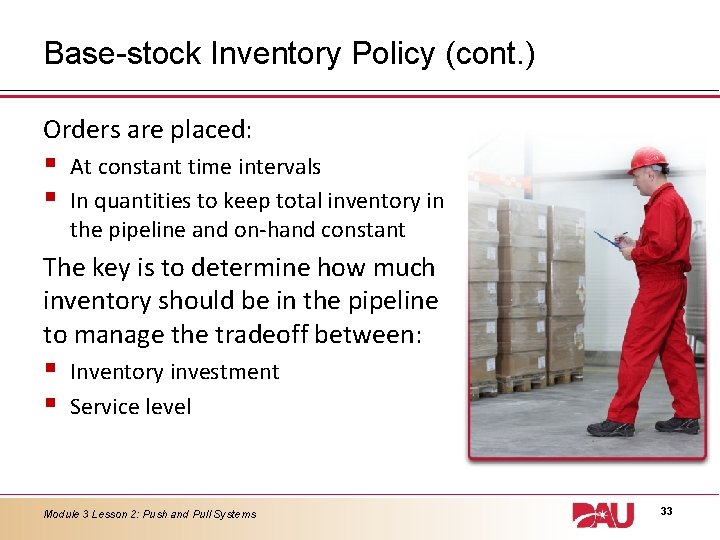
Base-stock Inventory Policy (cont. ) Orders are placed: § § At constant time intervals In quantities to keep total inventory in the pipeline and on-hand constant The key is to determine how much inventory should be in the pipeline to manage the tradeoff between: § § Inventory investment Service level Module 3 Lesson 2: Push and Pull Systems 33
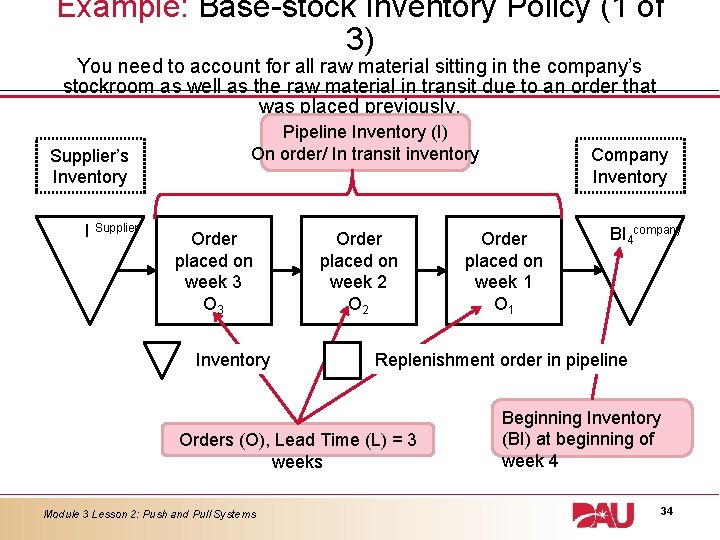
Example: Base-stock Inventory Policy (1 of 3) You need to account for all raw material sitting in the company’s stockroom as well as the raw material in transit due to an order that was placed previously. Supplier’s Inventory I Supplier Pipeline Inventory (I) On order/ In transit inventory Order placed on week 3 O 3 Inventory Order placed on week 2 Order placed on week 1 O 1 BI 4 company Replenishment order in pipeline Orders (O), Lead Time (L) = 3 weeks Module 3 Lesson 2: Push and Pull Systems Company Inventory Beginning Inventory (BI) at beginning of week 4 34
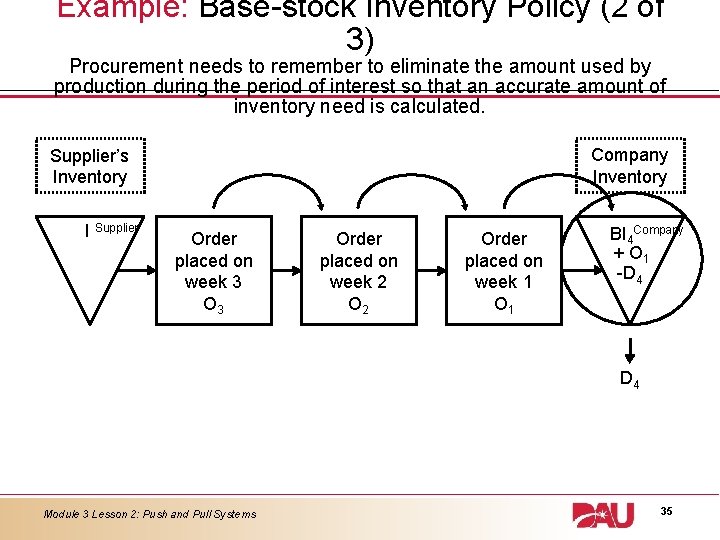
Example: Base-stock Inventory Policy (2 of 3) Procurement needs to remember to eliminate the amount used by production during the period of interest so that an accurate amount of inventory need is calculated. Company Inventory Supplier’s Inventory I Supplier Order placed on week 3 Order placed on week 2 Order placed on week 1 O 1 BI 4 Company + O 1 -D 4 Module 3 Lesson 2: Push and Pull Systems 35
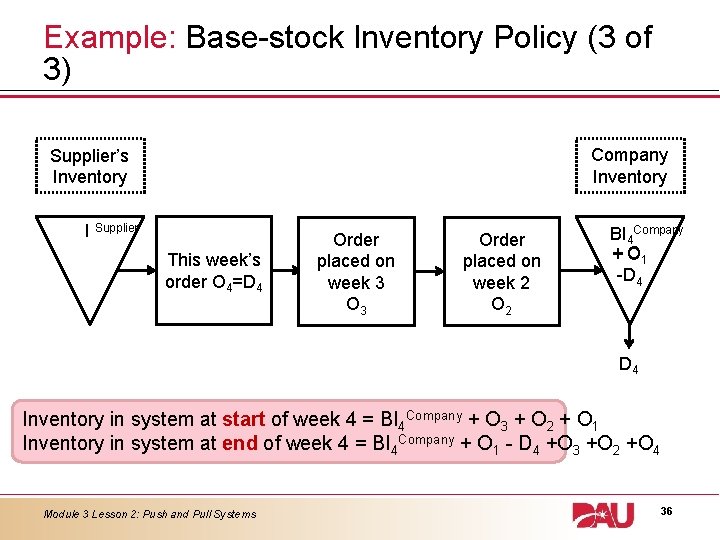
Example: Base-stock Inventory Policy (3 of 3) Company Inventory Supplier’s Inventory I Supplier This week’s order O 4=D 4 Order placed on week 3 Order placed on week 2 O 2 BI 4 Company + O 1 -D 4 Inventory in system at start of week 4 = BI 4 Company + O 3 + O 2 + O 1 Inventory in system at end of week 4 = BI 4 Company + O 1 - D 4 +O 3 +O 2 +O 4 Module 3 Lesson 2: Push and Pull Systems 36
Question and Answer What is the purpose of a basestock inventory policy? A. Increase WIP inventory at point of origin B. Limit total inventory in the pipeline and on-hand C. Increase the inventory levels onsite Module 3 Lesson 2: Push and Pull Systems 37
Question and Answer In which manner are orders placed when using a base-stock inventory policy? A. In quantities to keep inventory on hand constant B. In quantities to keep total inventory in the pipeline and on-hand constant C. In quantities to match on-hand inventory with last year’s inventory levels Module 3 Lesson 2: Push and Pull Systems 38
Summary Having completed this lesson, you should now be able to: § Differentiate push, pull, and hybrid systems § Demonstrate a Kanban § Explain the function and benefits of a base-stock inventory policy Module 3 Lesson 2: Push and Pull Systems 39
Summary (cont. ) You can now: § Question the amount of inventory flowing through a system, § Question the amount of inventory flowing across a factory floor, § Question how inventory is controlled in the factory (so that the Government doesn’t pay for excess inventory), § Understand what types of questions to ask for what types of production model is being used Module 3 Lesson 2: Push and Pull Systems 40