LECTURE COMPREHENSION NOTETAKING 1 PRECOURSEWORK EVALUATION 2 LOOKING


- Slides: 16
LECTURE COMPREHENSION & NOTE-TAKING
1 PRE-COURSEWORK EVALUATION
2 LOOKING AT LECTURE TRANSCRIPTS
RECOGNIZING CUES • Cues to Topic Introduction • Cues to Organization • Cues to Topic Conclusions
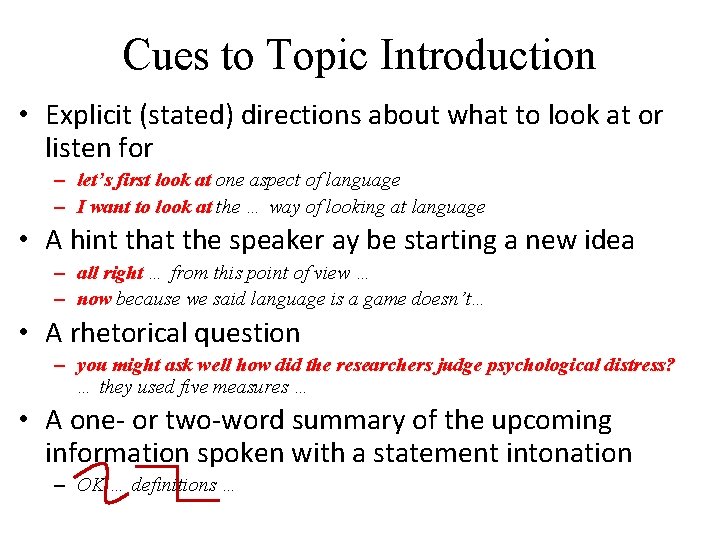
Cues to Topic Introduction • Explicit (stated) directions about what to look at or listen for – let’s first look at one aspect of language – I want to look at the … way of looking at language • A hint that the speaker ay be starting a new idea – all right … from this point of view … – now because we said language is a game doesn’t… • A rhetorical question – you might ask well how did the researchers judge psychological distress? … they used five measures … • A one- or two-word summary of the upcoming information spoken with a statement intonation – OK … definitions …
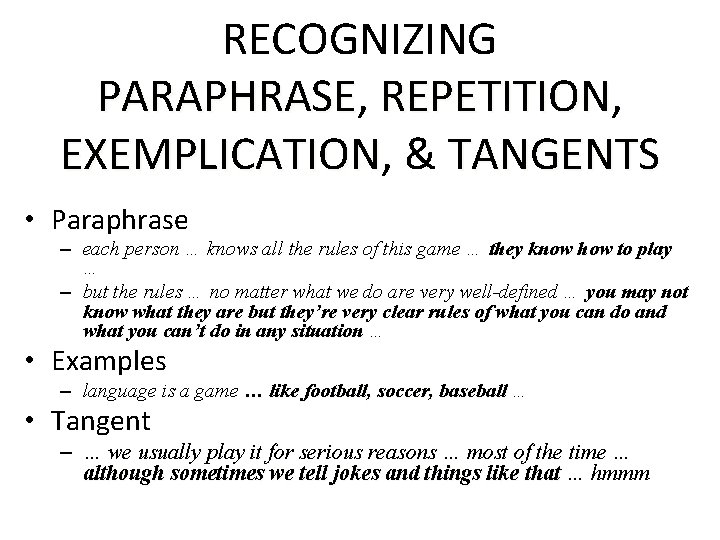
RECOGNIZING PARAPHRASE, PARAPHRASE REPETITION, REPETITION EXEMPLICATION, EXEMPLICATION & TANGENTS • Paraphrase – each person … knows all the rules of this game … they know how to play … – but the rules … no matter what we do are very well-defined … you may not know what they are but they’re very clear rules of what you can do and what you can’t do in any situation … • Examples – language is a game … like football, soccer, baseball … • Tangent – … we usually play it for serious reasons … most of the time … although sometimes we tell jokes and things like that … hmmm
3 NOTE-TAKING BASICS
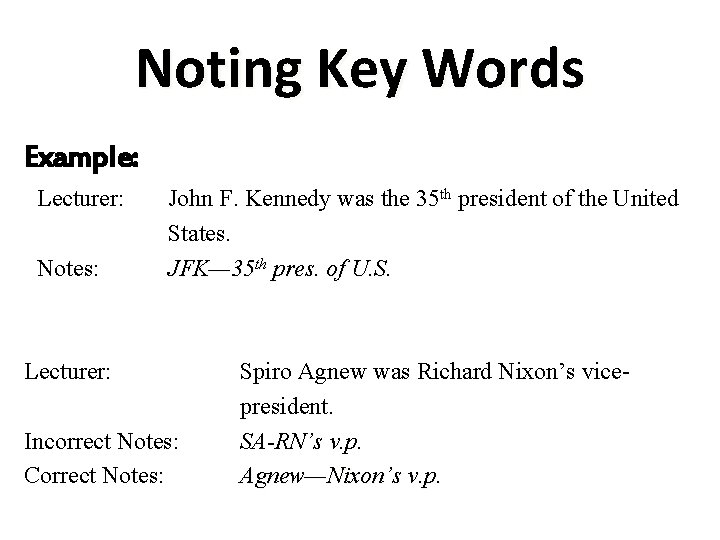
Noting Key Words Example: Lecturer: Notes: John F. Kennedy was the 35 th president of the United States. JFK— 35 th pres. of U. S. Lecturer: Incorrect Notes: Correct Notes: Spiro Agnew was Richard Nixon’s vicepresident. SA-RN’s v. p. Agnew—Nixon’s v. p.
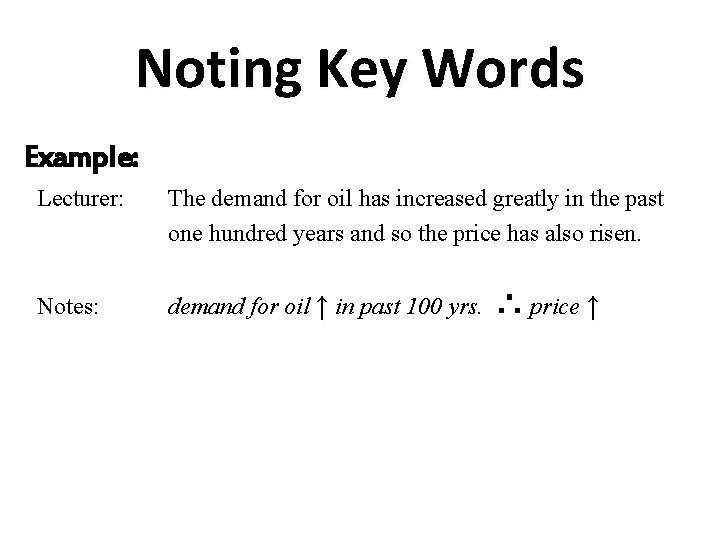
Noting Key Words Example: Lecturer: The demand for oil has increased greatly in the past one hundred years and so the price has also risen. Notes: demand for oil ↑ in past 100 yrs. ∴ price ↑
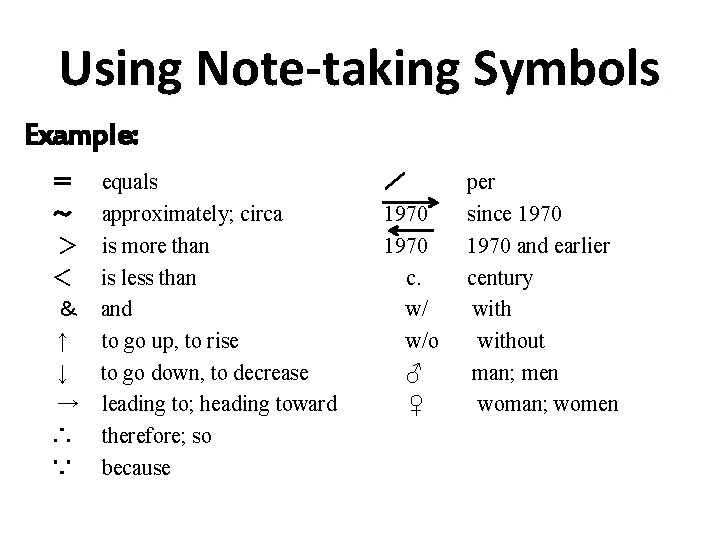
Using Note-taking Symbols Example: = equals ~ approximately; circa > is more than < is less than & and ↑ to go up, to rise ↓ to go down, to decrease → leading to; heading toward ∴ therefore; so ∵ because / 1970 c. w/ w/o ♂ ♀ per since 1970 and earlier century without man; men woman; women
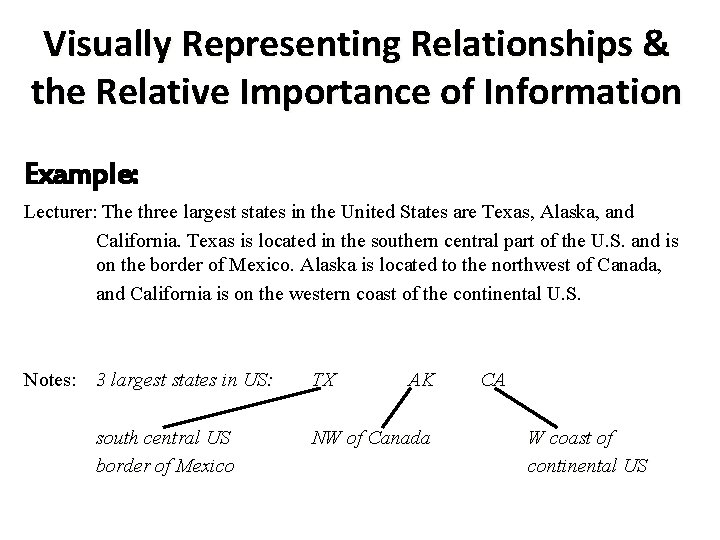
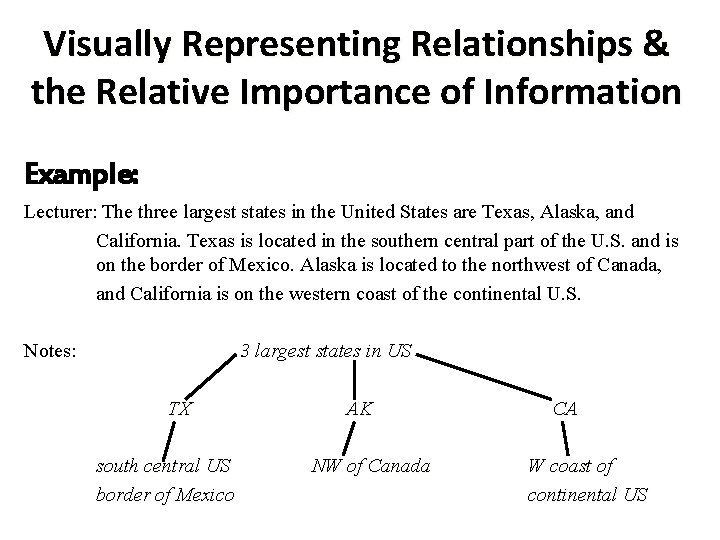
Visually Representing Relationships & the Relative Importance of Information Example: Lecturer: The three largest states in the United States are Texas, Alaska, and California. Texas is located in the southern central part of the U. S. and is on the border of Mexico. Alaska is located to the northwest of Canada, and California is on the western coast of the continental U. S. Notes: 3 largest states in US: south central US border of Mexico TX AK NW of Canada CA W coast of continental US
Visually Representing Relationships & the Relative Importance of Information Example: Lecturer: The three largest states in the United States are Texas, Alaska, and California. Texas is located in the southern central part of the U. S. and is on the border of Mexico. Alaska is located to the northwest of Canada, and California is on the western coast of the continental U. S. Notes: 3 largest states in US TX south central US border of Mexico AK NW of Canada CA W coast of continental US
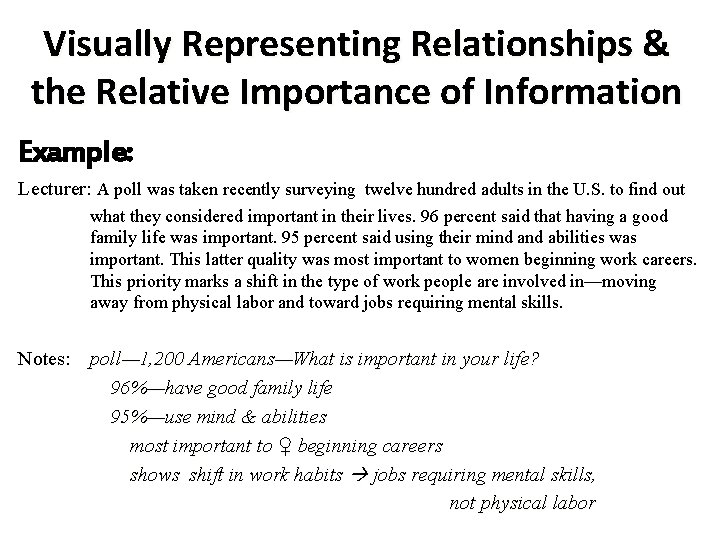
Visually Representing Relationships & the Relative Importance of Information Example: Lecturer: A poll was taken recently surveying twelve hundred adults in the U. S. to find out what they considered important in their lives. 96 percent said that having a good family life was important. 95 percent said using their mind abilities was important. This latter quality was most important to women beginning work careers. This priority marks a shift in the type of work people are involved in—moving away from physical labor and toward jobs requiring mental skills. Notes: poll— 1, 200 Americans—What is important in your life? 96%—have good family life 95%—use mind & abilities most important to ♀ beginning careers shows shift in work habits jobs requiring mental skills, not physical labor
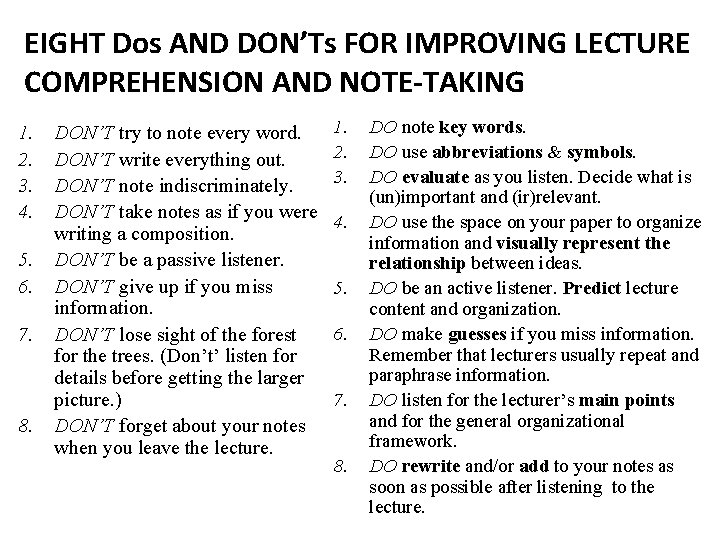
EIGHT Dos AND DON’Ts FOR IMPROVING LECTURE COMPREHENSION AND NOTE-TAKING 1. 2. 3. 4. 5. 6. 7. 8. DON’T try to note every word. DON’T write everything out. DON’T note indiscriminately. DON’T take notes as if you were writing a composition. DON’T be a passive listener. DON’T give up if you miss information. DON’T lose sight of the forest for the trees. (Don’t’ listen for details before getting the larger picture. ) DON’T forget about your notes when you leave the lecture. 1. 2. 3. 4. 5. 6. 7. 8. DO note key words DO use abbreviations & symbols DO evaluate as you listen. Decide what is (un)important and (ir)relevant. DO use the space on your paper to organize information and visually represent the relationship between ideas. DO be an active listener. Predict lecture content and organization. DO make guesses if you miss information. Remember that lecturers usually repeat and paraphrase information. DO listen for the lecturer’s main points and for the general organizational framework. DO rewrite and/or add to your notes as soon as possible after listening to the lecture.
4 NOTING NUMBERS AND STATISTICS
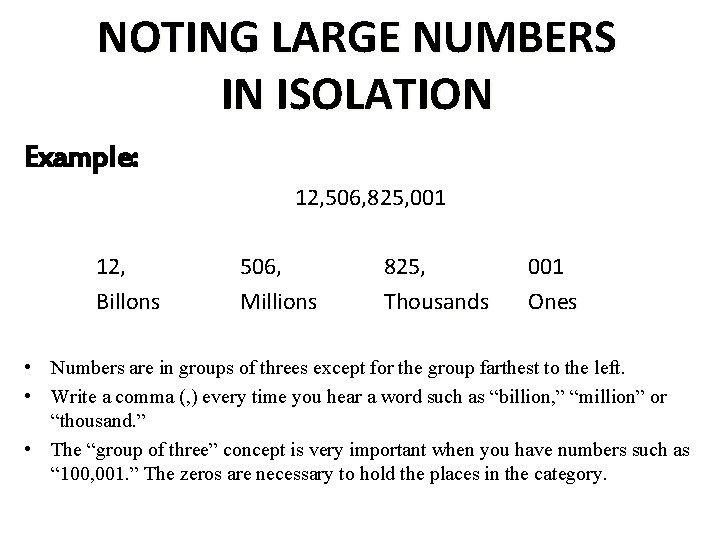
NOTING LARGE NUMBERS IN ISOLATION Example: 12, 506, 825, 001 12, Billons 506, Millions 825, Thousands 001 Ones • Numbers are in groups of threes except for the group farthest to the left. • Write a comma (, ) every time you hear a word such as “billion, ” “million” or “thousand. ” • The “group of three” concept is very important when you have numbers such as “ 100, 001. ” The zeros are necessary to hold the places in the category.