Lecture 7 High and Low Pressure Systems Homework



- Slides: 14
Lecture 7 High and Low Pressure Systems Homework Due Friday, October 3, 2014 TYU Ch 6: 1, 2, 5, 7, 11, 14, 17, 18, 20; TYPSS Ch 6: 2 TYU Ch 7: 1, 5, 10, 11, 13, 14, 15, 18, 20; TYPSS Ch 7: 1 TYU Ch 8: 1, 2, 6, 7, 12, 14, 15, 18, 20; TYPSS Ch 8: 2
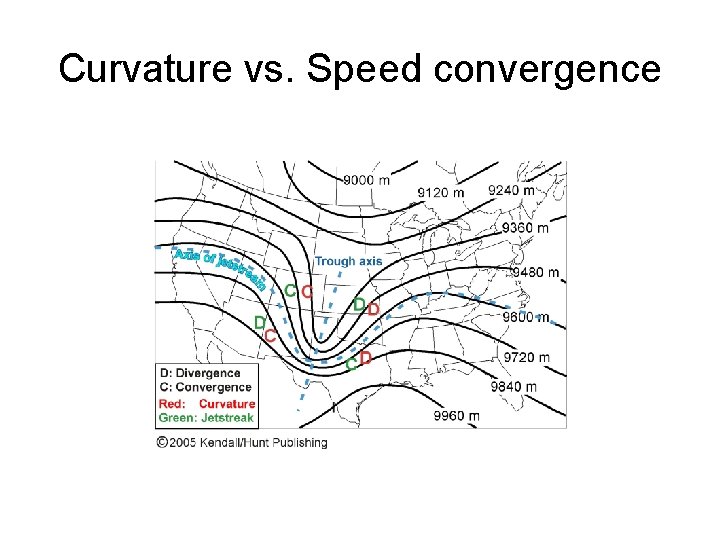
Divergence vs. Convergence Directional Convergence Speed Convergence Directional Divergence Speed Divergence
Divergence (Convergence) vs. Diffluence (confluence) • Diffluence is the spreading of height contours on an upper air map. – Speed slows => convergence – Direction is divergent => divergence – Convergence or divergence? • Uncertain • Numerical calculation necessary to tell
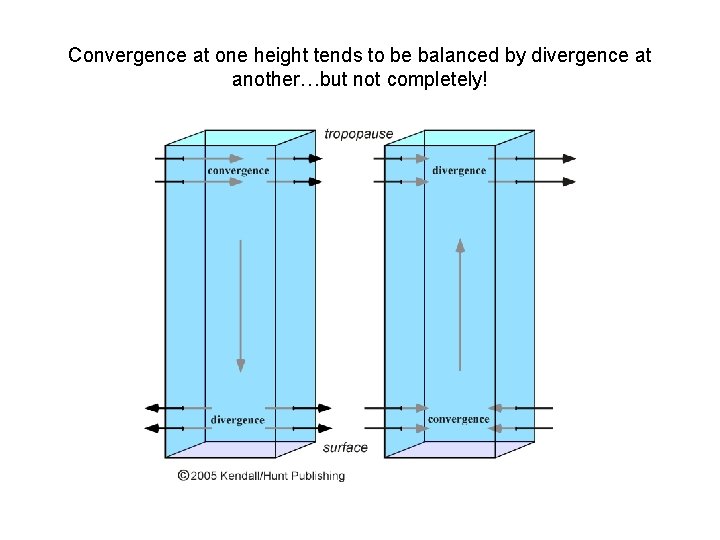
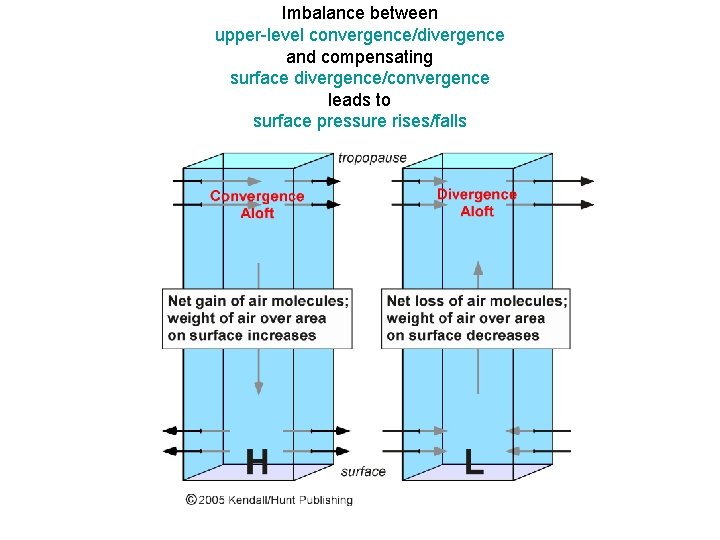
Convergence at one height tends to be balanced by divergence at another…but not completely!
Geostrophic Adjustment 1. Coriolis acceleration is equal wind multiplied by Coriolis parameter (f=. 0001 1/s). 2. Wind at rests accelerates from the sum of these forces until Coriolis and pressure gradient accelerations balance 3. The final state of balance is called “geostrophic balance”
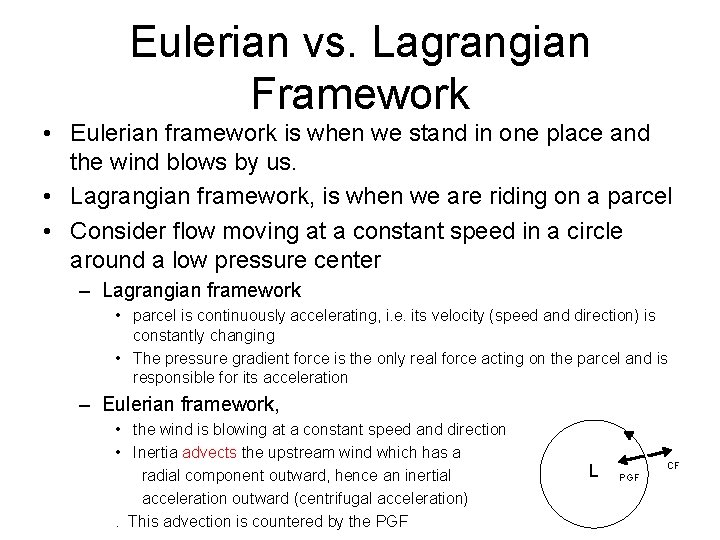
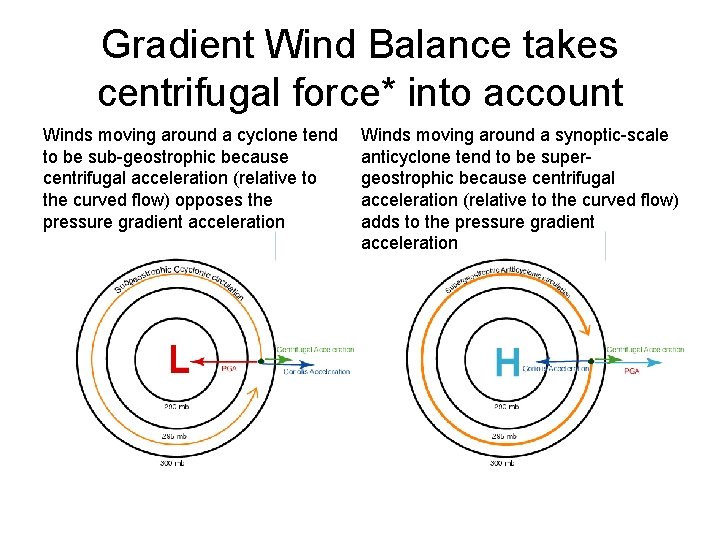
Eulerian vs. Lagrangian Framework • Eulerian framework is when we stand in one place and the wind blows by us. • Lagrangian framework, is when we are riding on a parcel • Consider flow moving at a constant speed in a circle around a low pressure center – Lagrangian framework • parcel is continuously accelerating, i. e. its velocity (speed and direction) is constantly changing • The pressure gradient force is the only real force acting on the parcel and is responsible for its acceleration – Eulerian framework, • the wind is blowing at a constant speed and direction • Inertia advects the upstream wind which has a radial component outward, hence an inertial acceleration outward (centrifugal acceleration). This advection is countered by the PGF L CF PGF
Gradient Wind Balance takes centrifugal force* into account Winds moving around a cyclone tend to be sub-geostrophic because centrifugal acceleration (relative to the curved flow) opposes the pressure gradient acceleration Winds moving around a synoptic-scale anticyclone tend to be supergeostrophic because centrifugal acceleration (relative to the curved flow) adds to the pressure gradient acceleration
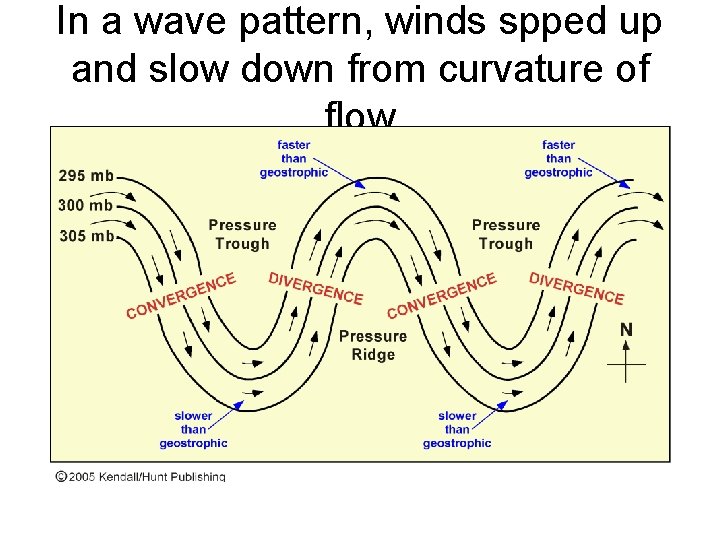
In a wave pattern, winds spped up and slow down from curvature of flow
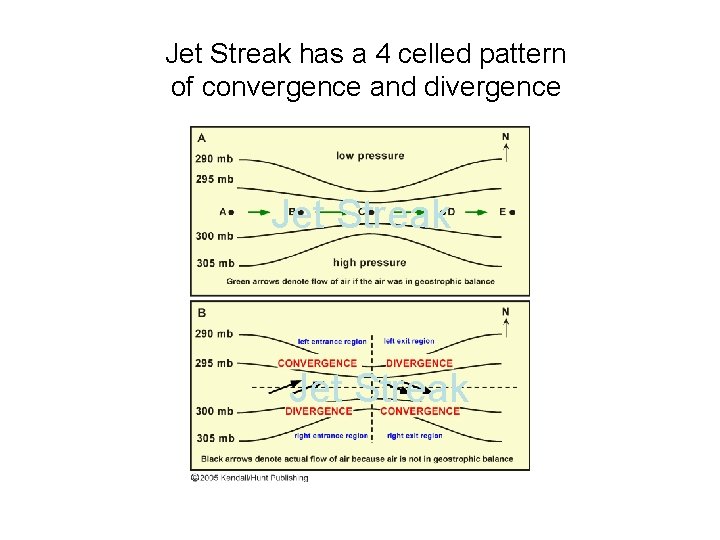
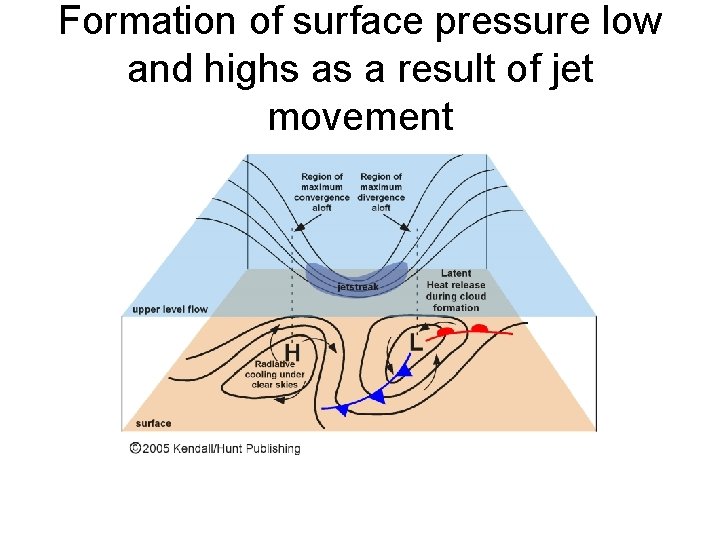
Jet Streak has a 4 celled pattern of convergence and divergence Jet Streak
Curvature vs. Speed convergence
Imbalance between upper-level convergence/divergence and compensating surface divergence/convergence leads to surface pressure rises/falls
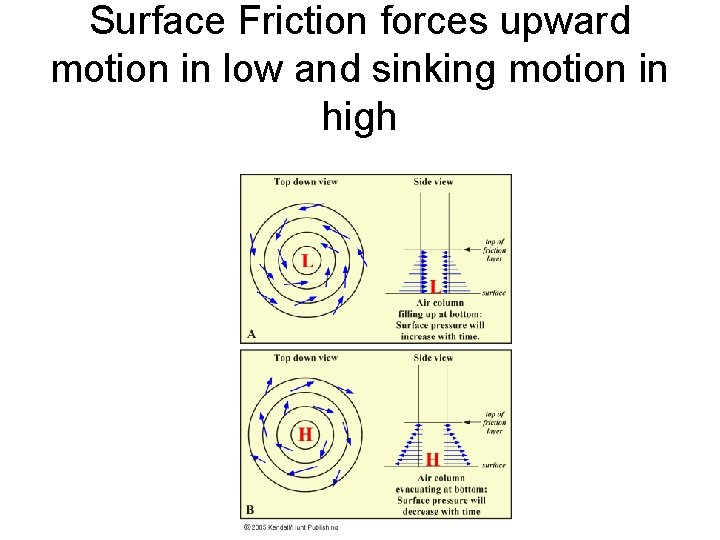
Surface Friction forces upward motion in low and sinking motion in high
How surface heating affects pressure
Formation of surface pressure low and highs as a result of jet movement