Lecture 5 a Recrystallization Introduction Purification Techniques Distillation
- Slides: 9
Lecture 5 a Recrystallization
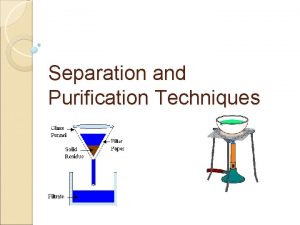
Introduction • Purification Techniques – Distillation: liquids, gases, some solids – Sublimation: solids only – Recrystallization: solids mainly – Chromatography: solids, liquids, gases – Extraction: mainly liquid-liquid (often involves acid-base chemistry), sometimes solid-liquid – Zone melting i. e. , purification of silicon, etc.
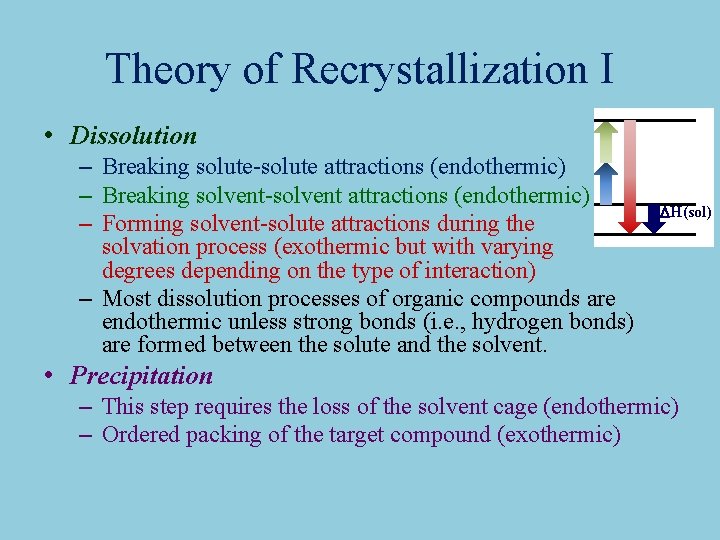
Theory of Recrystallization I • Dissolution – Breaking solute-solute attractions (endothermic) – Breaking solvent-solvent attractions (endothermic) – Forming solvent-solute attractions during the solvation process (exothermic but with varying degrees depending on the type of interaction) – Most dissolution processes of organic compounds are endothermic unless strong bonds (i. e. , hydrogen bonds) are formed between the solute and the solvent. DH(sol) • Precipitation – This step requires the loss of the solvent cage (endothermic) – Ordered packing of the target compound (exothermic)
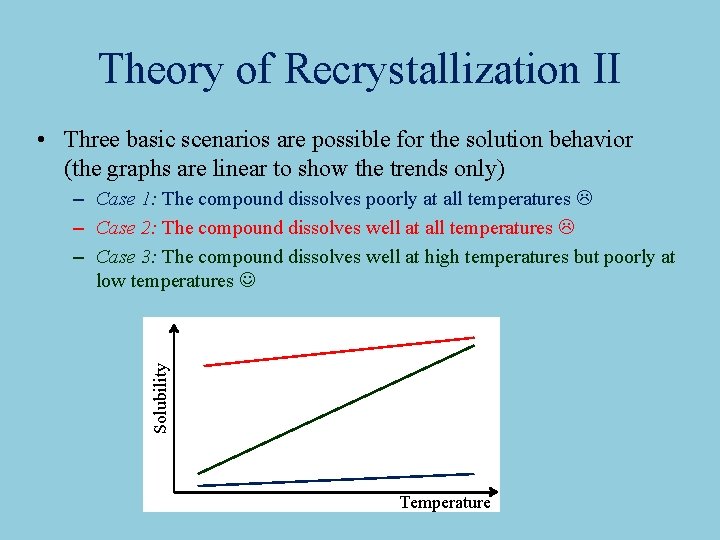
Theory of Recrystallization II • Three basic scenarios are possible for the solution behavior (the graphs are linear to show the trends only) Solubility – Case 1: The compound dissolves poorly at all temperatures – Case 2: The compound dissolves well at all temperatures – Case 3: The compound dissolves well at high temperatures but poorly at low temperatures Temperature
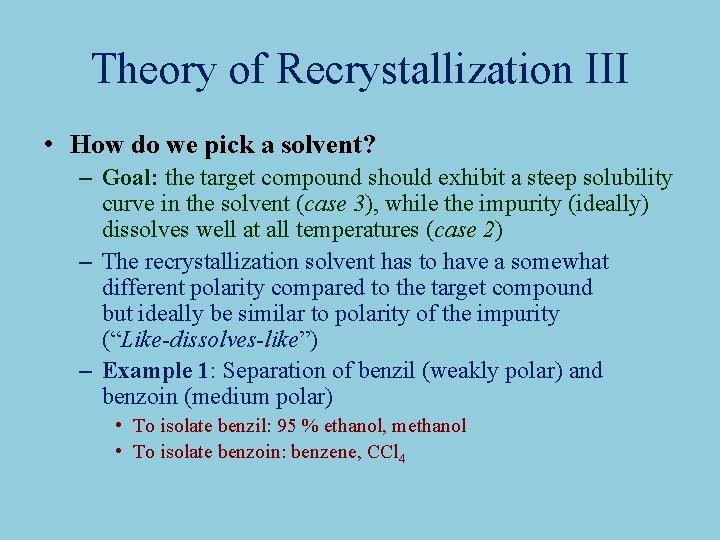
Theory of Recrystallization III • How do we pick a solvent? – Goal: the target compound should exhibit a steep solubility curve in the solvent (case 3), while the impurity (ideally) dissolves well at all temperatures (case 2) – The recrystallization solvent has to have a somewhat different polarity compared to the target compound but ideally be similar to polarity of the impurity (“Like-dissolves-like”) – Example 1: Separation of benzil (weakly polar) and benzoin (medium polar) • To isolate benzil: 95 % ethanol, methanol • To isolate benzoin: benzene, CCl 4
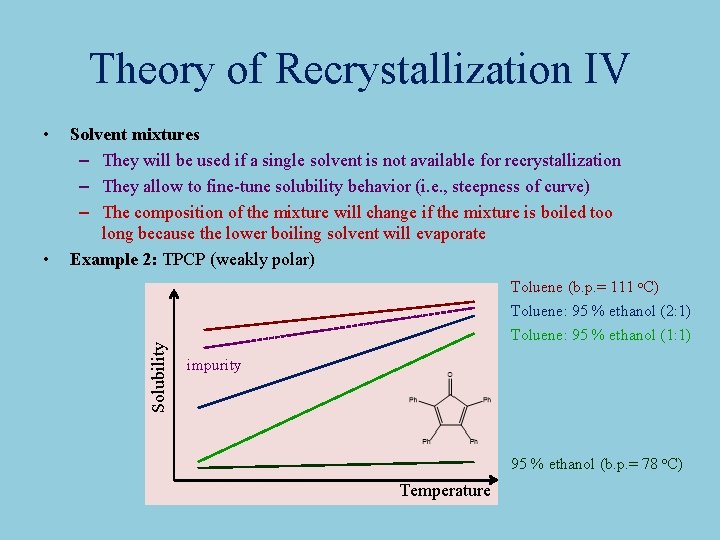
Theory of Recrystallization IV • Solvent mixtures – They will be used if a single solvent is not available for recrystallization – They allow to fine-tune solubility behavior (i. e. , steepness of curve) – The composition of the mixture will change if the mixture is boiled too long because the lower boiling solvent will evaporate Example 2: TPCP (weakly polar) Solubility • Toluene (b. p. = 111 o. C) Toluene: 95 % ethanol (2: 1) Toluene: 95 % ethanol (1: 1) impurity 95 % ethanol (b. p. = 78 o. C) Temperature
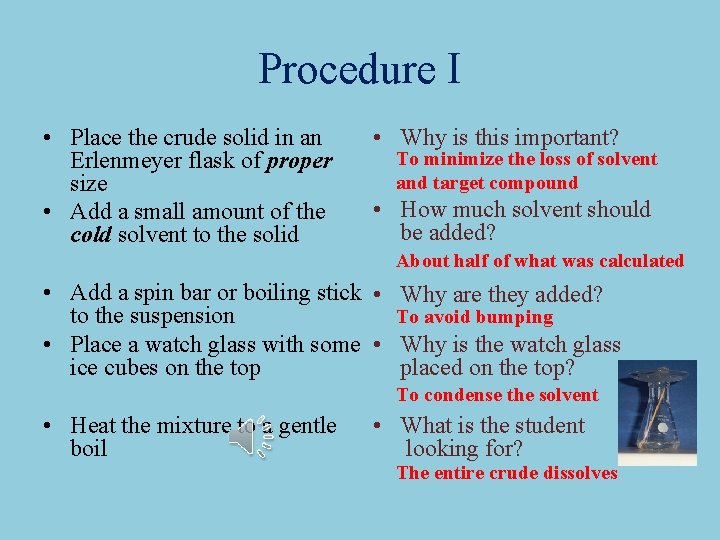
Procedure I • Place the crude solid in an Erlenmeyer flask of proper size • Add a small amount of the cold solvent to the solid • Why is this important? To minimize the loss of solvent and target compound • How much solvent should be added? About half of what was calculated • Add a spin bar or boiling stick • Why are they added? To avoid bumping to the suspension • Place a watch glass with some • Why is the watch glass ice cubes on the top placed on the top? To condense the solvent • Heat the mixture to a gentle boil • What is the student looking for? The entire crude dissolves
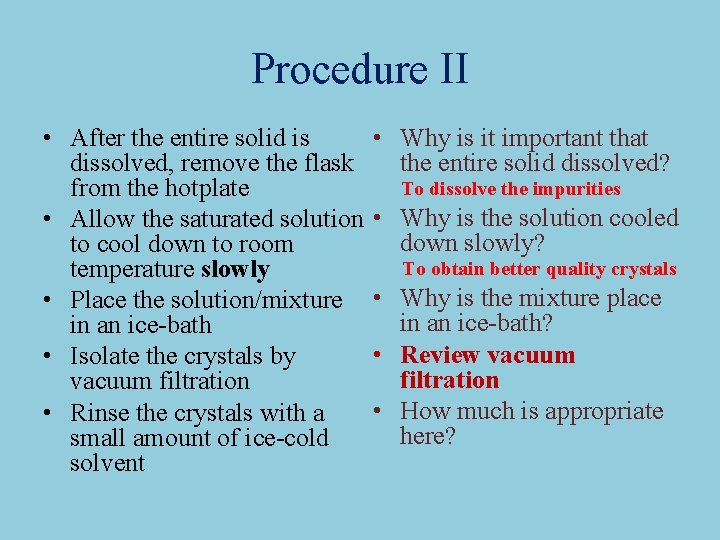
Procedure II • After the entire solid is dissolved, remove the flask from the hotplate • Allow the saturated solution to cool down to room temperature slowly • Place the solution/mixture in an ice-bath • Isolate the crystals by vacuum filtration • Rinse the crystals with a small amount of ice-cold solvent • Why is it important that the entire solid dissolved? To dissolve the impurities • Why is the solution cooled down slowly? To obtain better quality crystals • Why is the mixture place in an ice-bath? • Review vacuum filtration • How much is appropriate here?
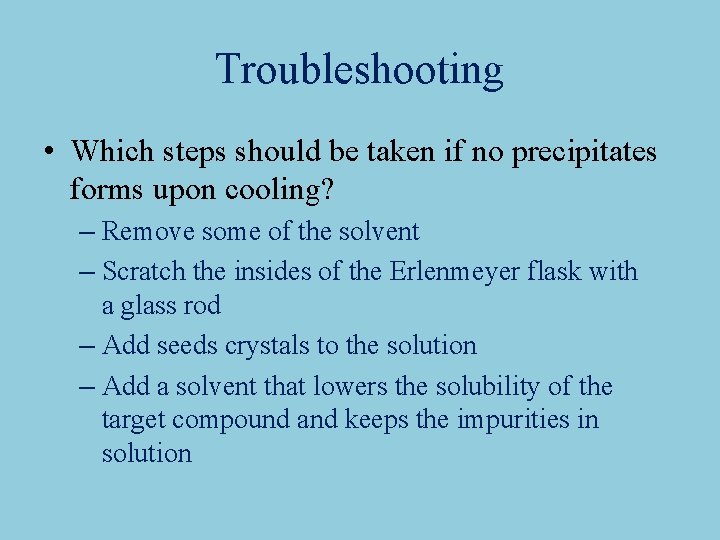
Troubleshooting • Which steps should be taken if no precipitates forms upon cooling? – Remove some of the solvent – Scratch the insides of the Erlenmeyer flask with a glass rod – Add seeds crystals to the solution – Add a solvent that lowers the solubility of the target compound and keeps the impurities in solution