Lecture 4 Introduction to Promela Promela and Spin

- Slides: 11
Lecture 4 Introduction to Promela
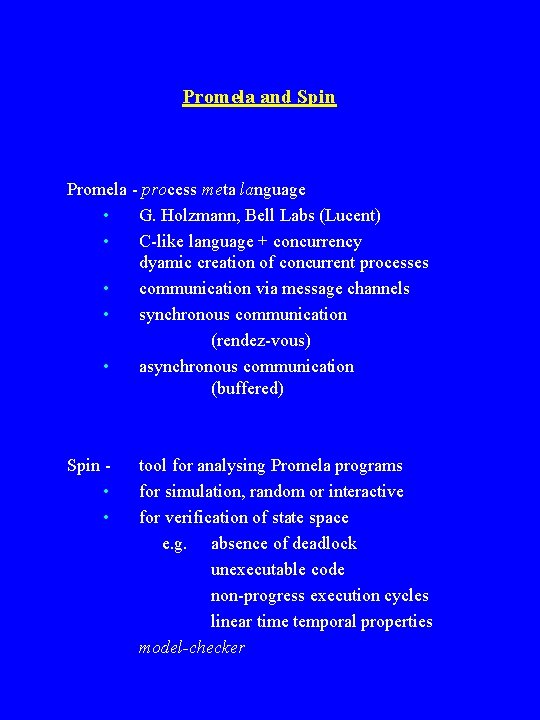
Promela and Spin Promela - process meta language • G. Holzmann, Bell Labs (Lucent) • C-like language + concurrency dyamic creation of concurrent processes • communication via message channels • synchronous communication (rendez-vous) • asynchronous communication (buffered) Spin • • tool for analysing Promela programs for simulation, random or interactive for verification of state space e. g. absence of deadlock unexecutable code non-progress execution cycles linear time temporal properties model-checker
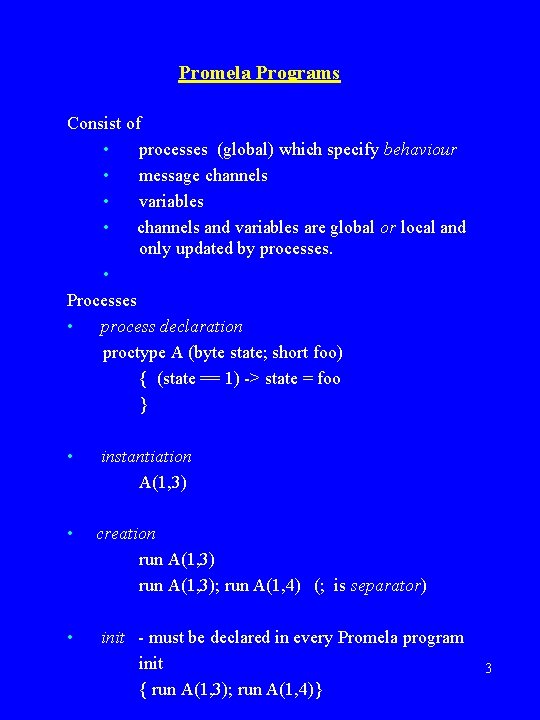
Promela Programs Consist of • processes (global) which specify behaviour • message channels • variables • channels and variables are global or local and only updated by processes. • Processes • process declaration proctype A (byte state; short foo) { (state == 1) -> state = foo } • instantiation A(1, 3) • creation run A(1, 3); run A(1, 4) (; is separator) • init - must be declared in every Promela program init { run A(1, 3); run A(1, 4)} 3
Executability Processes contain • statements • conditions No difference between conditions and statements: either executable or blocked. 1 represents True; 0 represents False. So, if a statement evaluates to 0, then it is blocked. If it evaluates to 1, then it is executable. • (a == b) This is busy waiting: while (a ~=b) do skip A process terminates (and disappears) when it reaches the end of its body and all the processes it started have terminated. 4
Basic Data Types Numbers • • bit byte short int 0. . 1 0. . 255 - (2^15)-1. . (2^15)-1 - (2^31)-1. . (2^31)-1 • bool is a synonym for bit. Initialisation upon declaration e. g. bit x=1; 5
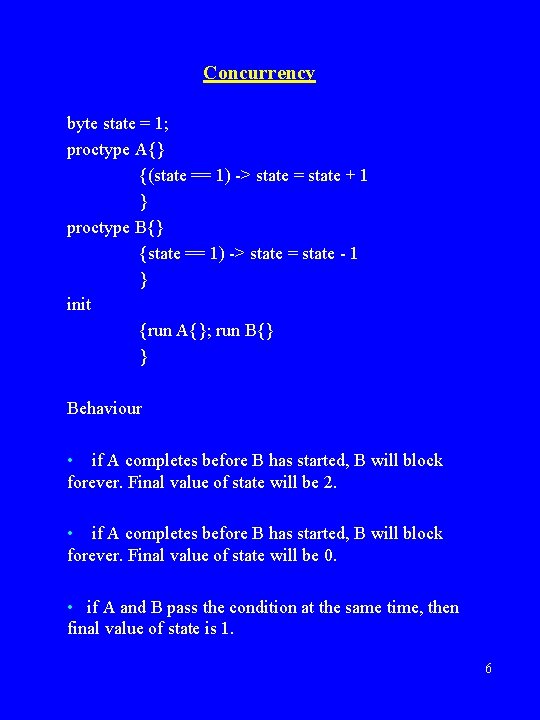
Concurrency byte state = 1; proctype A{} {(state == 1) -> state = state + 1 } proctype B{} {state == 1) -> state = state - 1 } init {run A{}; run B{} } Behaviour • if A completes before B has started, B will block forever. Final value of state will be 2. • if A completes before B has started, B will block forever. Final value of state will be 0. • if A and B pass the condition at the same time, then final value of state is 1. 6
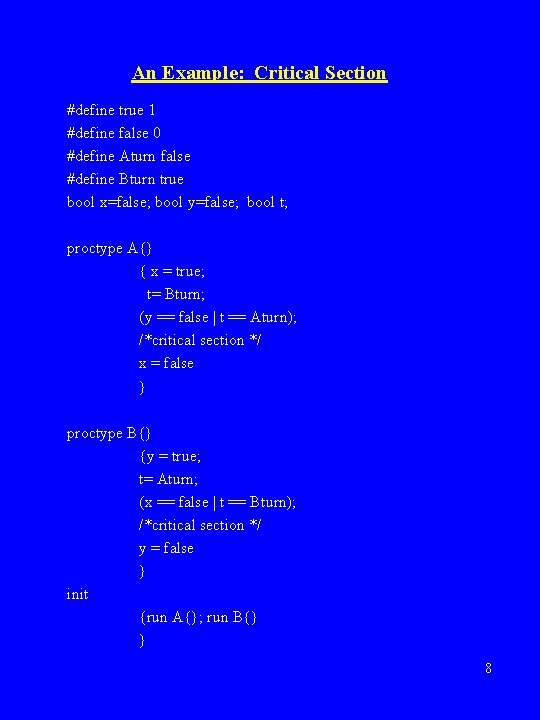
An Example: Critical Section Grant processes A and B mutually exclusive access to portions of code. Requires 3 additional variables (Dekker). 7
An Example: Critical Section #define true 1 #define false 0 #define Aturn false #define Bturn true bool x=false; bool y=false; bool t; proctype A{} { x = true; t= Bturn; (y == false | t == Aturn); /*critical section */ x = false } proctype B{} {y = true; t= Aturn; (x == false | t == Bturn); /*critical section */ y = false } init {run A{}; run B{} } 8
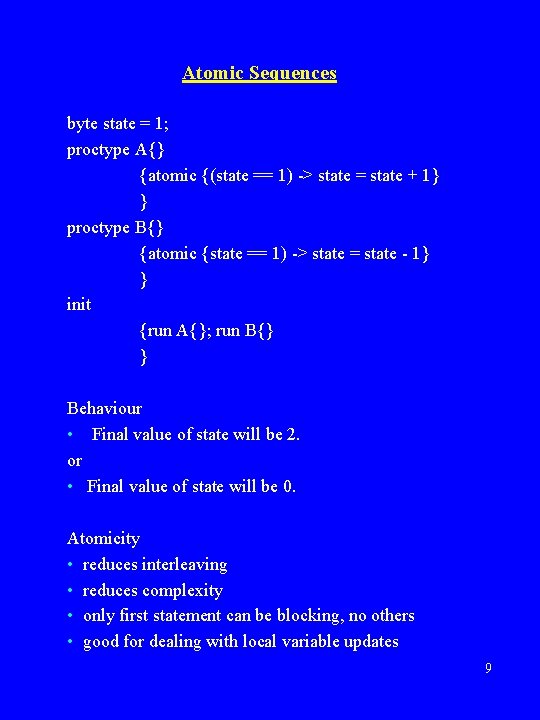
Atomic Sequences byte state = 1; proctype A{} {atomic {(state == 1) -> state = state + 1} } proctype B{} {atomic {state == 1) -> state = state - 1} } init {run A{}; run B{} } Behaviour • Final value of state will be 2. or • Final value of state will be 0. Atomicity • reduces interleaving • reduces complexity • only first statement can be blocking, no others • good for dealing with local variable updates 9
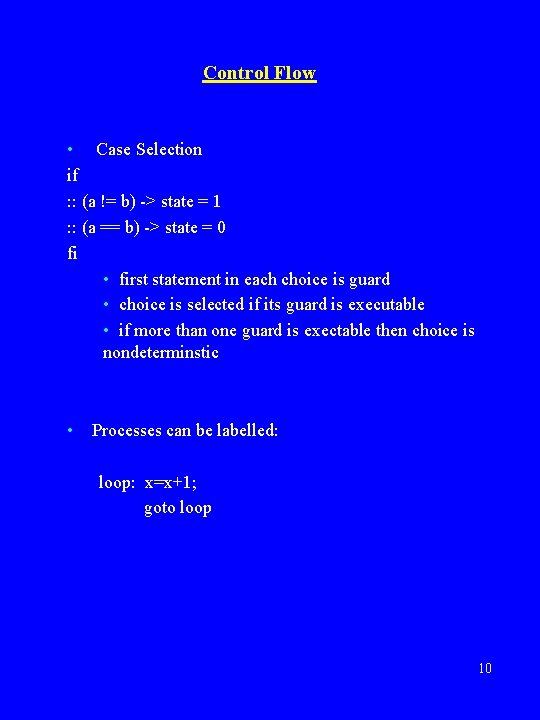
Control Flow • Case Selection if : : (a != b) -> state = 1 : : (a == b) -> state = 0 fi • first statement in each choice is guard • choice is selected if its guard is executable • if more than one guard is exectable then choice is nondeterminstic • Processes can be labelled: loop: x=x+1; goto loop 10
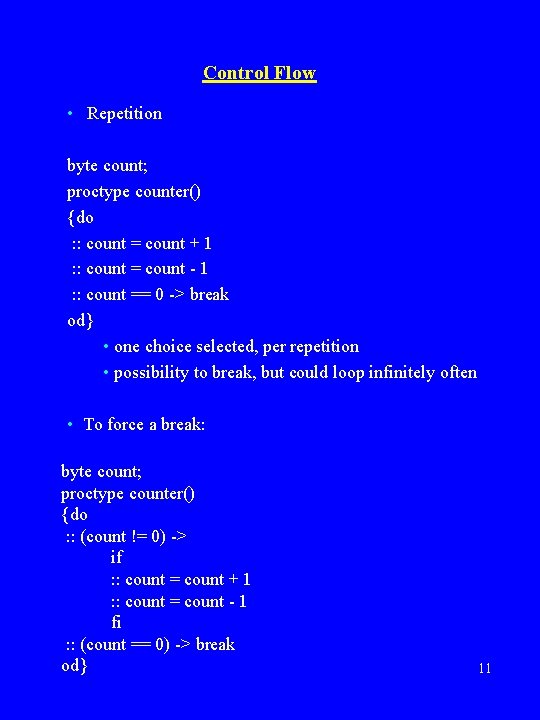
Control Flow • Repetition byte count; proctype counter() {do : : count = count + 1 : : count = count - 1 : : count == 0 -> break od} • one choice selected, per repetition • possibility to break, but could loop infinitely often • To force a break: byte count; proctype counter() {do : : (count != 0) -> if : : count = count + 1 : : count = count - 1 fi : : (count == 0) -> break od} 11