Lecture 2 What do we do projects in
- Slides: 33
Lecture 2 What do we do? (projects in the Sukharev Lab) Reading for the next classes: Chapter 2 (Chemical foundations)
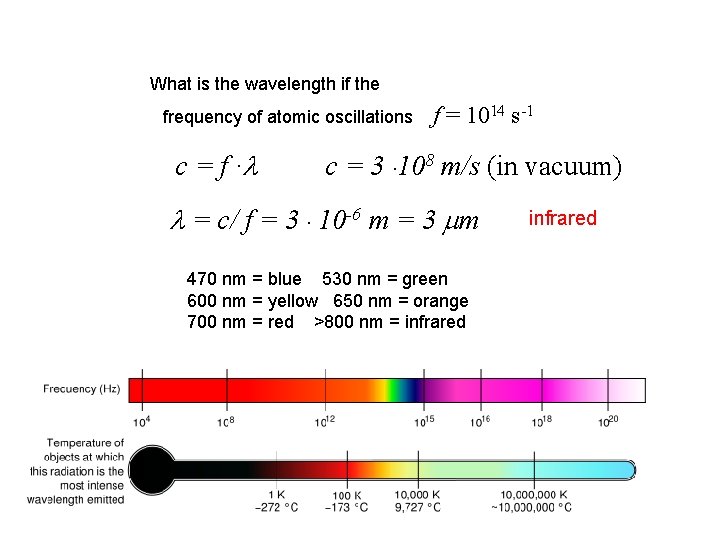
What is the wavelength if the frequency of atomic oscillations c = f ∙l f = 1014 s-1 c = 3 ∙ 108 m/s (in vacuum) l = c/ f = 3 ∙ 10 -6 m = 3 mm 470 nm = blue 530 nm = green 600 nm = yellow 650 nm = orange 700 nm = red >800 nm = infrared
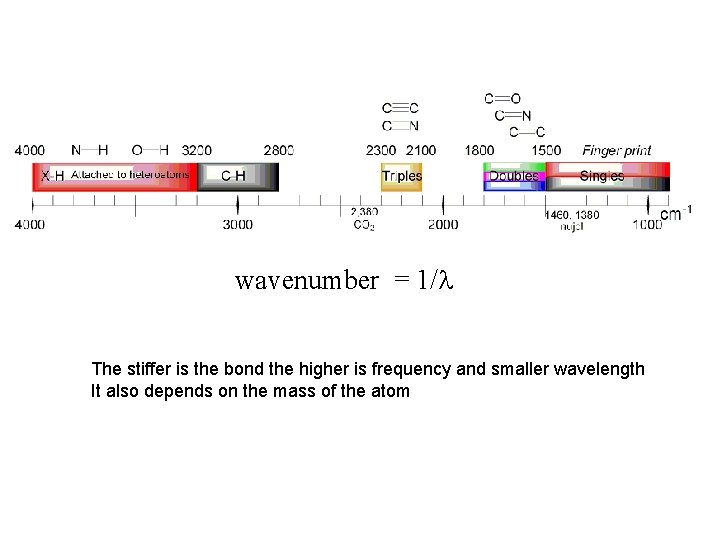
wavenumber = 1/l The stiffer is the bond the higher is frequency and smaller wavelength It also depends on the mass of the atom
Basic Senses • • • Vision Taste Smell Hearing, Equilibrium and Touch Temperature sensation
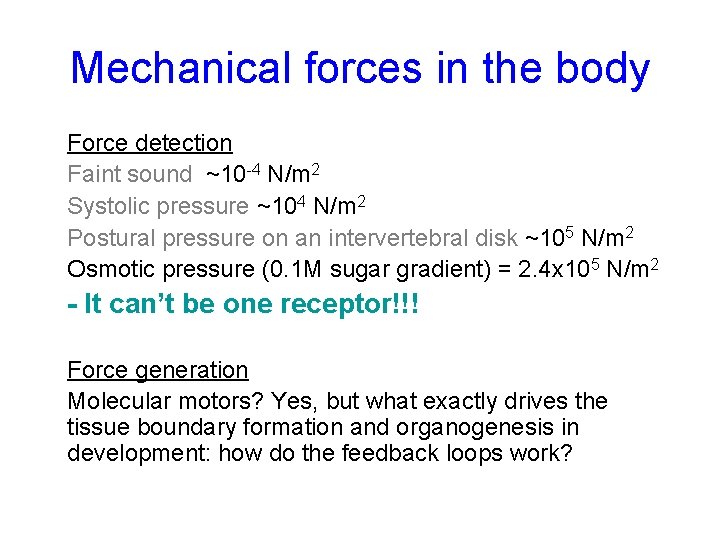
Mechanical forces in the body Force detection Faint sound ~10 -4 N/m 2 Systolic pressure ~104 N/m 2 Postural pressure on an intervertebral disk ~105 N/m 2 Osmotic pressure (0. 1 M sugar gradient) = 2. 4 x 10⁵ N/m 2 - It can’t be one receptor!!! Force generation Molecular motors? Yes, but what exactly drives the tissue boundary formation and organogenesis in development: how do the feedback loops work?
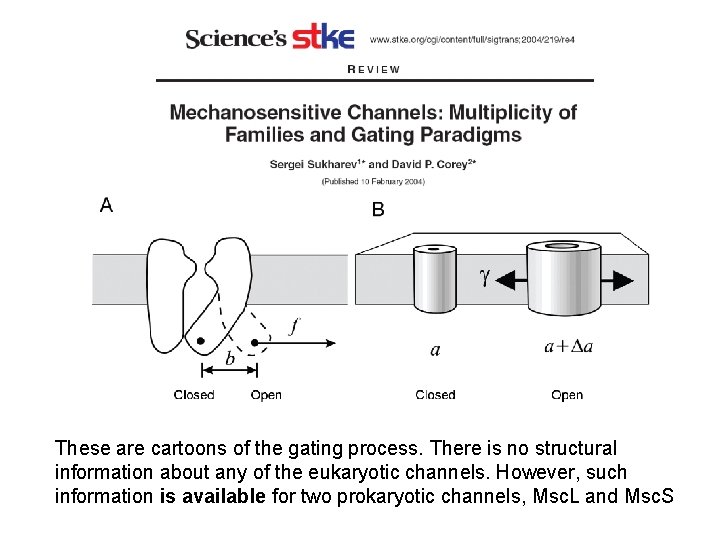
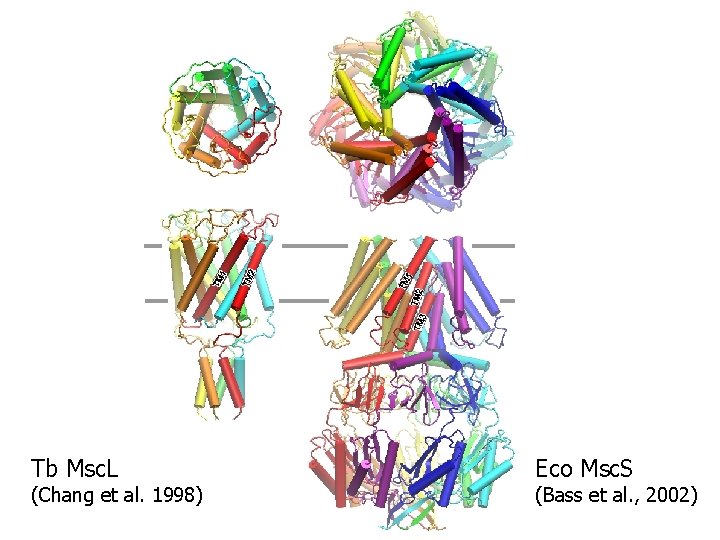
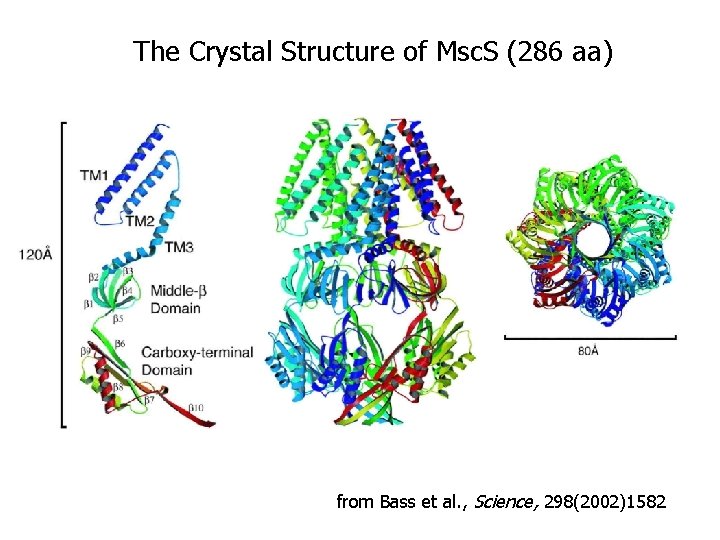
These are cartoons of the gating process. There is no structural information about any of the eukaryotic channels. However, such information is available for two prokaryotic channels, Msc. L and Msc. S
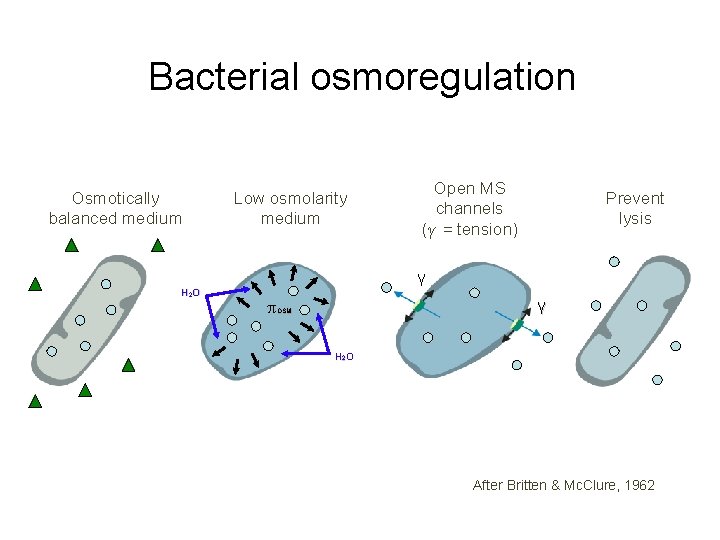
Bacterial osmoregulation Osmotically balanced medium Low osmolarity medium Open MS channels (γ = tension) Prevent lysis γ H 2 O π γ OSM H 2 O After Britten & Mc. Clure, 1962
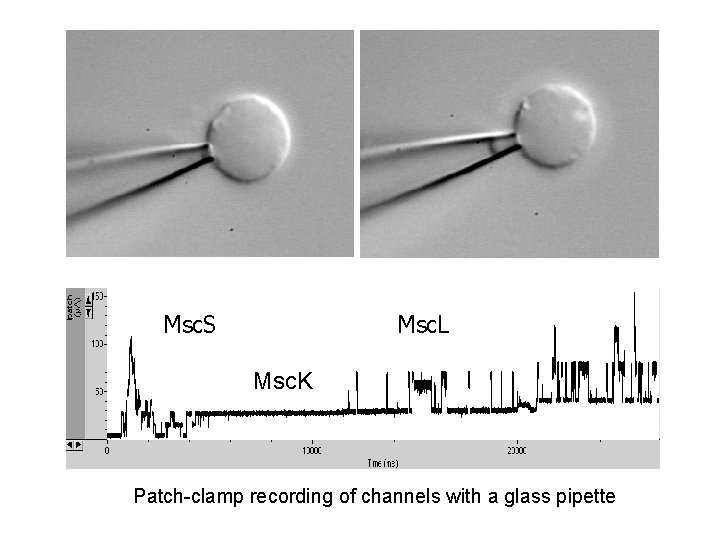
Msc. S Msc. L Msc. K Patch-clamp recording of channels with a glass pipette
Tb Msc. L (Chang et al. 1998) Eco Msc. S (Bass et al. , 2002)
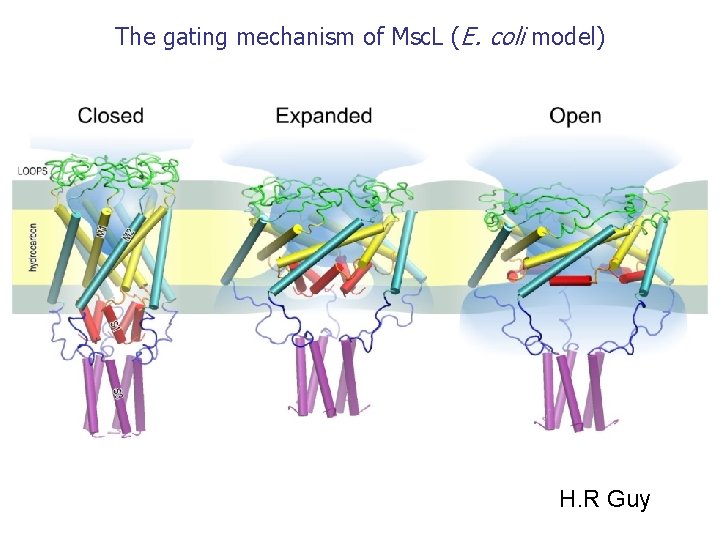
The gating mechanism of Msc. L (E. coli model) H. R Guy
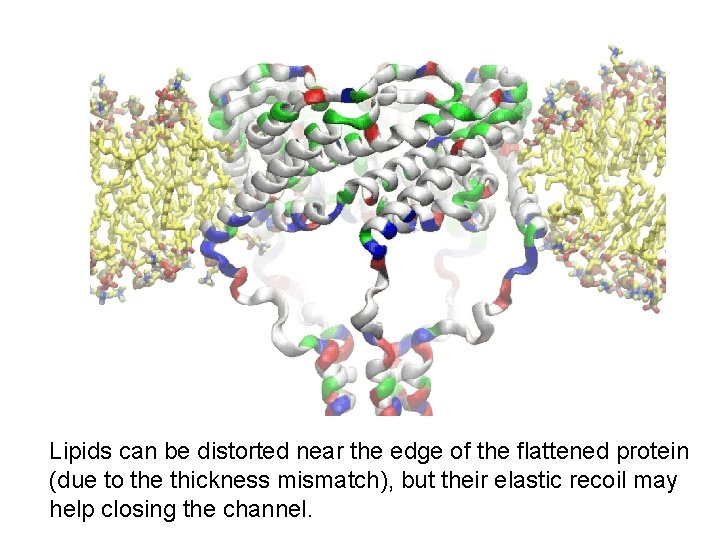
Lipids can be distorted near the edge of the flattened protein (due to the thickness mismatch), but their elastic recoil may help closing the channel.
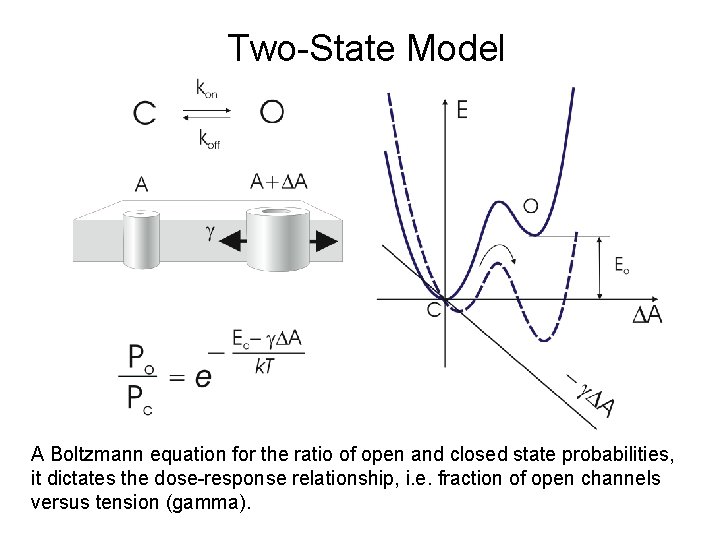
Two-State Model A Boltzmann equation for the ratio of open and closed state probabilities, it dictates the dose-response relationship, i. e. fraction of open channels versus tension (gamma).
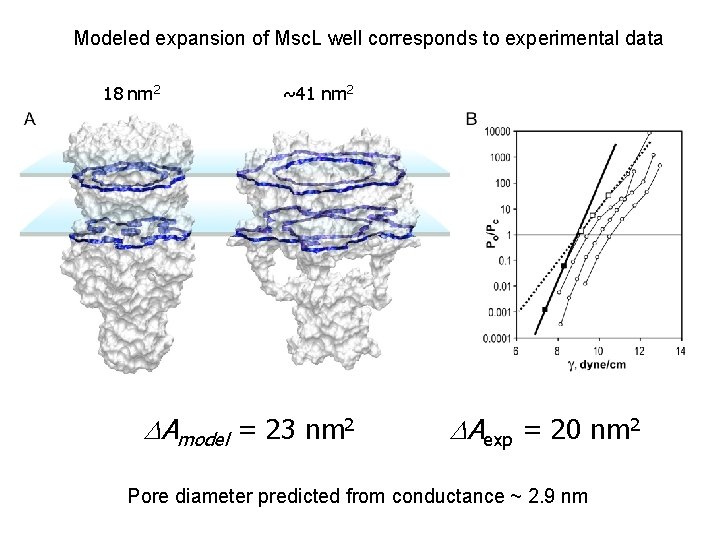
Modeled expansion of Msc. L well corresponds to experimental data 18 nm 2 ~41 nm 2 DAmodel = 23 nm 2 DAexp = 20 nm 2 Pore diameter predicted from conductance ~ 2. 9 nm
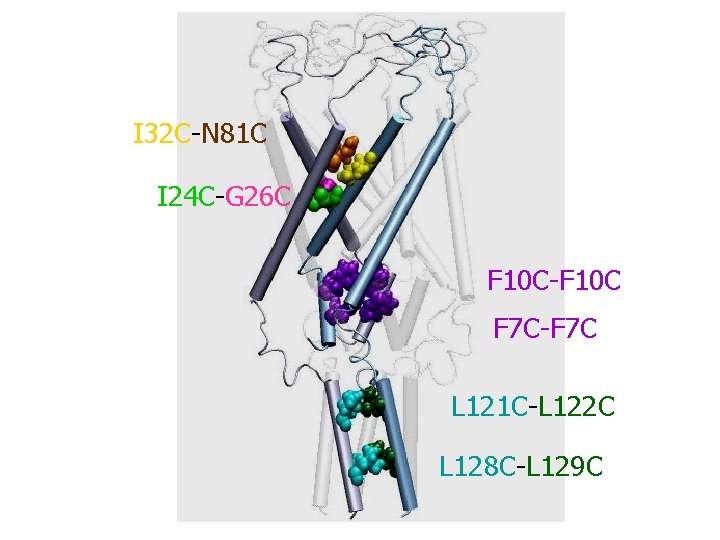
I 32 C-N 81 C I 24 C-G 26 C F 10 C-F 10 C F 7 C-F 7 C L 121 C-L 122 C L 128 C-L 129 C
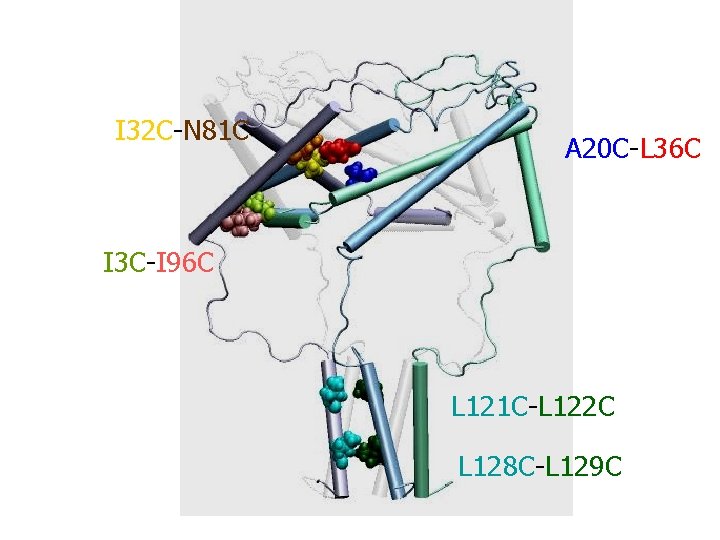
I 32 C-N 81 C A 20 C-L 36 C I 3 C-I 96 C L 121 C-L 122 C L 128 C-L 129 C
The Crystal Structure of Msc. S (286 aa) from Bass et al. , Science, 298(2002)1582
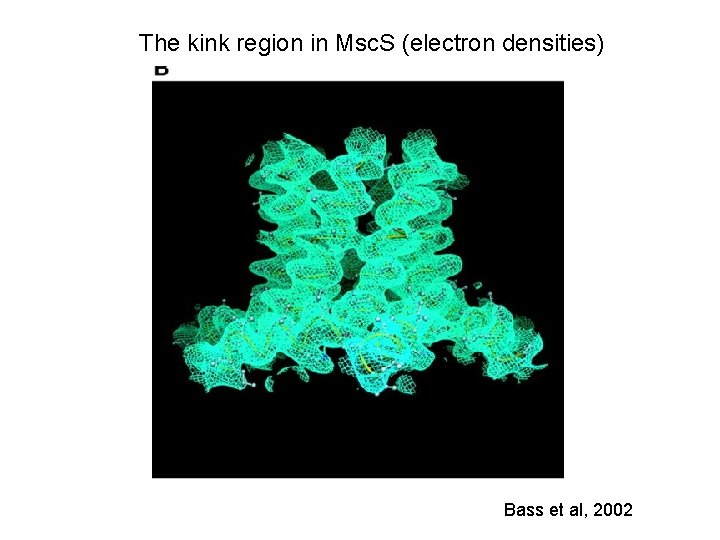
The kink region in Msc. S (electron densities) Bass et al, 2002
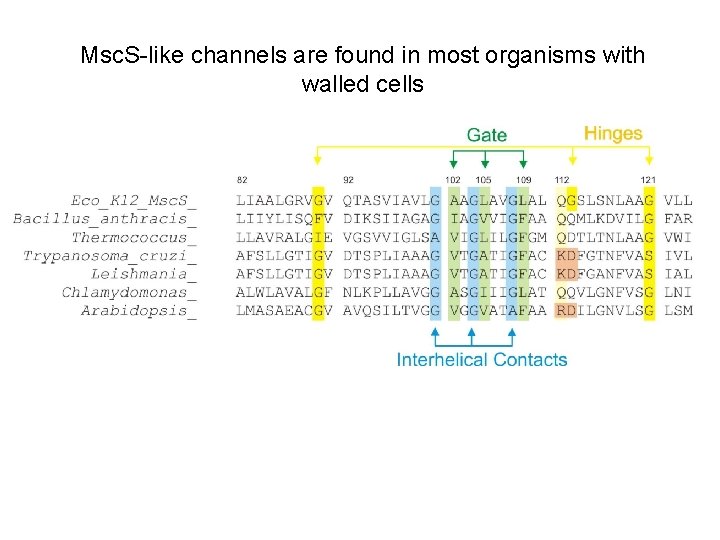
Msc. S-like channels are found in most organisms with walled cells
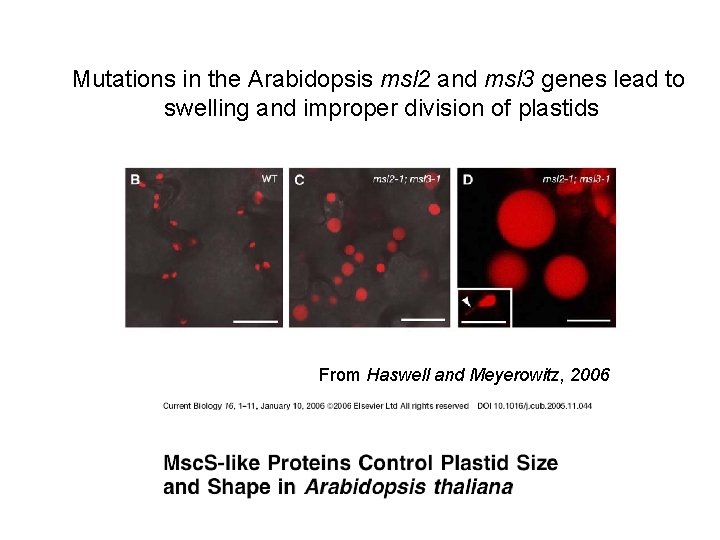
Mutations in the Arabidopsis msl 2 and msl 3 genes lead to swelling and improper division of plastids From Haswell and Meyerowitz, 2006
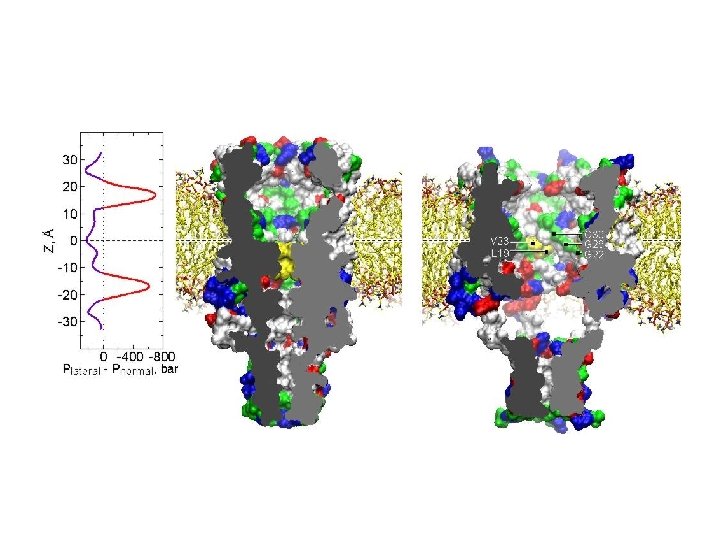
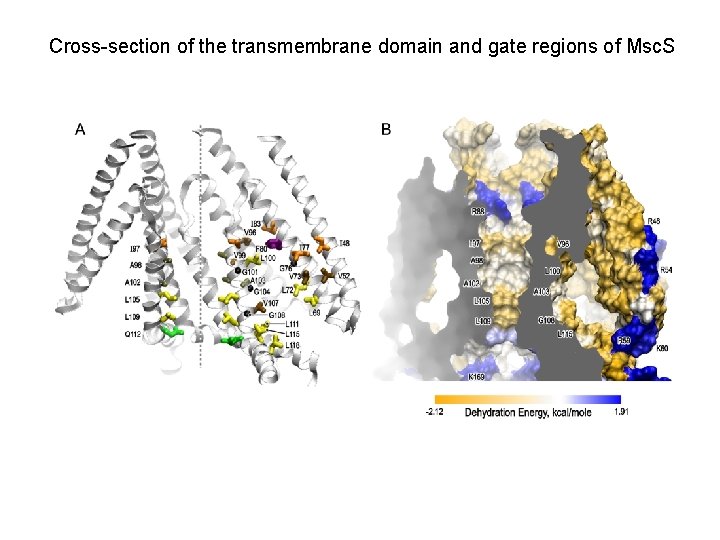
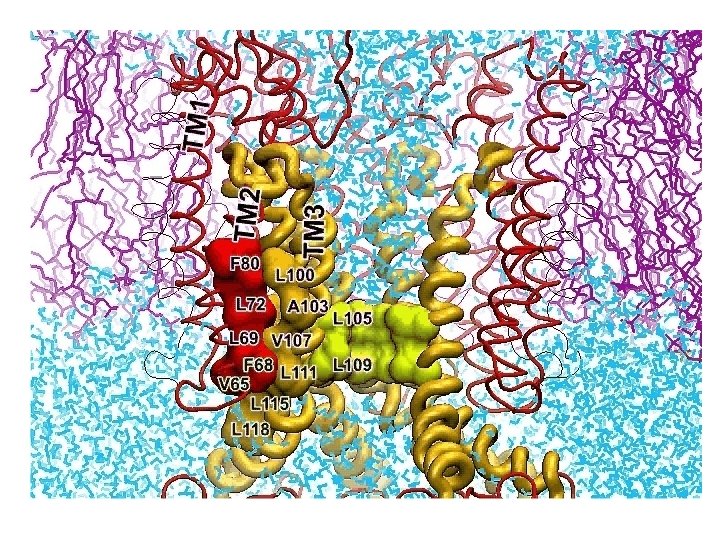
Cross-section of the transmembrane domain and gate regions of Msc. S
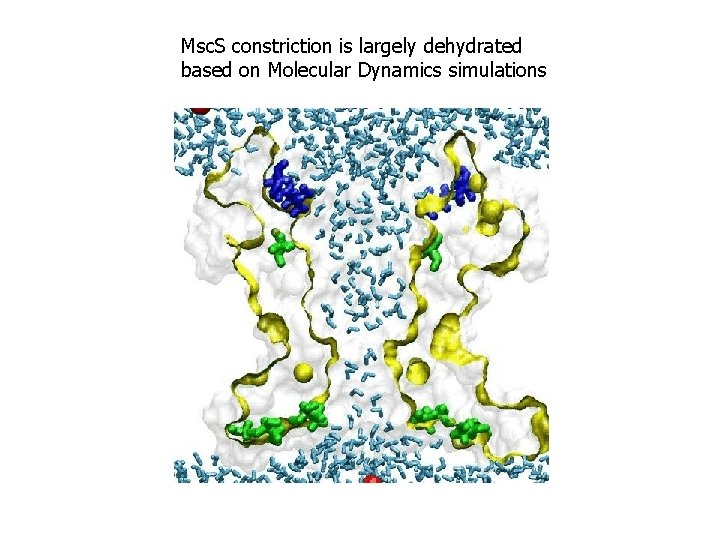
Msc. S constriction is largely dehydrated based on Molecular Dynamics simulations
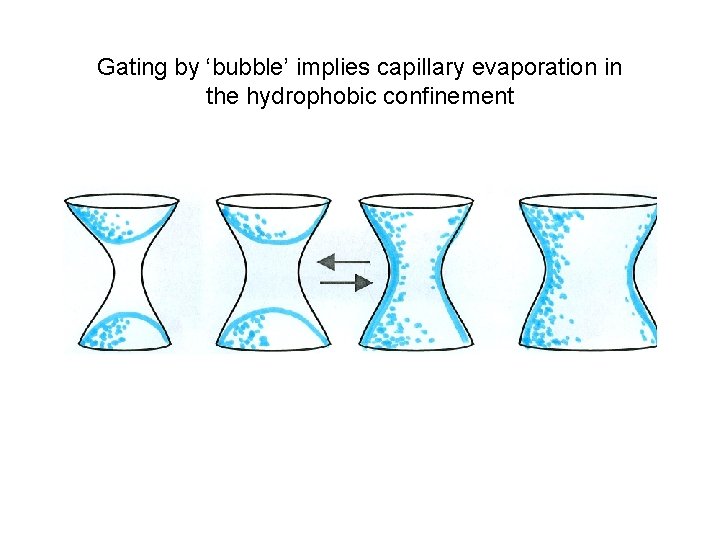
Gating by ‘bubble’ implies capillary evaporation in the hydrophobic confinement
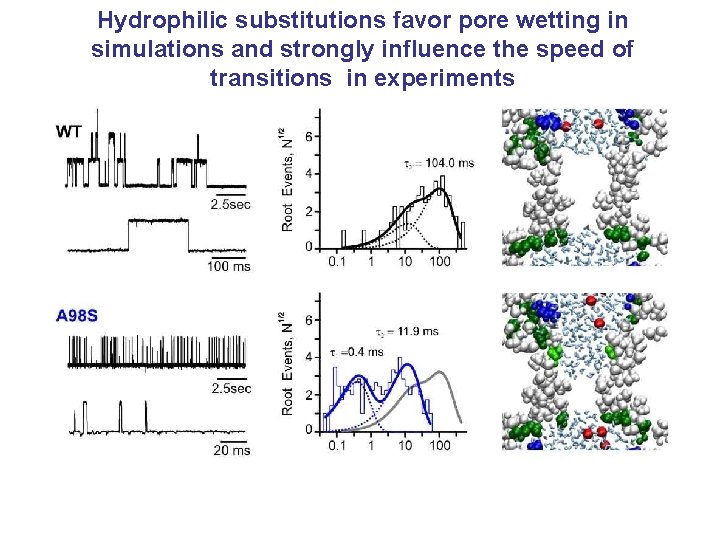
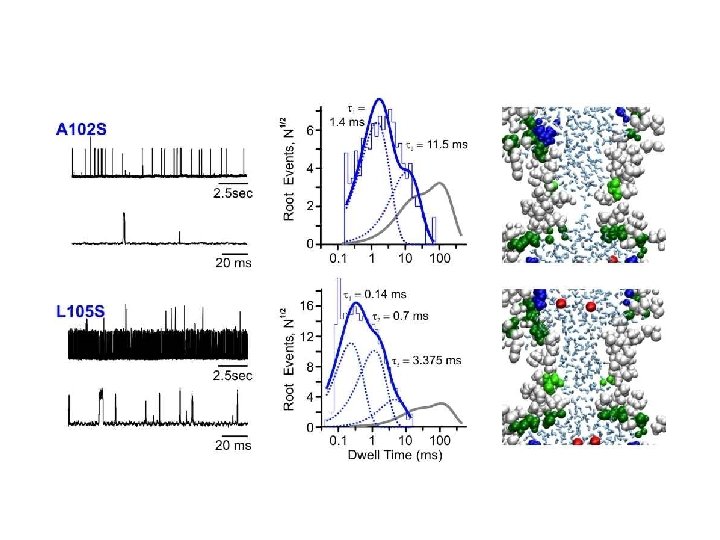
Hydrophilic substitutions favor pore wetting in simulations and strongly influence the speed of transitions in experiments
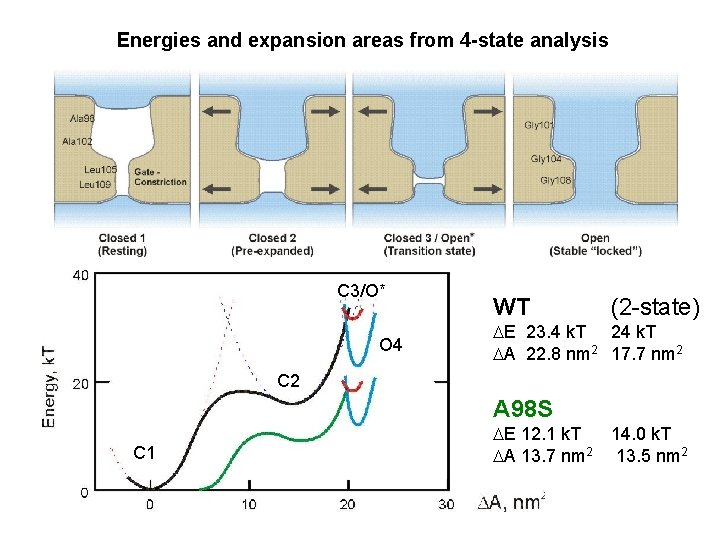
Energies and expansion areas from 4 -state analysis C 3/O* O 4 WT (2 -state) DE 23. 4 k. T 24 k. T DA 22. 8 nm 2 17. 7 nm 2 C 2 A 98 S C 1 DE 12. 1 k. T DA 13. 7 nm 2 14. 0 k. T 13. 5 nm 2
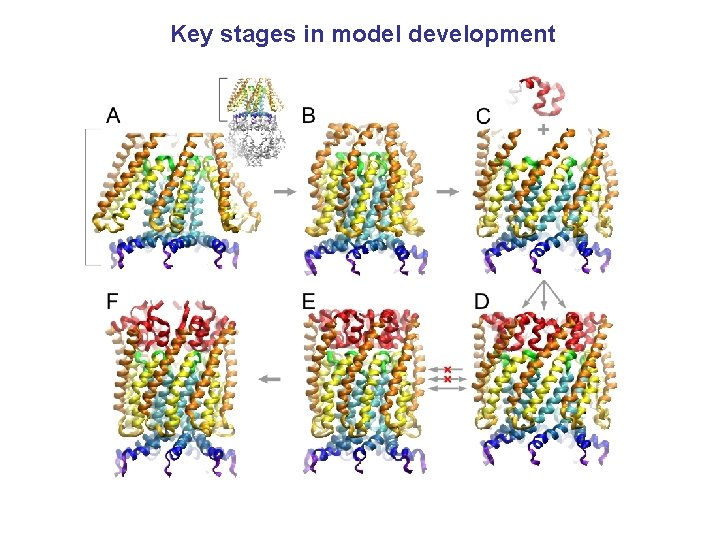
Key stages in model development
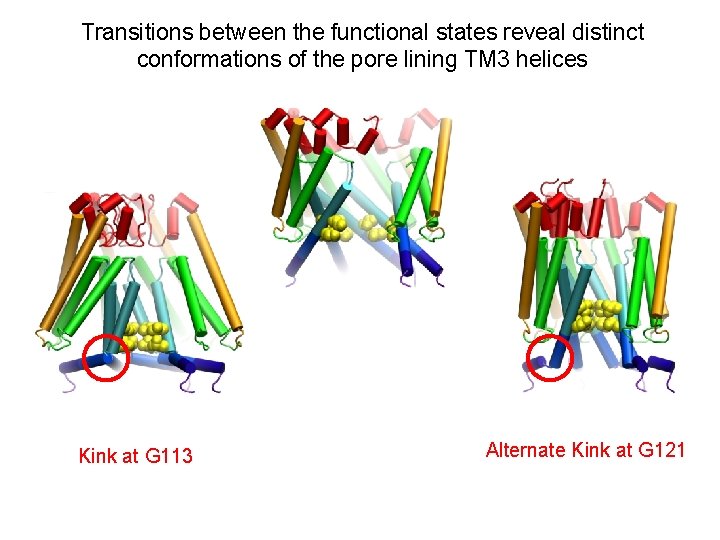
Transitions between the functional states reveal distinct conformations of the pore lining TM 3 helices Kink at G 113 Alternate Kink at G 121
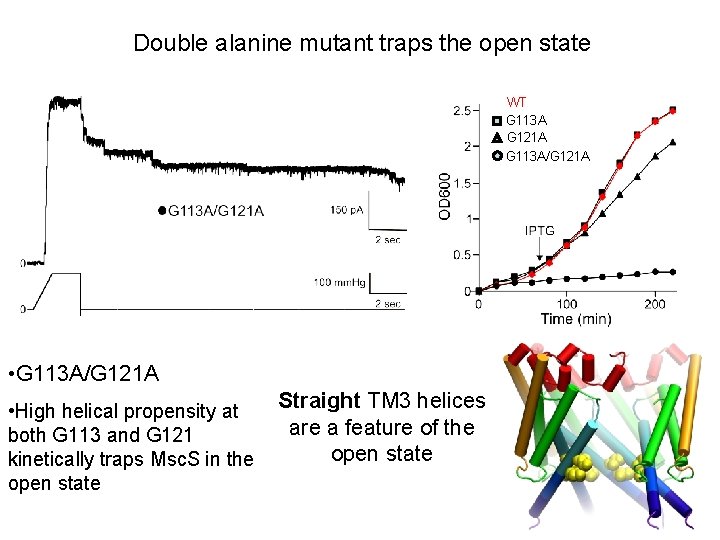
Double alanine mutant traps the open state WT G 113 A G 121 A G 113 A/G 121 A • G 113 A/G 121 A • High helical propensity at both G 113 and G 121 kinetically traps Msc. S in the open state Straight TM 3 helices are a feature of the open state
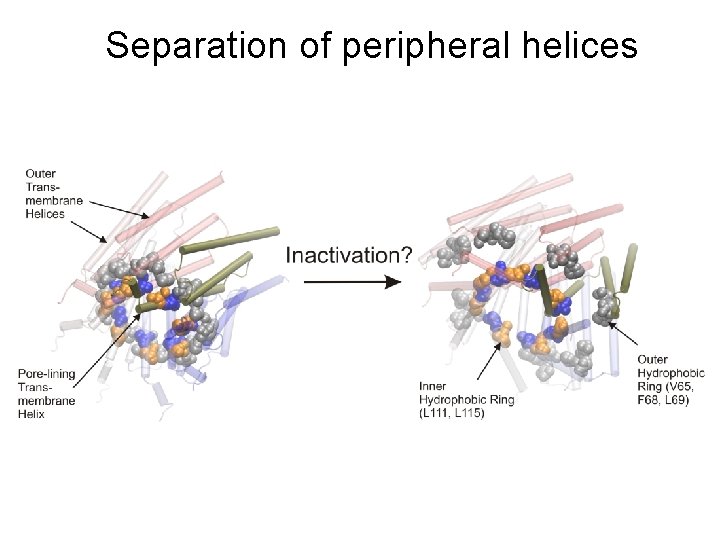
Separation of peripheral helices
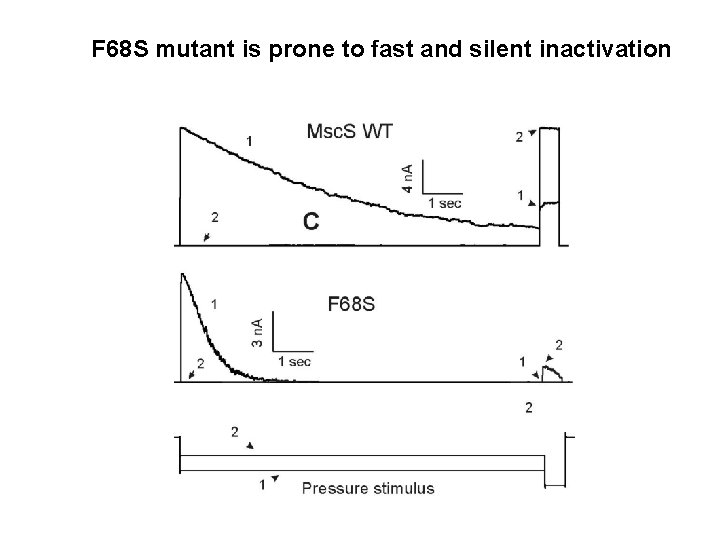
F 68 S mutant is prone to fast and silent inactivation