Lecture 11 Regional Economic Integration 1 Outline A


- Slides: 25
Lecture 11 Regional Economic Integration 1
Outline A. B. C. D. E. F. G. H. Introduction Level of Economic Integration The Case for Regional Integration Impediments to Integration European Union (EU) Regional Economic Integration in the America Regional Economic Integration in Asia Managerial Implications 2
A. Introduction p Regional Economic Integration n n Agreements among countries in a geographical region to reduce, and ultimately remove, tariff and non-tariff barriers to the free flow of goods, services, and factors of production among each other Examples: EU (European Union) p NAFTA (North American Free Trade Agreement) p APEC (Asia Pacific Economic Cooperation) p n Regional economic integration: good or bad? 3
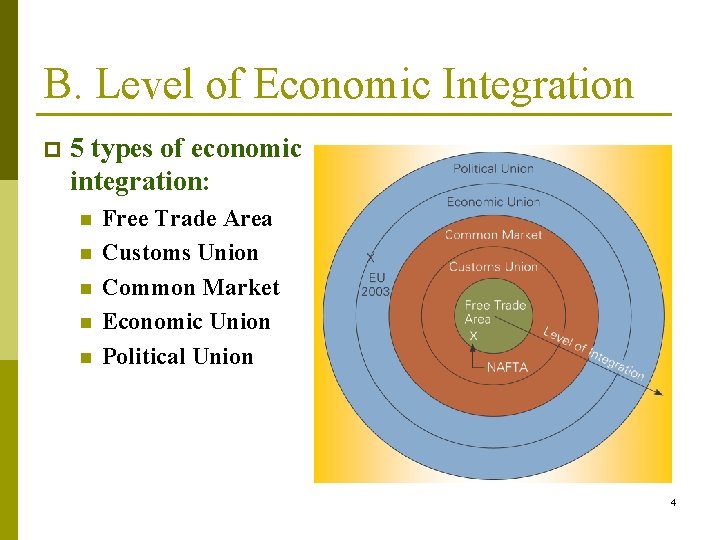
B. Level of Economic Integration p 5 types of economic integration: n n n Free Trade Area Customs Union Common Market Economic Union Political Union 4
B. Level of Economic Integration p Free Trade Area n n p All barriers to the trade of goods and services among members are removed Each member country can determine its own trade policies with regard to non-member countries Examples n EFTA (European Free Trade Association) p n Includes Iceland, Liechtenstein, Norway and Switzerland NAFTA (North American Free Trade Agreement) p Includes US, Canada and Mexico 5
B. Level of Economic Integration p Customs Union n Eliminates trade barriers between members Adopts a common external trade policy Example: Andean Community Includes Bolivia, Colombia, Ecuador, Peru and Venezuela p Establishes free trade among member countries and imposes a common external tariff (5%-20%) on products imported from outside p 6
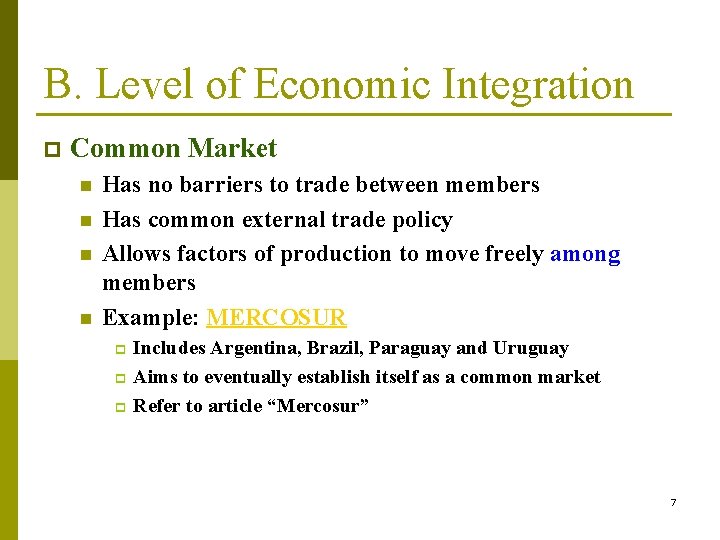
B. Level of Economic Integration p Common Market n n Has no barriers to trade between members Has common external trade policy Allows factors of production to move freely among members Example: MERCOSUR Includes Argentina, Brazil, Paraguay and Uruguay p Aims to eventually establish itself as a common market p Refer to article “Mercosur” p 7
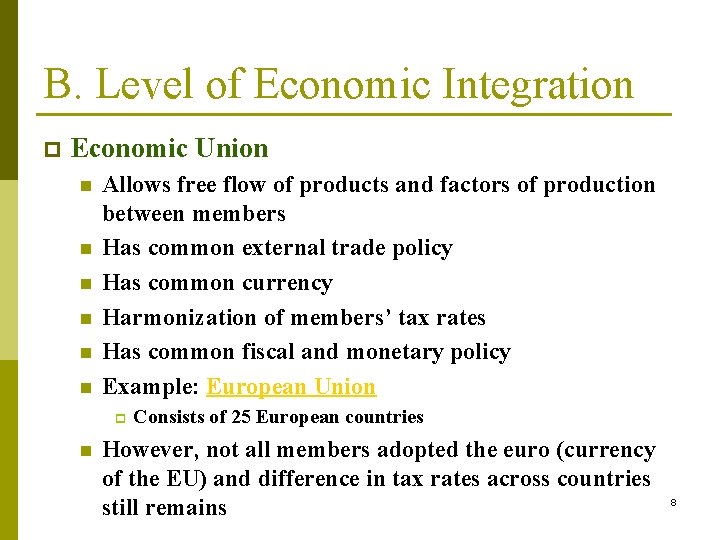
B. Level of Economic Integration p Economic Union n n n Allows free flow of products and factors of production between members Has common external trade policy Has common currency Harmonization of members’ tax rates Has common fiscal and monetary policy Example: European Union p n Consists of 25 European countries However, not all members adopted the euro (currency of the EU) and difference in tax rates across countries still remains 8
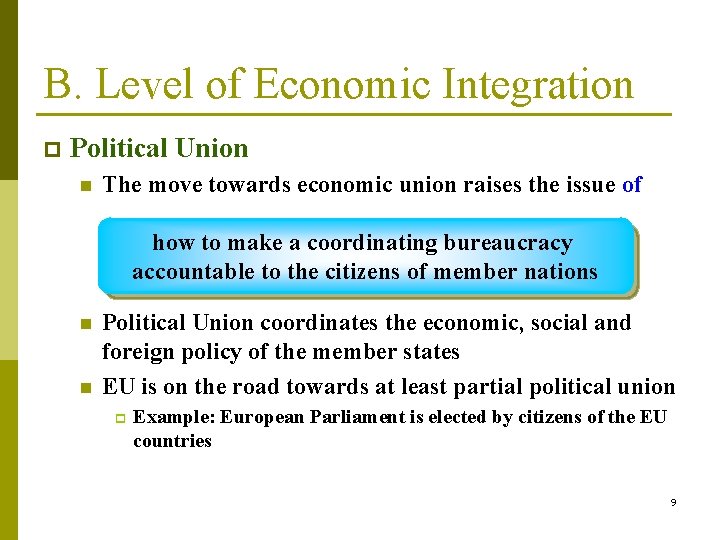
B. Level of Economic Integration p Political Union n The move towards economic union raises the issue of how to make a coordinating bureaucracy accountable to the citizens of member nations n n Political Union coordinates the economic, social and foreign policy of the member states EU is on the road towards at least partial political union p Example: European Parliament is elected by citizens of the EU countries 9
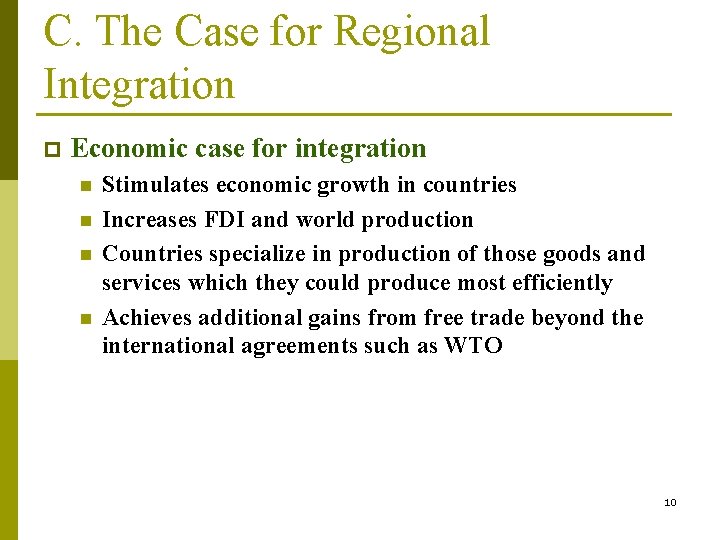
C. The Case for Regional Integration p Economic case for integration n n Stimulates economic growth in countries Increases FDI and world production Countries specialize in production of those goods and services which they could produce most efficiently Achieves additional gains from free trade beyond the international agreements such as WTO 10
C. The Case for Regional Integration p Political case for integration n n Economic interdependence creates incentives for political cooperation reduces potential for violent confrontation Example: After World War II, the European nation-states were no longer large enough to hold their own in world markets and world politics p An united Europe was needed to deal with the United States and the politically alien Soviet Union p The European Community (EC) was established (The forerunner of the EU) p 11
D. Impediments to Integration p Integration is hard to achieve and sustain for 2 reasons: Nation may benefit but groups within countries may be hurt • Example: Under NAFTA, Canadian and US firms moved production to Mexico Potential loss of sovereignty and control over domestic issues • Example: Great Britain remained using its British currency instead of the euro 12
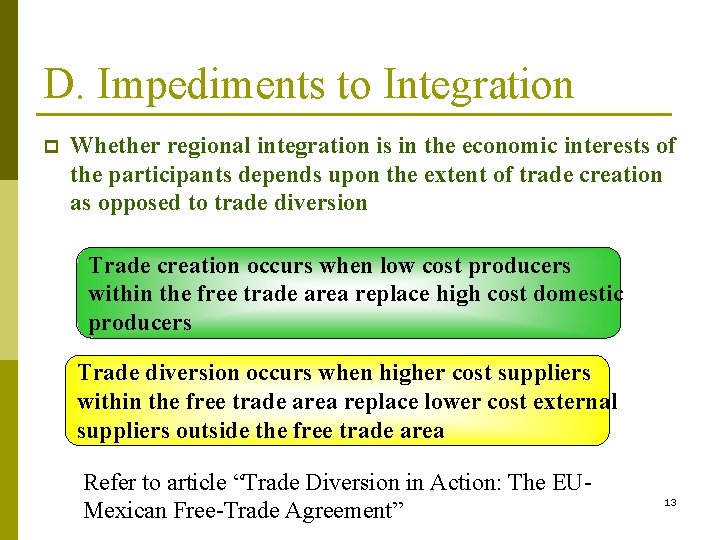
D. Impediments to Integration p Whether regional integration is in the economic interests of the participants depends upon the extent of trade creation as opposed to trade diversion Trade creation occurs when low cost producers within the free trade area replace high cost domestic producers Trade diversion occurs when higher cost suppliers within the free trade area replace lower cost external suppliers outside the free trade area Refer to article “Trade Diversion in Action: The EUMexican Free-Trade Agreement” 13
E. Regional Economic Integration in Europe p There are two trading blocks in Europe: n n p The European Union (EU) The European Free Trade Association The forerunner of the EU was the European Coal and Steel Community, which had the goal of removing barriers to trade in coal, iron, steel, and scrap metal formed in 1951 14
E. Regional Economic Integration in Europe p p After 1 st of January 2002, Euro notes and coins were issued and the national currencies were taken out of circulation Benefits of adoption of the single currency: n n n Savings (e. g. hedging costs) obtained from handling a single currency Easy to compare prices across Europe Forces improvement in efficiency and reduction of production costs Gives a strong boost to the development of highly liquid pan. European capital market The development of a pan-European euro denominated capital market increases the range of investment options open both to individuals and institutions 15
E. Regional Economic Integration in Europe p Costs: n Countries could lose control over monetary policy p n European Central Bank sets interest rates and determines monetary policy across the euro zone EU is not an “optimal currency area” because country economies are very different A common monetary policy interest rates are too high for depressed regions and too low for booming regions p Fiscal transfers from prosperous regions to depressed regions may occur p 16
E. Regional Economic Integration in Europe n A single currency should follow, not precede, political union p The Euro will unleash enormous pressures for tax harmonization and fiscal transfers. Both policies cannot be pursued without the appropriate political structure Strong Euro (2005) makes it harder for Euro zone exporters to sell their goods Examples: n n Increasing Competition in the European Automobile Market (Global Business Today: P. 303 -304) Refer to video shown in class – 21000 DVD 17
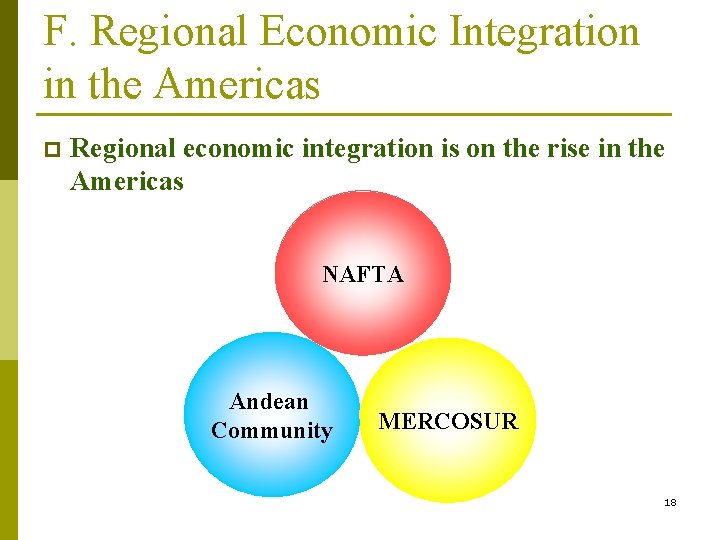
F. Regional Economic Integration in the Americas p Regional economic integration is on the rise in the Americas NAFTA Andean Community MERCOSUR 18
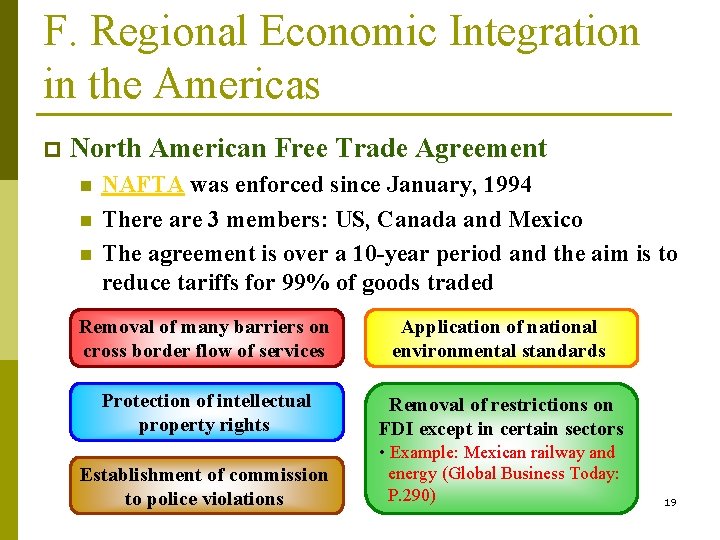
F. Regional Economic Integration in the Americas p North American Free Trade Agreement n n n NAFTA was enforced since January, 1994 There are 3 members: US, Canada and Mexico The agreement is over a 10 -year period and the aim is to reduce tariffs for 99% of goods traded Removal of many barriers on cross border flow of services Application of national environmental standards Protection of intellectual property rights Removal of restrictions on FDI except in certain sectors Establishment of commission to police violations • Example: Mexican railway and energy (Global Business Today: P. 290) 19
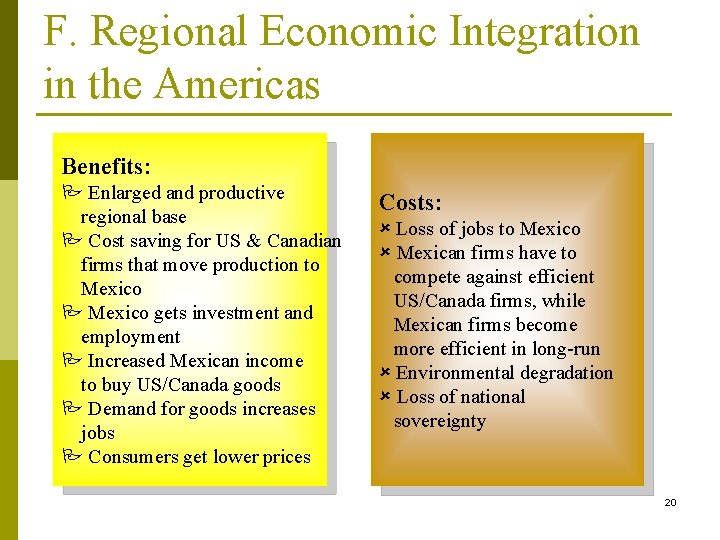
F. Regional Economic Integration in the Americas Benefits: P Enlarged and productive regional base P Cost saving for US & Canadian firms that move production to Mexico P Mexico gets investment and employment P Increased Mexican income to buy US/Canada goods P Demand for goods increases jobs P Consumers get lower prices Costs: Loss of jobs to Mexico Mexican firms have to compete against efficient US/Canada firms, while Mexican firms become more efficient in long-run Environmental degradation Loss of national sovereignty 20
F. Regional Economic Integration in the Americas p North American Free Trade Agreement n Examples: NAFTA and the U. S Textile Industry (Global Business Today: P. 278 -279) p Refer to article “Estimating Trade and Employment Effects of Trade Agreements” p p Andean Pact is the agreement between n p Bolivia, Colombia, Ecuador, Peru, Venezuela MERCOSUR is the major Latin American trade agreement between n Argentina, Brazil, Paraguay and Uruguay 21
G. Regional Economic Integration in Asia p ASEAN (Association of Southeast Asian Nations) n n Created in 1967 Aims to achieve free trade among member countries Aims to achieve cooperation in member countries’ industrial policies Consists of p n Brunei, Indonesia, Laos, Cambodia, Malaysia, the Philippines, Myanmar, Singapore, Thailand Vietnam (10 members) Refer to article “A Tango Speeds Asean Integration” 22
G. Regional Economic Integration in Asia p APEC (Asia Pacific Economic Cooperation) n n Founded in 1990 Promotes open trade and practical economic cooperation Promotes a sense of community Consists of 21 members p Australia, Brunei, Canada, Chile, People's Republic of China, Hong Kong, Indonesia, Japan, Republic of Korea, Malaysia, Mexico, New Zealand, Papua New Guinea, Peru, Philippines, Russia, Singapore, Chinese Taipei, Thailand, United States, Vietnam 23
H. Managerial Implications p Opportunities n Creation of a single market offers significant opportunities because: p n markets that were formerly protected from foreign competition are opened MNEs can benefit from the free movement of goods across borders, the harmonization of product standards, and the simplification of tax regimes by centralizing production in locations where the mix of factor costs and skills is optimal the MNEs can realize cost economies p by specialization and shipping of goods between locations a more efficient web of operations can be created p 24
H. Managerial Implications p Threats n n The business environment within each single market will become more competitive A further threat to non-EU and/or non-North American firms arises from: p n p the likely long-term improvements in the competitive position of many European and North American companies A final threat to firms outside of trading areas is the threat of being shut of the single market by the creation of a “trade fortress” Reference n Global Business Today: P. 299 -301 25