Lean Startup Method Heikki Immonen Karelia University of
- Slides: 11
Lean Startup Method Heikki Immonen Karelia University of Applied Sciences Joensuu, Finland 28. 2. 2018
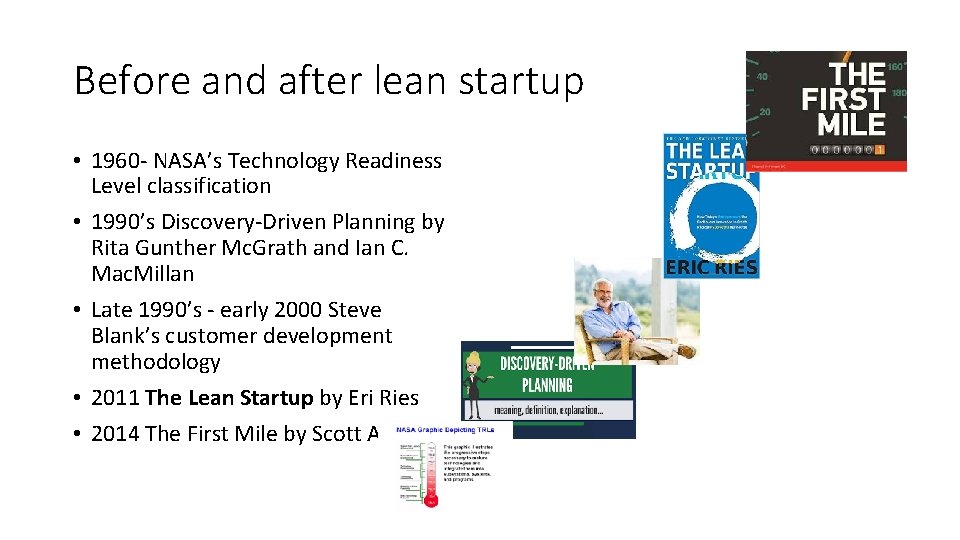
Before and after lean startup • 1960 - NASA’s Technology Readiness Level classification • 1990’s Discovery-Driven Planning by Rita Gunther Mc. Grath and Ian C. Mac. Millan • Late 1990’s - early 2000 Steve Blank’s customer development methodology • 2011 The Lean Startup by Eri Ries • 2014 The First Mile by Scott Anthony
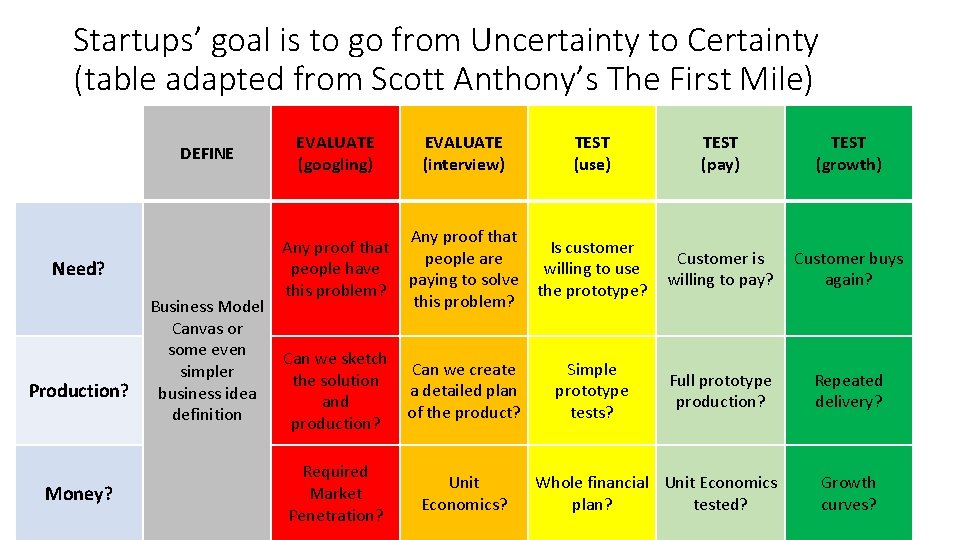
Startups’ goal is to go from Uncertainty to Certainty (table adapted from Scott Anthony’s The First Mile) DEFINE Need? Production? Money? Business Model Canvas or some even simpler business idea definition EVALUATE (googling) EVALUATE (interview) TEST (use) TEST (pay) TEST (growth) Any proof that people have this problem? Any proof that people are paying to solve this problem? Is customer willing to use the prototype? Customer is willing to pay? Customer buys again? Can we sketch the solution and production? Can we create a detailed plan of the product? Simple prototype tests? Full prototype production? Repeated delivery? Required Market Penetration? Unit Economics? Whole financial Unit Economics plan? tested? Growth curves?
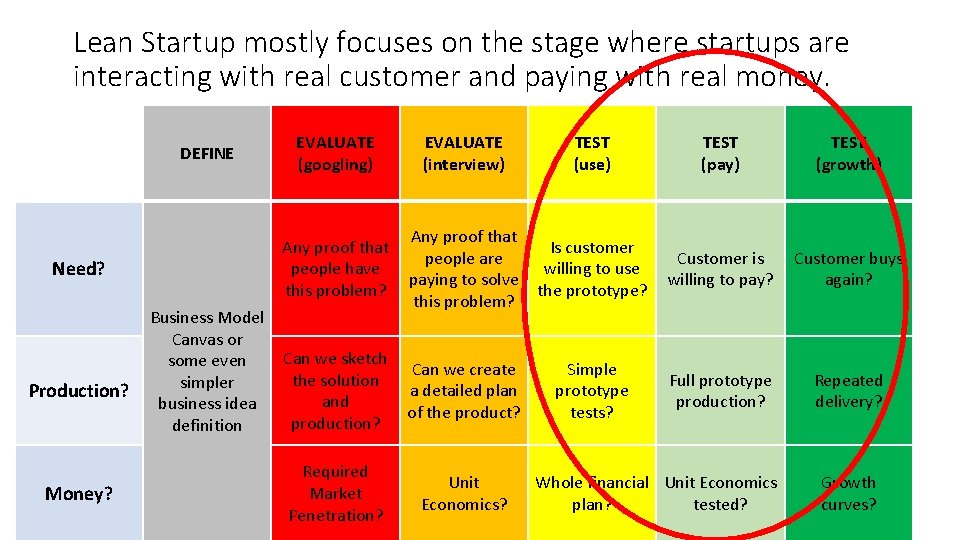
Lean Startup mostly focuses on the stage where startups are interacting with real customer and paying with real money. DEFINE Need? Production? Money? Business Model Canvas or some even simpler business idea definition EVALUATE (googling) EVALUATE (interview) TEST (use) TEST (pay) TEST (growth) Any proof that people have this problem? Any proof that people are paying to solve this problem? Is customer willing to use the prototype? Customer is willing to pay? Customer buys again? Can we sketch the solution and production? Can we create a detailed plan of the product? Simple prototype tests? Full prototype production? Repeated delivery? Required Market Penetration? Unit Economics? Whole financial Unit Economics plan? tested? Growth curves?
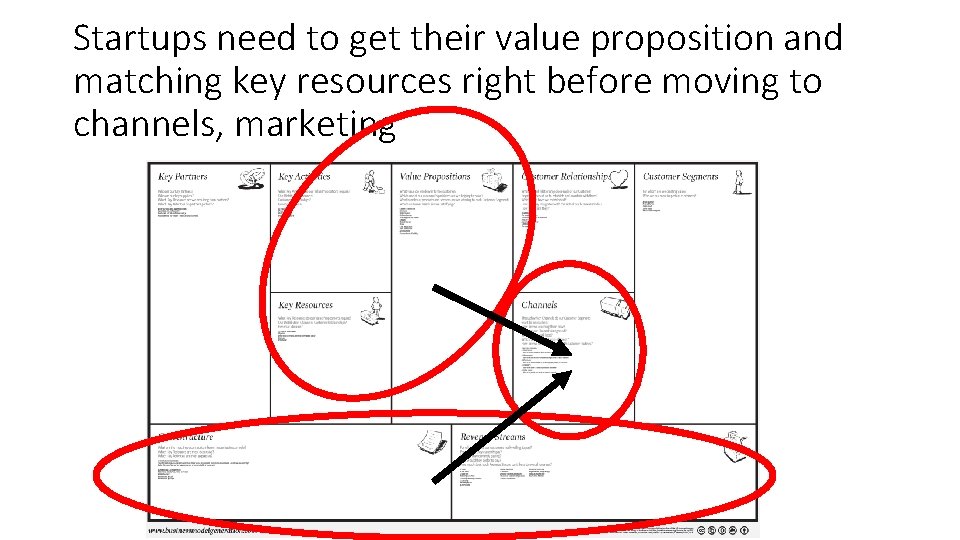
Startups need to get their value proposition and matching key resources right before moving to channels, marketing
Minimum Viable Product MVP • In order to enter the Lean Startup realm, you need to have a minimum viable product (MVP). • This is a product you can sell to your customers, but it has only the most minimal required features and quality.
List of Uncertainties • After creating the MVP you can use it to test uncertainties and ideas regarding your business idea. • For this you need to create a list of uncertainties. • From this list you choose the most critical uncertainties that you test first.
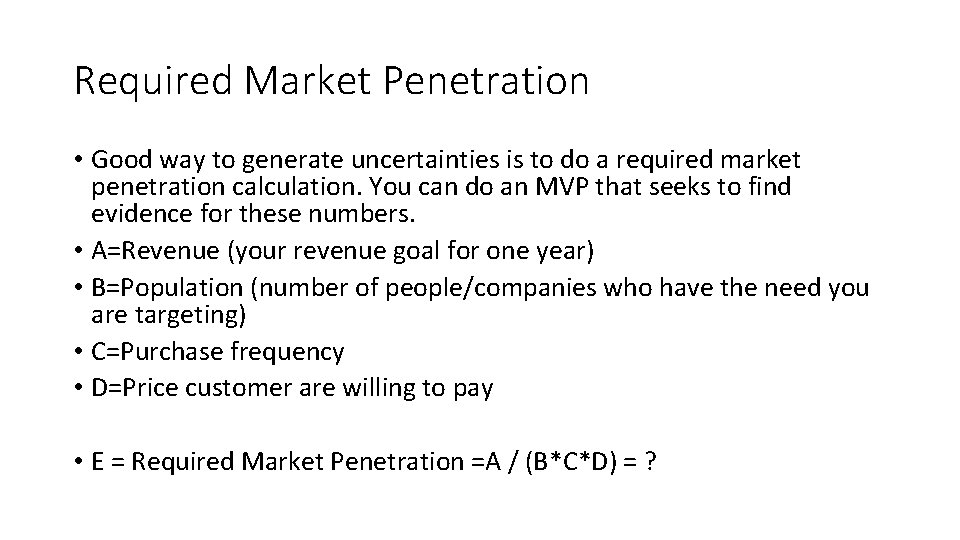
Required Market Penetration • Good way to generate uncertainties is to do a required market penetration calculation. You can do an MVP that seeks to find evidence for these numbers. • A=Revenue (your revenue goal for one year) • B=Population (number of people/companies who have the need you are targeting) • C=Purchase frequency • D=Price customer are willing to pay • E = Required Market Penetration =A / (B*C*D) = ?
Pivot • If you reach a point in your testing that the core ideas about your business are not working, you need to pivot. • Pivot means a major change in your business idea.
Growth • If you are able to establish that people are really willing to pay for your product, next you need to discover a profitable way to scale and grow your business.
Innovation accounting • Lean Startup emphasizes that you do your tests with customers rigorously so that you have statistically significant results. • One technique is to do split tests, which means that you randomly offer two different versions (A and B) of your product to potential customers and see, which version produces better results. • After this test, you take the more successful version as basis and generate a new version, which you think will perform better. Thus you will have another split test and so. • As long as your performance numbers are growing fast enough, you are on the right track.