Language Translation Issues General Syntactic Criteria General Syntax

- Slides: 15
Language Translation Issues General Syntactic Criteria
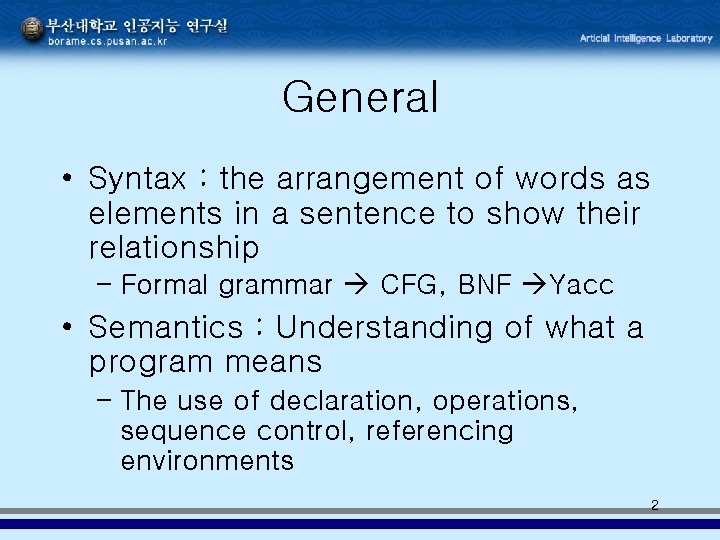
General • Syntax : the arrangement of words as elements in a sentence to show their relationship – Formal grammar CFG, BNF Yacc • Semantics : Understanding of what a program means – The use of declaration, operations, sequence control, referencing environments 2
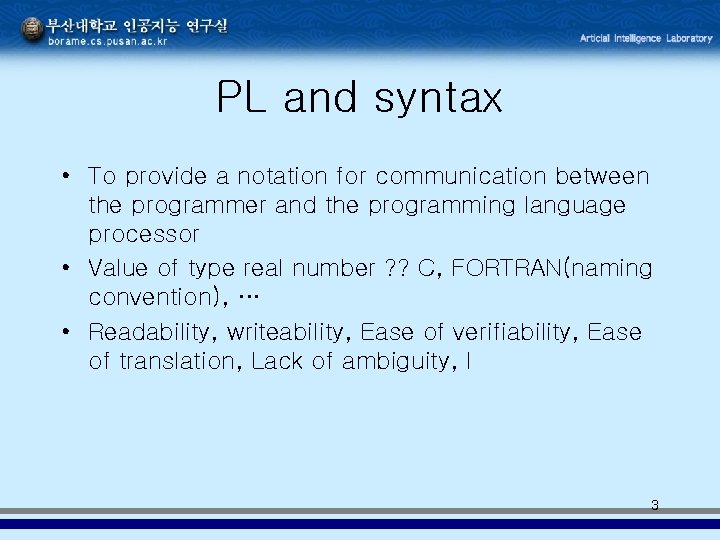
PL and syntax • To provide a notation for communication between the programmer and the programming language processor • Value of type real number ? ? C, FORTRAN(naming convention), … • Readability, writeability, Ease of verifiability, Ease of translation, Lack of ambiguity, l 3
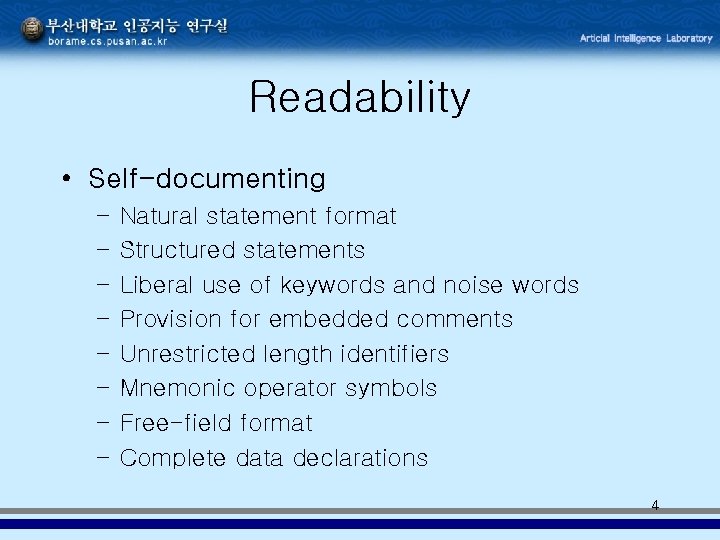
Readability • Self-documenting – – – – Natural statement format Structured statements Liberal use of keywords and noise words Provision for embedded comments Unrestricted length identifiers Mnemonic operator symbols Free-field format Complete data declarations 4
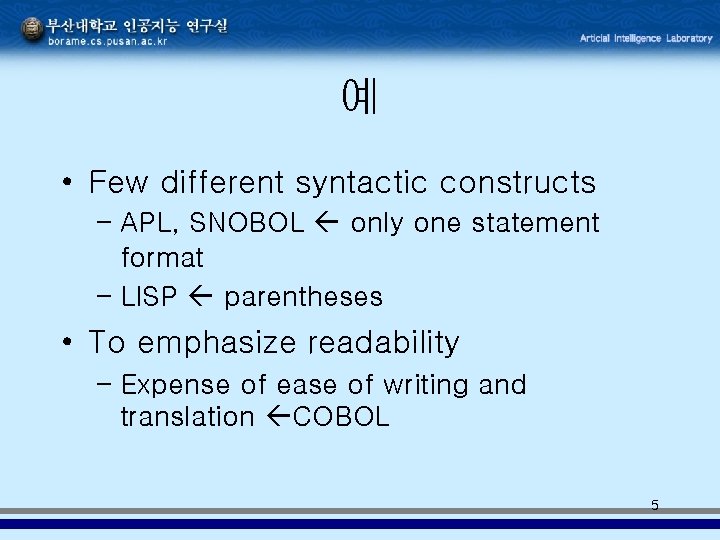
예 • Few different syntactic constructs – APL, SNOBOL only one statement format – LISP parentheses • To emphasize readability – Expense of ease of writing and translation COBOL 5
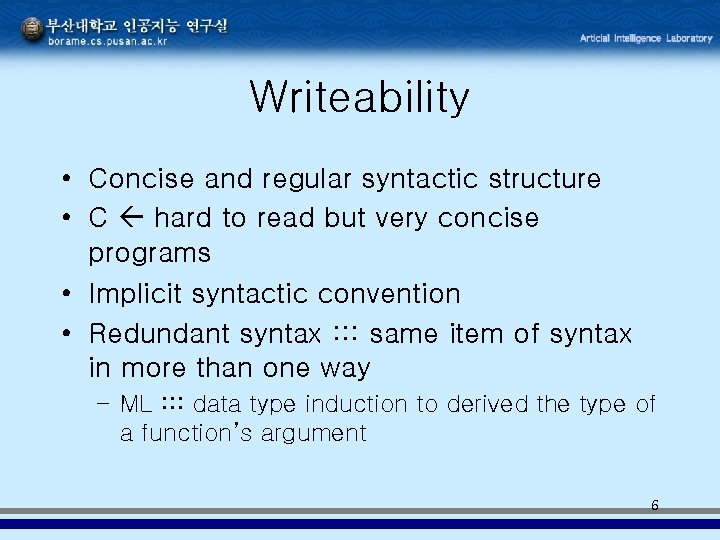
Writeability • Concise and regular syntactic structure • C hard to read but very concise programs • Implicit syntactic convention • Redundant syntax : : : same item of syntax in more than one way – ML : : : data type induction to derived the type of a function’s argument 6
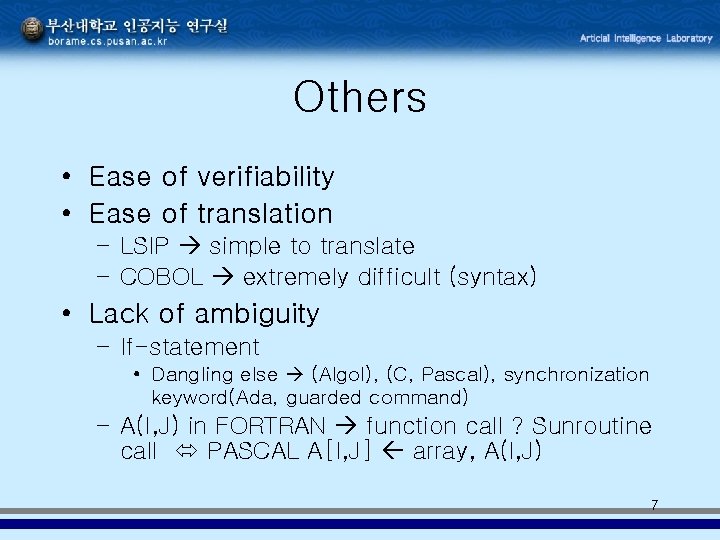
Others • Ease of verifiability • Ease of translation – LSIP simple to translate – COBOL extremely difficult (syntax) • Lack of ambiguity – If-statement • Dangling else (Algol), (C, Pascal), synchronization keyword(Ada, guarded command) – A(I, J) in FORTRAN function call ? Sunroutine call PASCAL A[I, J] array, A(I, J) 7
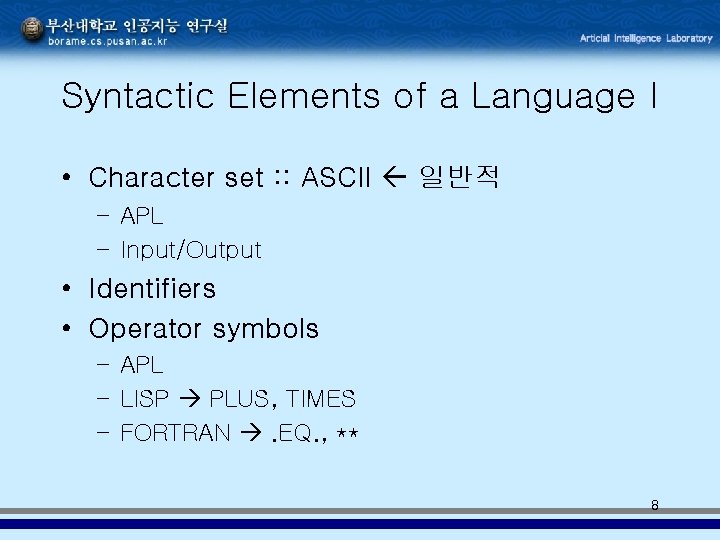
Syntactic Elements of a Language I • Character set : : ASCII 일반적 – APL – Input/Output • Identifiers • Operator symbols – APL – LISP PLUS, TIMES – FORTRAN . EQ. , ** 8
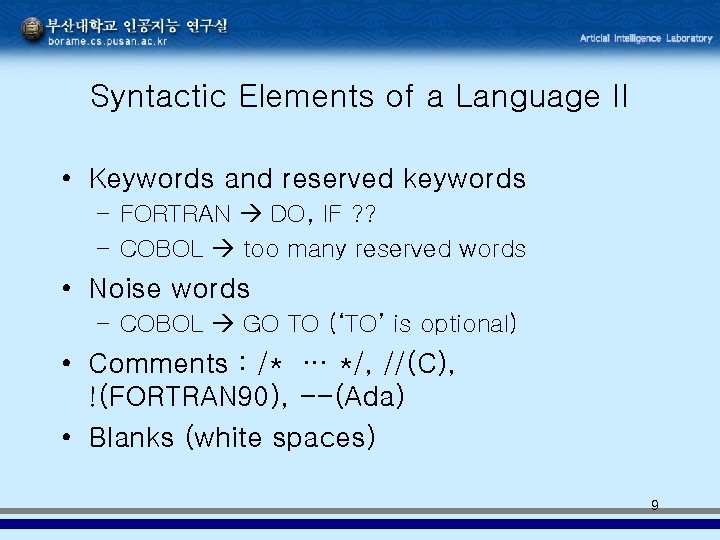
Syntactic Elements of a Language II • Keywords and reserved keywords – FORTRAN DO, IF ? ? – COBOL too many reserved words • Noise words – COBOL GO TO (‘TO’ is optional) • Comments : /* … */, //(C), !(FORTRAN 90), --(Ada) • Blanks (white spaces) 9
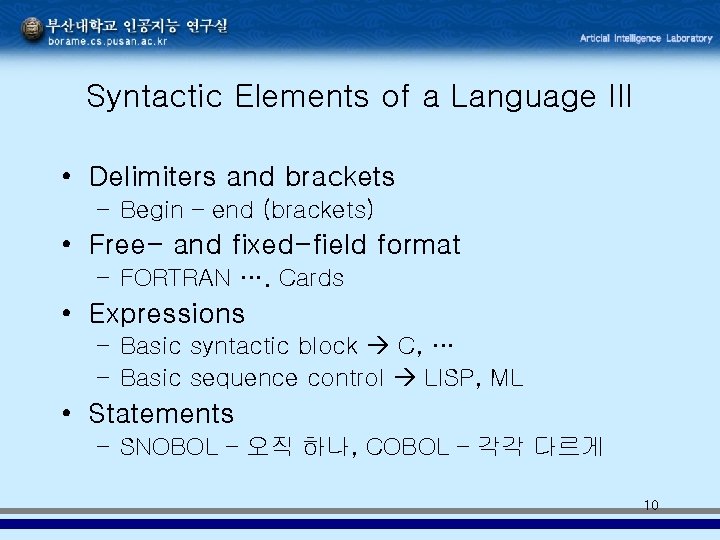
Syntactic Elements of a Language III • Delimiters and brackets – Begin – end (brackets) • Free- and fixed-field format – FORTRAN …. Cards • Expressions – Basic syntactic block C, … – Basic sequence control LISP, ML • Statements – SNOBOL – 오직 하나, COBOL – 각각 다르게 10
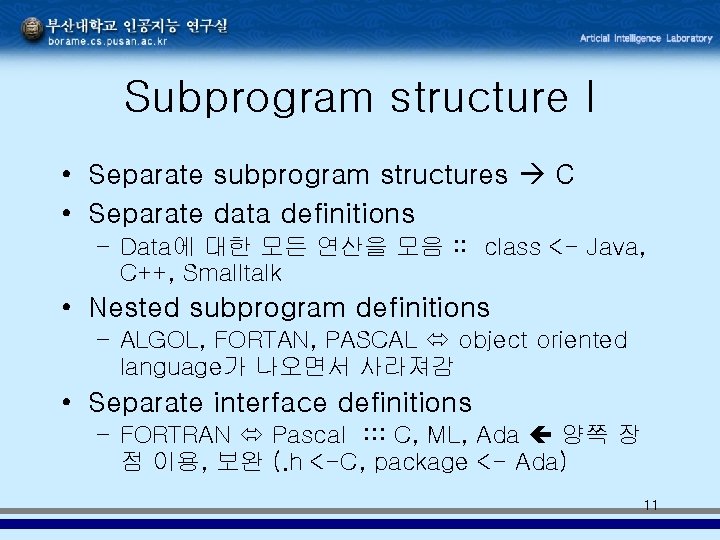
Subprogram structure I • Separate subprogram structures C • Separate data definitions – Data에 대한 모든 연산을 모음 : : class <- Java, C++, Smalltalk • Nested subprogram definitions – ALGOL, FORTAN, PASCAL object oriented language가 나오면서 사라져감 • Separate interface definitions – FORTRAN Pascal : : : C, ML, Ada 양쪽 장 점 이용, 보완 (. h <-C, package <- Ada) 11
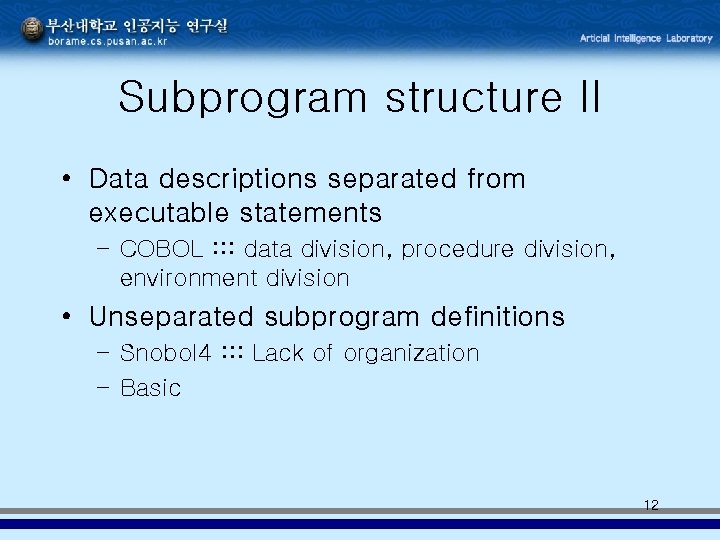
Subprogram structure II • Data descriptions separated from executable statements – COBOL : : : data division, procedure division, environment division • Unseparated subprogram definitions – Snobol 4 : : : Lack of organization – Basic 12
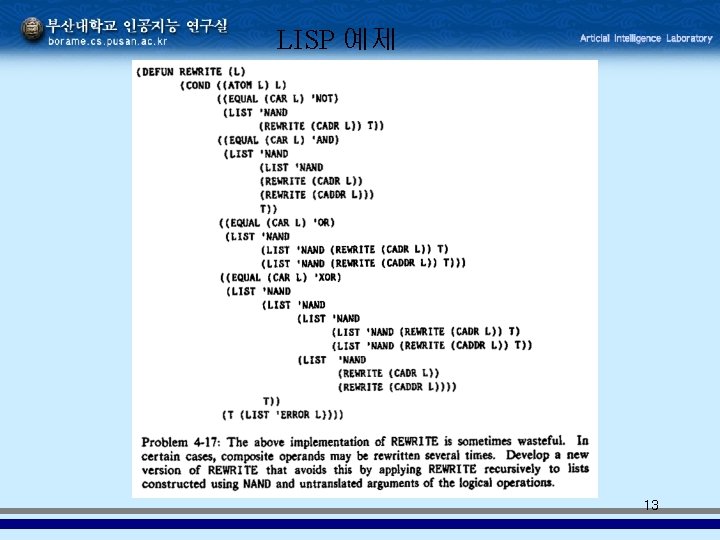
LISP 예제 13
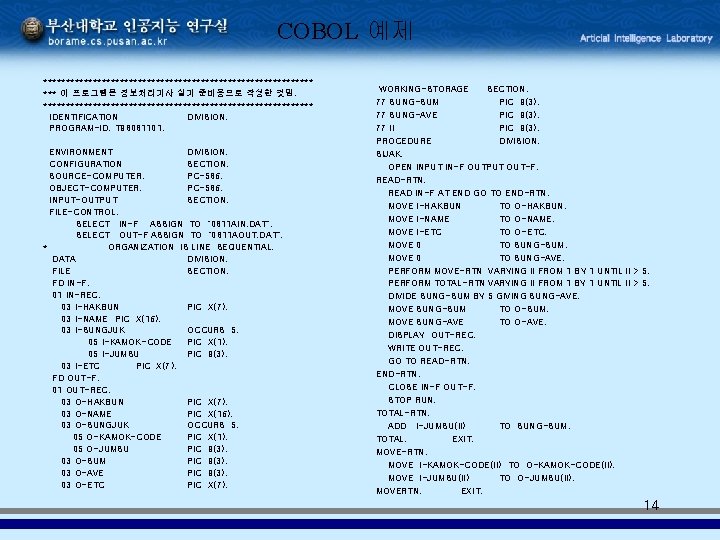
COBOL 예제 ****************************** *** 이 프로그램은 정보처리기사 실기 준비용으로 작성한 것임. ****************************** IDENTIFICATION DIVISION. PROGRAM-ID. T 98081101. ENVIRONMENT DIVISION. CONFIGURATION SECTION. SOURCE-COMPUTER. PC-586. OBJECT-COMPUTER. PC-586. INPUT-OUTPUT SECTION. FILE-CONTROL. SELECT IN-F ASSIGN TO "0811 AIN. DAT". SELECT OUT-F ASSIGN TO "0811 AOUT. DAT". * ORGANIZATION IS LINE SEQUENTIAL. DATA DIVISION. FILE SECTION. FD IN-F. 01 IN-REC. 03 I-HAKBUN PIC X(7). 03 I-NAME PIC X(16). 03 I-SUNGJUK OCCURS 5. 05 I-KAMOK-CODE PIC X(1). 05 I-JUMSU PIC 9(3). 03 I-ETC PIC X(7). FD OUT-F. 01 OUT-REC. 03 O-HAKBUN PIC X(7). 03 O-NAME PIC X(16). 03 O-SUNGJUK OCCURS 5. 05 O-KAMOK-CODE PIC X(1). 05 O-JUMSU PIC 9(3). 03 O-SUM PIC 9(3). 03 O-AVE PIC 9(3). 03 O-ETC PIC X(7). WORKING-STORAGE SECTION. 77 SUNG-SUM PIC 9(3). 77 SUNG-AVE PIC 9(3). 77 II PIC 9(3). PROCEDURE DIVISION. SIJAK. OPEN INPUT IN-F OUTPUT OUT-F. READ-RTN. READ IN-F AT END GO TO END-RTN. MOVE I-HAKBUN TO O-HAKBUN. MOVE I-NAME TO O-NAME. MOVE I-ETC TO O-ETC. MOVE 0 TO SUNG-SUM. MOVE 0 TO SUNG-AVE. PERFORM MOVE-RTN VARYING II FROM 1 BY 1 UNTIL II > 5. PERFORM TOTAL-RTN VARYING II FROM 1 BY 1 UNTIL II > 5. DIVIDE SUNG-SUM BY 5 GIVING SUNG-AVE. MOVE SUNG-SUM TO O-SUM. MOVE SUNG-AVE TO O-AVE. DISPLAY OUT-REC. WRITE OUT-REC. GO TO READ-RTN. END-RTN. CLOSE IN-F OUT-F. STOP RUN. TOTAL-RTN. ADD I-JUMSU(II) TO SUNG-SUM. TOTAL. EXIT. MOVE-RTN. MOVE I-KAMOK-CODE(II) TO O-KAMOK-CODE(II). MOVE I-JUMSU(II) TO O-JUMSU(II). MOVERTN. EXIT. 14
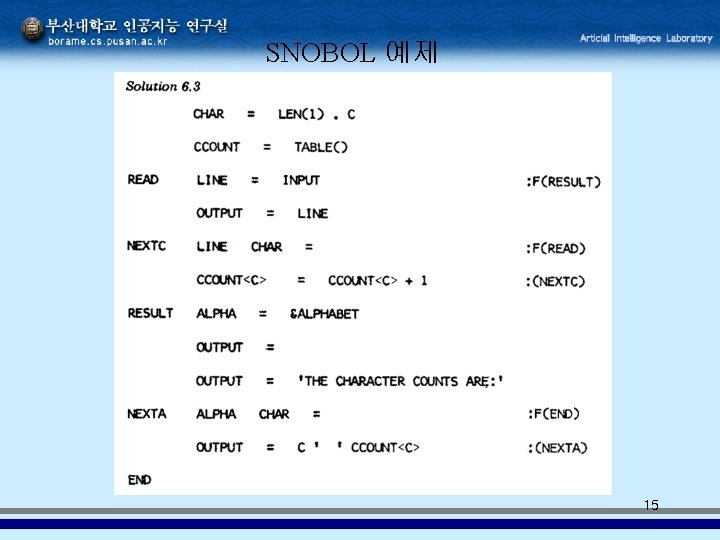
SNOBOL 예제 15