Language Arts WHY AND WHEN WE SPEAK SPANISH

- Slides: 18
Language Arts “WHY AND WHEN WE SPEAK SPANISH IN PUBLIC” BY MYIAM MARQUEZ
Quick Write/Partner Talk � Get out a sheet of paper and write your heading on it. � When you are in public and hear people around you speaking a language other than English, what is your immediate reaction? �Are you intrigued? Do you feel uncomfortable? Why?
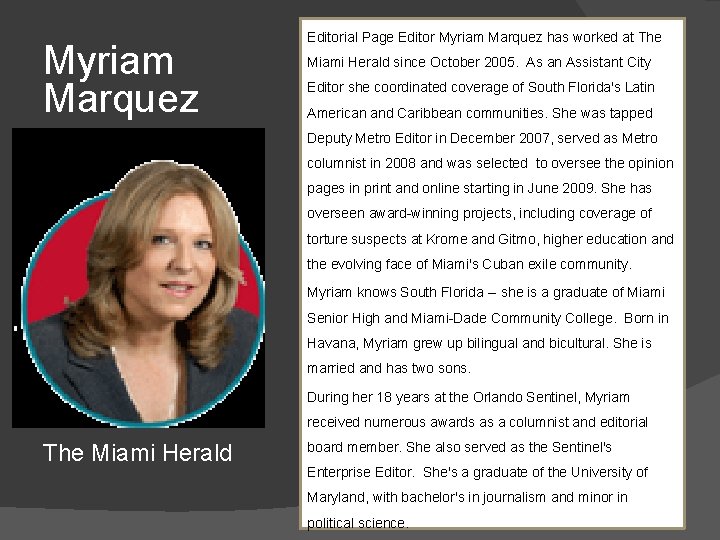
Myriam Marquez Editorial Page Editor Myriam Marquez has worked at The Miami Herald since October 2005. As an Assistant City Editor she coordinated coverage of South Florida's Latin American and Caribbean communities. She was tapped Deputy Metro Editor in December 2007, served as Metro columnist in 2008 and was selected to oversee the opinion pages in print and online starting in June 2009. She has overseen award-winning projects, including coverage of torture suspects at Krome and Gitmo, higher education and the evolving face of Miami's Cuban exile community. Myriam knows South Florida -- she is a graduate of Miami Senior High and Miami-Dade Community College. Born in Havana, Myriam grew up bilingual and bicultural. She is married and has two sons. During her 18 years at the Orlando Sentinel, Myriam received numerous awards as a columnist and editorial The Miami Herald board member. She also served as the Sentinel's Enterprise Editor. She's a graduate of the University of Maryland, with bachelor's in journalism and minor in political science.
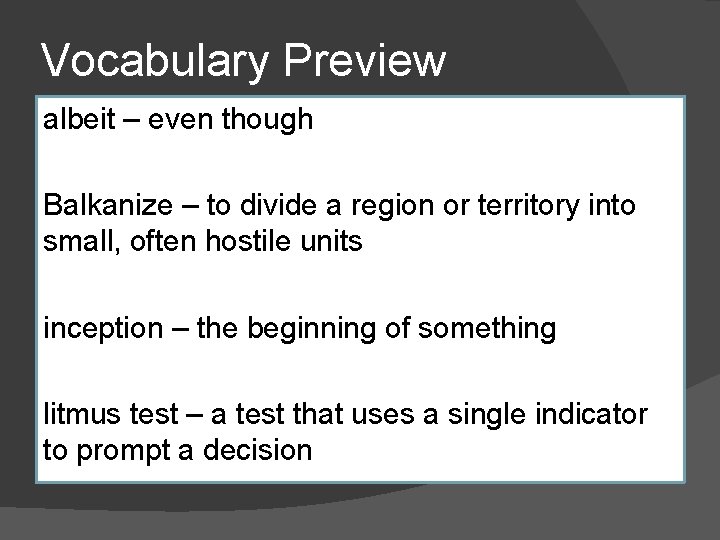
Vocabulary Preview albeit – even though Balkanize – to divide a region or territory into small, often hostile units inception – the beginning of something litmus test – a test that uses a single indicator to prompt a decision
First read- silent, independent � 1. What is the author’s purpose? � 2. What type of text is this? (Look at the chart on the wall or on the back of the red folders) � 3. Number the paragraphs (should be 14)
Paragraphs 1, 2 & 3 � Depict the scene Marquez describes by drawing a picture.
Paragraphs 4, 5 & 6 � Paraphrase these paragraphs
Paragraphs 7, 8, 9 & 10 � Circle the most important words and explain in the margin why each is important
Paragraphs 11, 12, 13, & 14 � Summarize the last 4 paragraphs.
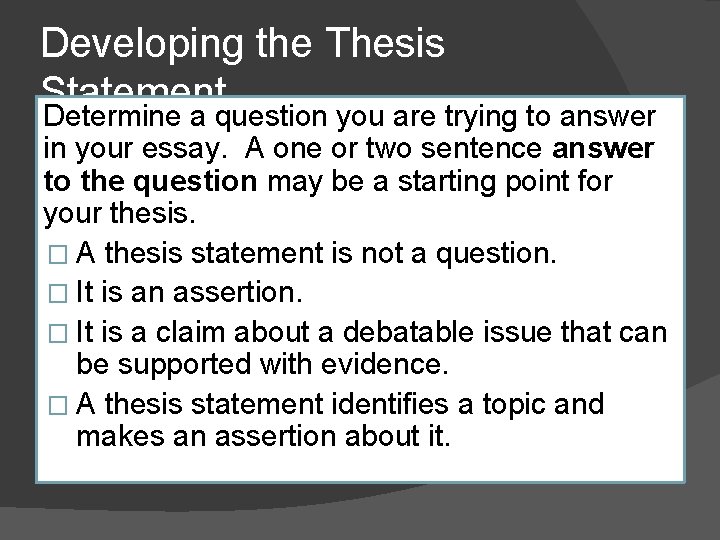
Developing the Thesis Statement Determine a question you are trying to answer in your essay. A one or two sentence answer to the question may be a starting point for your thesis. � A thesis statement is not a question. � It is an assertion. � It is a claim about a debatable issue that can be supported with evidence. � A thesis statement identifies a topic and makes an assertion about it.
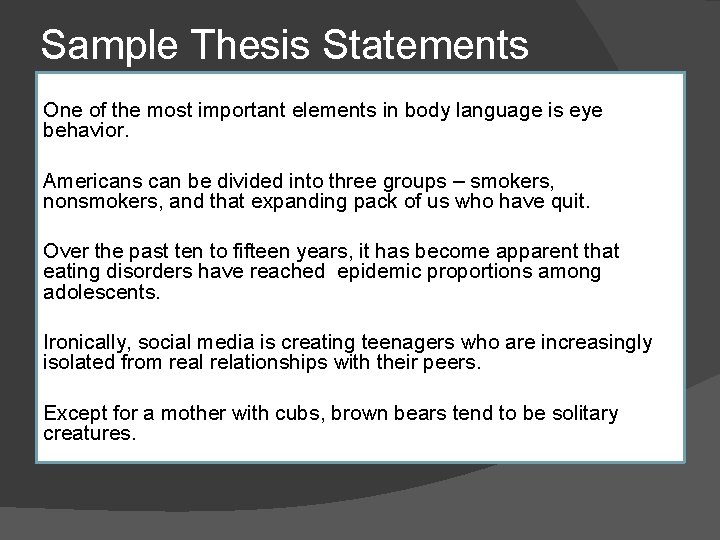
Sample Thesis Statements One of the most important elements in body language is eye behavior. Americans can be divided into three groups – smokers, nonsmokers, and that expanding pack of us who have quit. Over the past ten to fifteen years, it has become apparent that eating disorders have reached epidemic proportions among adolescents. Ironically, social media is creating teenagers who are increasingly isolated from real relationships with their peers. Except for a mother with cubs, brown bears tend to be solitary creatures.
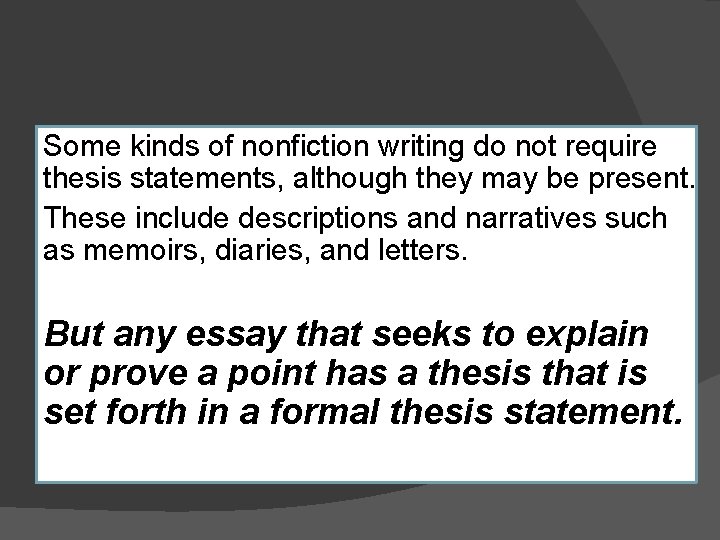
Some kinds of nonfiction writing do not require thesis statements, although they may be present. These include descriptions and narratives such as memoirs, diaries, and letters. But any essay that seeks to explain or prove a point has a thesis that is set forth in a formal thesis statement.
� 1. What is Marquez’s thesis? � 2. How does the author organize the text? (Look at text structures in the red folder)
Entire Article � Go back and look at what you wrote for the purpose of her article. Were you correct? Would you change what you wrote? � How does Marquez organize the text? �Expository notes and organizational patterns
Short Answer � Do you agree or disagree with Marquez that our patriotism should not be gauged (measured) by whether we speak English in public? �Include specific details from the essay
“Speak Up” by Janet Wong � Read the poem with a partner or small group � Discuss the poem
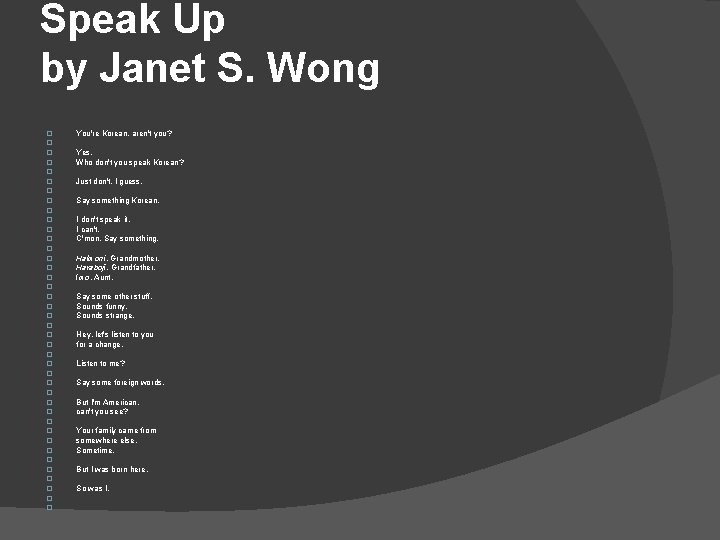
Speak Up by Janet S. Wong � � � � � � � � � � You're Korean, aren't you? Yes. Who don't you speak Korean? Just don't, I guess. Say something Korean. I don't speak it. I can't. C'mon. Say something. Halmoni. Grandmother. Haraboji. Grandfather. Imo. Aunt. Say some other stuff. Sounds funny. Sounds strange. Hey, let's listen to you for a change. Listen to me? Say some foreign words. But I'm American, can't you see? Your family came from somewhere else. Sometime. But I was born here. So was I.
“Why and When We Speak Spanish in Public” and “Speak Up” � Compare/ contrast with Venn Diagram the poem and article �Make sure you include the immigrant experience, definition of being an American and point of view of both writers