Kalman Filter 12 03 22 Thu Joon Shik
- Slides: 14
Kalman Filter 12. 03. 22. (Thu) Joon Shik Kim Computational Models of Intelligence
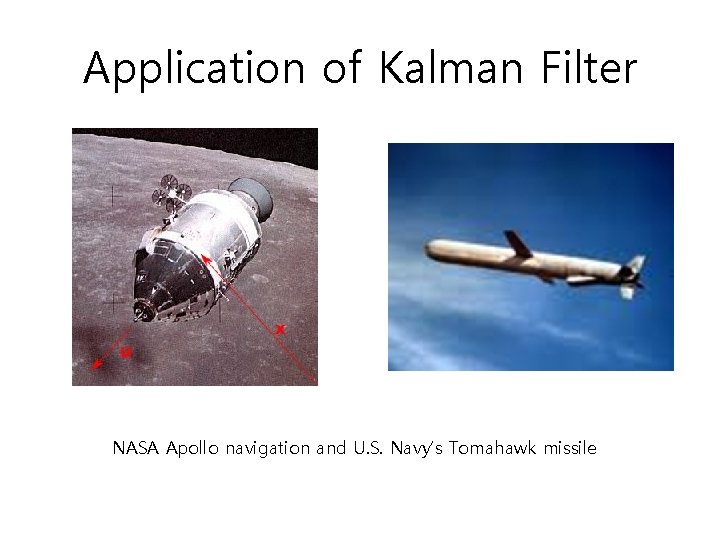
Application of Kalman Filter NASA Apollo navigation and U. S. Navy’s Tomahawk missile
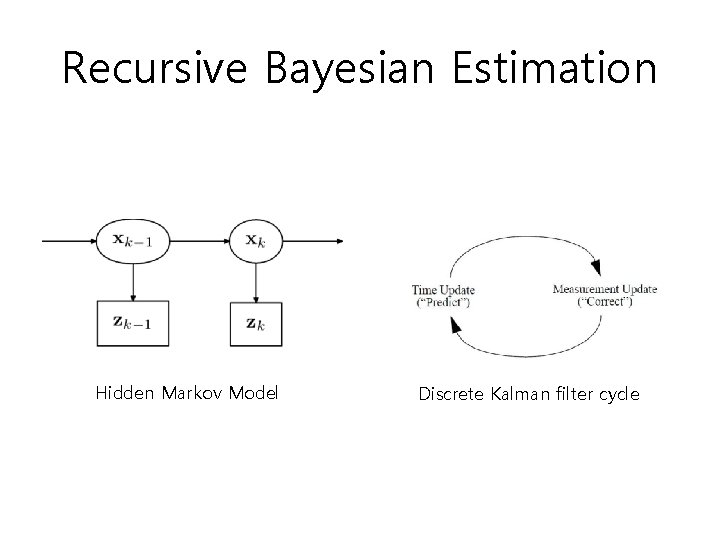
Recursive Bayesian Estimation Hidden Markov Model Discrete Kalman filter cycle
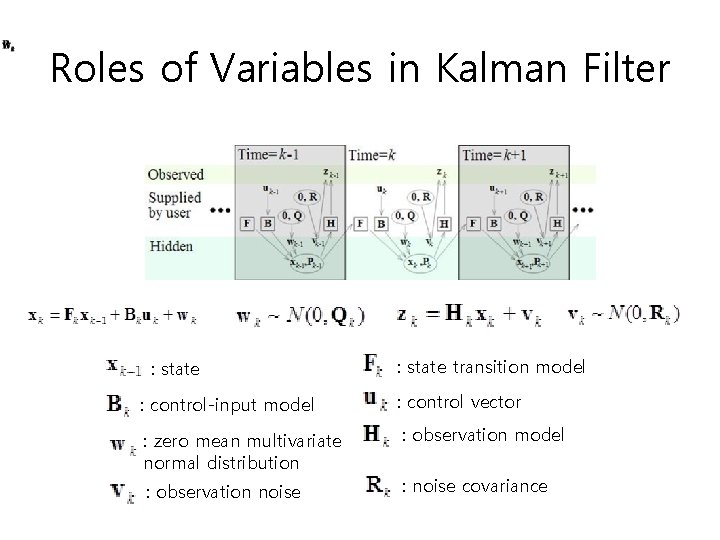
Roles of Variables in Kalman Filter : state transition model : control-input model : control vector : zero mean multivariate normal distribution : observation model : observation noise : noise covariance
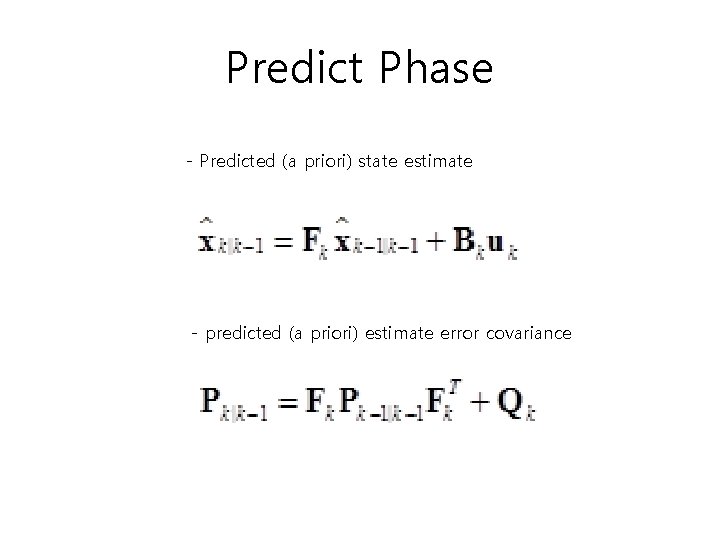
Predict Phase - Predicted (a priori) state estimate - predicted (a priori) estimate error covariance
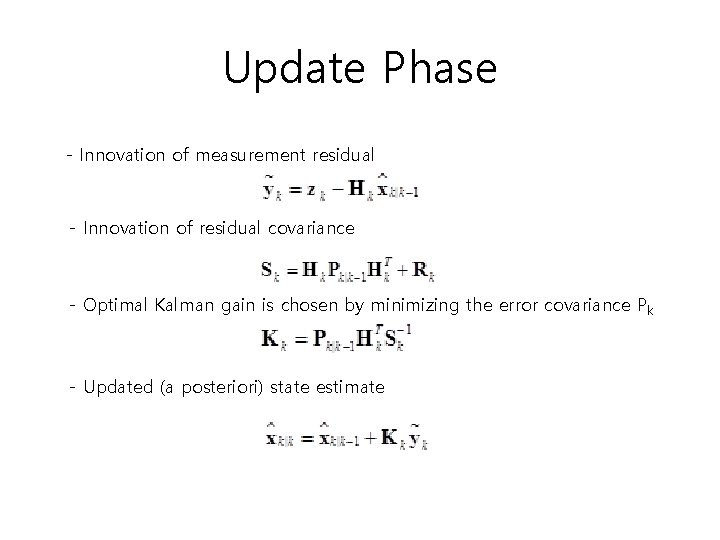
Update Phase - Innovation of measurement residual - Innovation of residual covariance - Optimal Kalman gain is chosen by minimizing the error covariance Pk - Updated (a posteriori) state estimate
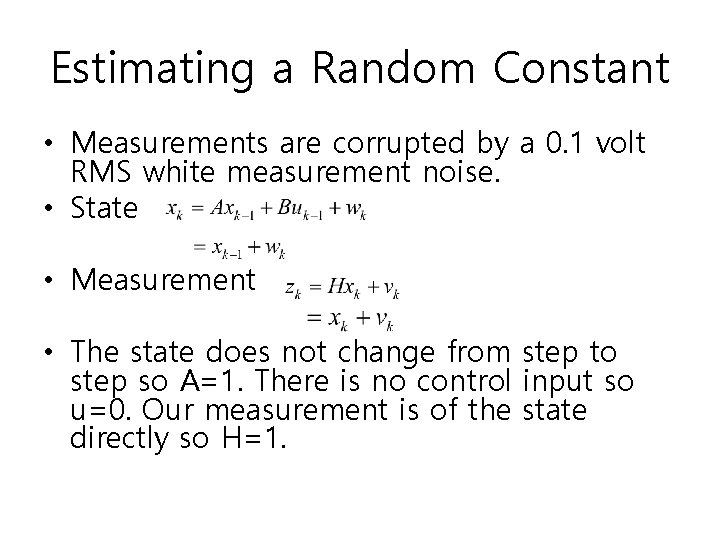
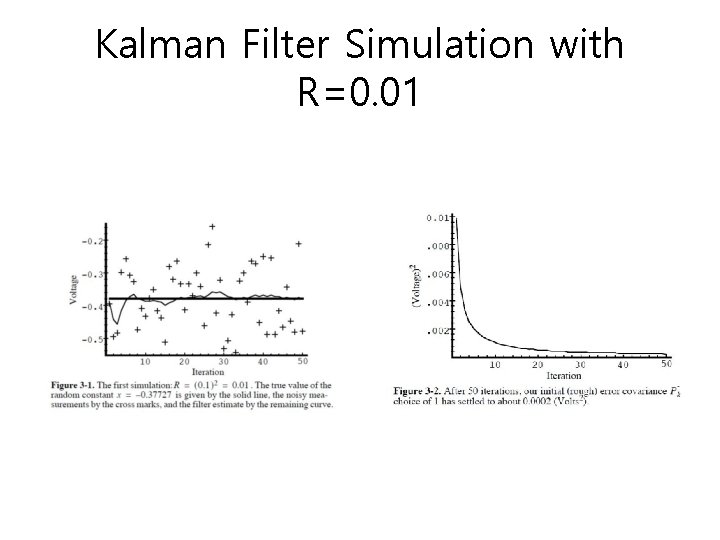
Estimating a Random Constant • Measurements are corrupted by a 0. 1 volt RMS white measurement noise. • State • Measurement • The state does not change from step to step so A=1. There is no control input so u=0. Our measurement is of the state directly so H=1.
Kalman Filter Simulation with R=0. 01
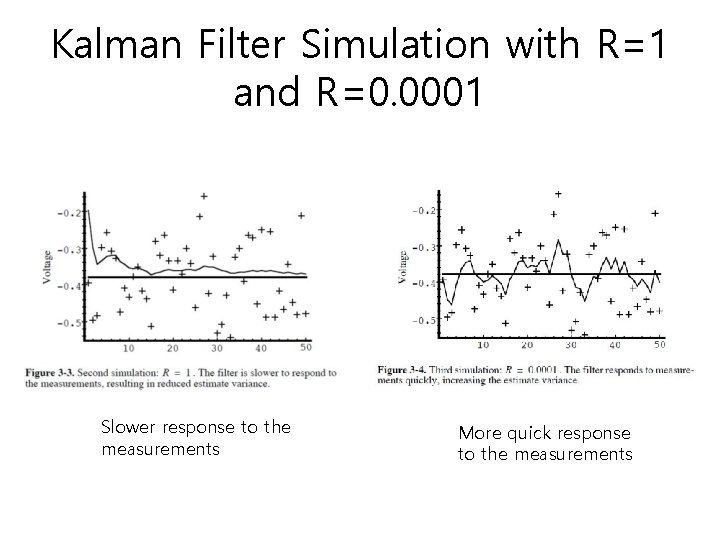
Kalman Filter Simulation with R=1 and R=0. 0001 Slower response to the measurements More quick response to the measurements
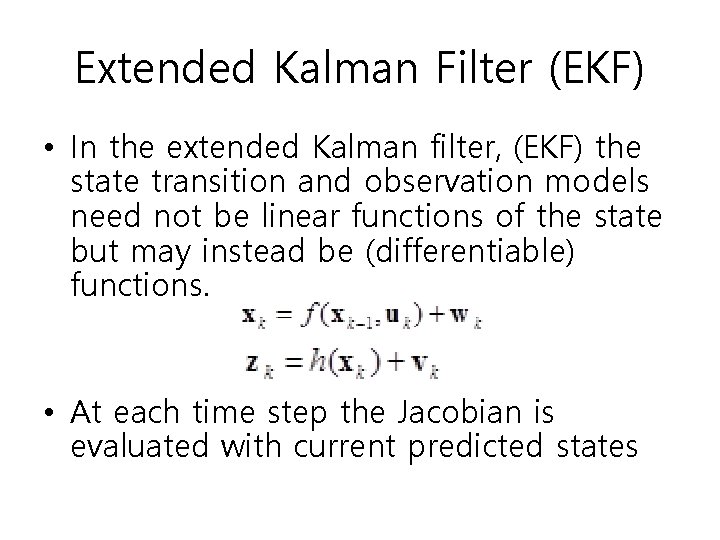
Extended Kalman Filter (EKF) • In the extended Kalman filter, (EKF) the state transition and observation models need not be linear functions of the state but may instead be (differentiable) functions. • At each time step the Jacobian is evaluated with current predicted states
Unscented Kalman filter (UKF) (1/2) • When the state transition and observation models – that is, the predict and update functions f and h– are highly non-linear, the extended Kalman filter can give particularly poor performance. This is because the covariance is propagated through linearization of the underlying non-linear model.
Unscented Kalman filter (UKF) (2/2) • The unscented Kalman filter (UKF) uses a deterministic sampling technique known as the unscented transform to pick a minimal set of sample points (called sigma points) around the mean. • The result is a filter which more accurately captures the true mean and covariance.
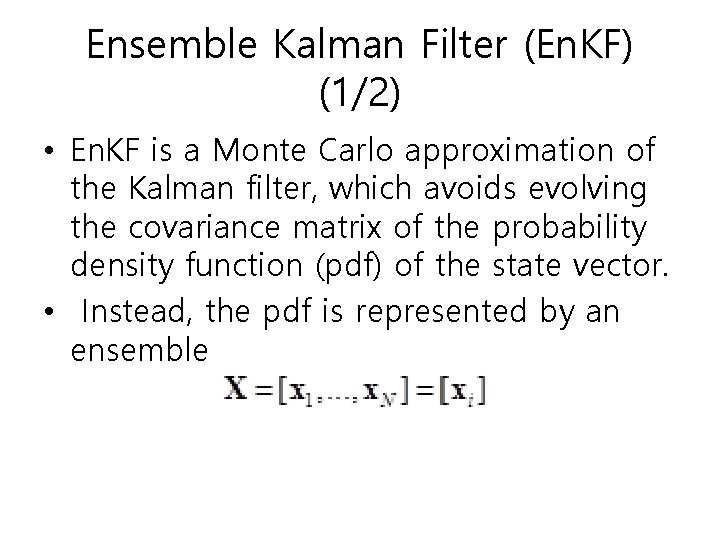
Ensemble Kalman Filter (En. KF) (1/2) • En. KF is a Monte Carlo approximation of the Kalman filter, which avoids evolving the covariance matrix of the probability density function (pdf) of the state vector. • Instead, the pdf is represented by an ensemble
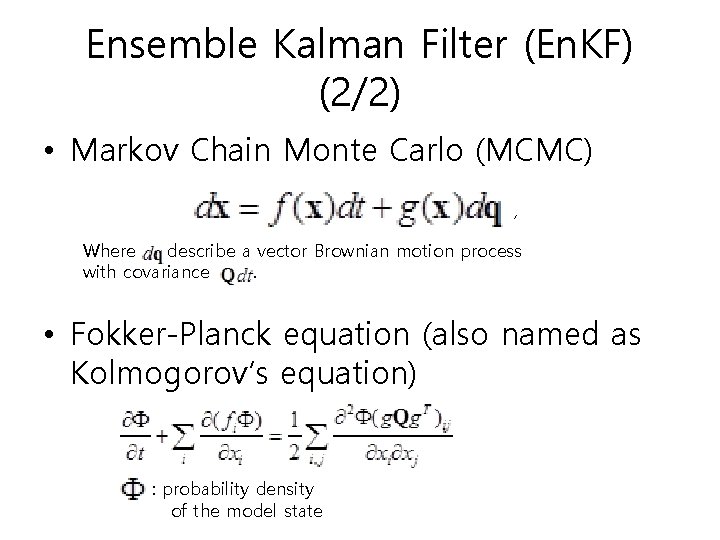
Ensemble Kalman Filter (En. KF) (2/2) • Markov Chain Monte Carlo (MCMC) , Where describe a vector Brownian motion process with covariance. • Fokker-Planck equation (also named as Kolmogorov’s equation) : probability density of the model state