July 2009 doc IEEE 802 15 09 0480
- Slides: 16
July 2009 doc. : IEEE 802. 15 -09 -0480 -02 -004 g Project: IEEE P 802. 15 Working Group for Wireless Personal Area Networks (WPANs) Submission Title: [Power and Spectrum Efficient PHY Proposal for 802. 15. 4 g] Date Submitted: [ 15 July, 2009] Source: [Khanh Tuan Le] Company [Texas Instruments] [Per Torstein Roine] Company [Texas Instruments] Address [Gaustadalleen 21, 0349 Oslo, Norway] Voice: [+47 22958535], E-Mail: [k. t. le@ti. com] Re: [] Abstract: [Power and spectrum efficient PHY proposal based on GFSK for 802. 15. 4 g. Definition of multiple channels to support FHSS and Adaptive Frequency Agility. ] Purpose: [Technical proposal. Presented to the 802. 15. 4 g SUN Task Group for consideration. ] Notice: This document has been prepared to assist the IEEE P 802. 15. It is offered as a basis for discussion and is not binding on the contributing individual(s) or organization(s). The material in this document is subject to change in form and content after further study. The contributor(s) reserve(s) the right to add, amend or withdraw material contained herein. Release: The contributor acknowledges and accepts that this contribution becomes the property of IEEE and may be made publicly available by P 802. 15. Power and Spectrum Efficient PHY Proposal for 802. 15. 4 g 1 Khanh Tuan Le (TI)
July 2009 doc. : IEEE 802. 15 -09 -0480 -02 -004 g Power and Spectrum Efficient PHY Proposal for 802. 15. 4 g IEEE 802 Plenary Meeting 15 th July 2009, San Francisco Khanh Tuan Le Power and Spectrum Efficient PHY Proposal for 802. 15. 4 g 2 Khanh Tuan Le (TI)
July 2009 doc. : IEEE 802. 15 -09 -0480 -02 -004 g Introduction • Efficient working technology with focus on the user requirements, available frequency spectrum and applicable regulations for systems operating in the license exempt frequency bands • This is an update of the submitted final proposal IEEE 802. 15 -09 -0290 -02 -004 g “Power and Spectrum Efficient PHY Proposal for 802. 15. 4 g” Power and Spectrum Efficient PHY Proposal for 802. 15. 4 g 3 Khanh Tuan Le (TI)
July 2009 doc. : IEEE 802. 15 -09 -0480 -02 -004 g Summary of the updates Power and Spectrum Efficient PHY Proposal for 802. 15. 4 g 4 Khanh Tuan Le (TI)
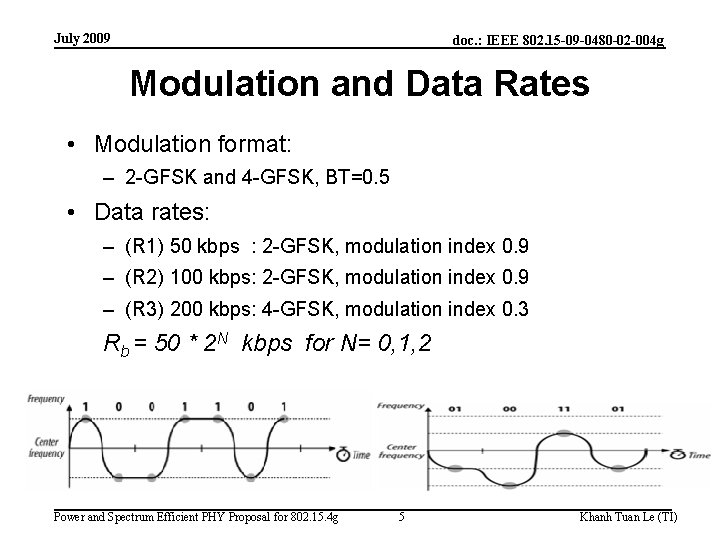
July 2009 doc. : IEEE 802. 15 -09 -0480 -02 -004 g Modulation and Data Rates • Modulation format: – 2 -GFSK and 4 -GFSK, BT=0. 5 • Data rates: – (R 1) 50 kbps : 2 -GFSK, modulation index 0. 9 – (R 2) 100 kbps: 2 -GFSK, modulation index 0. 9 – (R 3) 200 kbps: 4 -GFSK, modulation index 0. 3 Rb = 50 * 2 N kbps for N= 0, 1, 2 Power and Spectrum Efficient PHY Proposal for 802. 15. 4 g 5 Khanh Tuan Le (TI)
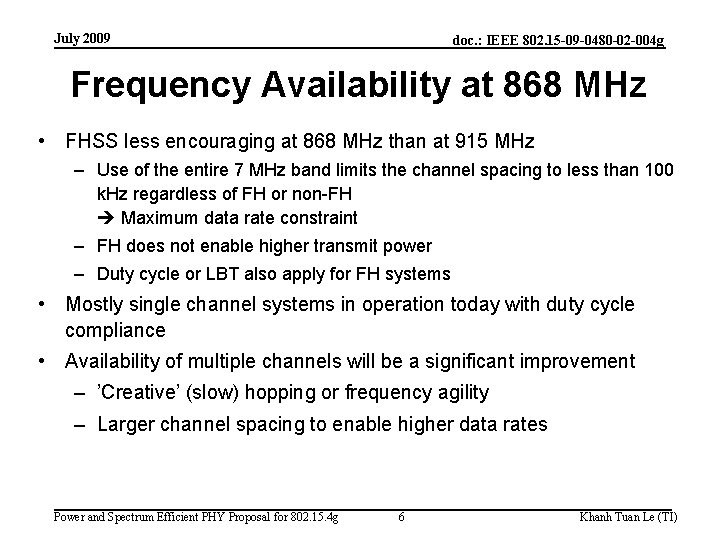
July 2009 doc. : IEEE 802. 15 -09 -0480 -02 -004 g Frequency Availability at 868 MHz • FHSS less encouraging at 868 MHz than at 915 MHz – Use of the entire 7 MHz band limits the channel spacing to less than 100 k. Hz regardless of FH or non-FH Maximum data rate constraint – FH does not enable higher transmit power – Duty cycle or LBT also apply for FH systems • Mostly single channel systems in operation today with duty cycle compliance • Availability of multiple channels will be a significant improvement – ’Creative’ (slow) hopping or frequency agility – Larger channel spacing to enable higher data rates Power and Spectrum Efficient PHY Proposal for 802. 15. 4 g 6 Khanh Tuan Le (TI)
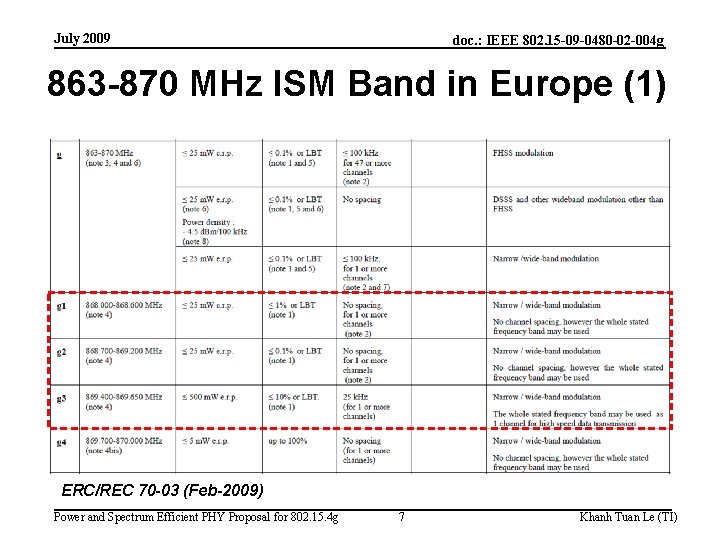
July 2009 doc. : IEEE 802. 15 -09 -0480 -02 -004 g 863 -870 MHz ISM Band in Europe (1) ERC/REC 70 -03 (Feb-2009) Power and Spectrum Efficient PHY Proposal for 802. 15. 4 g 7 Khanh Tuan Le (TI)
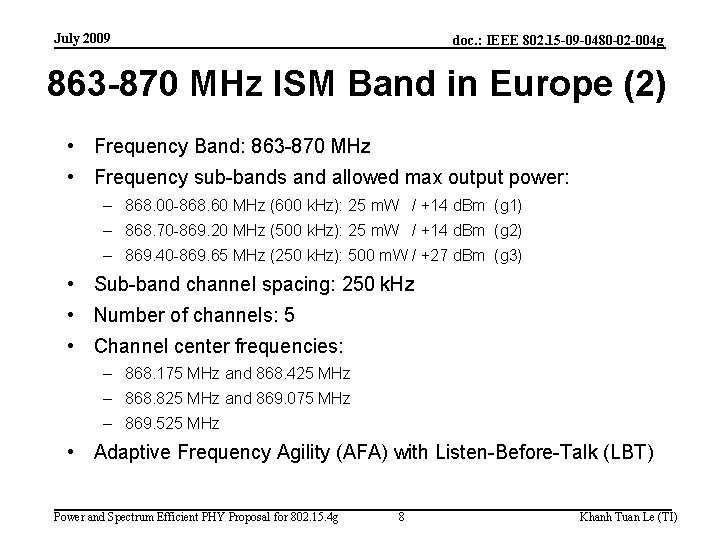
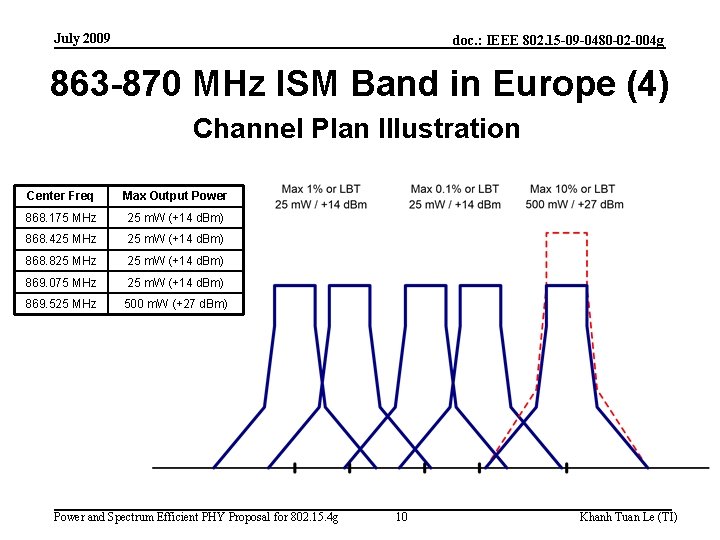
July 2009 doc. : IEEE 802. 15 -09 -0480 -02 -004 g 863 -870 MHz ISM Band in Europe (2) • Frequency Band: 863 -870 MHz • Frequency sub-bands and allowed max output power: – 868. 00 -868. 60 MHz (600 k. Hz): 25 m. W / +14 d. Bm (g 1) – 868. 70 -869. 20 MHz (500 k. Hz): 25 m. W / +14 d. Bm (g 2) – 869. 40 -869. 65 MHz (250 k. Hz): 500 m. W / +27 d. Bm (g 3) • Sub-band channel spacing: 250 k. Hz • Number of channels: 5 • Channel center frequencies: – 868. 175 MHz and 868. 425 MHz – 868. 825 MHz and 869. 075 MHz – 869. 525 MHz • Adaptive Frequency Agility (AFA) with Listen-Before-Talk (LBT) Power and Spectrum Efficient PHY Proposal for 802. 15. 4 g 8 Khanh Tuan Le (TI)
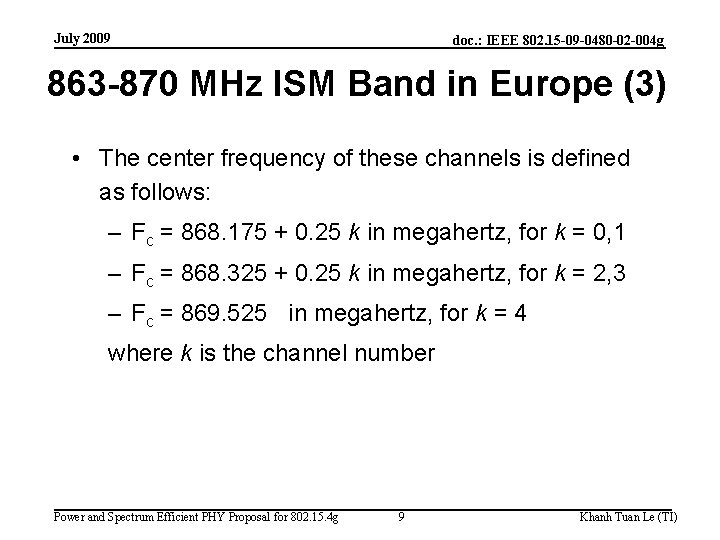
July 2009 doc. : IEEE 802. 15 -09 -0480 -02 -004 g 863 -870 MHz ISM Band in Europe (3) • The center frequency of these channels is defined as follows: – Fc = 868. 175 + 0. 25 k in megahertz, for k = 0, 1 – Fc = 868. 325 + 0. 25 k in megahertz, for k = 2, 3 – Fc = 869. 525 in megahertz, for k = 4 where k is the channel number Power and Spectrum Efficient PHY Proposal for 802. 15. 4 g 9 Khanh Tuan Le (TI)
July 2009 doc. : IEEE 802. 15 -09 -0480 -02 -004 g 863 -870 MHz ISM Band in Europe (4) Channel Plan Illustration Center Freq Max Output Power 868. 175 MHz 25 m. W (+14 d. Bm) 868. 425 MHz 25 m. W (+14 d. Bm) 868. 825 MHz 25 m. W (+14 d. Bm) 869. 075 MHz 25 m. W (+14 d. Bm) 869. 525 MHz 500 m. W (+27 d. Bm) Power and Spectrum Efficient PHY Proposal for 802. 15. 4 g 10 Khanh Tuan Le (TI)
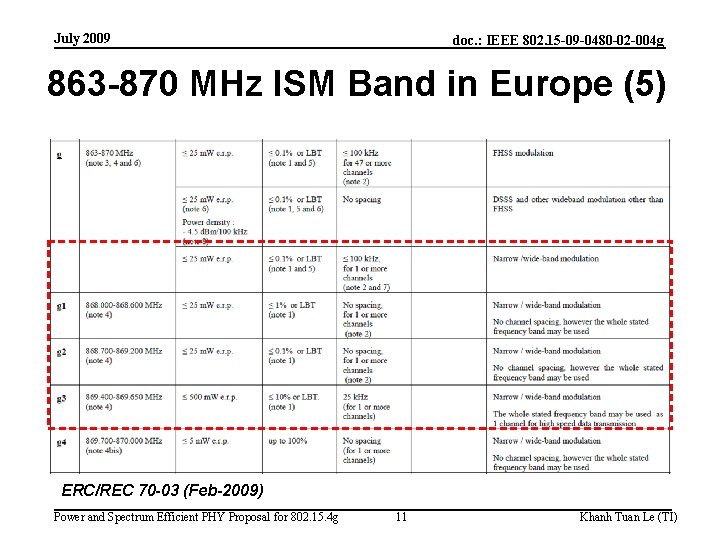
July 2009 doc. : IEEE 802. 15 -09 -0480 -02 -004 g 863 -870 MHz ISM Band in Europe (5) ERC/REC 70 -03 (Feb-2009) Power and Spectrum Efficient PHY Proposal for 802. 15. 4 g 11 Khanh Tuan Le (TI)
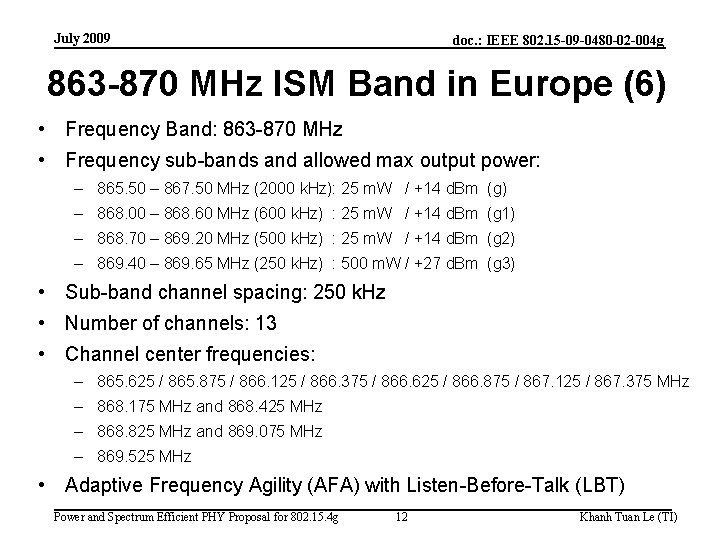
July 2009 doc. : IEEE 802. 15 -09 -0480 -02 -004 g 863 -870 MHz ISM Band in Europe (6) • Frequency Band: 863 -870 MHz • Frequency sub-bands and allowed max output power: – 865. 50 – 867. 50 MHz (2000 k. Hz): 25 m. W / +14 d. Bm (g) – 868. 00 – 868. 60 MHz (600 k. Hz) : 25 m. W / +14 d. Bm (g 1) – 868. 70 – 869. 20 MHz (500 k. Hz) : 25 m. W / +14 d. Bm (g 2) – 869. 40 – 869. 65 MHz (250 k. Hz) : 500 m. W / +27 d. Bm (g 3) • Sub-band channel spacing: 250 k. Hz • Number of channels: 13 • Channel center frequencies: – 865. 625 / 865. 875 / 866. 125 / 866. 375 / 866. 625 / 866. 875 / 867. 125 / 867. 375 MHz – 868. 175 MHz and 868. 425 MHz – 868. 825 MHz and 869. 075 MHz – 869. 525 MHz • Adaptive Frequency Agility (AFA) with Listen-Before-Talk (LBT) Power and Spectrum Efficient PHY Proposal for 802. 15. 4 g 12 Khanh Tuan Le (TI)
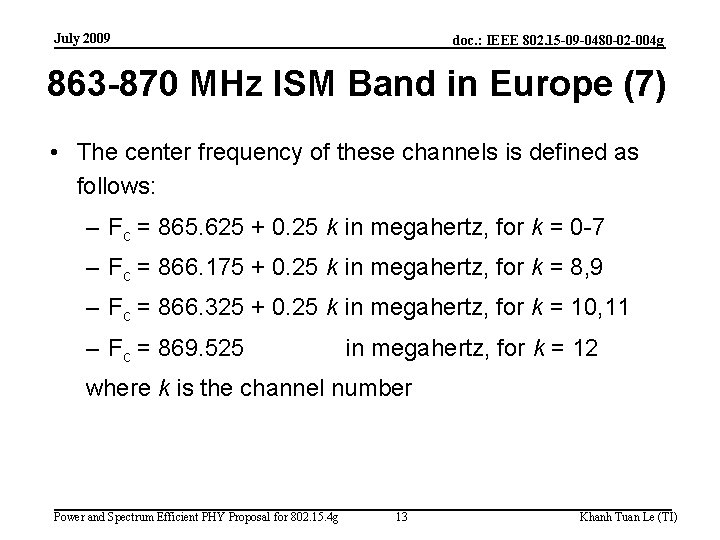
July 2009 doc. : IEEE 802. 15 -09 -0480 -02 -004 g 863 -870 MHz ISM Band in Europe (7) • The center frequency of these channels is defined as follows: – Fc = 865. 625 + 0. 25 k in megahertz, for k = 0 -7 – Fc = 866. 175 + 0. 25 k in megahertz, for k = 8, 9 – Fc = 866. 325 + 0. 25 k in megahertz, for k = 10, 11 – Fc = 869. 525 in megahertz, for k = 12 where k is the channel number Power and Spectrum Efficient PHY Proposal for 802. 15. 4 g 13 Khanh Tuan Le (TI)
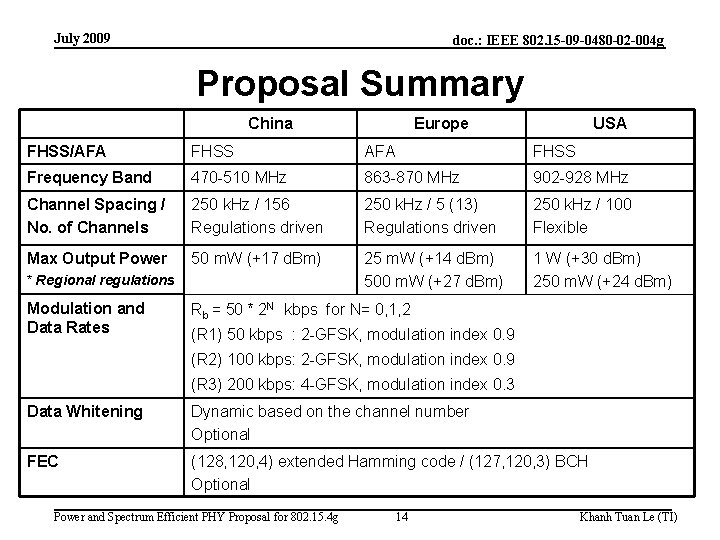
July 2009 doc. : IEEE 802. 15 -09 -0480 -02 -004 g Proposal Summary China Europe USA FHSS/AFA FHSS Frequency Band 470 -510 MHz 863 -870 MHz 902 -928 MHz Channel Spacing / No. of Channels 250 k. Hz / 156 Regulations driven 250 k. Hz / 5 (13) Regulations driven 250 k. Hz / 100 Flexible Max Output Power 50 m. W (+17 d. Bm) 25 m. W (+14 d. Bm) 500 m. W (+27 d. Bm) 1 W (+30 d. Bm) 250 m. W (+24 d. Bm) * Regional regulations Modulation and Data Rates Rb = 50 * 2 N kbps for N= 0, 1, 2 (R 1) 50 kbps : 2 -GFSK, modulation index 0. 9 (R 2) 100 kbps: 2 -GFSK, modulation index 0. 9 (R 3) 200 kbps: 4 -GFSK, modulation index 0. 3 Data Whitening Dynamic based on the channel number Optional FEC (128, 120, 4) extended Hamming code / (127, 120, 3) BCH Optional Power and Spectrum Efficient PHY Proposal for 802. 15. 4 g 14 Khanh Tuan Le (TI)
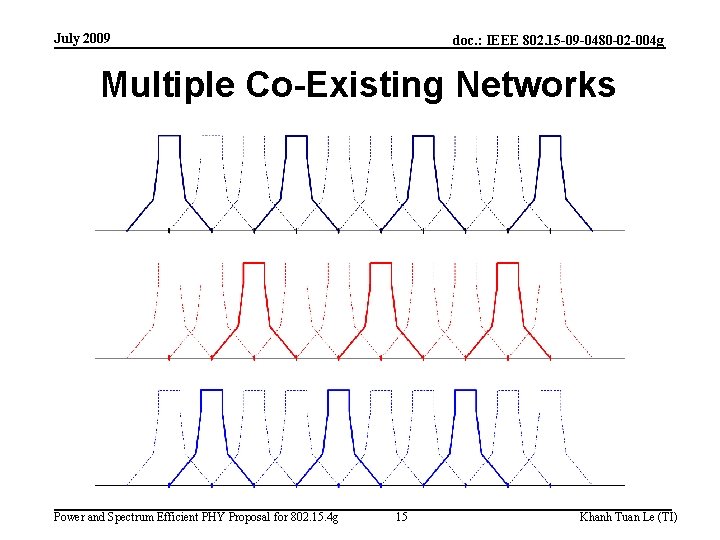
July 2009 doc. : IEEE 802. 15 -09 -0480 -02 -004 g Multiple Co-Existing Networks Power and Spectrum Efficient PHY Proposal for 802. 15. 4 g 15 Khanh Tuan Le (TI)
July 2009 doc. : IEEE 802. 15 -09 -0480 -02 -004 g Thank you! Power and Spectrum Efficient PHY Proposal for 802. 15. 4 g 16 Khanh Tuan Le (TI)