
Judging and grading of milk DEPARTMENT DAIRY TECHNOLOGY




- Slides: 13
Judging and grading of milk DEPARTMENT : DAIRY TECHNOLOGY COURSE TITLE : SENSORY EVALUATION OF DAIRY PRODUCTS COURSE NO. : DTT -321 COURSE TEACHER: BIPIN KUMAR SINGH
Judging of Milk Judging of milk refers to the evaluation of its "quality" on the basis of various attributes. Grading refers to the classification of milk into different grades. The ‘ quality' of any dairy product is determined by organoleptic/sensory tests, smell taste, touch and sound. Of these, taste and smell are the most important in judging and grading. Based on the quality as determined by the evaluation of the milk, samples could be broadly classified into two categories: acceptable and rejected. The samples which are grouped under "acceptable category" can further be differentiated in grades. This classification is based on physical characteristics such as color, smell, taste, and presence of visible foreign material in milk. The evaluator makes use of the most sensitive organs viz. eyes, nose, tongue, and hands.
Sensory Evaluation is. . . The use of all 5 senses • Taste • Smell • Sight • Touch • Hearing to gather information • conscious or unconscious • informal or formal • subjective or objective
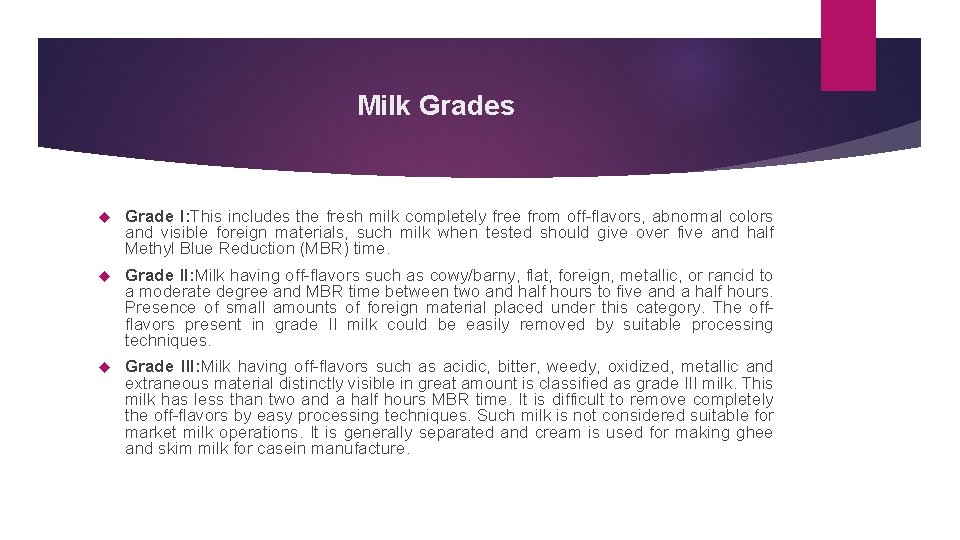
Milk Grades Grade I: This includes the fresh milk completely free from off-flavors, abnormal colors and visible foreign materials, such milk when tested should give over five and half Methyl Blue Reduction (MBR) time. Grade II: Milk having off-flavors such as cowy/barny, flat, foreign, metallic, or rancid to a moderate degree and MBR time between two and half hours to five and a half hours. Presence of small amounts of foreign material placed under this category. The off- flavors present in grade II milk could be easily removed by suitable processing techniques. Grade III: Milk having off-flavors such as acidic, bitter, weedy, oxidized, metallic and extraneous material distinctly visible in great amount is classified as grade III milk. This milk has less than two and a half hours MBR time. It is difficult to remove completely the off-flavors by easy processing techniques. Such milk is not considered suitable for market milk operations. It is generally separated and cream is used for making ghee and skim milk for casein manufacture.
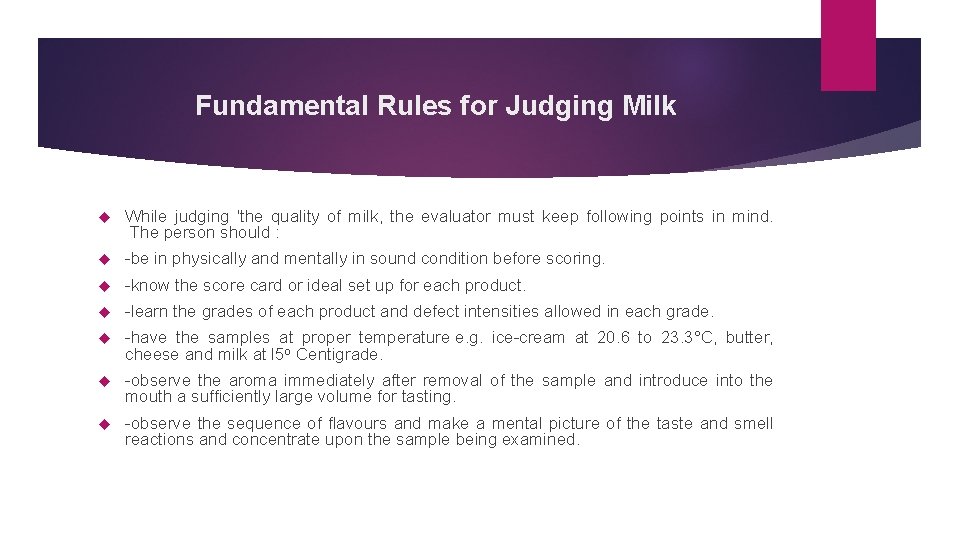
Fundamental Rules for Judging Milk While judging 'the quality of milk, the evaluator must keep following points in mind. The person should : -be in physically and mentally in sound condition before scoring. -know the score card or ideal set up for each product. -learn the grades of each product and defect intensities allowed in each grade. -have the samples at proper temperature e. g. ice-cream at 20. 6 to 23. 3°C, butter, cheese and milk at l 5 o Centigrade. -observe the aroma immediately after removal of the sample and introduce into the mouth a sufficiently large volume for tasting. -observe the sequence of flavours and make a mental picture of the taste and smell reactions and concentrate upon the sample being examined.
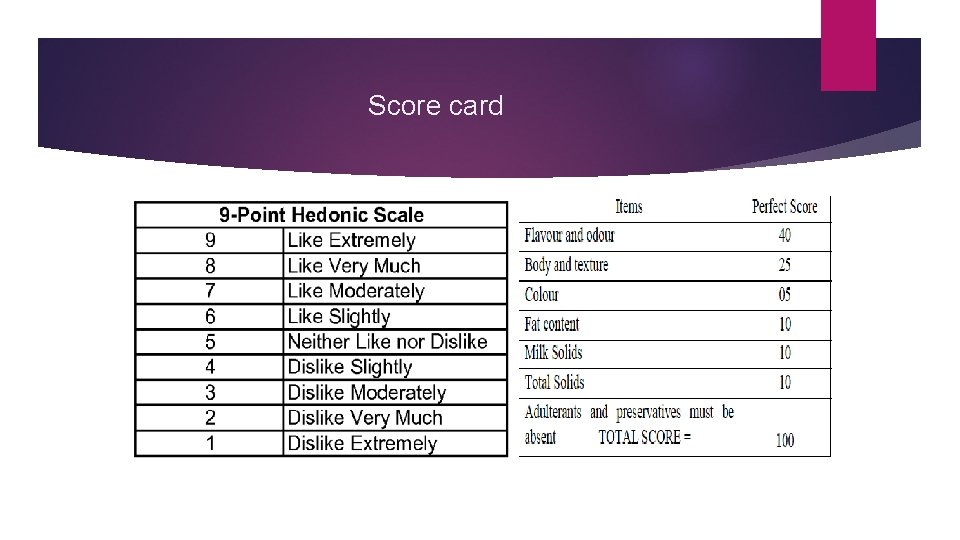
Score card
Milk scoring techniques Preparation of samples for evaluation: This depends on the purpose of objective of evaluation, number of participants and the quality criteria to be assessed. If several persons are to judge the milk samples for flavour, container and closure and other criteria then several containers of each individual lot of milk must be provided.
Order of examination and scoring: (a) Closure : - closure should be carefully observed. Nowadays bottles or cartons (not used in India) are not the usual packaging material. The milk is being packaged in polyethylene sachets. (b) Container : - container as stated above, since plastic bags are now in vogue ; there should be examined for extent of fullness, cleanliness and freedom from cuts/nicks/pinholes from leakage. Add your title (C) Evaluation of milk flavour: - The milk should be properly tempered between 13 to 18°C preferably 15. 5°C. Milk samples should be poured and a sip taken, rolled around the mouth and flavour sensation noted and then expectorated. Typically the flavour of milk should be " PLEASANTLY SWEET AND POSSESS NEITHER A FORETASTE NOR AN AFTERTASTE" other then that imparted by the natural richness due to milk fat and milk solids the scoring guide lists most frequently observed off - flavours. The defects should be described while scoring.
Undesirable flavours (a) Acid : - Milk that has developed some acidity as a result of bacterial growth (generally Streptococcus lactis) will have a detectable acid flavor long before it may be classified as sour. Milk may have an acid flavor when only a small part of high acid milk is mixed with milk of lower acidity; yet the total acidity on the entire lot may be within normal range. (b) Astringent : - Not common in milk. (C) Barny) : - Transmitted off - flavour due to poor ventilation, foul smelling environment, perceived by sniffing and tasting, charecteristic aftertaste. (d) Bitter : - A bitter taste in fresh milk may be caused by (1) strong feeds or weeds which may carry through into the milk, or (2) conditions present in milk from cows in late lactation, e. g. , stripper cows just before the drying-up period. (e) Cooked : - This flavor results from heating milk. It may appear when all or part of the milk has been heated too high or too long. Normally, the higher the heating temperature, the more intense the cooked flavor.
Undesirable flavours (f) Cowy (acetone) : - Distinct, persistent unpleasant, medicinal chemical aftertaste with acetone bodies in milk i. e ketosis in cows. (G) Feed: - The feed a cow eats may impart certain flavors to milk. Some stronger feeds will carry through more noticeably than others. Green grass, silage, turnips, and alfalfa hay are outstanding examples. Feed flavor can be minimized or eliminated by taking the cows offending feeds at least 4 hours before milking. Certain feeds can be detected in milk if fed to the cow even 15 to 30 minutes before milking (h) Fermented /fruity : - Resembles vinegar, pineapple and apple. Found in old pasteurized milk, due to growth of pseudomonas spp. (p. Fragii). (I) Flat: - The source of this uncommon flavor is difficult to determine. The flavor may be described as tasteless. The characteristic flavor or normal milk is lacking, but the milk has no off-flavor. Flat-flavored milk resembles normal milk that has been partially diluted with water, even though this may not have been done. . (j) Foreign : - Any seriously objectionable flavor foreign to milk, such as fly spray, paint, oil, kerosene, creosote, or a medicinal substance, will render the milk unpalatable or unfit for use. Such a flavor may either directly contaminate the milk or be absorbed. Sanitizes are included in this flavor category. The residue of the sanitizes, such as hypochlorite and iodophor, if left on dairy equipment, may be absorbed by milk and import a foreign flavor. Phenolic compounds used in udder ointments may combine with iodophor or hypochlorite to form a highly objectionable foreign flavor which is detectable in a very low concentration.
Contd… (k) Garlic /onion (weedy) : - The obnoxious weed flavor, imparted to milk when the cow eats garlic, onions, or leeks, is not classified as one of the usual feed flavors described above. The garlic/onion flavor is recognized by the distinctive taste and odor suggestive of its name. It may actually be so objectionable as to render the milk undesirable for use. (l) lacks freshness (stale) : Taste reaction indicates loss of fine pleasing taste, slightly chalky. May be 'forerunner' of either oxidised or Rancid off-flavour or off-flavour caused by psychrotrophs. (m) Malty: - Flavour definite or pronounced, suggestive of malt caused by the growth of s. Lactis var maltigenes at >18. 2°C for 2 -3 h can be smelled or tasted. Bacterial population in millions, followed by acid/sour taste. (n) Metal - induced oxidised off-flavour : - due to rapid oxidation - metal catalyzed. Metallic, oily, cardboardy, happy, stale, tallow, painty and fishy are used to describe this off - flavour. (o) Light - induced oxidized off - flavour : - Discribed as burnt, burnt protein, burnt feathers, cabbagy, medicinal or chemical like, light - activated or sunlight flavour or sunshine flavour, light catalyzed lipid oxidation as well as protein degradation both are involved. It requires riboflavin which is naturally present in milk.
Contd… Salty: Salty taste, which may be present in milk from cows in the late stages of lactation, is often characteristic of milk from cows infected with mastitis. It is not commonly found in herd milk or mixed milk received at a dairy plant. This defect cannot be detected by odor. Weedy: The weedy flavor is not included among the usual feed flavors. It generally has a bitter characteristic, varying with specific weeds of certain localities. It may include obnoxious flavors caused by such plants as ragweed, bitterweed, or peppergrass, and may become a very troublesome flavor defect. It can be eliminated or minimized by keeping cows away from weed-infested pastures or by not offering feeds containing such weeds until after the cow is milked.