John Locke the State of Nature A Founding

- Slides: 15
John Locke & the State of Nature A Founding Philosophy
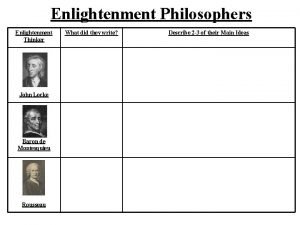
Natural Rights n John Locke - English Philosopher (16321704) n Most important influence on the Founders of U. S. n His ideas shaped the Dec. of Ind. , Constitution, Bill of Rights
What would life be like without government? n Locke said this would be a “State of Nature. ” n Not a condition where people live in the wilderness n Situation where there is no power acting as a government
Helps us answer: n What is human nature? n What is the purpose of gov’t. n How do people get the right to govern? n How should a gov’t be organized? n What kinds of gov’t are good/bad and should be supported/resisted?
Critical Thinking Exercise What would Locke say?
Question #1 n Locke felt that there were rules in a state of nature that people would follow through their own conscience n But not all humans are reasonable/good n There might be disagreement about the “laws of nature” n There would be no gov’t because gov’t cannot exist until it’s created
Question # 2 n No one would have the right to govern you - you would have no right to govern someone else n Someone gets the right to govern only through consent of others n If people have not consented, there is no legitimate gov’t.
Question 3 n Locke believed in natural rights - 3 basics that you could defend if threatened n Life n Liberty n Property
Question 4 n Locke believed people were basically good, but selfinterested n He believed that the stronger/smarter would try to take away the natural rights of the weak
Question 5 n Weaker/less sophisticated would protect themselves by joining together against the strong
Question 6 n Peoples rights would be very insecure n There would be no laws that people agreed on n There would be no government to enforce the laws that there were
Recapping our natural rights… n According to Locke: n. Life n. Liberty n. Property n. Sound familiar? ?
“The sacred rights of mankind are written, as with a sun beam in the whole volume of human nature, by the Hand of the Divinity itself, and can never be erased or obscured by mortal power. ” Alexander Hamilton
The Social Contract n Locke believed that in a state of nature your rights were always in jeopardy n In order to secure rights for all, we enter into what Locked called the social contract n We agree to create and live under a gov’t with the power to make and enforce laws
n We give up our right to do anything we please n We gain the protection and security of our natural rights n Purpose of gov’t is to protect those rights that the individual cannot protect in the state of nature.