
THE TWO THEORIES ON SOCIALIZATION MR GREVING TABULA
THE TWO THEORIES ON SOCIALIZATION MR. GREVING
TABULA RASA • Means “Blank Slate” • Created by the philosopher John Locke, who is often famous for inspiring the founding fathers. • Human Beings can be molded into any type of character. • Most sociologists wouldn’t take this extreme view.
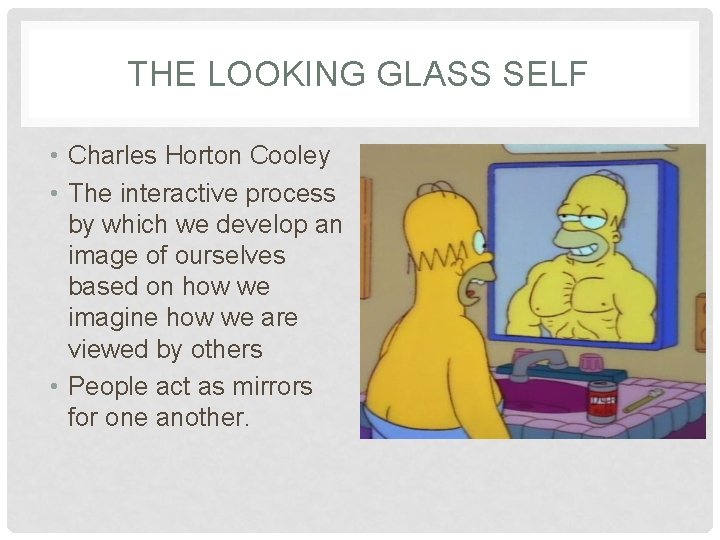
THE LOOKING GLASS SELF • Charles Horton Cooley • The interactive process by which we develop an image of ourselves based on how we imagine how we are viewed by others • People act as mirrors for one another.
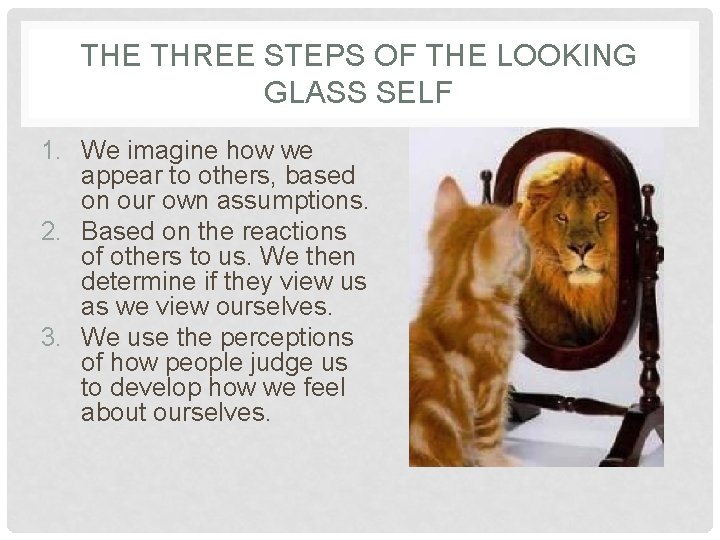
THE THREE STEPS OF THE LOOKING GLASS SELF 1. We imagine how we appear to others, based on our own assumptions. 2. Based on the reactions of others to us. We then determine if they view us as we view ourselves. 3. We use the perceptions of how people judge us to develop how we feel about ourselves.
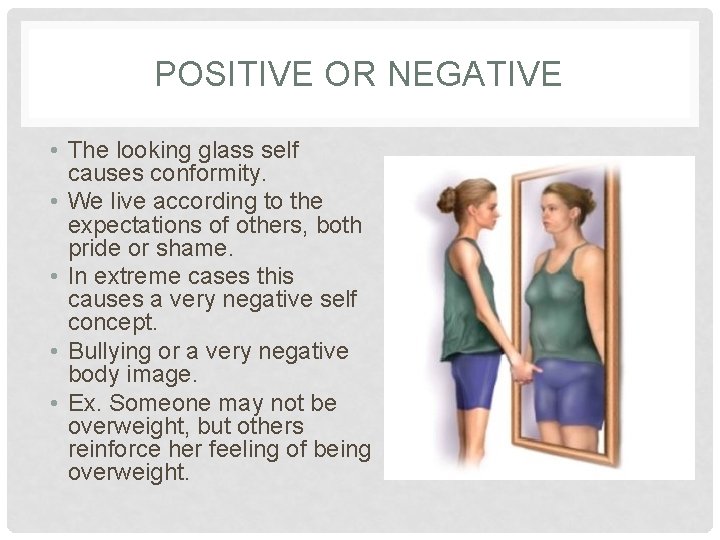
POSITIVE OR NEGATIVE • The looking glass self causes conformity. • We live according to the expectations of others, both pride or shame. • In extreme cases this causes a very negative self concept. • Bullying or a very negative body image. • Ex. Someone may not be overweight, but others reinforce her feeling of being overweight.
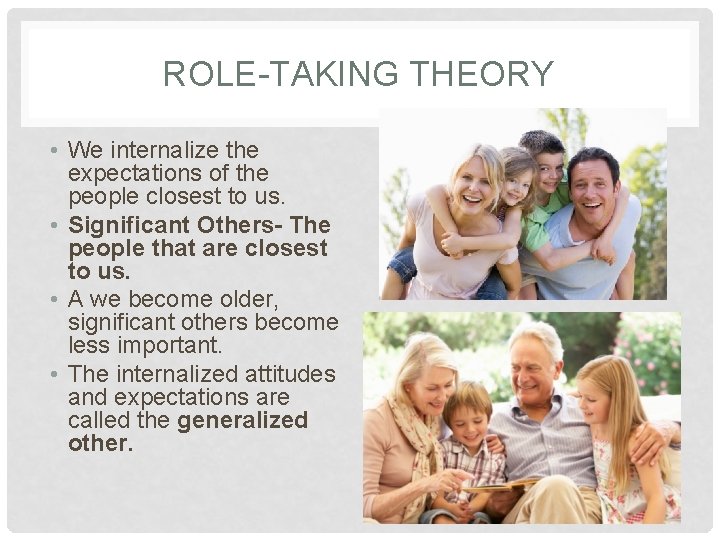
ROLE-TAKING THEORY • We internalize the expectations of the people closest to us. • Significant Others- The people that are closest to us. • A we become older, significant others become less important. • The internalized attitudes and expectations are called the generalized other.
I AND ME THROUGH ROLE- TAKING YOU DEVELOP A SENSE OF SELF I Me • The un-socialized, spontaneous self interested component of a self identity. • The part of ourselves that is aware of the expectations and attitudes of society- the socialized self Throughout your childhood you eventually leave the socialization process with the ME part of yourself being more pronounced.
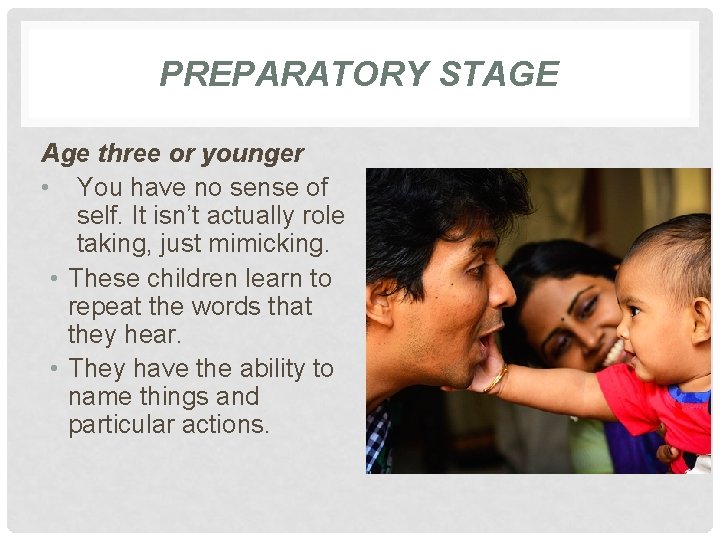
PREPARATORY STAGE Age three or younger • You have no sense of self. It isn’t actually role taking, just mimicking. • These children learn to repeat the words that they hear. • They have the ability to name things and particular actions.
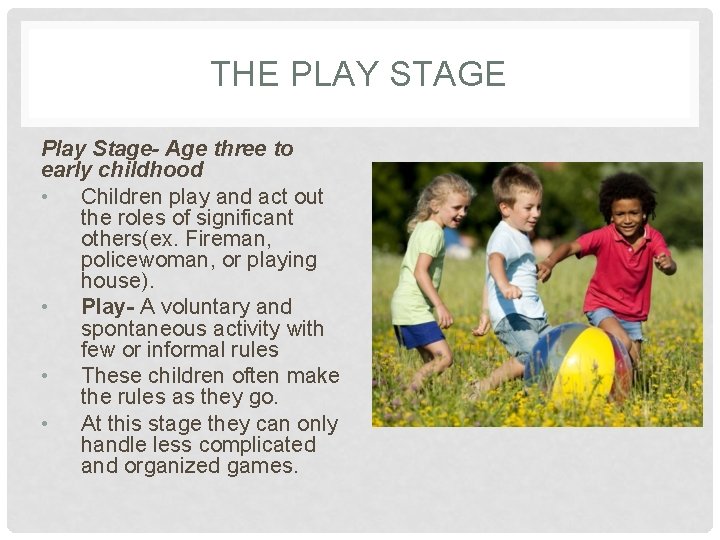
THE PLAY STAGE Play Stage- Age three to early childhood • Children play and act out the roles of significant others(ex. Fireman, policewoman, or playing house). • Play- A voluntary and spontaneous activity with few or informal rules • These children often make the rules as they go. • At this stage they can only handle less complicated and organized games.
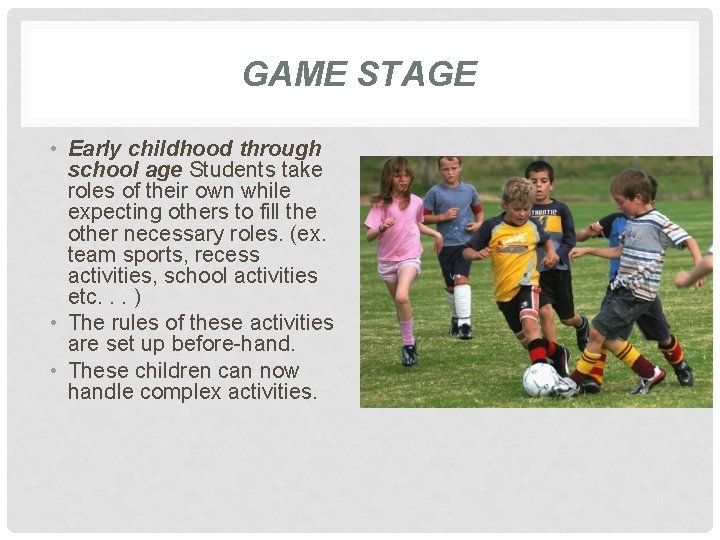
GAME STAGE • Early childhood through school age Students take roles of their own while expecting others to fill the other necessary roles. (ex. team sports, recess activities, school activities etc. . . ) • The rules of these activities are set up before-hand. • These children can now handle complex activities.
- Slides: 10