Introduction to Quantum Information Processing CS 467 CS


- Slides: 26
Introduction to Quantum Information Processing CS 467 / CS 667 Phys 467 / Phys 767 C&O 481 / C&O 681 Lecture 17 (2005) Richard Cleve DC 3524 cleve@cs. uwaterloo. ca Course web site at: http: //www. cs. uwaterloo. ca/~cleve/courses/cs 467 1
Contents • Communication complexity – Lower bound for the inner product problem • Simultaneous message passing and fingerprinting • Hidden matching problem • Nonlocality revisited 2
• Communication complexity – Lower bound for the inner product problem • Simultaneous message passing and fingerprinting • Hidden matching problem • Nonlocality revisited 3
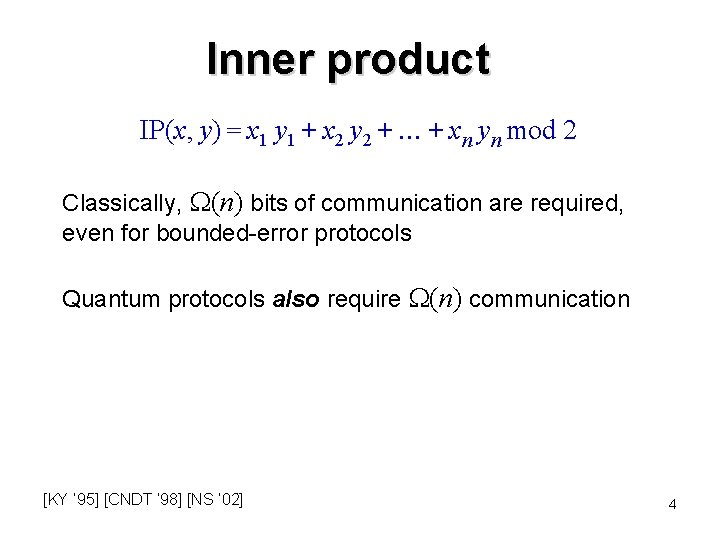
Inner product IP(x, y) = x 1 y 1 + x 2 y 2 + + xn yn mod 2 Classically, (n) bits of communication are required, even for bounded-error protocols Quantum protocols also require (n) communication [KY ‘ 95] [CNDT ‘ 98] [NS ‘ 02] 4
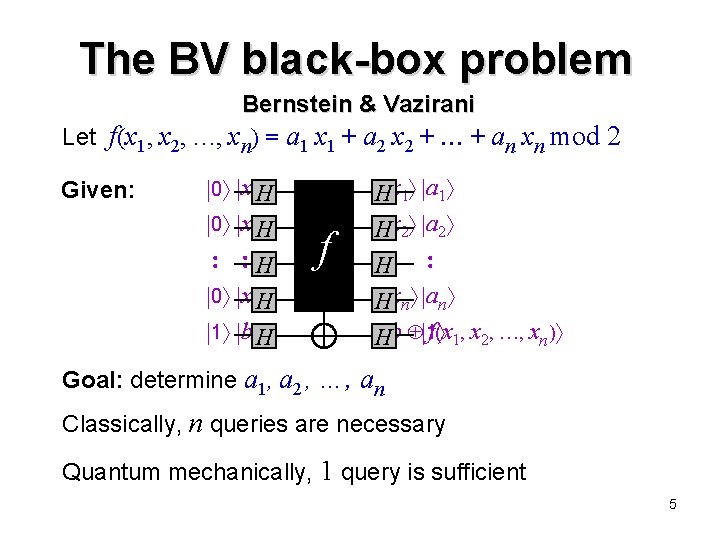
The BV black-box problem Bernstein & Vazirani Let f(x 1, x 2, …, xn) = a 1 x 1 + a 2 x 2 + + an xn mod 2 Given: 0 x 1 H 0 x 2 H H 0 xn. H 1 b H f H x 1 a 1 H x 2 a 2 H H xn an H b 1 f( x 1, x 2, …, xn) Goal: determine a 1, a 2 , …, an Classically, n queries are necessary Quantum mechanically, 1 query is sufficient 5
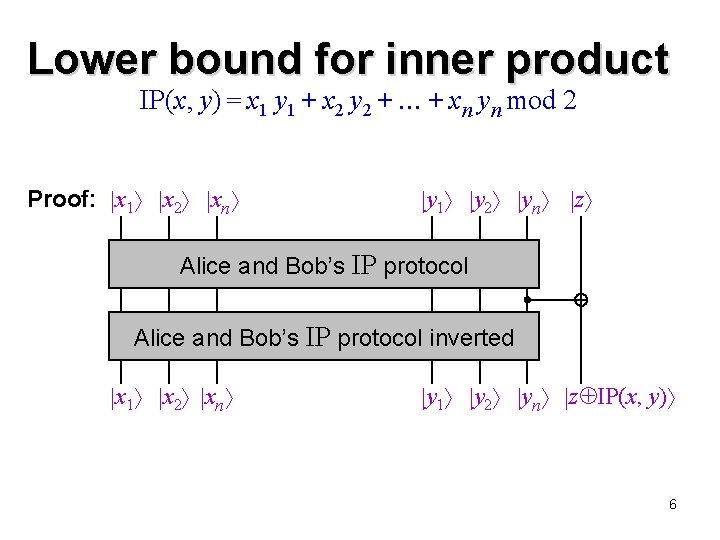
Lower bound for inner product IP(x, y) = x 1 y 1 + x 2 y 2 + + xn yn mod 2 Proof: x 1 x 2 xn y 1 y 2 yn z Alice and Bob’s IP protocol inverted x 1 x 2 xn y 1 y 2 yn z IP(x, y) 6
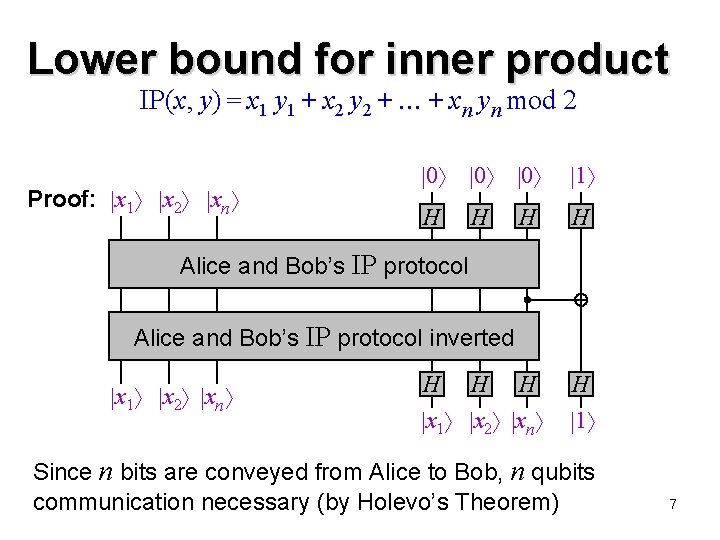
Lower bound for inner product IP(x, y) = x 1 y 1 + x 2 y 2 + + xn yn mod 2 Proof: x 1 x 2 xn 0 0 0 1 H H H x 1 x 2 xn H 1 H Alice and Bob’s IP protocol inverted x 1 x 2 xn Since n bits are conveyed from Alice to Bob, n qubits communication necessary (by Holevo’s Theorem) 7
• Communication complexity – Lower bound for the inner product problem • Simultaneous message passing and fingerprinting • Hidden matching problem • Nonlocality revisited 8
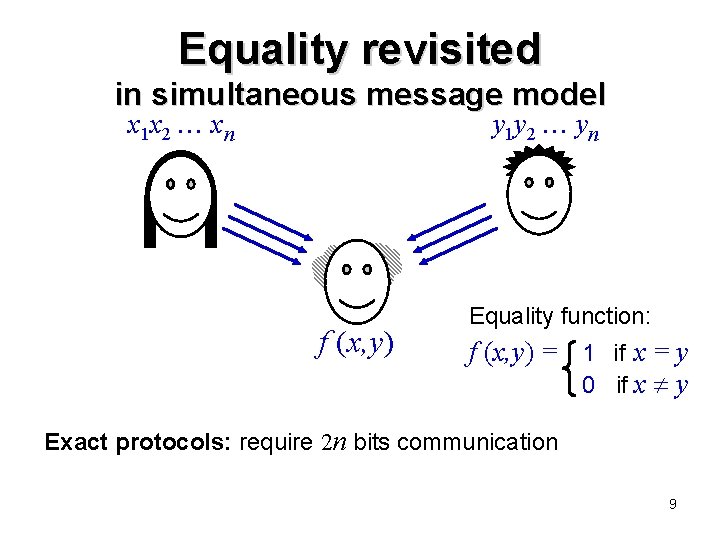
Equality revisited in simultaneous message model x 1 x 2 xn y 1 y 2 yn f (x, y) Equality function: f (x, y) = 1 if x = y 0 if x y Exact protocols: require 2 n bits communication 9
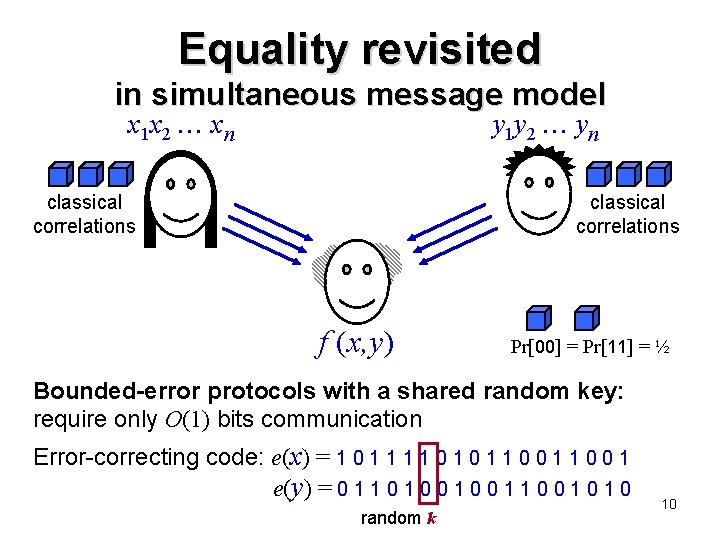
Equality revisited in simultaneous message model x 1 x 2 xn y 1 y 2 yn classical correlations f (x, y) Pr[00] = Pr[11] = ½ Bounded-error protocols with a shared random key: require only O(1) bits communication Error-correcting code: e(x) = 1 0 1 1 0 0 1 e(y) = 0 1 1 0 0 1 0 1 0 random k 10
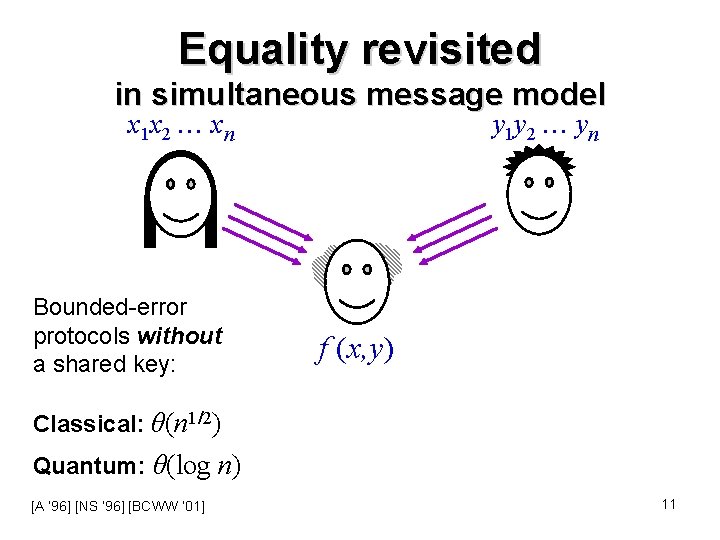
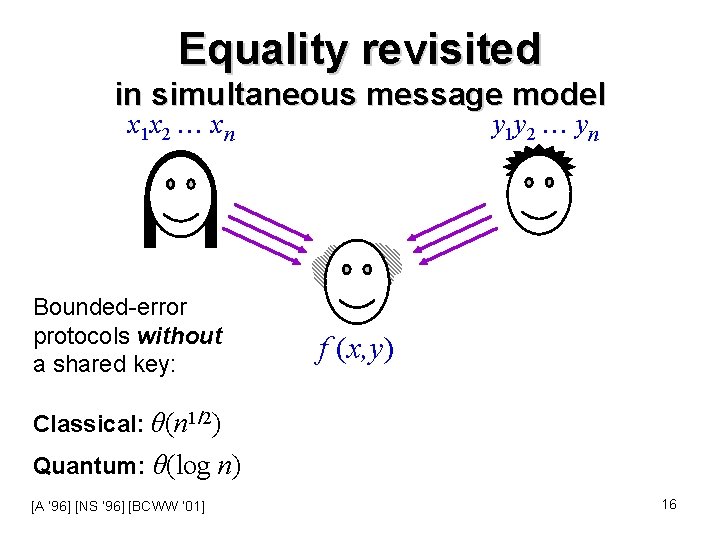
Equality revisited in simultaneous message model x 1 x 2 xn Bounded-error protocols without a shared key: y 1 y 2 yn f (x, y) Classical: θ(n 1/2) Quantum: θ(log n) [A ’ 96] [NS ’ 96] [BCWW ’ 01] 11
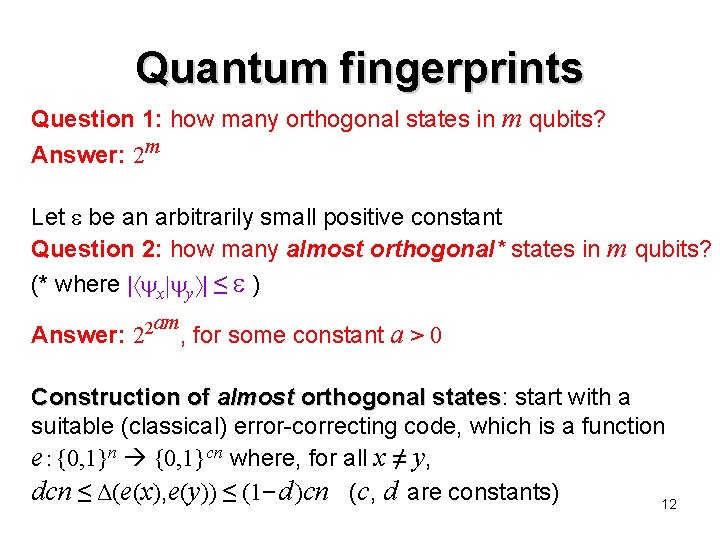
Quantum fingerprints Question 1: how many orthogonal states in m qubits? Answer: 2 m Let be an arbitrarily small positive constant Question 2: how many almost orthogonal* states in m qubits? (* where | x y | ≤ ) am Answer: 22 , for some constant a > 0 Construction of almost orthogonal states: states start with a suitable (classical) error-correcting code, which is a function e : {0, 1}n {0, 1}cn where, for all x ≠ y, dcn ≤ Δ(e(x), e(y)) ≤ (1− d )cn (c, d are constants) 12
Construction of almost orthogonal states Set x for each x {0, 1}n (log(cn) qubits) Then x y Since dcn ≤ Δ(e(x), e(y)) ≤ (1− d )cn, we have | x y | ≤ 1− 2 d By duplicating each state, x x … x , the pairwise inner products can be made arbitrarily small: (1− 2 d )r ≤ Result: m = r log(cn) qubits storing (as opposed to n qubits!) 2 n =2 (1/c)2 m/r different states 13
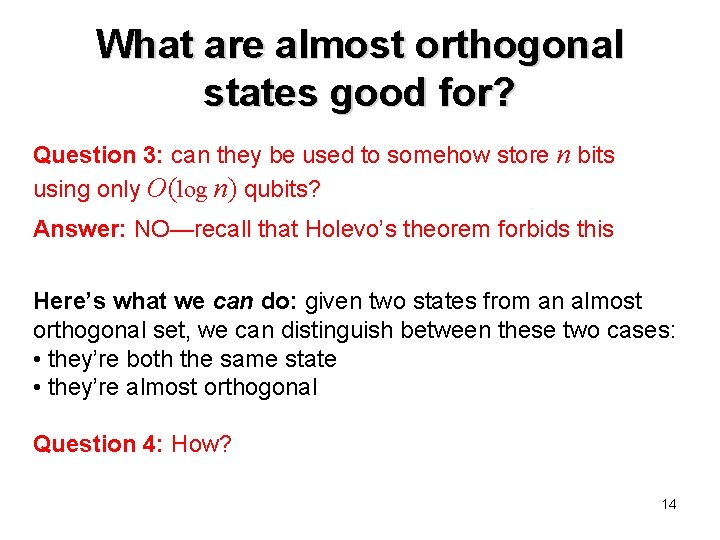
What are almost orthogonal states good for? Question 3: can they be used to somehow store n bits using only O(log n) qubits? Answer: NO—recall that Holevo’s theorem forbids this Here’s what we can do: given two states from an almost orthogonal set, we can distinguish between these two cases: • they’re both the same state • they’re almost orthogonal Question 4: How? 14
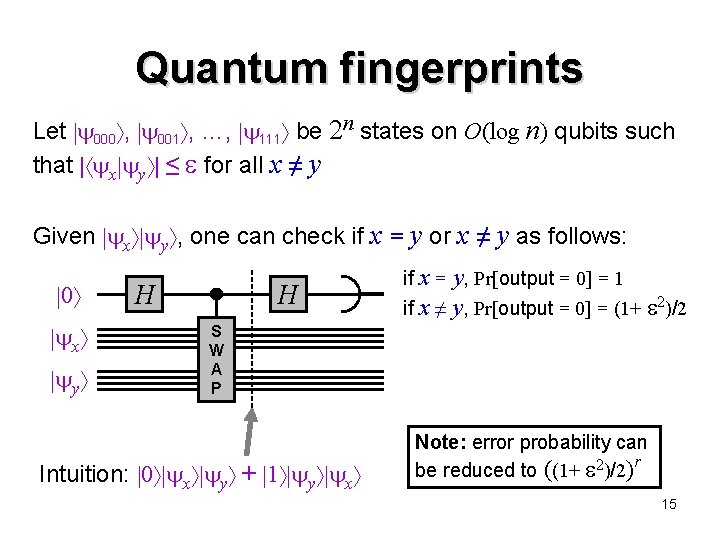
Quantum fingerprints Let 000 , 001 , …, 111 be 2 n states on O(log n) qubits such that | x y | ≤ for all x ≠ y Given x y , one can check if x = y or x ≠ y as follows: 0 x y H H if x = y, Pr[output = 0] = 1 if x ≠ y, Pr[output = 0] = (1+ 2)/2 S W A P Intuition: 0 x y + 1 y x Note: error probability can be reduced to ((1+ 2)/2)r 15
Equality revisited in simultaneous message model x 1 x 2 xn Bounded-error protocols without a shared key: y 1 y 2 yn f (x, y) Classical: θ(n 1/2) Quantum: θ(log n) [A ’ 96] [NS ’ 96] [BCWW ’ 01] 16
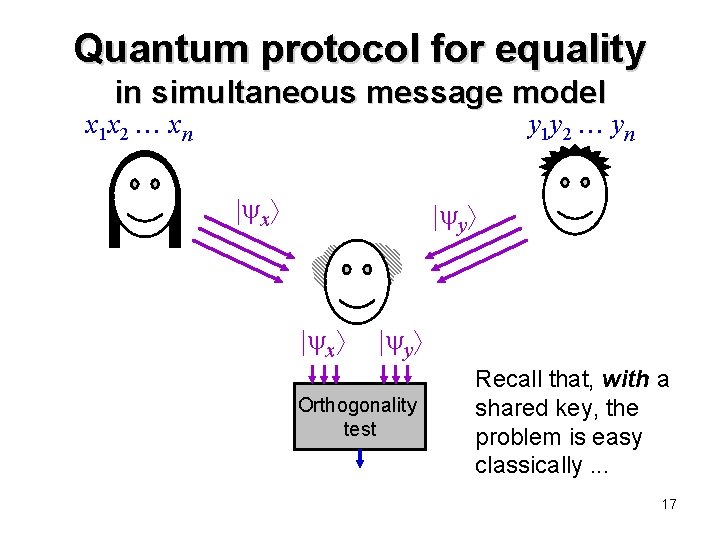
Quantum protocol for equality in simultaneous message model x 1 x 2 xn y 1 y 2 yn x y Orthogonality test Recall that, with a shared key, the problem is easy classically. . . 17
• Communication complexity – Lower bound for the inner product problem • Simultaneous message passing and fingerprinting • Hidden matching problem • Nonlocality revisited 18
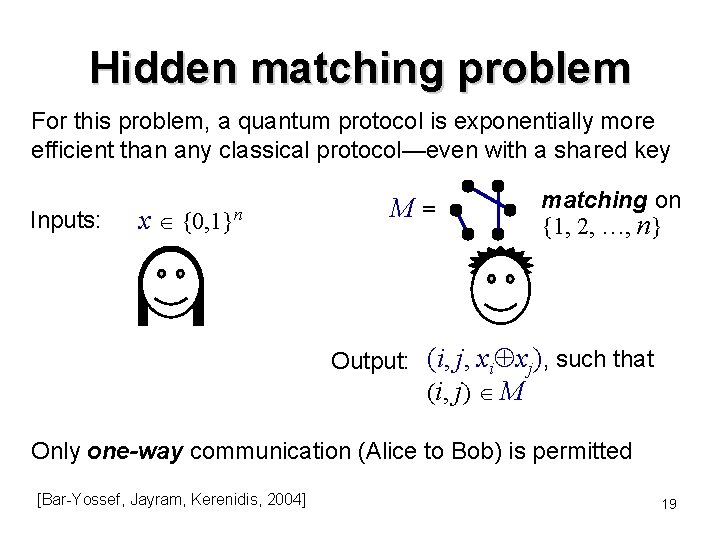
Hidden matching problem For this problem, a quantum protocol is exponentially more efficient than any classical protocol—even with a shared key Inputs: x {0, 1}n M= matching on {1, 2, …, n} Output: (i, j, xi xj), such that (i , j ) M Only one-way communication (Alice to Bob) is permitted [Bar-Yossef, Jayram, Kerenidis, 2004] 19
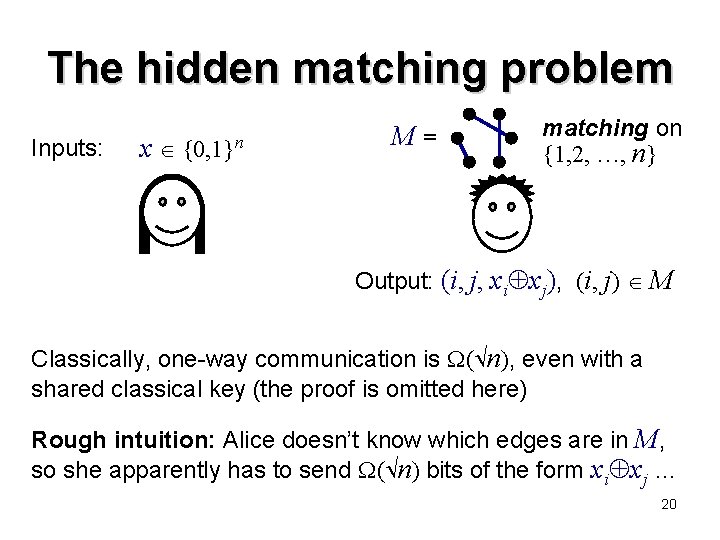
The hidden matching problem Inputs: x {0, 1}n M= matching on {1, 2, …, n} Output: (i, j, xi xj), (i, j) M Classically, one-way communication is ( n), even with a shared classical key (the proof is omitted here) Rough intuition: Alice doesn’t know which edges are in M, so she apparently has to send ( n) bits of the form xi xj … 20
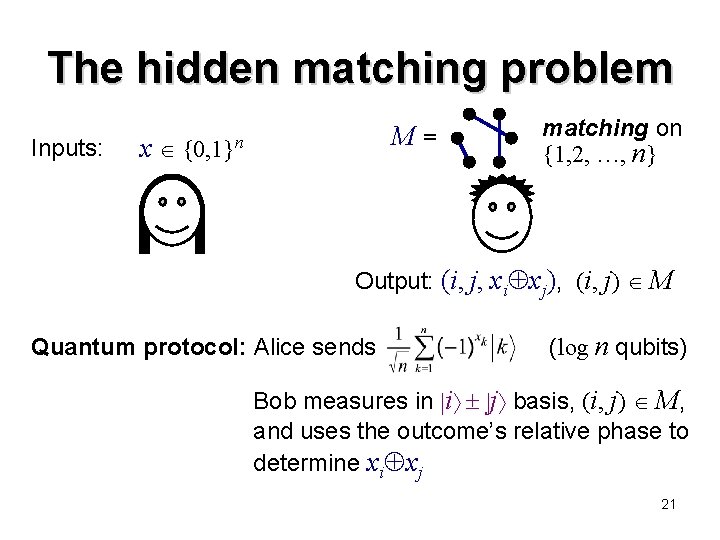
The hidden matching problem Inputs: x M= {0, 1}n matching on {1, 2, …, n} Output: (i, j, xi xj), (i, j) M Quantum protocol: Alice sends (log n qubits) Bob measures in i j basis, (i, j) M, and uses the outcome’s relative phase to determine xi xj 21
• Communication complexity – Lower bound for the inner product problem • Simultaneous message passing and fingerprinting • Hidden matching problem • Nonlocality revisited 22
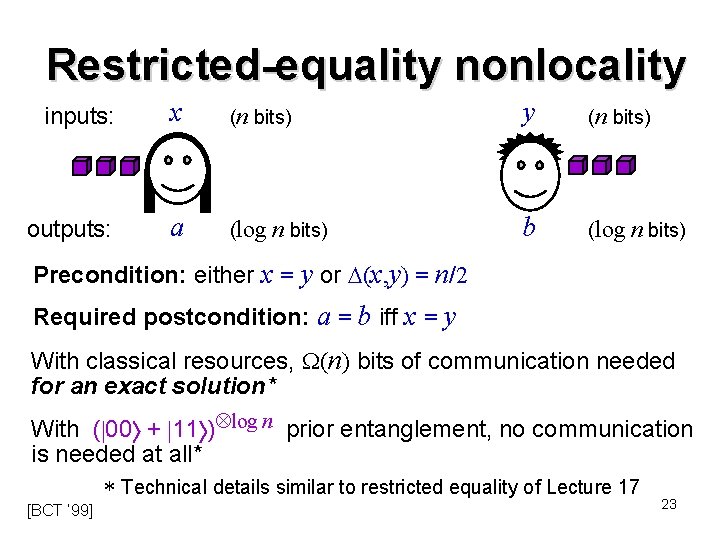
Restricted-equality nonlocality inputs: x (n bits) y (n bits) outputs: a (log n bits) b (log n bits) Precondition: either x = y or (x, y) = n/2 Required postcondition: a = b iff x = y With classical resources, (n) bits of communication needed for an exact solution* With ( 00 + 11 ) log n prior entanglement, no communication is needed at all* Technical details similar to restricted equality of Lecture 17 [BCT ‘ 99] 23
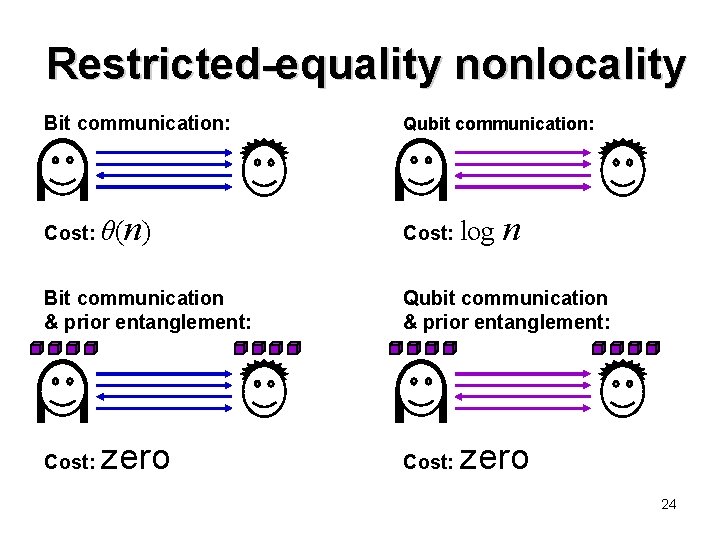
Restricted-equality nonlocality Bit communication: Cost: θ( n) Bit communication & prior entanglement: Cost: zero Qubit communication: Cost: log n Qubit communication & prior entanglement: Cost: zero 24
Nonlocality and communication complexity conclusions • Quantum information affects communication complexity in interesting ways • There is a rich interplay between quantum communication complexity and: – quantum algorithms – quantum information theory – other notions of complexity theory … 25
26