
Introduction to Quantum Information Processing CS 467 CS

- Slides: 29
Introduction to Quantum Information Processing CS 467 / CS 667 Phys 467 / Phys 767 C&O 481 / C&O 681 Lecture 16 (2005) Richard Cleve DC 3524 cleve@cs. uwaterloo. ca Course web site at: http: //www. cs. uwaterloo. ca/~cleve/courses/cs 467 1
Contents • Preliminary remarks about quantum communication • The GHZ “paradox” • The Bell inequality and its violation – Physicist’s perspective – Computer Scientist’s perspective • The magic square game 2
• Preliminary remarks about quantum communication • The GHZ “paradox” • The Bell inequality and its violation – Physicist’s perspective – Computer Scientist’s perspective • The magic square game 3
Quantum information can apparently be used to substantially reduce computation costs for a number of interesting problems How does quantum information affect the communication costs of information processing tasks? We explore this issue. . . 4
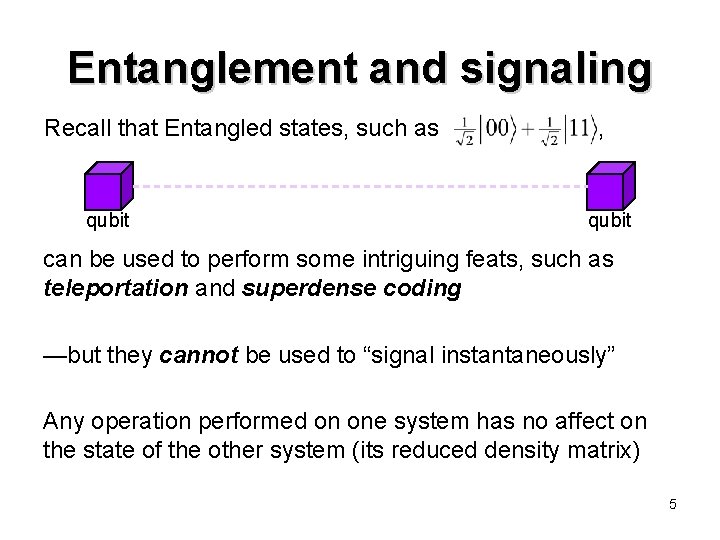
Entanglement and signaling Recall that Entangled states, such as qubit , qubit can be used to perform some intriguing feats, such as teleportation and superdense coding —but they cannot be used to “signal instantaneously” Any operation performed on one system has no affect on the state of the other system (its reduced density matrix) 5
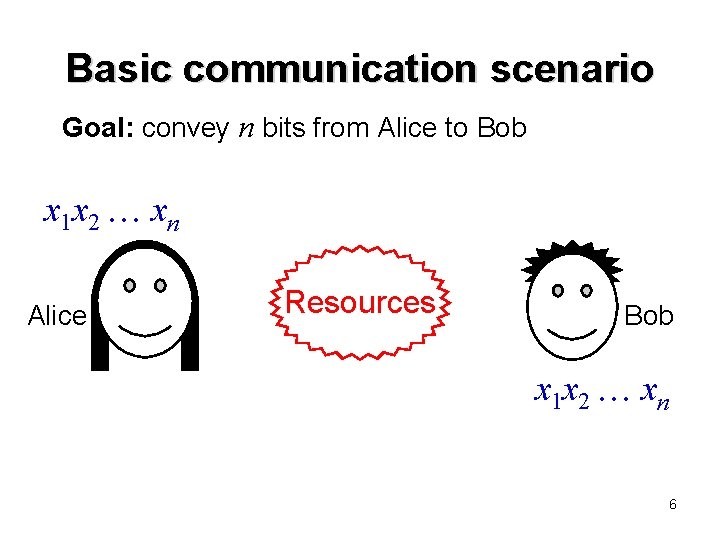
Basic communication scenario Goal: convey n bits from Alice to Bob x 1 x 2 xn Alice Resources Bob x 1 x 2 xn 6
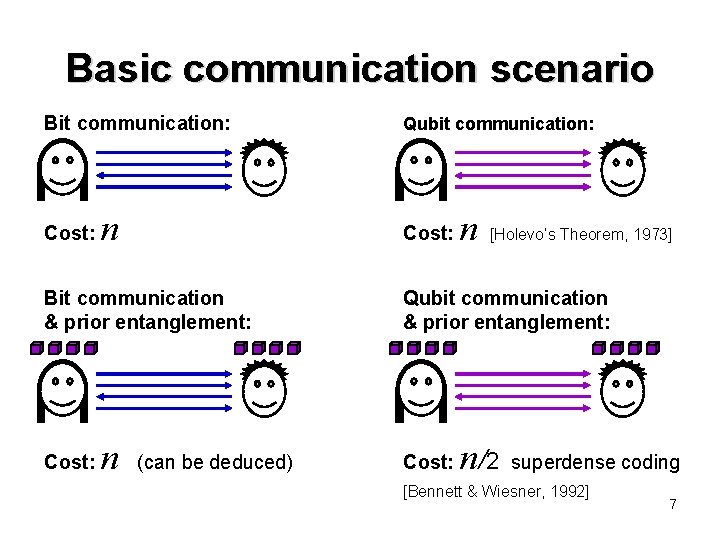
Basic communication scenario Bit communication: Cost: n Cost: Bit communication & prior entanglement: Cost: n Qubit communication: (can be deduced) n [Holevo’s Theorem, 1973] Qubit communication & prior entanglement: Cost: n/2 superdense coding [Bennett & Wiesner, 1992] 7
• Preliminary remarks about quantum communication • The GHZ “paradox” • The Bell inequality and its violation – Physicist’s perspective – Computer Scientist’s perspective • The magic square game 8
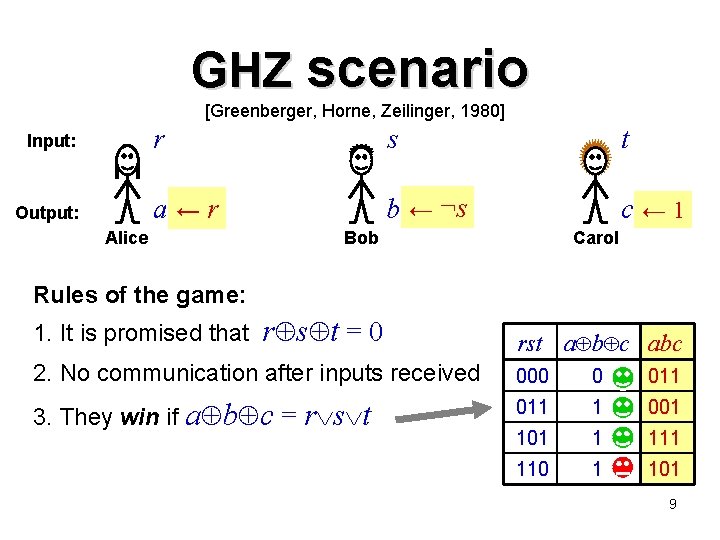
GHZ scenario [Greenberger, Horne, Zeilinger, 1980] Input: Output: r s t a ←r b ← ¬s c ← 1 Alice Bob Carol Rules of the game: 1. It is promised that r s t = 0 rst a b c abc 2. No communication after inputs received 000 0 011 3. They win if a b c = r s t 011 1 001 1 111 110 1 101 9
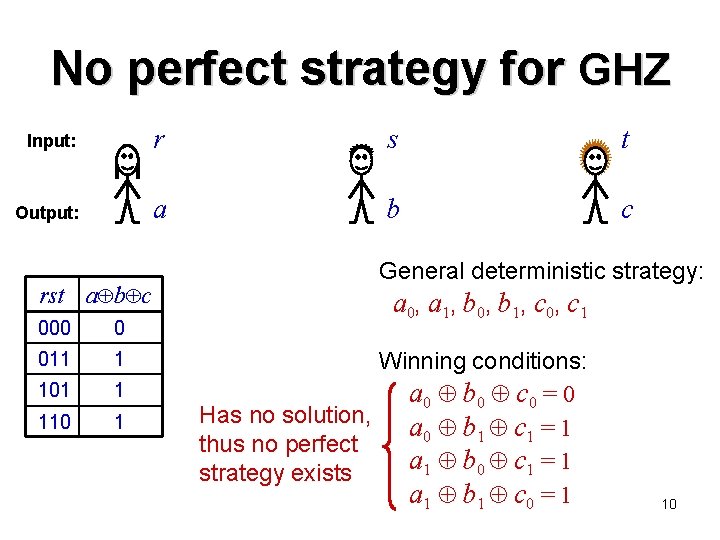
No perfect strategy for GHZ Input: r s t Output: a b c rst a b c 000 0 011 1 101 1 110 1 General deterministic strategy: a 0, a 1, b 0, b 1, c 0, c 1 Winning conditions: a 0 b 0 c 0 = 0 Has no solution, a 0 b 1 c 1 = 1 thus no perfect a 1 b 0 c 1 = 1 strategy exists a 1 b 1 c 0 = 1 10
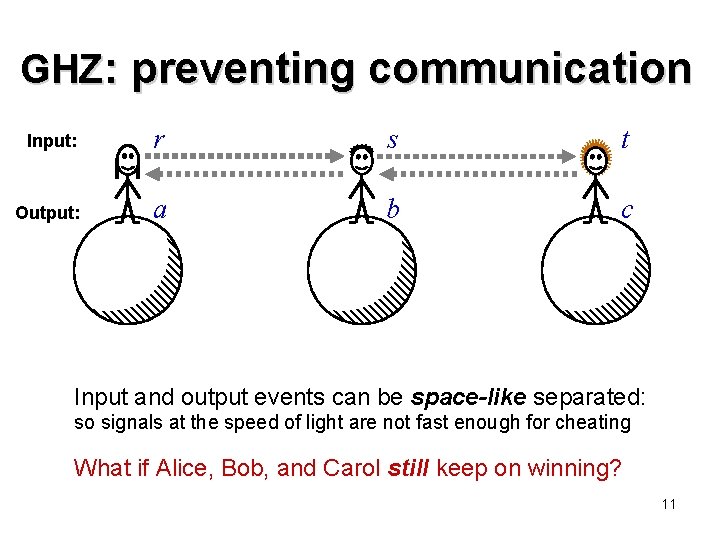
GHZ: preventing communication Input: r s t Output: a b c Input and output events can be space-like separated: so signals at the speed of light are not fast enough for cheating What if Alice, Bob, and Carol still keep on winning? 11
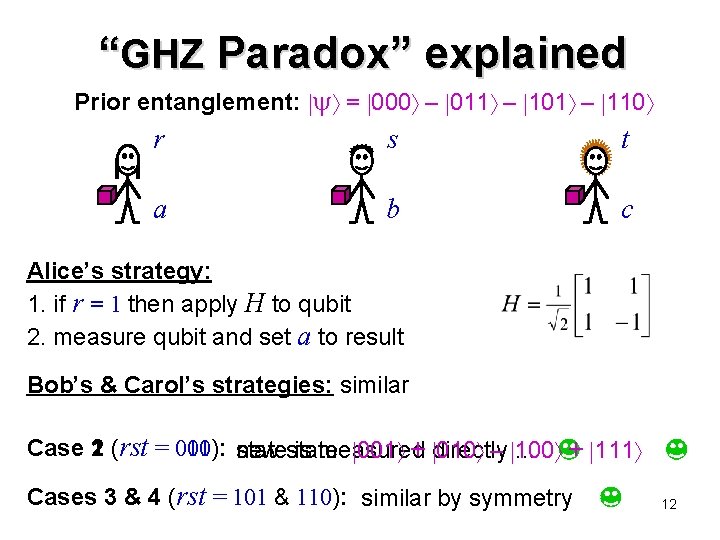
“GHZ Paradox” explained Prior entanglement: = 000 – 011 – 101 – 110 r s t a b c Alice’s strategy: 1. if r = 1 then apply H to qubit 2. measure qubit and set a to result Bob’s & Carol’s strategies: similar Case 2 1 (rst = 011): 000): new 001 + 010 – 100 state is measured directly … + 111 Cases 3 & 4 (rst = 101 & 110): similar by symmetry 12
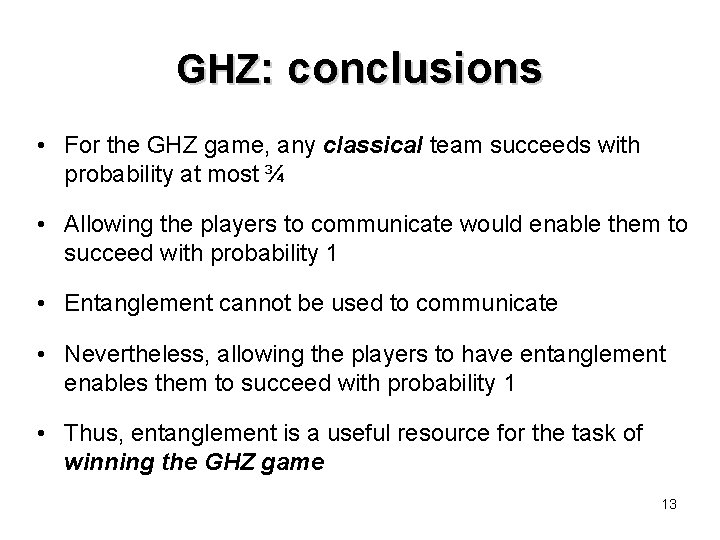
GHZ: conclusions • For the GHZ game, any classical team succeeds with probability at most ¾ • Allowing the players to communicate would enable them to succeed with probability 1 • Entanglement cannot be used to communicate • Nevertheless, allowing the players to have entanglement enables them to succeed with probability 1 • Thus, entanglement is a useful resource for the task of winning the GHZ game 13
• Preliminary remarks about quantum communication • The GHZ “paradox” • The Bell inequality and its violation – Physicist’s perspective – Computer Scientist’s perspective • The magic square game 14
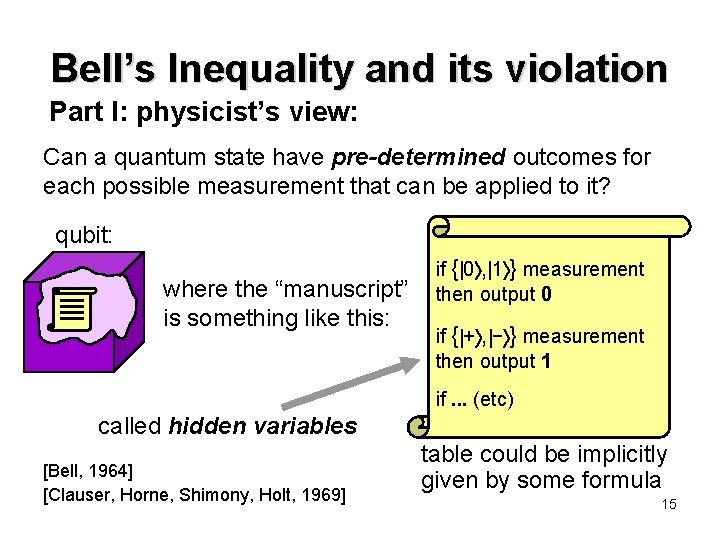
Bell’s Inequality and its violation Part I: physicist’s view: Can a quantum state have pre-determined outcomes for each possible measurement that can be applied to it? qubit: where the “manuscript” is something like this: if { 0 , 1 } measurement then output 0 if { + , − } measurement then output 1 if. . . (etc) called hidden variables [Bell, 1964] [Clauser, Horne, Shimony, Holt, 1969] table could be implicitly given by some formula 15
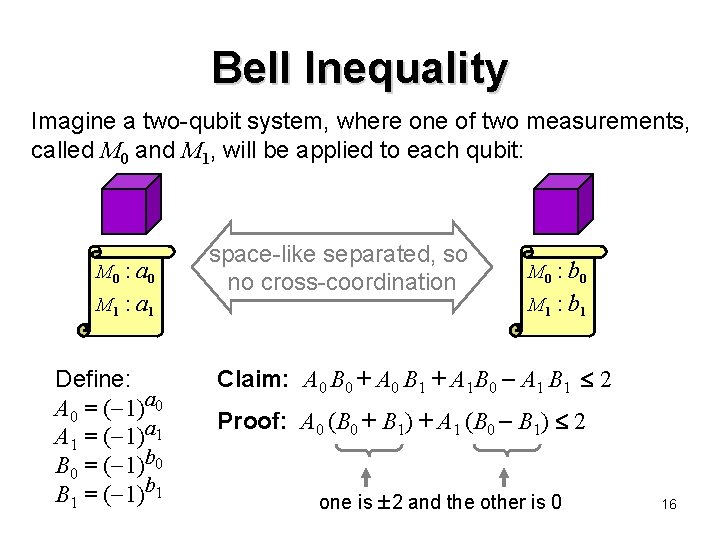
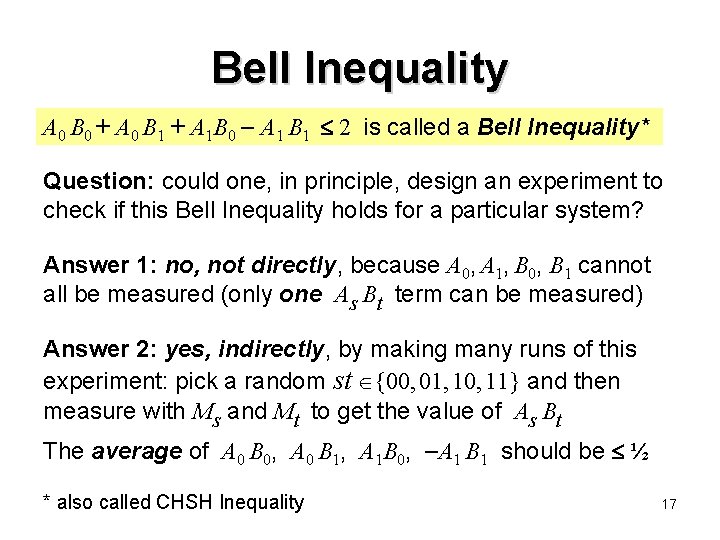
Bell Inequality Imagine a two-qubit system, where one of two measurements, called M 0 and M 1, will be applied to each qubit: M 0 : a 0 M 1 : a 1 Define: A 0 = ( 1)a 0 A 1 = ( 1)a 1 B 0 = ( 1)b 0 B 1 = ( 1)b 1 space-like separated, so no cross-coordination M 0 : b 0 M 1 : b 1 Claim: A 0 B 0 + A 0 B 1 + A 1 B 0 A 1 B 1 2 Proof: A 0 (B 0 + B 1) + A 1 (B 0 B 1) 2 one is 2 and the other is 0 16
Bell Inequality A 0 B 0 + A 0 B 1 + A 1 B 0 A 1 B 1 2 is called a Bell Inequality* Question: could one, in principle, design an experiment to check if this Bell Inequality holds for a particular system? Answer 1: no, not directly, because A 0, A 1, B 0, B 1 cannot all be measured (only one As Bt term can be measured) Answer 2: yes, indirectly, by making many runs of this experiment: pick a random st {00, 01, 10, 11} and then measure with Ms and Mt to get the value of As Bt The average of A 0 B 0, A 0 B 1, A 1 B 0, A 1 B 1 should be ½ * also called CHSH Inequality 17
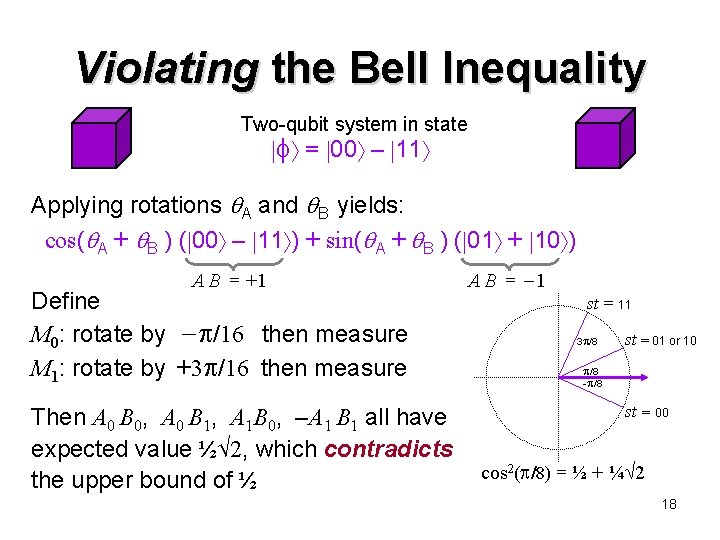
Violating the Bell Inequality Two-qubit system in state = 00 – 11 Applying rotations A and B yields: cos( A + B ) ( 00 – 11 ) + sin( A + B ) ( 01 + 10 ) A B = +1 Define M 0: rotate by /16 then measure M 1: rotate by +3 /16 then measure Then A 0 B 0, A 0 B 1, A 1 B 0, A 1 B 1 all have expected value ½√ 2, which contradicts the upper bound of ½ AB = 1 st = 11 3 /8 st = 01 or 10 /8 - /8 st = 00 cos 2( /8) = ½ + ¼√ 2 18
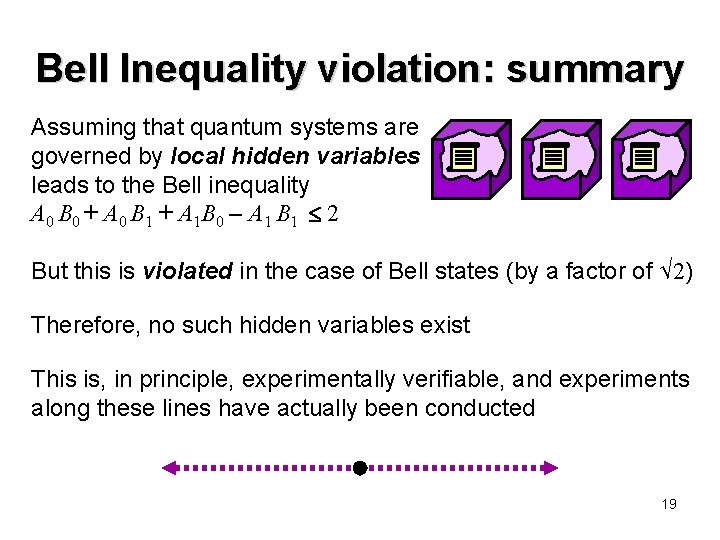
Bell Inequality violation: summary Assuming that quantum systems are governed by local hidden variables leads to the Bell inequality A 0 B 0 + A 0 B 1 + A 1 B 0 A 1 B 1 2 But this is violated in the case of Bell states (by a factor of √ 2) Therefore, no such hidden variables exist This is, in principle, experimentally verifiable, and experiments along these lines have actually been conducted 19
• Preliminary remarks about quantum communication • The GHZ “paradox” • The Bell inequality and its violation – Physicist’s perspective – Computer Scientist’s perspective • The magic square game 20
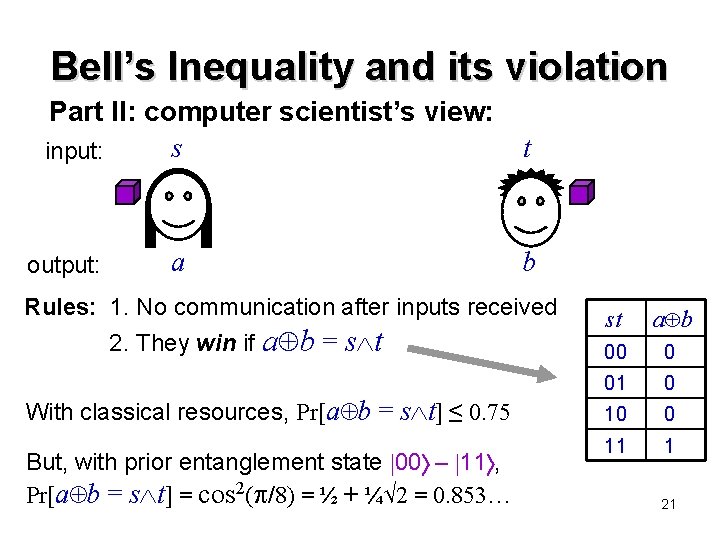
Bell’s Inequality and its violation Part II: computer scientist’s view: s input: output: a t b Rules: 1. No communication after inputs received 2. They win if a b = s t With classical resources, Pr[a b = s t] ≤ 0. 75 But, with prior entanglement state 00 – 11 , Pr[a b = s t] = cos 2( /8) = ½ + ¼√ 2 = 0. 853… st a b 00 0 01 0 10 0 11 1 21
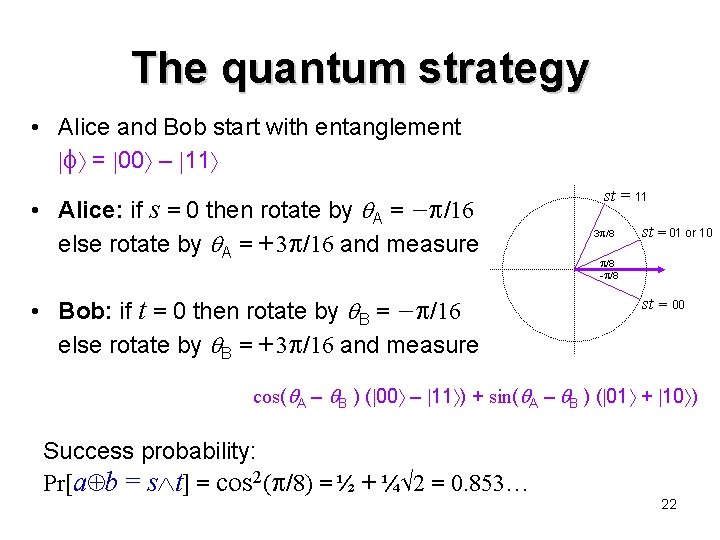
The quantum strategy • Alice and Bob start with entanglement = 00 – 11 • Alice: if s = 0 then rotate by A = /16 else rotate by A = + 3 /16 and measure • Bob: if t = 0 then rotate by B = /16 else rotate by B = + 3 /16 and measure st = 11 3 /8 st = 01 or 10 /8 - /8 st = 00 cos( A – B ) ( 00 – 11 ) + sin( A – B ) ( 01 + 10 ) Success probability: Pr[a b = s t] = cos 2( /8) = ½ + ¼√ 2 = 0. 853… 22
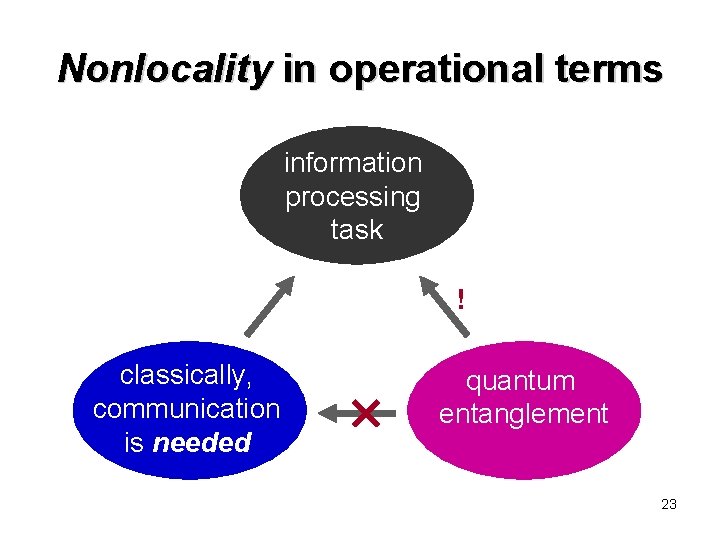
Nonlocality in operational terms information processing task ! classically, communication is needed quantum entanglement 23
• Preliminary remarks about quantum communication • The GHZ “paradox” • The Bell inequality and its violation – Physicist’s perspective – Computer Scientist’s perspective • The magic square game 24
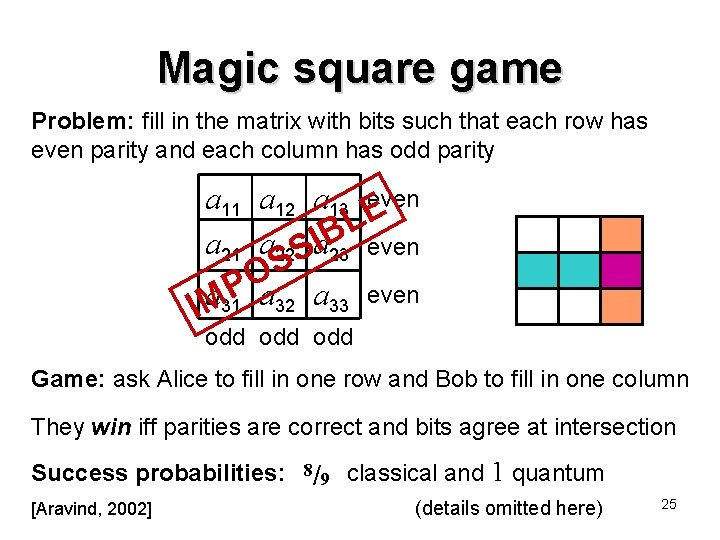
Magic square game Problem: fill in the matrix with bits such that each row has even parity and each column has odd parity a 11 a 12 a 13 even E L a 21 a 22 Sa. IB 23 even S O P even a a a 31 32 33 M I odd odd Game: ask Alice to fill in one row and Bob to fill in one column They win iff parities are correct and bits agree at intersection Success probabilities: [Aravind, 2002] 8/9 classical and 1 quantum (details omitted here) 25
Preview of communication complexity 26
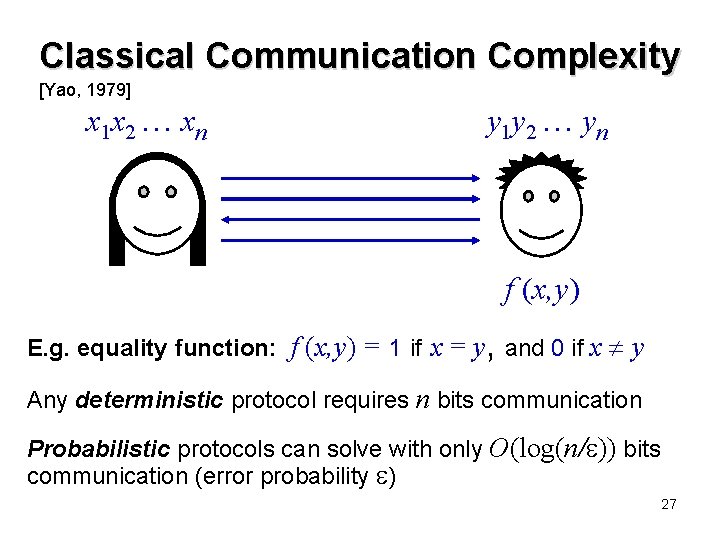
Classical Communication Complexity [Yao, 1979] x 1 x 2 xn y 1 y 2 yn f (x, y) E. g. equality function: f (x, y) = 1 if x = y, and 0 if x y Any deterministic protocol requires n bits communication Probabilistic protocols can solve with only O(log(n/ )) bits communication (error probability ) 27
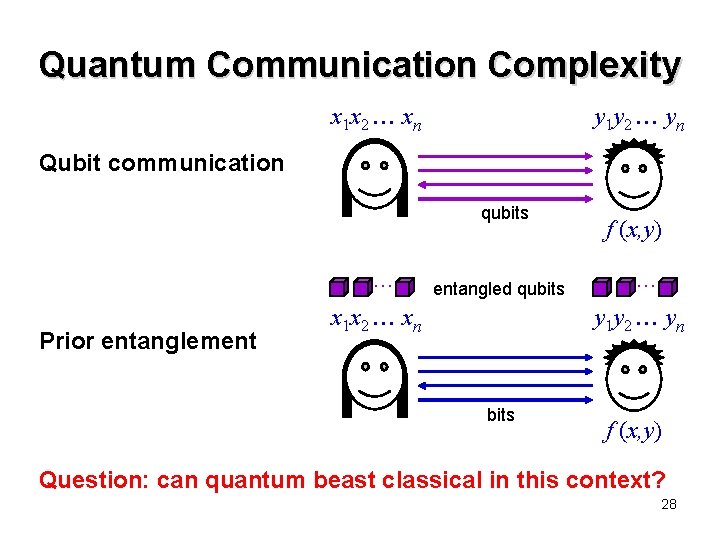
Quantum Communication Complexity x 1 x 2 xn y 1 y 2 yn Qubit communication qubits Prior entanglement entangled qubits x 1 x 2 xn f (x, y) y 1 y 2 yn bits f (x, y) Question: can quantum beast classical in this context? 28
29