Introduction to Psychology Introduction to Psychology as a




- Slides: 35
Introduction to Psychology
Introduction to Psychology as a Social Science • • Course: 02 -46 -116 Section 30 Instructor: Michelle Petherick Coordinator: Dr. Jackson Day: Monday Time: 7: 00 -9: 50 PM Office Hours: Mondays 5: 00 -6: 30 Where: CHS 273? Email: mpeth@uwindsor. ca
Course Objectives It is hoped that by the end of the course you will: – Be able to explain why psychology is a science – Be able to articulate the most salient theories and findings in the field – Have a better understanding of yourself and those around you – Have developed critical thinking skills
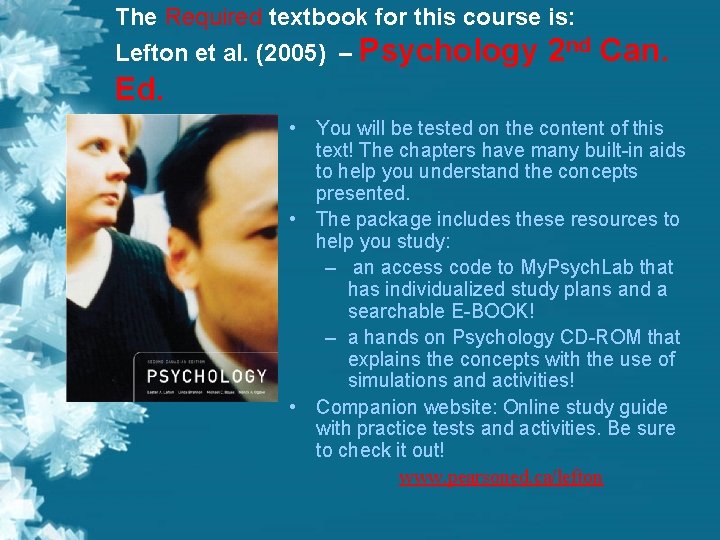
The Required textbook for this course is: Lefton et al. (2005) – Psychology 2 nd Can. Ed. • You will be tested on the content of this text! The chapters have many built-in aids to help you understand the concepts presented. • The package includes these resources to help you study: – an access code to My. Psych. Lab that has individualized study plans and a searchable E-BOOK! – a hands on Psychology CD-ROM that explains the concepts with the use of simulations and activities! • Companion website: Online study guide with practice tests and activities. Be sure to check it out! www. pearsoned. ca/lefton
Your Responsibilities • Print out syllabus: Go to www. uwindsor. ca/psychology, choose undergraduate (left-hand menu), click courses/outlines (fly-out), choose our course number • Do NOT register for a lab • Purchase text book • Read assigned chapters • Complete lab assignments • Study for and write exams • Consider optional bonus marks • Check the Psychology 116 website frequently • Follow basic rules of good conduct
Rules of Conduct Respect your fellow students – Late Arrivals/Leaving Early – Noise Level – Raising your hand to ask questions – Missed Assignments/Exams – Cell phones – Food/Beverages – Consideration of peers
My Responsibilities • Attempt to make this course informative and interesting • Review and expand upon information presented in the text • Make all Power. Point material available on the website at least 1 week before exams • Make myself available to answer your questions and address your concerns • Assist you in preparing for exams
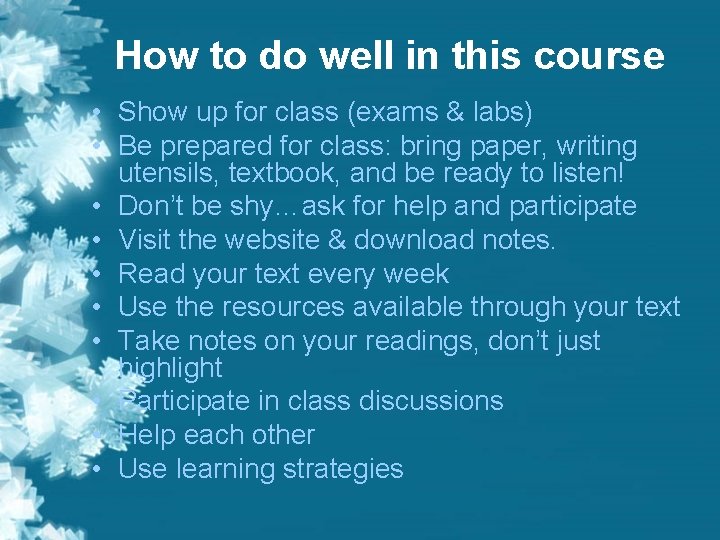
How to do well in this course • Show up for class (exams & labs) • Be prepared for class: bring paper, writing utensils, textbook, and be ready to listen! • Don’t be shy…ask for help and participate • Visit the website & download notes. • Read your text every week • Use the resources available through your text • Take notes on your readings, don’t just highlight • Participate in class discussions • Help each other • Use learning strategies
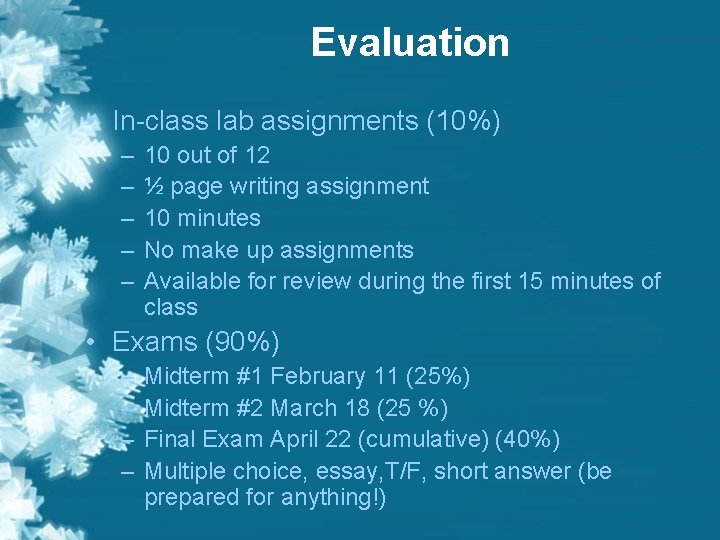
Evaluation • In-class lab assignments (10%) – – – 10 out of 12 ½ page writing assignment 10 minutes No make up assignments Available for review during the first 15 minutes of class • Exams (90%) – – Midterm #1 February 11 (25%) Midterm #2 March 18 (25 %) Final Exam April 22 (cumulative) (40%) Multiple choice, essay, T/F, short answer (be prepared for anything!)
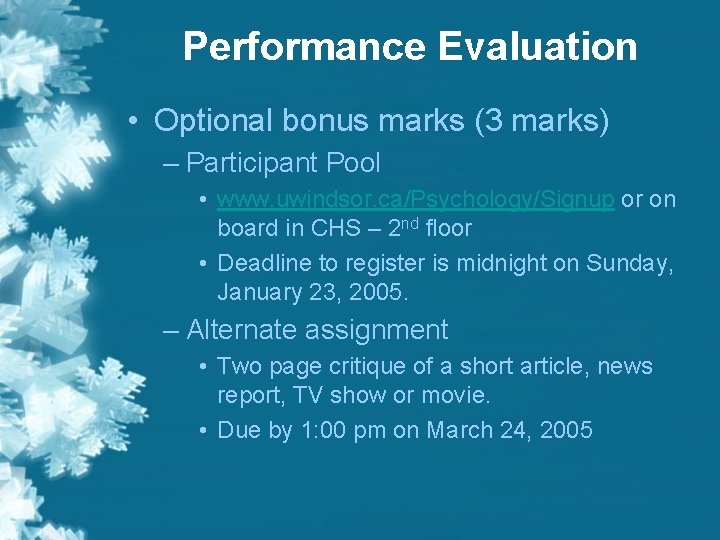
Performance Evaluation • Optional bonus marks (3 marks) – Participant Pool • www. uwindsor. ca/Psychology/Signup or on board in CHS – 2 nd floor • Deadline to register is midnight on Sunday, January 23, 2005. – Alternate assignment • Two page critique of a short article, news report, TV show or movie. • Due by 1: 00 pm on March 24, 2005
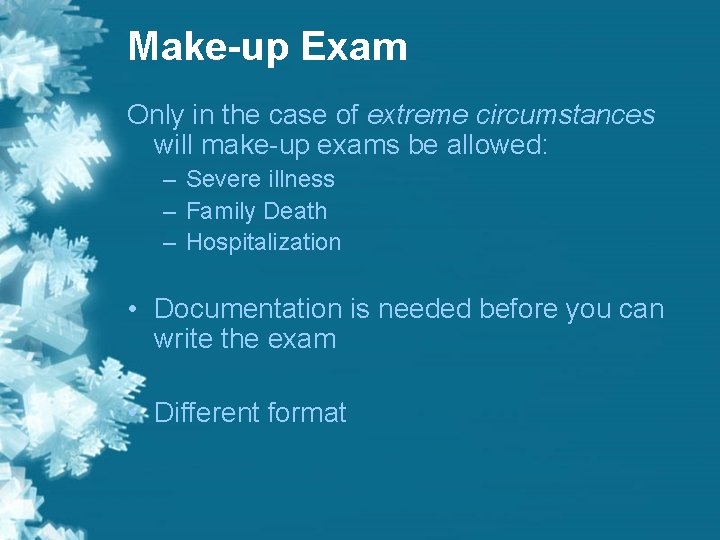
Make-up Exam Only in the case of extreme circumstances will make-up exams be allowed: – Severe illness – Family Death – Hospitalization • Documentation is needed before you can write the exam • Different format
Contesting a mark • Must provide a written statement within 10 days indicating your reasons • Hand in request with original marked paper • I will pass it on to the marker • Keep in mind that when your paper is re-evaluated, it is possible that your mark could be decreased
Questions ? ? ?
Activity!! • Get in groups of 4 -5 • Introduce yourselves to each other – Name – Year – Faculty • Volunteers • Recorder & Reporter • Name your group • Discussion • Why did you take this class? (3 top answers) • What do you hope to learn? (3 top answers) • How do you think you will use the information in your career? (3 top answers)
BREAK!!
Child Development Chapter 10
Overview of Topics – Developmental Psychology • • Definition Key Issues Research Designs Physical Development – Prenatal – Postnatal
Developmental Psychology • Developmental psychology is the study of lifelong—often age-related— processes of change – Not synonymous with child psychology – Involves change over the entire lifespan – Often age-related but not ONLY age- related
Question: Don’t Panic…Just try to Participate • What are some examples of things that cause an individual to change physically, emotionally, cognitively, or morally that are not related to age?
Issues in Developmental Psychology • Nature or Nurture – Biology versus Environment – Is intelligence determined more by heredity or by environment? – Interaction; specific place within a predetermined range • Stability versus Change – People stay the same versus people change – Closely related to Nature v. Nurture debate – Interaction; specific place within a predetermined range • Continuity versus Discontinuity – Continuous or discrete development
Research Designs • In a cross-sectional design, individuals of different ages are compared at the same time to see how they differ – Example: • Changes in attitudes toward teachers from k – grade 5 • Different groups of participants asked same questions • Differences between groups assessed – Limitations • Development or pre-existing differences? • Development or different life experiences? • Individual differences? – Benefits • Collect data rather quickly/easily • Assess participants at one particular point in time
Research Designs • In a longitudinal design, the same group is studied at specific ages – Example: • Changes in IQ from K through grade 5 • Same participants tested in K, 1, 2… 5. • Differences at each age assessed – Limitations: • Difficulties with data collection – Withdrawal from study – Expensive – Time intensive • Practice effects • Tests become obsolete • Changes in environment – Benefits: • Assess Individual differences and group differences • Minimizes pre-existing group differences
Physical Development • Developmental events that occur before birth are referred to as prenatal • Those that occur in the month after birth are neonatal • Those that occur after the first month are called postnatal
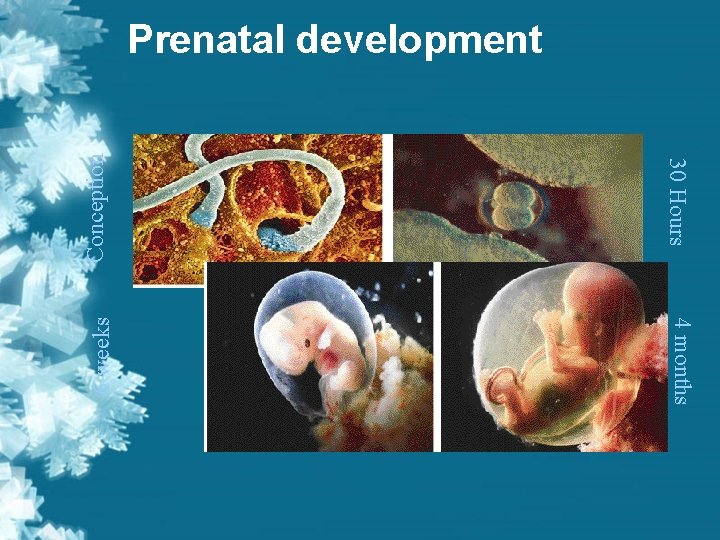
Conception 30 Hours 6 weeks Prenatal development 4 months
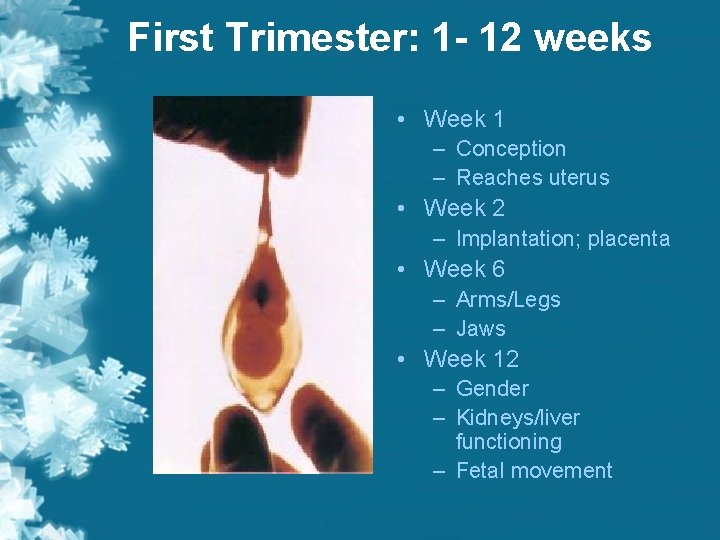
First Trimester: 1 - 12 weeks • Week 1 – Conception – Reaches uterus • Week 2 – Implantation; placenta • Week 6 – Arms/Legs – Jaws • Week 12 – Gender – Kidneys/liver functioning – Fetal movement
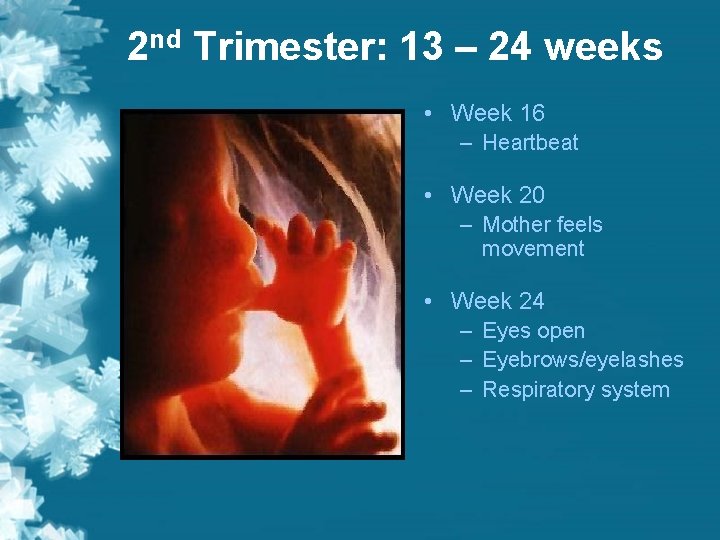
2 nd Trimester: 13 – 24 weeks • Week 16 – Heartbeat • Week 20 – Mother feels movement • Week 24 – Eyes open – Eyebrows/eyelashes – Respiratory system
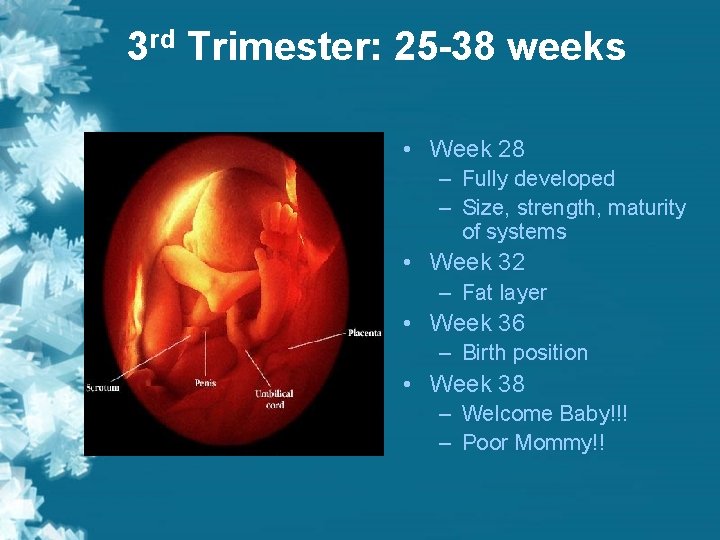
3 rd Trimester: 25 -38 weeks • Week 28 – Fully developed – Size, strength, maturity of systems • Week 32 – Fat layer • Week 36 – Birth position • Week 38 – Welcome Baby!!! – Poor Mommy!!
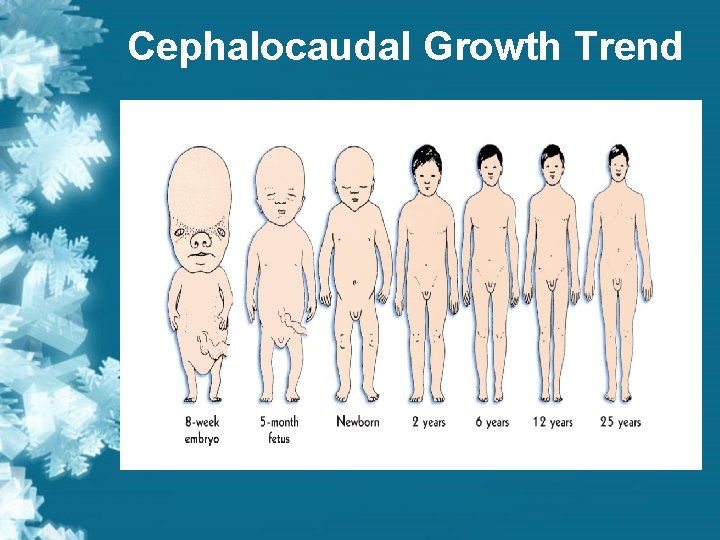
Growth after Birth • Cephalocaudal Trend – Head to tail • Proximadistal Trend – near to far
Cephalocaudal Growth Trend
Physical Abilities • Newborn Reflexes – Rooting – Sucking – Moro (“startle”) – Babinski – Grasp – Eye Blink – Plantar
Perception in Infancy • Fantz (1961) designed a technique to study infant perception • Present two stimuli simultaneously and see if infant looks at one longer • A longer gaze indicates infant can tell the difference between the two stimuli
Perception in Infancy • The technique indicates that infants prefer: – curved patterns over straight patterns – complex patterns over simple patterns – Normal faces over random face patterns • By 7 months, infants can recognize happy faces and sounds and discriminate between them
Perception in Infancy • The Visual Cliff examines infants’ depth perception • Infant crawls on a glass surface, half of which is covered with checkerboard • 9 -month-olds avoid the transparent surface, demonstrating depthperception
Coming Next Week!! • Piaget & Cognitive Development • Eriksen & Psychosocial Development • Our first Lab Activity & Assignment • READ CHAPTER 10!!
The End!! Have a Good Week