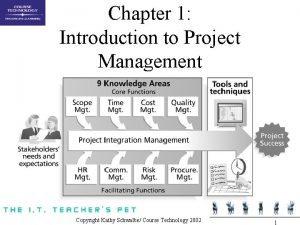
Introduction to Project Management Project Closure and Transition
- Slides: 19
Introduction to Project Management Project Closure and Transition Lecture a This material (Comp 19 Unit 11) was developed by Johns Hopkins University, funded by the Department of Health and Human Services, Office of the National Coordinator for Health Information Technology under Award Number IU 24 OC 000013. This material was updated in 2016 by Johns Hopkins University under Award Number 90 WT 0005. This work is licensed under the Creative Commons Attribution-Non. Commercial-Share. Alike 4. 0 International License. To view a copy of this license, visit http: //creativecommons. org/licenses/by-nc-sa/4. 0/.
Project Closure and Transition Learning Objectives—Lecture a • Bring project activities to a close. • Conclude the customer acceptance process. • Document and archive lessons learned. • Update and close out project documents. • Manage transition to operations. 2
The End (of the Project) Is Near! After so much hard work, you want to end the project on a high note! • Execute project closing processes with extra care and attention— – Closure processes are important in the PMBOK® – one of the five Process Groups – Effective closing is critical to declaring the project a success 3
First Steps in Project Closing Revisit the Project Charter and Project Management Plan: – What marks the conclusion of the project? – How were the products of your project to be transitioned to operational use? Is it part of your project? o Is there a hand-off to a separate project or organization? o – Don’t give in to scope creep at this late stage by doing work that is not included in your project ! 4
Review Prior Phases, Activities, and Deliverables Review the results of closure of prior individual phases: • Are there any outstanding issues? Identify all ongoing activities: • Are they on track to complete on time and within budget? Identify deliverables still outstanding • Will they be completed on time? 5
Organize the Project Closing Activities Prepare step-by-step task list, guided by the PMP. Apply extra management attention to ensure the completion of ongoing activities and deliverables. Identify and manage the risks to a successful project completion. 6
Close Out Procurements • Ensure that all procurement contracts are closed: Has contracted work been performed? o Have materials and products been received? o Have vendors been paid? o Are there open claims or disputes? o • Refer to your legal office for assistance! 7
Conclude the Customer Acceptance Process Revisit Project Charter—what were the acceptance criteria for the project? • Does the charter call for acceptance testing process by the customer? – Specific procedures for tests of deliverables to be conducted by the customer – Clearly defined required outcomes from the tests – Sign off by the acceptance test team 8
Customer Acceptance Document Used to formally record the customer’s acceptance that the project is concluded Contents: – Statement that the— o Customer accepts project deliverables o Project has been completed to the customer’s satisfaction – Signed by the customer – Optional Section — or, better yet, a separate document – Comments by the customer about the project 9
Final Project Presentation to the Customer Part of the customer acceptance process may include your team making a final presentation to the customer Summarize the project and its outcomes: • Project Charter—what was the business need? • Highlights of the project execution • Accomplishments—how the project and its products met the business need 10
Why Document the Project? Provide an historical reference for the organization • Create a comprehensive final report • Support education and training for future projects • Provide examples of PM documents • Capture lessons learned • Support continuous improvement 11
Sample Contents of Final Project Report • Original Project Information: Charter, business need, project objectives • Project Execution: Compare planned and actual outcomes, budget, schedule, deliverables • Assessment of project and what it accomplished for the customer • References: Project Charter, Project Management Plan, WBS, etc. 12
Project Documentation Supports Organizational Learning Documenting the project contributes to the training of future PMs: • Tracking the planned vs. actual expenditures – Can cost estimation models be improved? • Recording experiences using document templates – Should the templates be modified based on your experiences? • Capturing issues and their resolution – Can future PMs learn from how you handled problems and challenges? 13
Document Your Lessons Learned Who is the audience? • Future PMs and project teams Sample Contents: • What worked well? Why? • What didn’t work? Why not? • What would you do differently? Add your lessons learned to an online database in your organization—searchable by future PMs 14
How to Capture Lessons Learned • Don’t wait until the end of the project— capture lessons at project milestones • Draft a document with team members contributing • Consider alternatives to “yet another” document: – Conduct facilitated meetings—get all the lessons captured together as a team – Record your lessons learned in audio files ! 15
Manage Transition to Operations • For your project to have beneficial effects, the products of your project must get implemented • The challenge is to get these products integrated into an ongoing operational environment—in critical health-care settings • Close collaboration with operational managers is essential 16
Project Closure and Transition Summary—Lecture a In this unit we learned to: • Wrap up project activities. • Finish the customer acceptance process. • Document and archive lessons learned. • Update and close out project documents. • Manage the transition to operations. 17
Project Closure and Transition References—Lecture a References • Fleming Q. (2003). Project procurement management: contracting, subcontracting, teaming. 1 st ed. FMC Press. • Health Information and Management System Society. Chicago, IL. 2010. Available from: http: //www. himss. org • Houston S, Bove LA. (2010). Project management for healthcare informatics. Springer Science + Business Media, LLC; • Kerzner H. (2009). Project management: a systems approach to planning, scheduling, and controlling. 10 th ed. New York: Wiley. • Liebowitz J. (1999) Key ingredients to the success of an organization’s knowledge management strategy. Knowledge and process management. (6: 1), pp. 37 -40. • A Guide to the Project Management Body of Knowledge: (pmbok Guide). 5 th ed. Newtown Square, Pa. : Project Management Institute, 2013 • Schwalbe K. Information technology project management. 8 th ed. ; Cambridge, MA: Course Technology; 2015. • Stackpole C. (2013). A User’s Manual to the PMBOK Guide. 2 nd Ed. Wiley. • Stackpole C. (2013). A project manager’s book of forms: a companion to the PMBOK guide. 2 nd Ed. New York: Wiley. • Wysocki, RK. (2013). Effective project management: traditional, agile, extreme. 7 th 18 Edition. New York: Wiley.
Introduction to Project Management Project Closure and Transition Lecture a This material (Comp 19 Unit 11) was developed by Johns Hopkins University, funded by the Department of Health and Human Services, Office of the National Coordinator for Health Information Technology under Award Number IU 24 OC 000013. This material was updated in 2016 by Johns Hopkins University under Award Number 90 WT 0005. 19