INTRODUCTION TO HANYU PINYIN Andrea Lay Freshman English


- Slides: 27
INTRODUCTION TO HANYU PINYIN Andrea Lay 賴宜謙 Freshman English Spring 2017
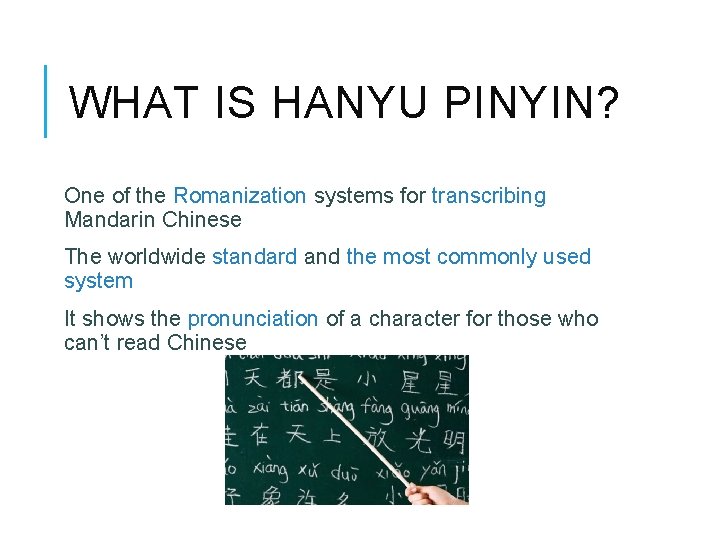
WHAT IS HANYU PINYIN? One of the Romanization systems for transcribing Mandarin Chinese The worldwide standard and the most commonly used system It shows the pronunciation of a character for those who can’t read Chinese
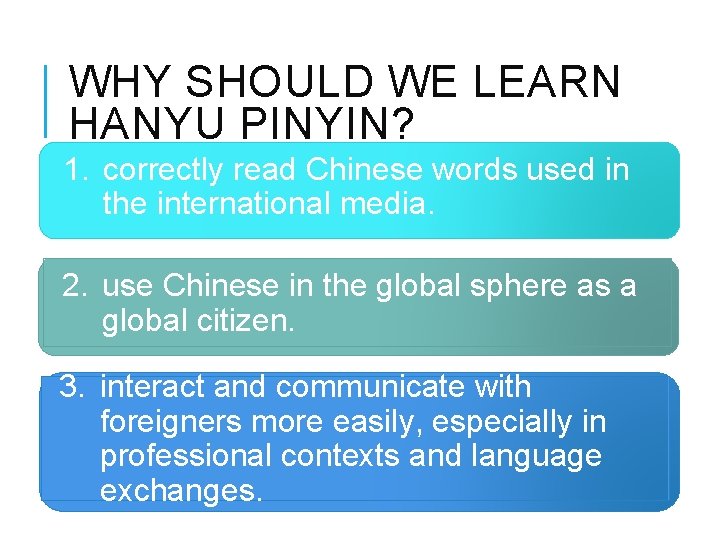
WHY SHOULD WE LEARN HANYU PINYIN? 1. correctly read Chinese words used in the international media. 2. use Chinese in the global sphere as a global citizen. 3. interact and communicate with foreigners more easily, especially in professional contexts and language exchanges.
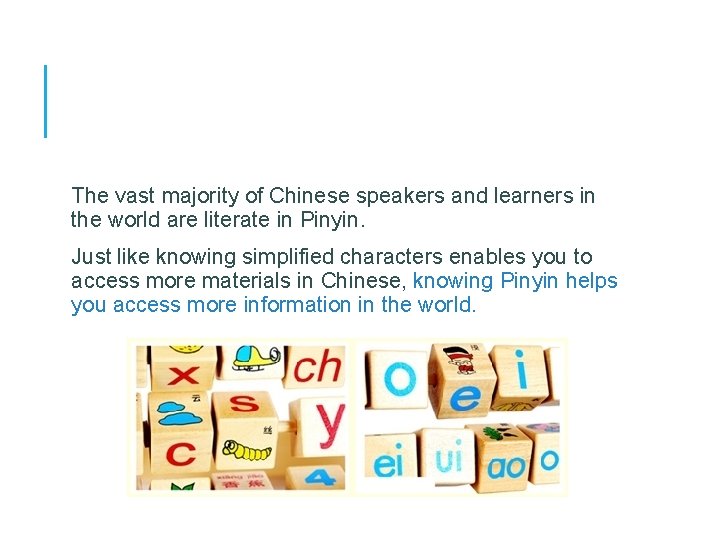
The vast majority of Chinese speakers and learners in the world are literate in Pinyin. Just like knowing simplified characters enables you to access more materials in Chinese, knowing Pinyin helps you access more information in the world.
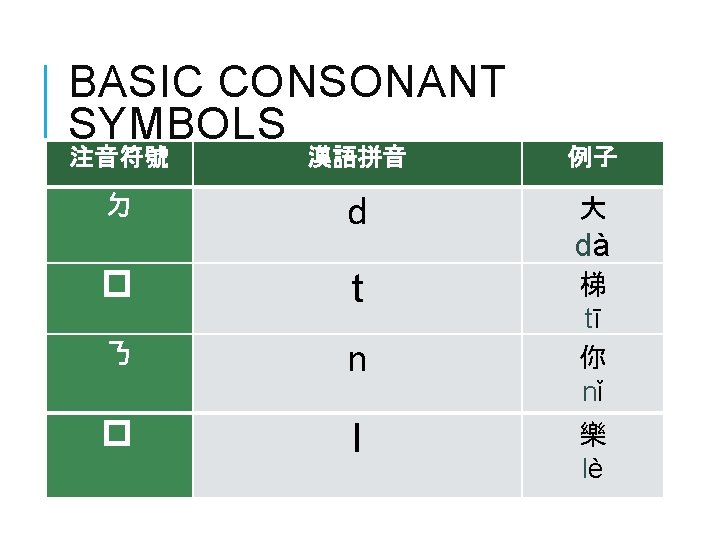
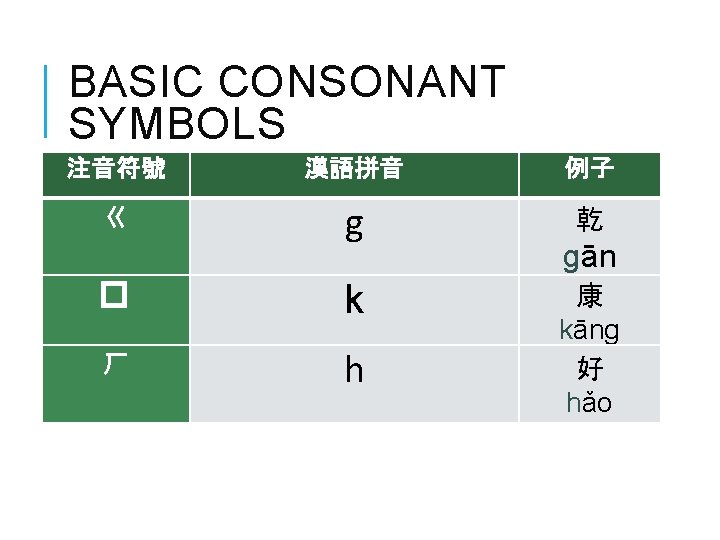
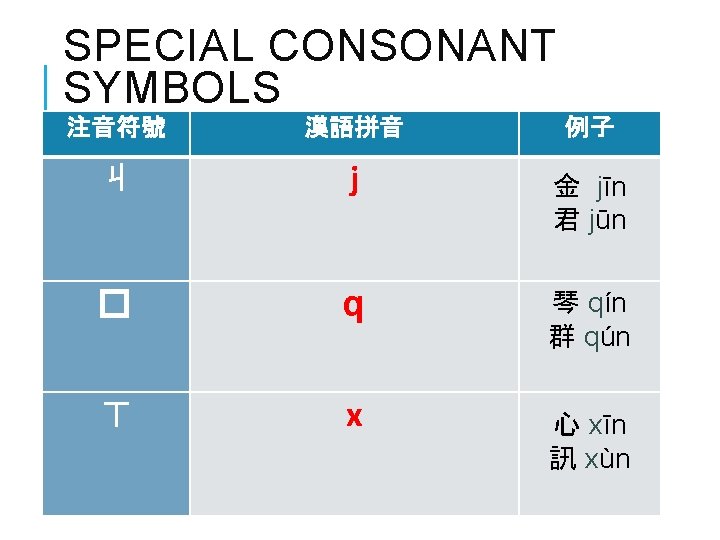
LET’S LEARN HANYU PINYIN
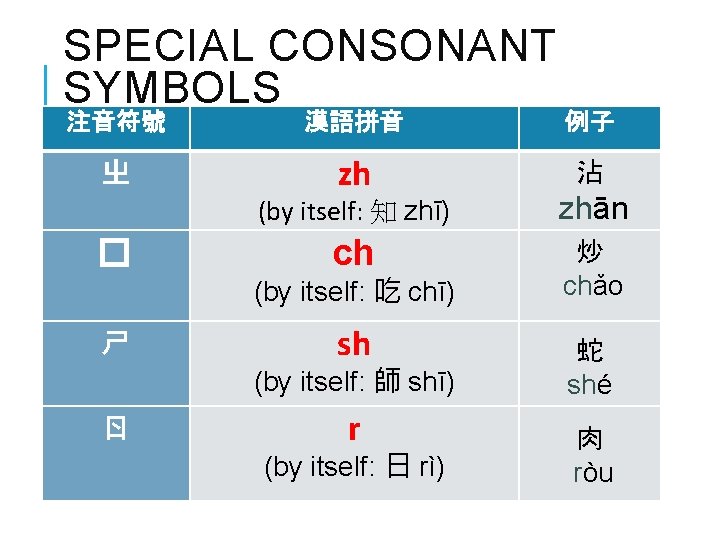
SPECIAL CONSONANT SYMBOLS 注音符號 漢語拼音 例子 ㄓ zh 沾 � (by itself: 知 zhī) zhān ch 炒 chǎo (by itself: 吃 chī) ㄕ ㄖ sh (by itself: 師 shī) r (by itself: 日 rì) 蛇 shé 肉 ròu
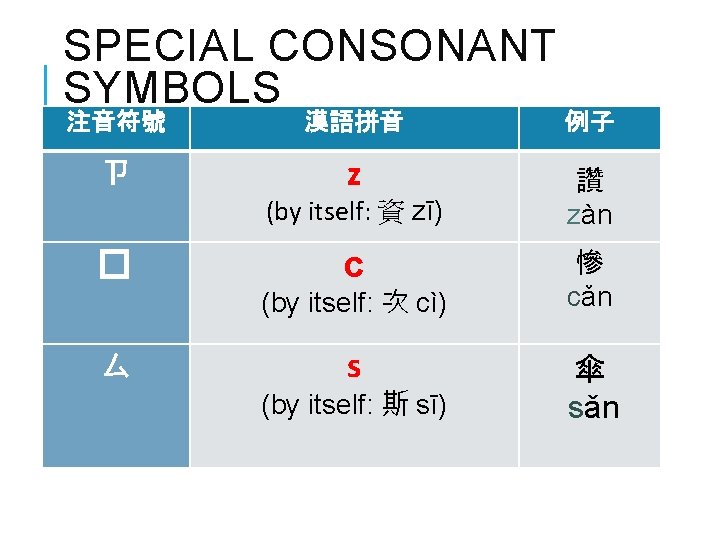
SPECIAL CONSONANT SYMBOLS 注音符號 漢語拼音 ㄗ z � (by itself: 資 zī) 讚 zàn c 慘 cǎn s 傘 sǎn (by itself: 次 cì) ㄙ 例子 (by itself: 斯 sī)
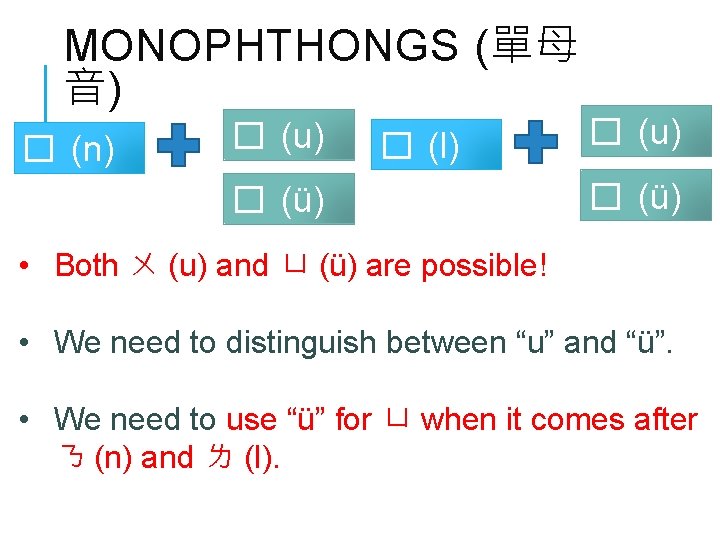
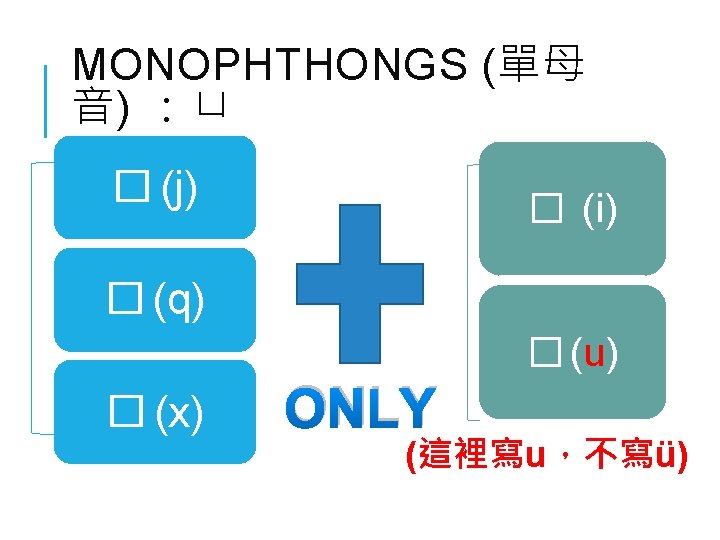
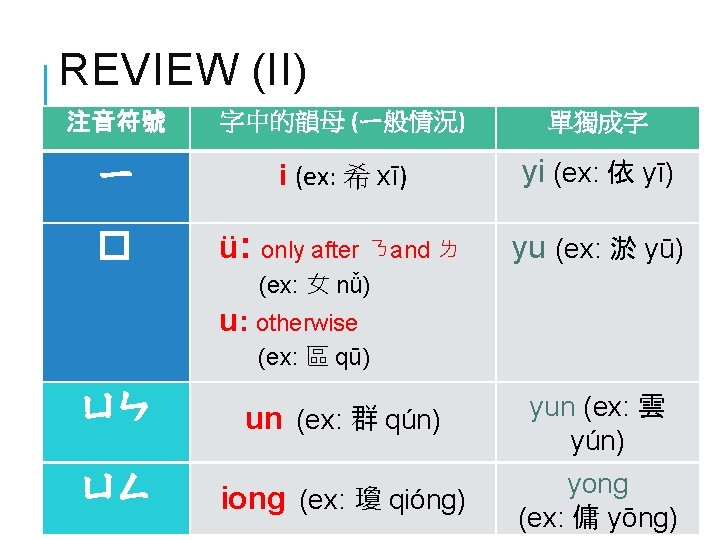
MONOPHTHONGS (單母 音) � (n) � (u) � (l) � (ü) � (u) � (ü) • Both ㄨ (u) and ㄩ (ü) are possible! • We need to distinguish between “u” and “ü”. • We need to use “ü” for ㄩ when it comes after ㄋ (n) and ㄌ (l).
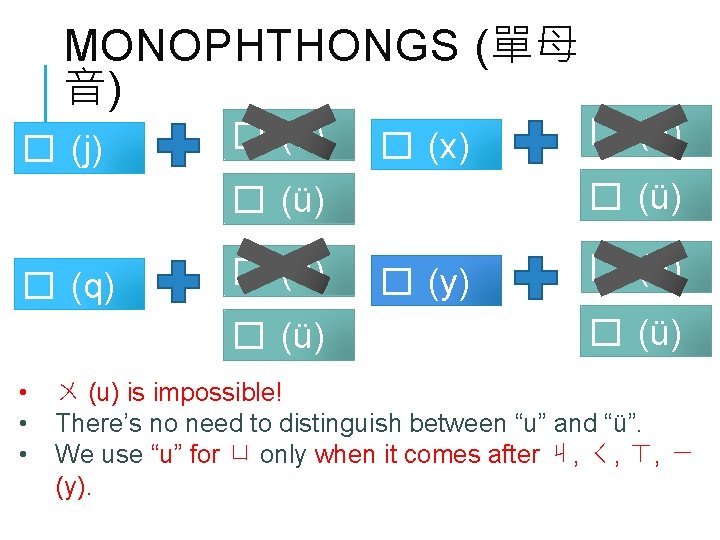
MONOPHTHONGS (單母 音) � (j) � (u) � (x) � (ü) � (q) � (u) � (ü) • • • � (u) � (y) � (u) � (ü) ㄨ (u) is impossible! There’s no need to distinguish between “u” and “ü”. We use “u” for ㄩ only when it comes after ㄐ, ㄑ, ㄒ, ㄧ (y).
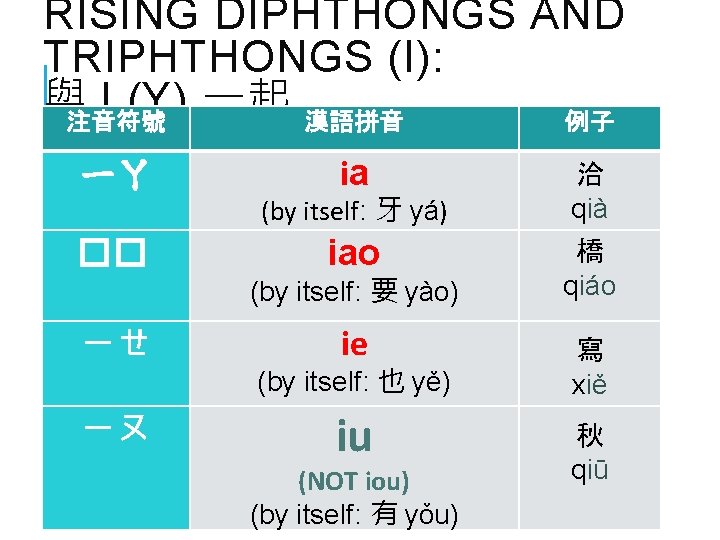
RISING DIPHTHONGS AND TRIPHTHONGS (I): 與注音符號 I (Y) 一起 漢語拼音 例子 ㄧㄚ �� ia 洽 qià iao 橋 qiáo (by itself: 牙 yá) (by itself: 要 yào) ㄧㄝ ㄧㄡ ie (by itself: 也 yě) iu (NOT iou) (by itself: 有 yǒu) 寫 xiě 秋 qiū
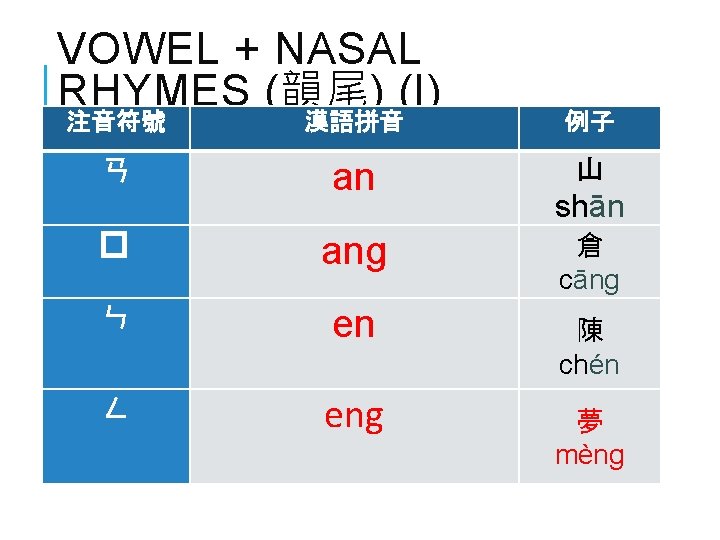
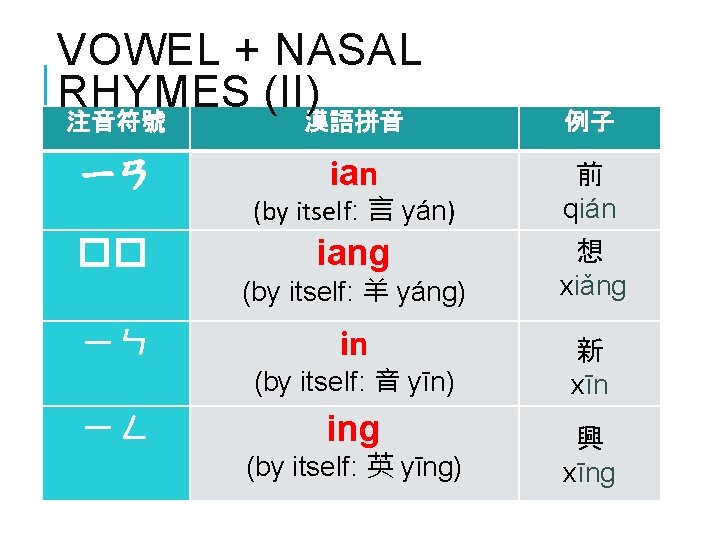
VOWEL + NASAL RHYMES (II) 注音符號 漢語拼音 例子 ㄧㄢ ian 前 qián iang 想 xiǎng �� (by itself: 言 yán) (by itself: 羊 yáng) ㄧㄣ ㄧㄥ in (by itself: 音 yīn) ing (by itself: 英 yīng) 新 xīn 興 xīng
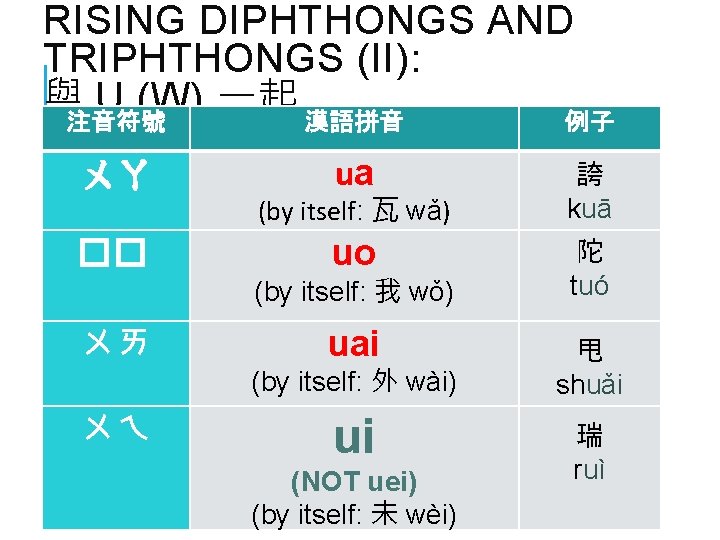
RISING DIPHTHONGS AND TRIPHTHONGS (II): 與注音符號 U (W) 一起 漢語拼音 例子 ㄨㄚ �� ua 誇 kuā uo 陀 tuó uai 甩 shuǎi ui 瑞 ruì (by itself: 瓦 wǎ) (by itself: 我 wǒ) ㄨㄞ ㄨㄟ (by itself: 外 wài) (NOT uei) (by itself: 未 wèi)
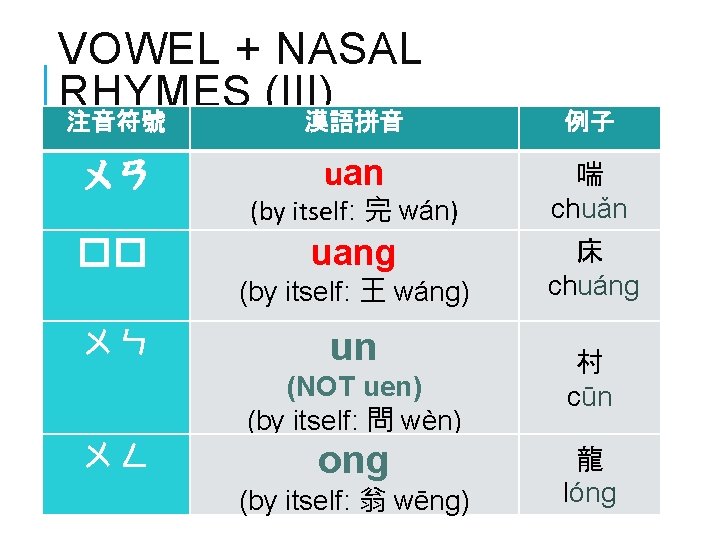
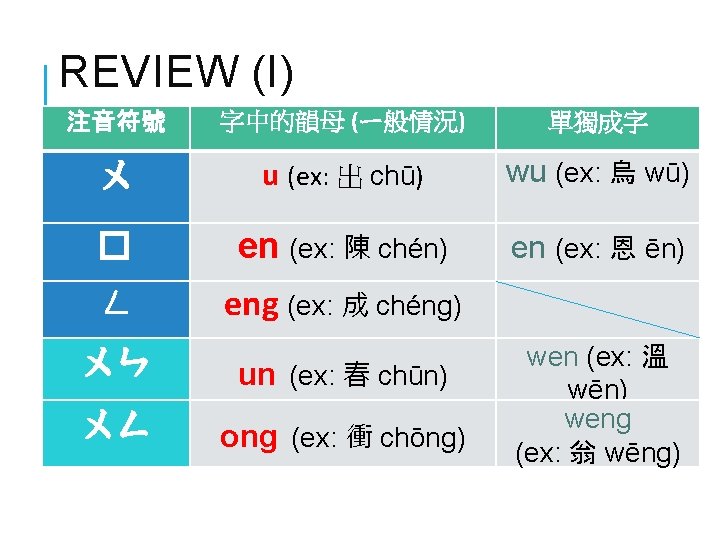
VOWEL + NASAL RHYMES (III) 注音符號 漢語拼音 例子 ㄨㄢ uan 喘 chuǎn uang 床 chuáng �� (by itself: 完 wán) (by itself: 王 wáng) ㄨㄣ ㄨㄥ un (NOT uen) (by itself: 問 wèn) ong (by itself: 翁 wēng) 村 cūn 龍 lóng
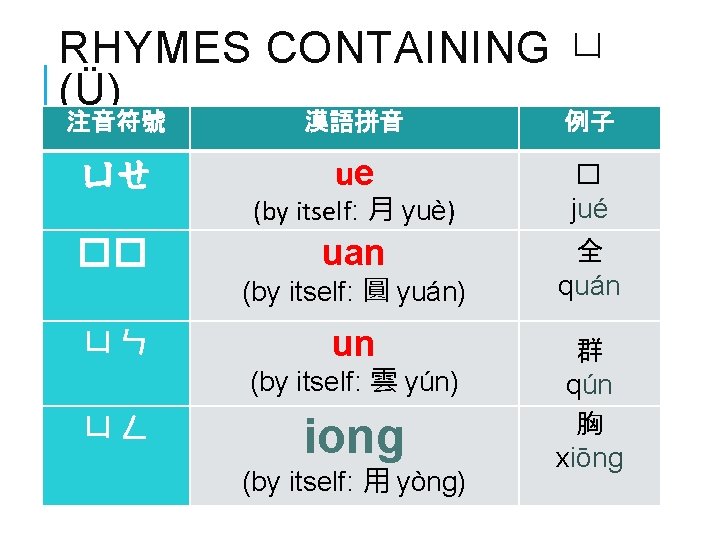
RHYMES CONTAINING ㄩ (Ü) 注音符號 漢語拼音 例子 ㄩㄝ ue � jué uan 全 quán un 群 qún 胸 xiōng �� (by itself: 月 yuè) (by itself: 圓 yuán) ㄩㄣ ㄩㄥ (by itself: 雲 yún) iong (by itself: 用 yòng)
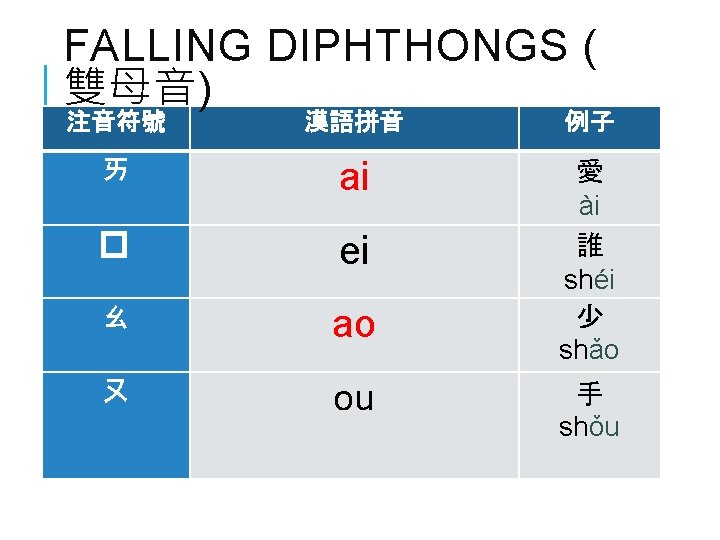
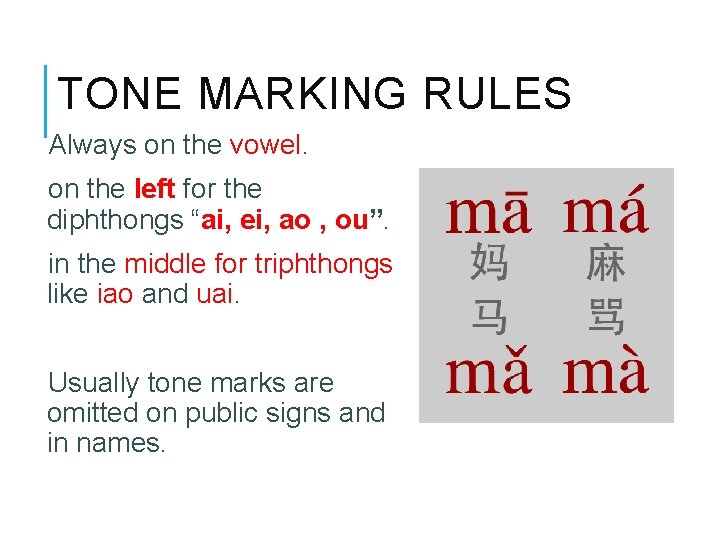
TONE MARKING RULES Always on the vowel. on the left for the diphthongs “ai, ei, ao , ou”. in the middle for triphthongs like iao and uai. Usually tone marks are omitted on public signs and in names.
THANK YOU!