Introduction to discussion on Climate Change Richard Wilson
- Slides: 9
Introduction to discussion on Climate Change Richard Wilson Harvard University
p p p p p Nino constantly insists that proof of anthropogenic climate change is weak. It is not a repeatable experiment unlike astronomy it does not repeat itself. Can we improve the evidence for or against? Does it matter whether it is man made or naturally occurring? I suggest that we should carry out any experiments Seriously suggested to clarify the situation Should we do something? I will go over my questions.
p Energy costs are about 1/3 of our budgets. p Burning carbon by or for us maybe 1/4
The conventional view p p p p p Before 1800 Earth absorbs radiation from the sun Re-emits as black body Temperature calculated to be about T 200 degrees K 1824 Jacques Fourier proposes that the earth is a greenhouse T = 200 x 2^(0. 25) Circa 1870 Tyndall and others: H 20 and CO 2 greenhouses gases 1897 Arrhenius calculates relation between CO 2 and temperature About 1930 mixing between surface ocean and deep oceans is weak If t ~ 700 yrs then a problem, if 70 years mixing will prevent excessive rise 1946 Dobson’s lectures in Oxford makes predictions
p p p p 1968 + Keeling’s measurements of CO 2 in Mauna Loa 1968 Glenn Seaborg tells Congress: Nuclear power will NOT cause CO 2 increase 1970+ Scientists continually raise the issue: politicians do nothing 1986 Hansen (NASA) thinks we should do something. Temperature rise estimates for doubling CO 2 average 3 degrees - might be 10 degrees. Is that a probability ? What does that mean? 1990 computer calculations agree. But is this because they all make the same mistake?
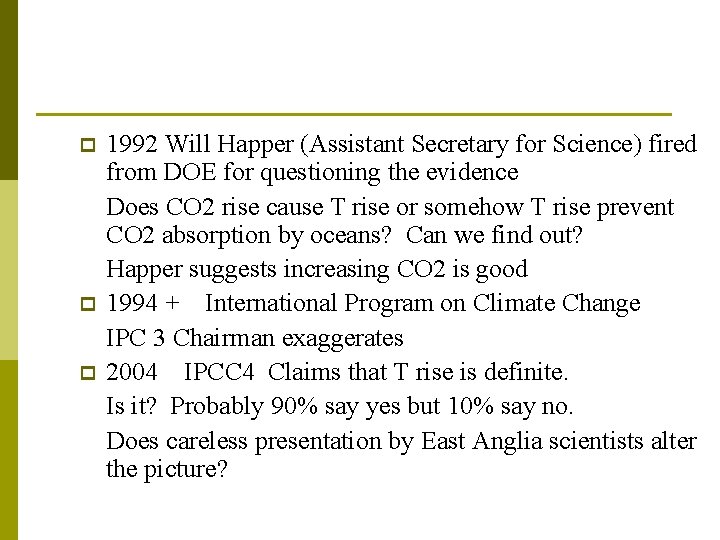
p p p 1992 Will Happer (Assistant Secretary for Science) fired from DOE for questioning the evidence Does CO 2 rise cause T rise or somehow T rise prevent CO 2 absorption by oceans? Can we find out? Happer suggests increasing CO 2 is good 1994 + International Program on Climate Change IPC 3 Chairman exaggerates 2004 IPCC 4 Claims that T rise is definite. Is it? Probably 90% say yes but 10% say no. Does careless presentation by East Anglia scientists alter the picture?
p p If T rise is uncertain The effect in the environment is more uncertain. p What is the effect of a different discount rate?
what do we recommend? p Carry out any scientific study that clarifies the situation p Rethinking data on T rise (T Quirk at this meeting) p Do anything cheap to reduce C burning? p Study the effects p Sit on our Hands? (Michaels) p
Enough of my questions What do you say?