Intonation of parentheses Intonation of parentheses Utterances may
- Slides: 11
Intonation of parentheses
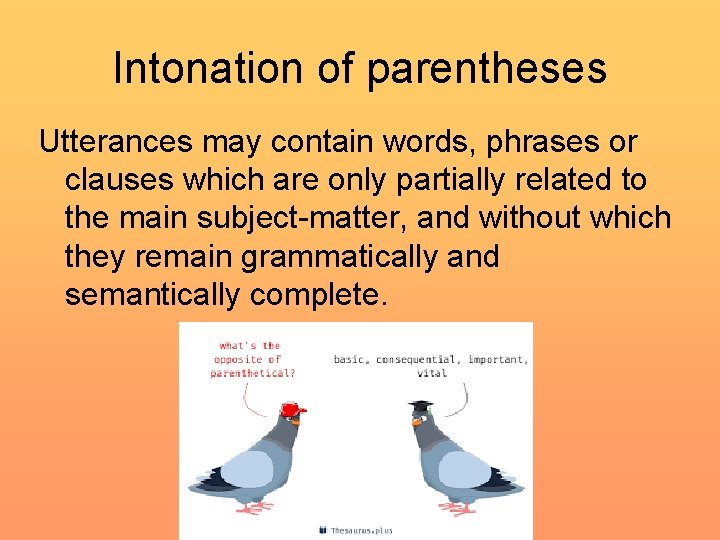
Intonation of parentheses Utterances may contain words, phrases or clauses which are only partially related to the main subject-matter, and without which they remain grammatically and semantically complete.
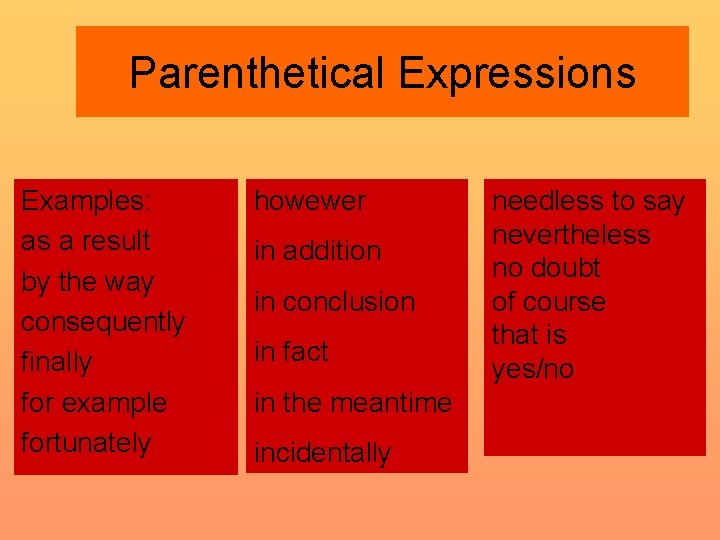
Parenthetical Expressions Examples: as a result by the way consequently finally for example fortunately howewer in addition in conclusion in fact in the meantime incidentally needless to say nevertheless no doubt of course that is yes/no
Such words, phrases or clauses, generally known as adjections, fall into three classes: 1. Parentheses; 2. Direct address; 3. Reporting Phrases.
• These words and phrases are often used in order to gain time while the speaker is framing out his remark or they show the speaker’s attitude (supposition, certainty, satisfaction, etc. ).
As a rule, at the beginning of the sentence parenthetical words and phrases form a separate sense-group and are generally pronounced with the rising tone. a) / Well, | we received a very interesting invitation.
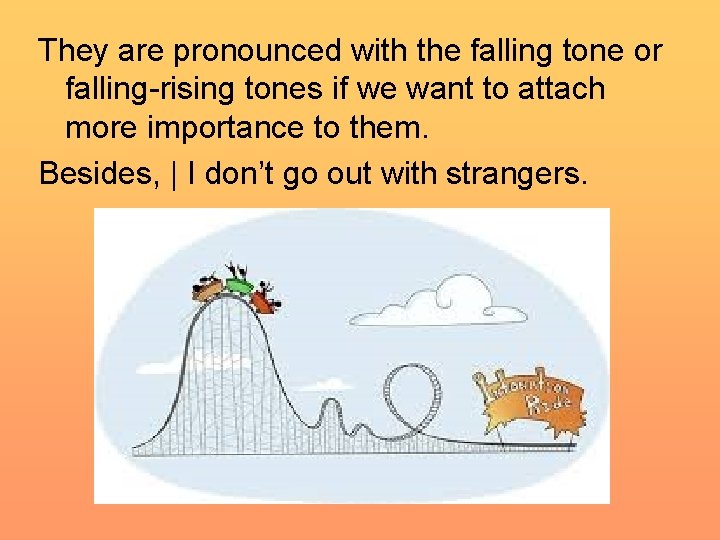
They are pronounced with the falling tone or falling-rising tones if we want to attach more importance to them. Besides, | I don’t go out with strangers.
When the speaker doesn’t attach any importance to the parenthetical words and phrases at all, they do not form a separate sense-group and are often unstressed. Well, I do. Well, let’s ask the others.
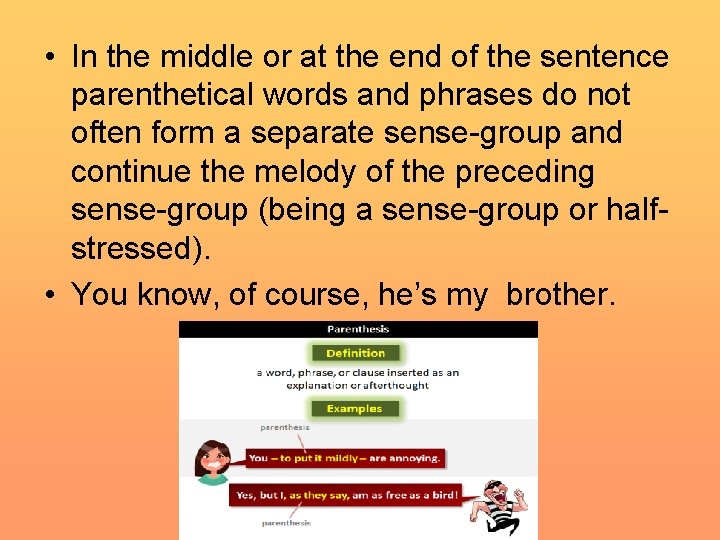
• In the middle or at the end of the sentence parenthetical words and phrases do not often form a separate sense-group and continue the melody of the preceding sense-group (being a sense-group or halfstressed). • You know, of course, he’s my brother.
• Fall+Rise is used sometimes in the middle to attach more importance • ” Well, my. dear, ” he /said, “it looks like you have arthritis. ”
• There are some parentheses that regularly take LOW FALL when initial, even though they are not obviously reinforcing. They can be seen as tonally idiomatic. Examples include at least and at any rate and also by the way and incidentally