International Campus Kish Sharif University of Technology Session
- Slides: 22
International Campus – Kish Sharif University of Technology Session # 3
§ Instructor § Omid Fatahi Valilai, Ph. D. Industrial Engineering Department, Sharif University of Technology § Email: Omidf@ie. sharif. edu , Tel: 021 -6616 -5706 § Web site: http: //sharif. edu/~fvalilai § Class time § Wednesdays § Course evaluation § § Mid-term Final exam Quiz Exercise (30%) (40%) (10%) (20%) International Campus – Kish, Sharif University of Technology PM (Project Management), Session #3 2
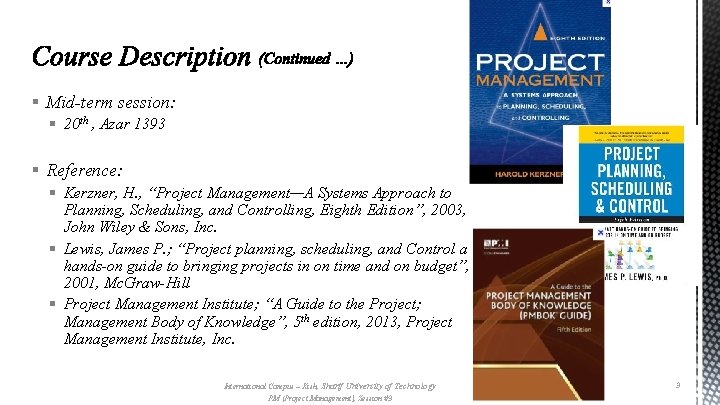
§ Mid-term session: § 20 th , Azar 1393 § Reference: § Kerzner, H. , “Project Management—A Systems Approach to Planning, Scheduling, and Controlling, Eighth Edition”, 2003, John Wiley & Sons, Inc. § Lewis, James P. ; “Project planning, scheduling, and Control a hands-on guide to bringing projects in on time and on budget”, 2001, Mc. Graw-Hill § Project Management Institute; “A Guide to the Project; Management Body of Knowledge”, 5 th edition, 2013, Project Management Institute, Inc. International Campus – Kish, Sharif University of Technology PM (Project Management), Session #3 3
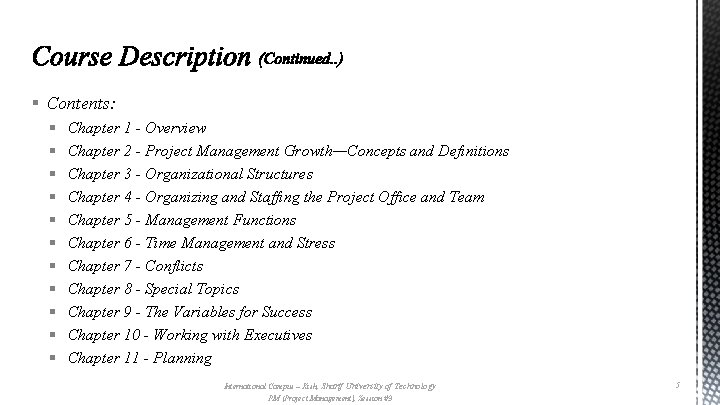
§ Contents: § § § Chapter 1 - Overview Chapter 2 - Project Management Growth—Concepts and Definitions Chapter 3 - Organizational Structures Chapter 4 - Organizing and Staffing the Project Office and Team Chapter 5 - Management Functions Chapter 6 - Time Management and Stress Chapter 7 - Conflicts Chapter 8 - Special Topics Chapter 9 - The Variables for Success Chapter 10 - Working with Executives Chapter 11 - Planning International Campus – Kish, Sharif University of Technology PM (Project Management), Session #3 5
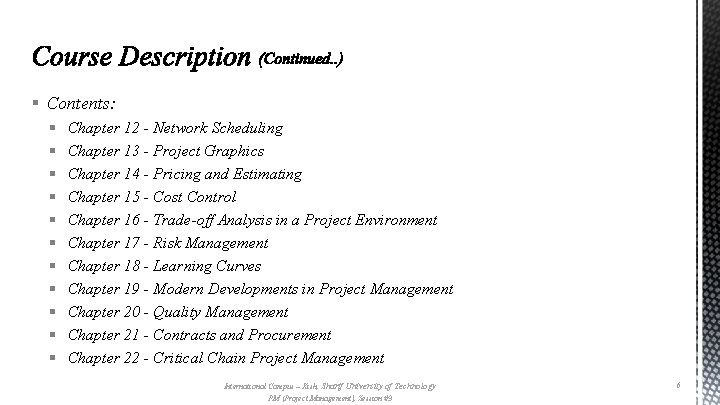
§ Contents: § § § Chapter 12 - Network Scheduling Chapter 13 - Project Graphics Chapter 14 - Pricing and Estimating Chapter 15 - Cost Control Chapter 16 - Trade-off Analysis in a Project Environment Chapter 17 - Risk Management Chapter 18 - Learning Curves Chapter 19 - Modern Developments in Project Management Chapter 20 - Quality Management Chapter 21 - Contracts and Procurement Chapter 22 - Critical Chain Project Management International Campus – Kish, Sharif University of Technology PM (Project Management), Session #3 6
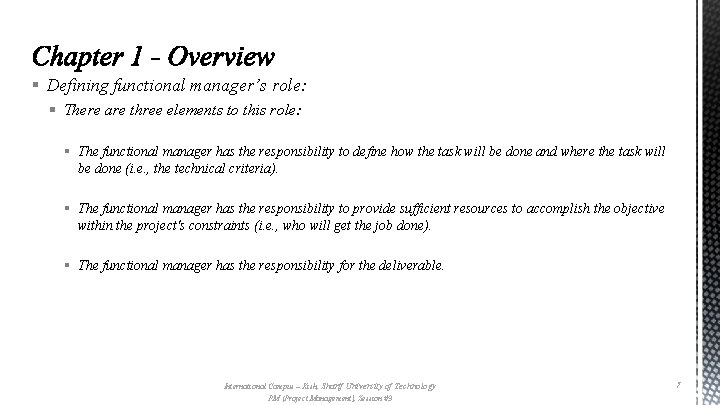
§ Defining functional manager’s role: § There are three elements to this role: § The functional manager has the responsibility to define how the task will be done and where the task will be done (i. e. , the technical criteria). § The functional manager has the responsibility to provide sufficient resources to accomplish the objective within the project's constraints (i. e. , who will get the job done). § The functional manager has the responsibility for the deliverable. International Campus – Kish, Sharif University of Technology PM (Project Management), Session #3 7
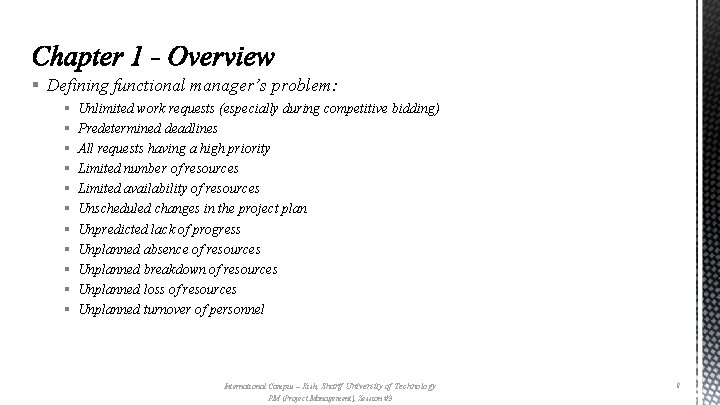
§ Defining functional manager’s problem: § § § Unlimited work requests (especially during competitive bidding) Predetermined deadlines All requests having a high priority Limited number of resources Limited availability of resources Unscheduled changes in the project plan Unpredicted lack of progress Unplanned absence of resources Unplanned breakdown of resources Unplanned loss of resources Unplanned turnover of personnel International Campus – Kish, Sharif University of Technology PM (Project Management), Session #3 8
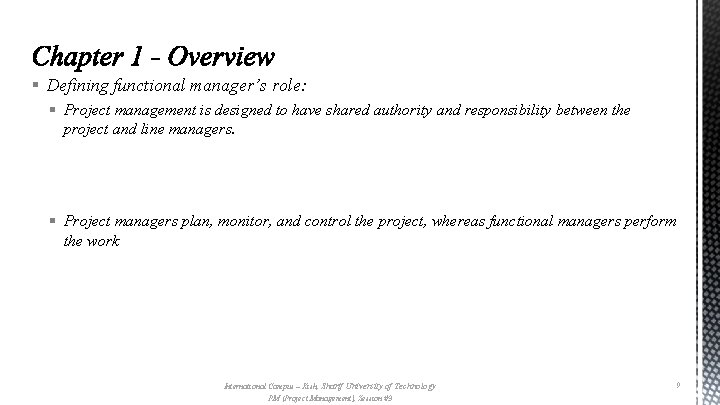
§ Defining functional manager’s role: § Project management is designed to have shared authority and responsibility between the project and line managers. § Project managers plan, monitor, and control the project, whereas functional managers perform the work International Campus – Kish, Sharif University of Technology PM (Project Management), Session #3 9
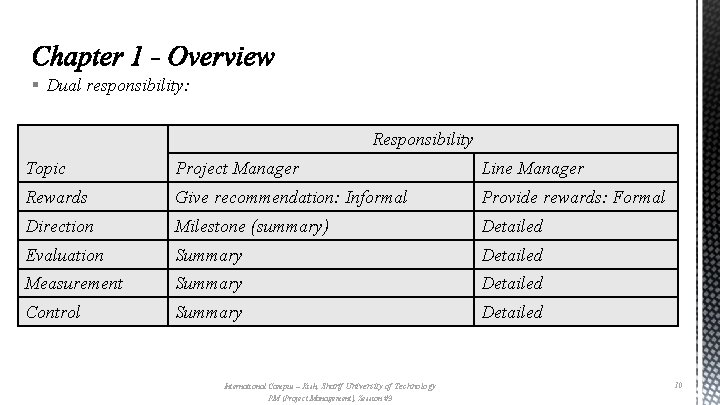
§ Dual responsibility: Responsibility Topic Project Manager Line Manager Rewards Give recommendation: Informal Provide rewards: Formal Direction Milestone (summary) Detailed Evaluation Summary Detailed Measurement Summary Detailed Control Summary Detailed International Campus – Kish, Sharif University of Technology PM (Project Management), Session #3 10
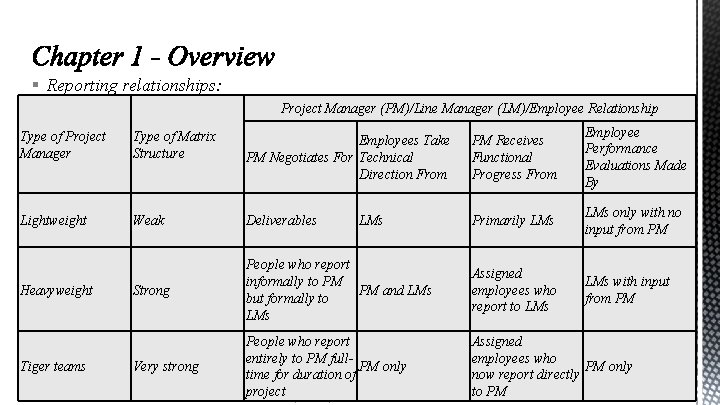
§ Reporting relationships: Project Manager (PM)/Line Manager (LM)/Employee Relationship Type of Project Manager Type of Matrix Structure Employees Take PM Negotiates For Technical Direction From PM Receives Functional Progress From Employee Performance Evaluations Made By Lightweight Weak Deliverables Primarily LMs only with no input from PM Strong People who report informally to PM PM and LMs but formally to LMs Assigned employees who report to LMs with input from PM Heavyweight Tiger teams Very strong LMs People who report entirely to PM full. PM only time for duration of International Campus – Kish, Sharif University of Technology project PM (Project Management), Session #3 Assigned employees who PM only now report directly to PM 11
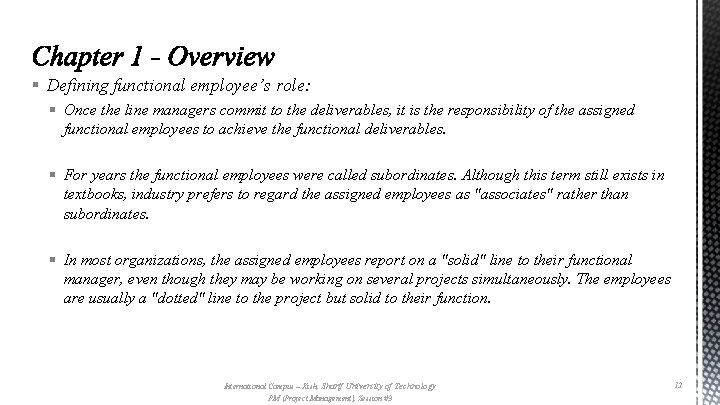
§ Defining functional employee’s role: § Once the line managers commit to the deliverables, it is the responsibility of the assigned functional employees to achieve the functional deliverables. § For years the functional employees were called subordinates. Although this term still exists in textbooks, industry prefers to regard the assigned employees as "associates" rather than subordinates. § In most organizations, the assigned employees report on a "solid" line to their functional manager, even though they may be working on several projects simultaneously. The employees are usually a "dotted" line to the project but solid to their function. International Campus – Kish, Sharif University of Technology PM (Project Management), Session #3 12
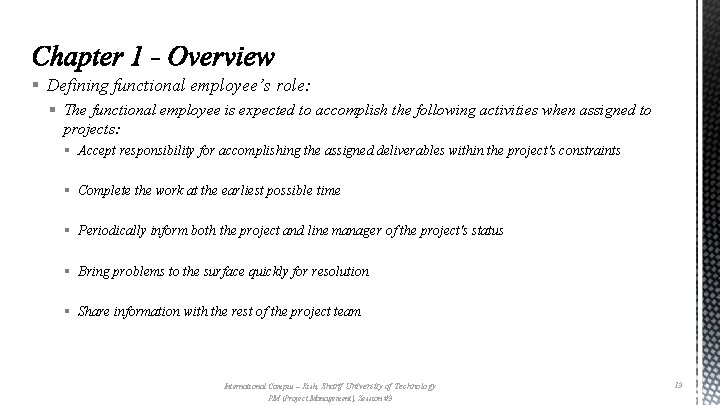
§ Defining functional employee’s role: § The functional employee is expected to accomplish the following activities when assigned to projects: § Accept responsibility for accomplishing the assigned deliverables within the project's constraints § Complete the work at the earliest possible time § Periodically inform both the project and line manager of the project's status § Bring problems to the surface quickly for resolution § Share information with the rest of the project team International Campus – Kish, Sharif University of Technology PM (Project Management), Session #3 13
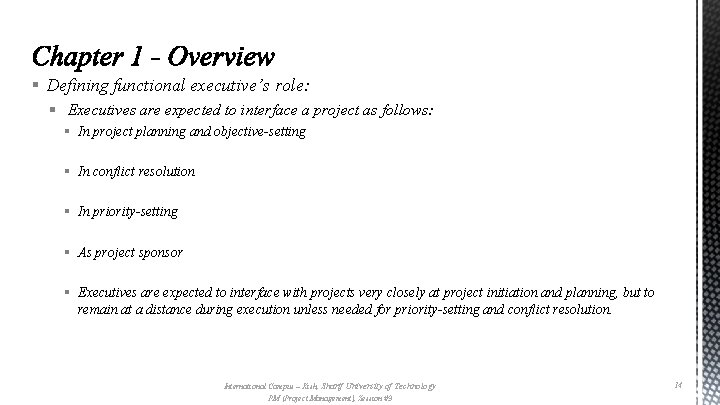
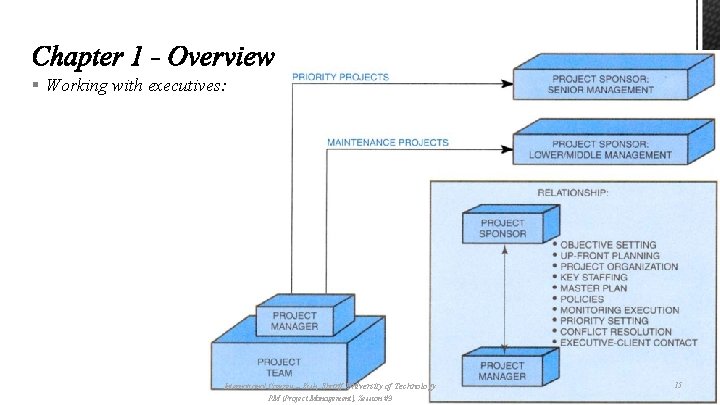
§ Defining functional executive’s role: § Executives are expected to interface a project as follows: § In project planning and objective-setting § In conflict resolution § In priority-setting § As project sponsor § Executives are expected to interface with projects very closely at project initiation and planning, but to remain at a distance during execution unless needed for priority-setting and conflict resolution. International Campus – Kish, Sharif University of Technology PM (Project Management), Session #3 14
§ Working with executives: International Campus – Kish, Sharif University of Technology PM (Project Management), Session #3 15
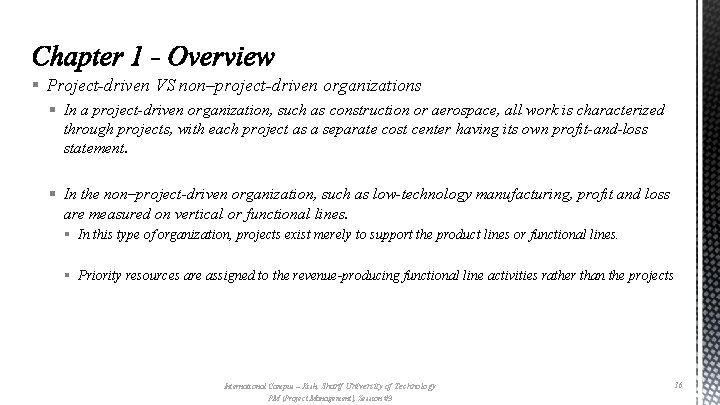
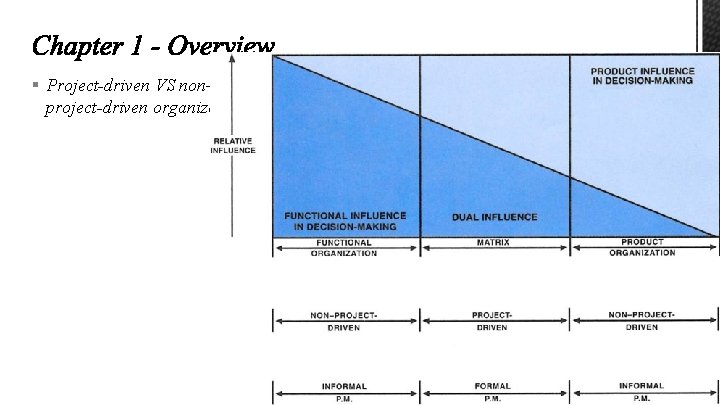
§ Project-driven VS non–project-driven organizations § In a project-driven organization, such as construction or aerospace, all work is characterized through projects, with each project as a separate cost center having its own profit-and-loss statement. § In the non–project-driven organization, such as low-technology manufacturing, profit and loss are measured on vertical or functional lines. § In this type of organization, projects exist merely to support the product lines or functional lines. § Priority resources are assigned to the revenue-producing functional line activities rather than the projects International Campus – Kish, Sharif University of Technology PM (Project Management), Session #3 16
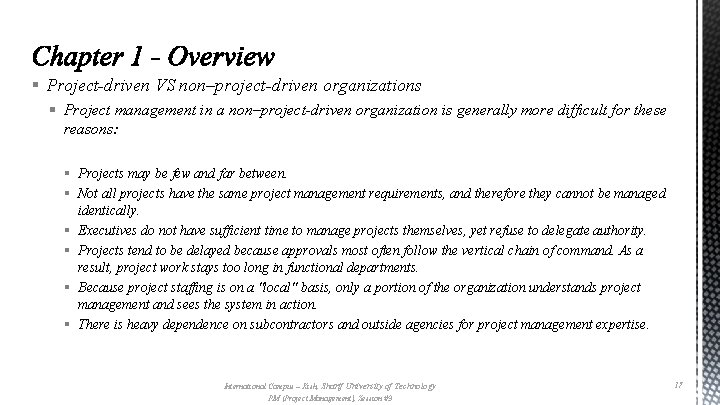
§ Project-driven VS non–project-driven organizations § Project management in a non–project-driven organization is generally more difficult for these reasons: § Projects may be few and far between. § Not all projects have the same project management requirements, and therefore they cannot be managed identically. § Executives do not have sufficient time to manage projects themselves, yet refuse to delegate authority. § Projects tend to be delayed because approvals most often follow the vertical chain of command. As a result, project work stays too long in functional departments. § Because project staffing is on a "local" basis, only a portion of the organization understands project management and sees the system in action. § There is heavy dependence on subcontractors and outside agencies for project management expertise. International Campus – Kish, Sharif University of Technology PM (Project Management), Session #3 17
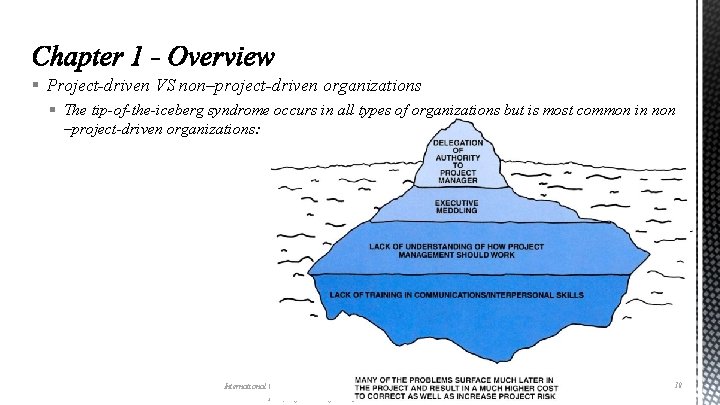
§ Project-driven VS non–project-driven organizations § The tip-of-the-iceberg syndrome occurs in all types of organizations but is most common in non –project-driven organizations: International Campus – Kish, Sharif University of Technology PM (Project Management), Session #3 18
§ Project-driven VS non– project-driven organizations International Campus – Kish, Sharif University of Technology PM (Project Management), Session #3 19
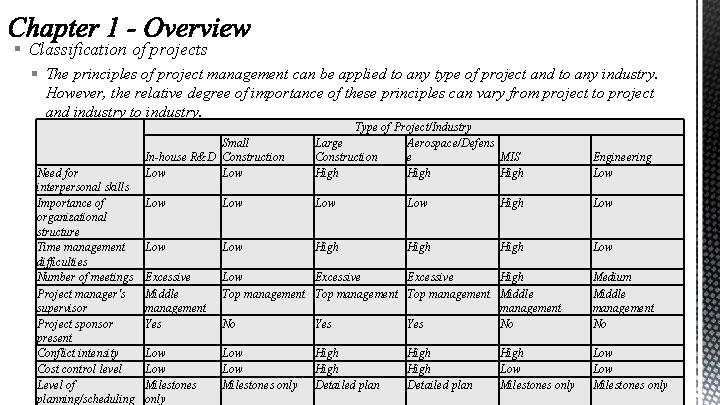
§ Classification of projects § The principles of project management can be applied to any type of project and to any industry. However, the relative degree of importance of these principles can vary from project to project and industry to industry. Need for interpersonal skills Importance of organizational structure Time management difficulties Number of meetings Project manager's supervisor Project sponsor present Conflict intensity Cost control level Level of planning/scheduling Small In-house R&D Construction Low Type of Project/Industry Large Aerospace/Defens Construction e MIS High Engineering Low Low Low High High Low Excessive Middle management Yes Low Excessive High Top management Middle management No Yes No Medium Middle management No Low Milestones only Low High Milestones only Detailed plan International Campus – Kish, Sharif University of Technology Low Milestones only PM (Project Management), Session #3 High Low Milestones only 20
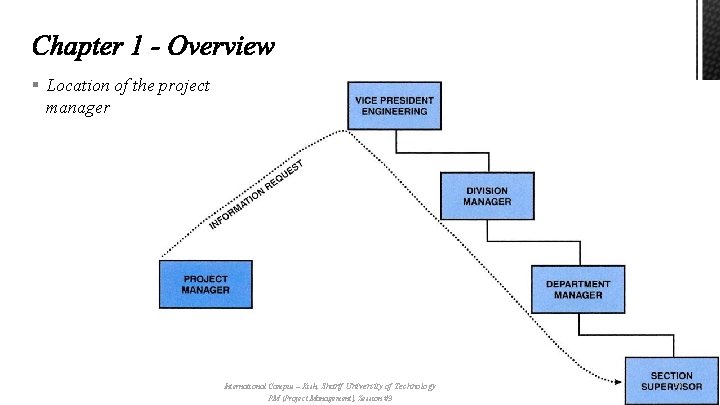
§ Location of the project manager International Campus – Kish, Sharif University of Technology PM (Project Management), Session #3 21
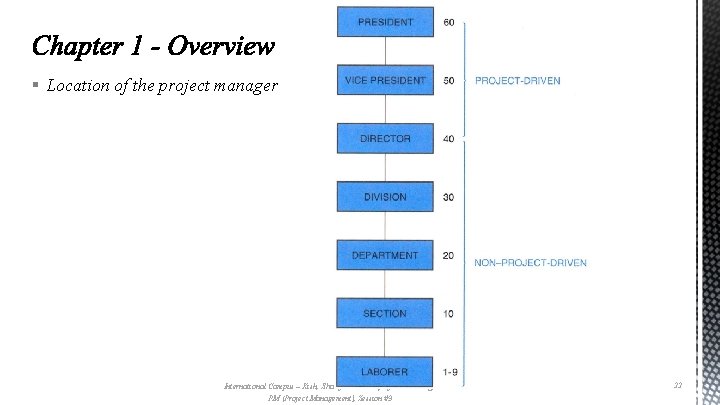
§ Location of the project manager International Campus – Kish, Sharif University of Technology PM (Project Management), Session #3 22
§ HW#01 § Consider the Chapter 1 problems and provide answers to the following questions: § Problem 1. 1, 1. 3, 1. 6, 1. 9, 1. 12, 1. 17 § Consider the case study in the chapter 1 and describe it based on your own understanding § The Home work should be sent to Fvalilai@sharif. edu till next session § Email subject: “KISH: PM: HW 01: studentnumber” International Campus – Kish, Sharif University of Technology PM (Project Management), Session #3 23