
Arden University Lunchtime Learning Events 10 May 18
- Slides: 14
Arden University Lunchtime Learning Events 10 May ’ 18 Tower Hill Campus, London – UK https: //abasiel. wordpress. com/elearning-r-d WHERE DO I START WITH MY RESEARCH? Top tips from a real-world case study Dr Lisa Arai Honorary Senior Research Associate Centre for Academic Primary Care School of Social and Community Medicine University of Bristol ~~~~~~~~~~~~~~~~~~~~~~~~ Contact: Dr. Anthony Basiel abasiel@arden. ac. uk © 2018 Arden University – Lunchtime Learning Events
Contents Part 1: https: //youtu. be/Nu 2 p. Ek. Bs. WQ 8 Download MP 4 file: http: //tinyurl. com/ybqw 8 vxn 1. Study background 2. Top tips 3. Summary 4. Q&A © 2018 Arden University – Lunchtime Learning Events
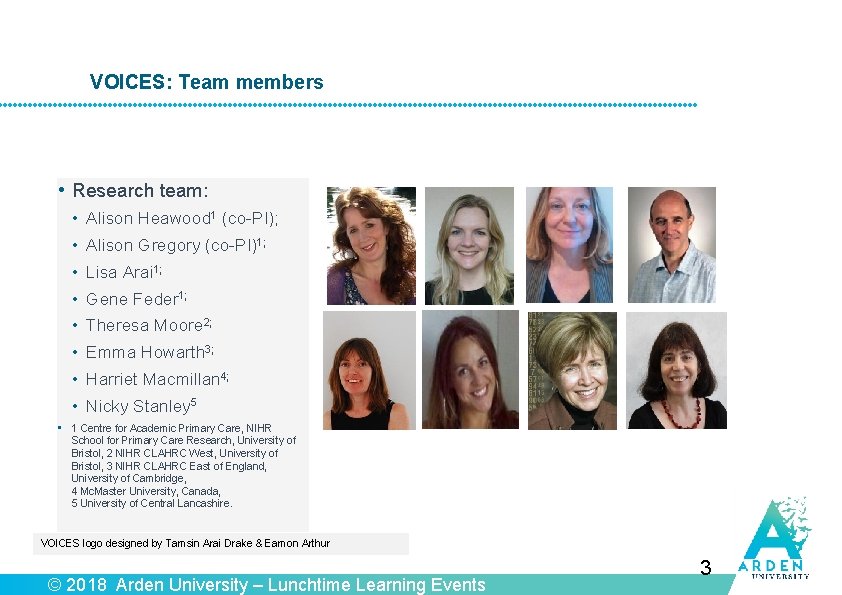
VOICES: Team members • Research team: • Alison Heawood 1 (co-PI); • Alison Gregory (co-PI)1; • Lisa Arai 1; • Gene Feder 1; • Theresa Moore 2; • Emma Howarth 3; • Harriet Macmillan 4; • Nicky Stanley 5 • 1 Centre for Academic Primary Care, NIHR School for Primary Care Research, University of Bristol, 2 NIHR CLAHRC West, University of Bristol, 3 NIHR CLAHRC East of England, University of Cambridge, 4 Mc. Master University, Canada, 5 University of Central Lancashire. VOICES logo designed by Tamsin Arai Drake & Eamon Arthur © 2018 Arden University – Lunchtime Learning Events 3
1. Study background • Domestic violence & abuse (‘DVA’): • ‘… any incident or pattern of incidents of controlling, coercive, threatening behaviour, violence or abuse between those aged 16 or over who are, or have been, intimate partners or family members regardless of gender or sexuality. ’ • 1 in 4 women in E&W experience DVA in lifetime; • 15% children witness at least one form of DVA in childhood; • VOICES’ aim: To understand impact of DVA on children’s health from perspective of children & articulate role of primary care in responding to needs. © 2018 Arden University – Lunchtime Learning Events
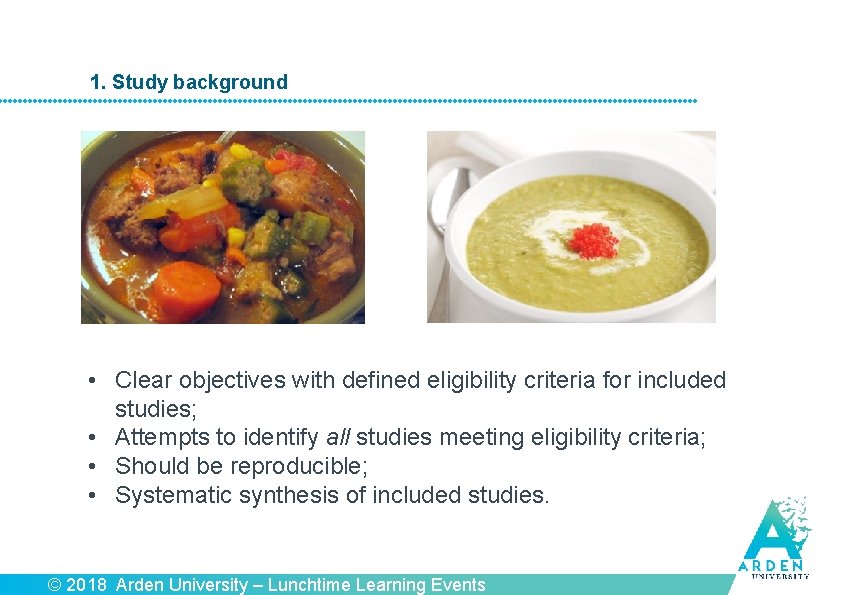
1. Study background • Clear objectives with defined eligibility criteria for included studies; • Attempts to identify all studies meeting eligibility criteria; • Should be reproducible; • Systematic synthesis of included studies. © 2018 Arden University – Lunchtime Learning Events
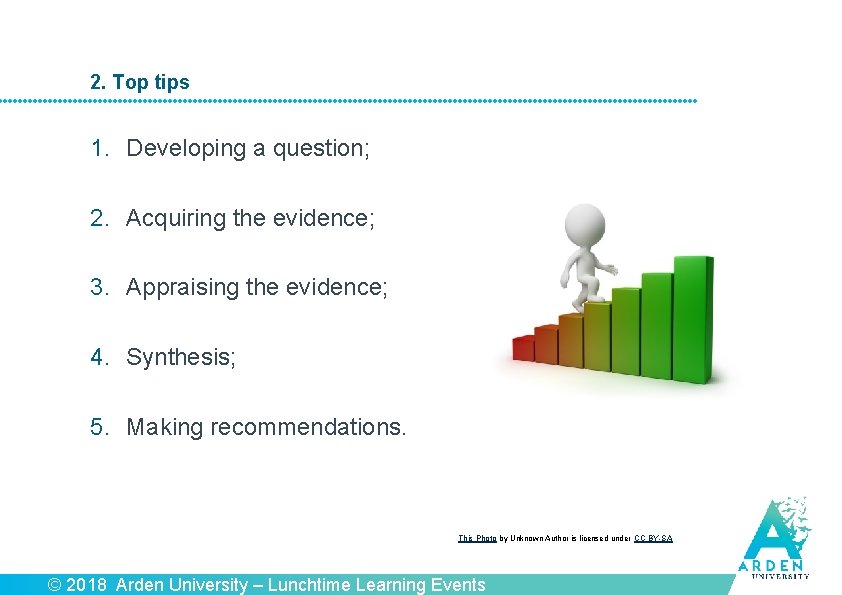
2. Top tips 1. Developing a question; 2. Acquiring the evidence; 3. Appraising the evidence; 4. Synthesis; 5. Making recommendations. This Photo by Unknown Author is licensed under CC BY-SA © 2018 Arden University – Lunchtime Learning Events
See You. Tube Video – Part 2 • Part 2: https: //youtu. be/qz 5 HG 3 w. Nus • Download MP 4 file: http: //tinyurl. com/ybdon 75 g © 2018 Arden University – Lunchtime Learning Events
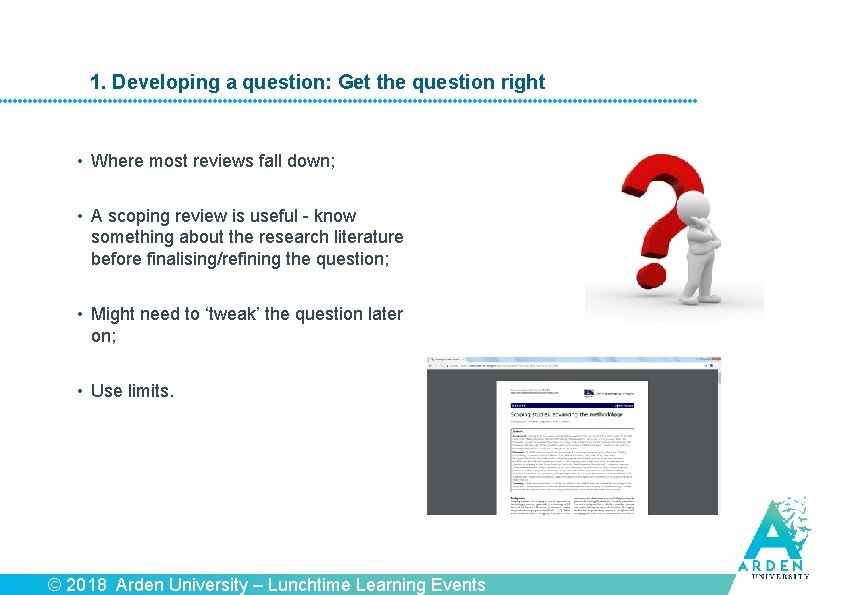
1. Developing a question: Get the question right • Where most reviews fall down; • A scoping review is useful - know something about the research literature before finalising/refining the question; • Might need to ‘tweak’ the question later on; • Use limits. © 2018 Arden University – Lunchtime Learning Events
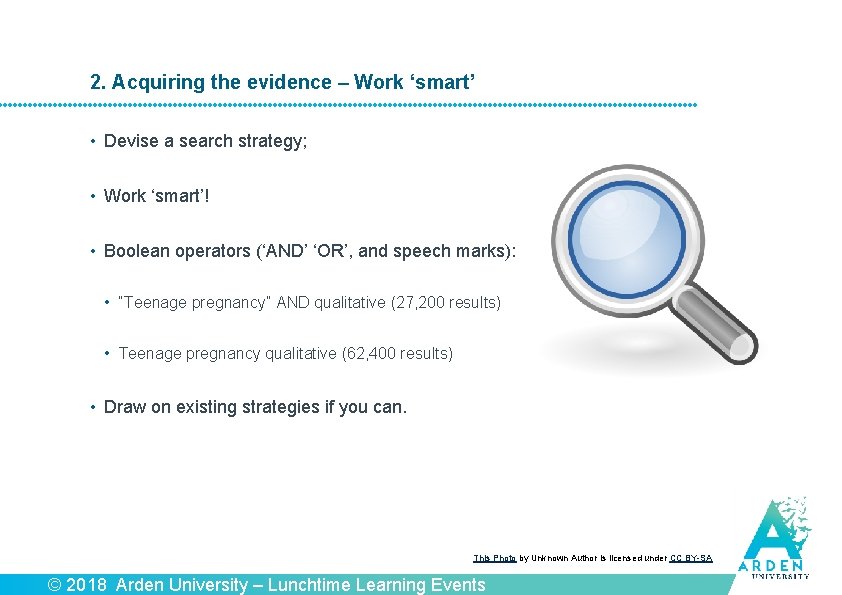
2. Acquiring the evidence – Work ‘smart’ • Devise a search strategy; • Work ‘smart’! • Boolean operators (‘AND’ ‘OR’, and speech marks): • “Teenage pregnancy” AND qualitative (27, 200 results) • Teenage pregnancy qualitative (62, 400 results) • Draw on existing strategies if you can. This Photo by Unknown Author is licensed under CC BY-SA © 2018 Arden University – Lunchtime Learning Events
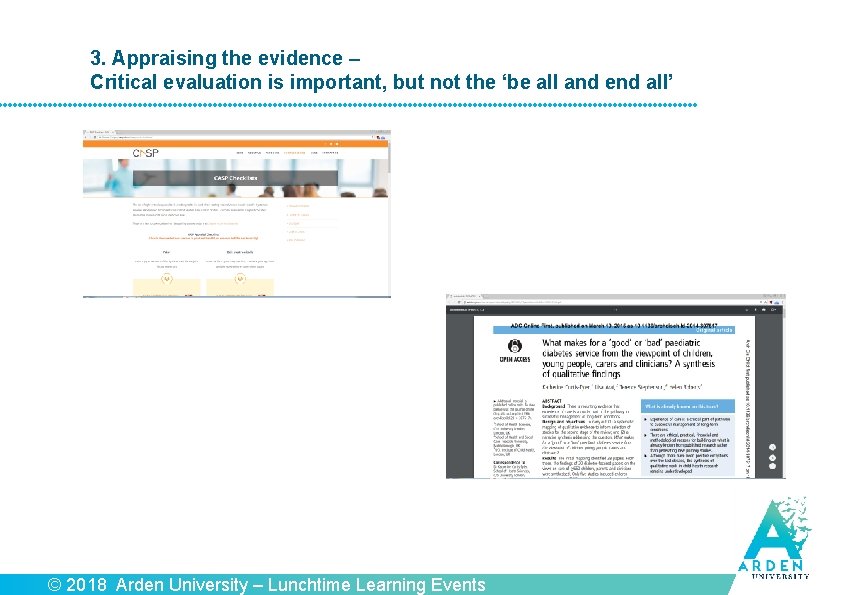
3. Appraising the evidence – Critical evaluation is important, but not the ‘be all and end all’ © 2018 Arden University – Lunchtime Learning Events
4. Synthesis - Be creative! • 1. Lived experience of DVA: • Children’s everyday, lived experience of DVA, about nature of violence, its severity and frequency, as well as family and wider context within which DVA occurs. . • 2. Actions, agency and coping with DVA: • Children’s agency and myriad ways in which children respond to, and cope with, DVA and are able to protect themselves and others (including animals). • 3. Turning points: • This theme captures children’s reports of points at which their experience of DVA changes, usually by escaping it. • 4. Managing relationships post-separation; • Smaller theme is about continuation of DVA, in some form, after parental separation (often in the context of fathers’ contact with children). • 5. Impact of DVA; • Very few studies focus specifically on impacts of DVA; most papers included here have a more general focus. • 6. Reflecting and learning from DVA: • About how children reflect on, and see meaning in, their experiences, and (in some cases) take the positive from them. © 2018 Arden University – Lunchtime Learning Events
5. Making recommendations - Recommendations are harder than they seem, but important • With applied research, this really matters; • Make them real world relevant; • Make them for different groups; • For practitioners; • For policymakers; • For researchers. © 2018 Arden University – Lunchtime Learning Events
3. Summary • In summary: • Even if not doing a systematic review, you can draw on systematic review methodology to help with a ‘traditional’ literature review; • The review process has 5 steps: • • • Developing a question; Acquiring the evidence; Appraising the evidence; Synthesis; and Making recommendations; • My five top tips are: 1. 2. 3. 4. 5. Get the question right; Work ‘smart’; Critical evaluation is important, but not the ‘be all and end all’; Be creative; Recommendations are harder than they seem, but important. © 2018 Arden University – Lunchtime Learning Events
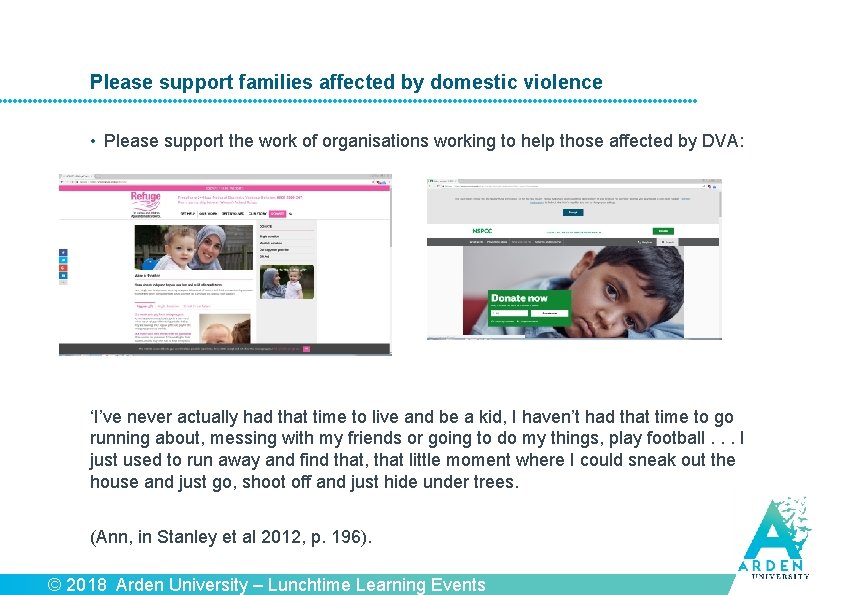
Please support families affected by domestic violence • Please support the work of organisations working to help those affected by DVA: ‘I’ve never actually had that time to live and be a kid, I haven’t had that time to go running about, messing with my friends or going to do my things, play football. . . I just used to run away and find that, that little moment where I could sneak out the house and just go, shoot off and just hide under trees. (Ann, in Stanley et al 2012, p. 196). © 2018 Arden University – Lunchtime Learning Events