Integrating Resilience in Water Management Emani Kumar Deputy
- Slides: 25
Integrating Resilience in Water Management Emani Kumar Deputy Secretary General, ICLEI – Local Governments for Sustainability Executive Director, ICLEI- Local Governments for Sustainability, South Asia
Content • About ICLEI-SA • Vulnerability of Indian cities to Droughts and Floods • Cross cutting strategies to build resilient in water sector- ICLEI-SA ü City Level: Adopting Integrated Urban Water Management in Indian Cities (Adopt ü ü ü IUWM) State level: Integrated Urban Water Management Planning and Implementation in Rajasthan Regional level: Integrated Rural Urban Water Management for Climate based Adaptations in Indian Cities (IAdapt) Global Level : ICLEI Water Agenda • Way Forward
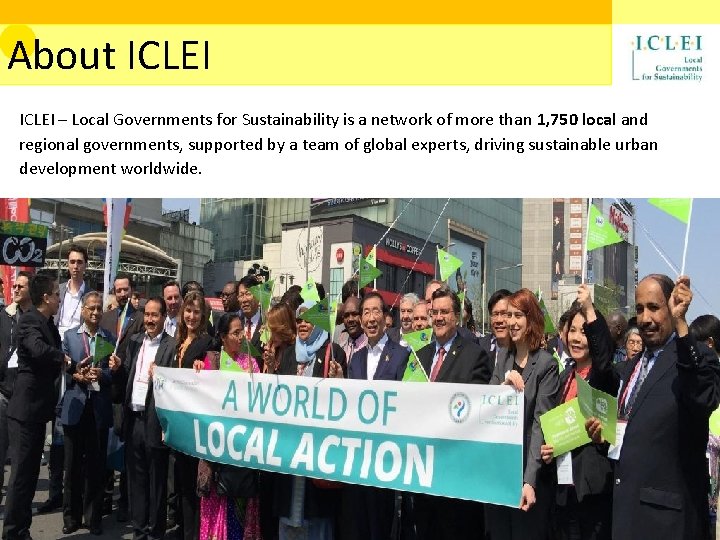
About ICLEI – Local Governments for Sustainability is a network of more than 1, 750 local and regional governments, supported by a team of global experts, driving sustainable urban development worldwide.
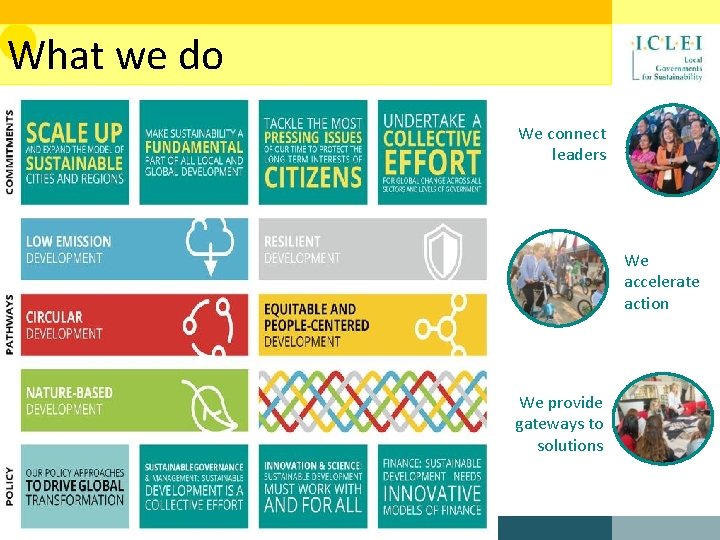
What we do We connect leaders We accelerate action We provide gateways to solutions
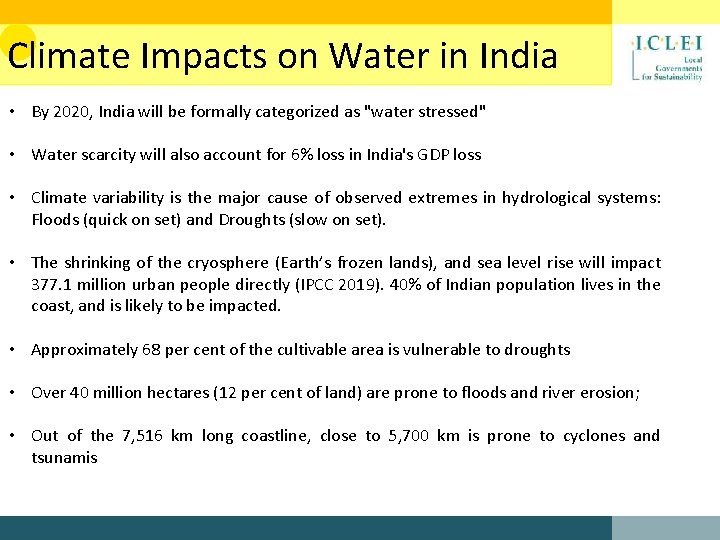
Climate Impacts on Water in India • By 2020, India will be formally categorized as "water stressed" • Water scarcity will also account for 6% loss in India's GDP loss • Climate variability is the major cause of observed extremes in hydrological systems: Floods (quick on set) and Droughts (slow on set). • The shrinking of the cryosphere (Earth’s frozen lands), and sea level rise will impact 377. 1 million urban people directly (IPCC 2019). 40% of Indian population lives in the coast, and is likely to be impacted. • Approximately 68 per cent of the cultivable area is vulnerable to droughts • Over 40 million hectares (12 per cent of land) are prone to floods and river erosion; • Out of the 7, 516 km long coastline, close to 5, 700 km is prone to cyclones and tsunamis
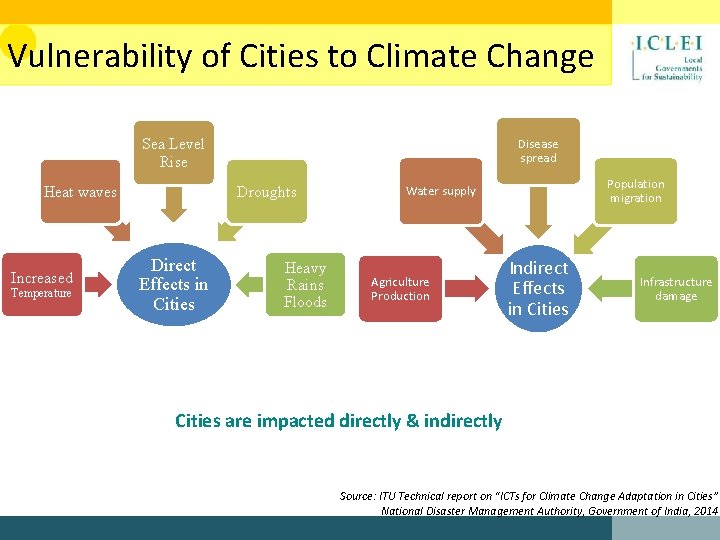
Vulnerability of Cities to Climate Change Sea Level Rise Heat waves Increased Temperature Disease spread Droughts Direct Effects in Cities Heavy Rains Floods Population migration Water supply Agriculture Production Indirect Effects in Cities Infrastructure damage Cities are impacted directly & indirectly Source: ITU Technical report on “ICTs for Climate Change Adaptation in Cities” National Disaster Management Authority, Government of India, 2014
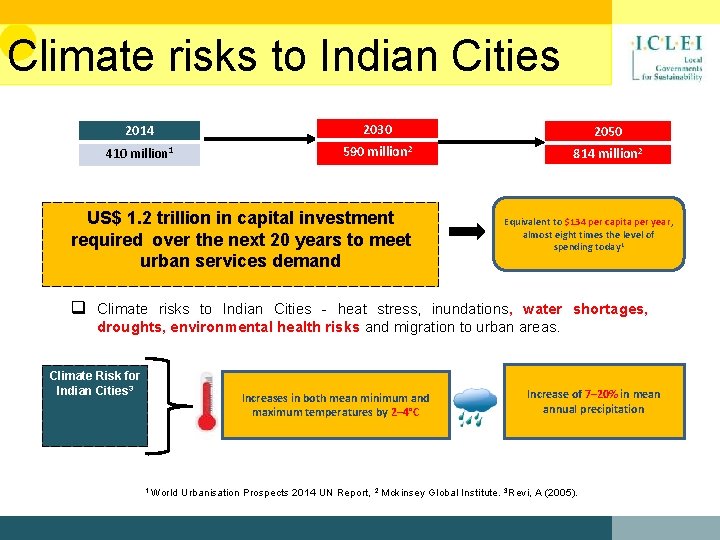
Climate risks to Indian Cities 2014 2030 2050 410 million 1 590 million 2 814 million 2 US$ 1. 2 trillion in capital investment required over the next 20 years to meet urban services demand Equivalent to $134 per capita per year, almost eight times the level of spending today 1 q Climate risks to Indian Cities - heat stress, inundations, water shortages, droughts, environmental health risks and migration to urban areas. Climate Risk for Indian Cities 3 Increases in both mean minimum and maximum temperatures by 2– 4°C 1 World Increase of 7– 20% in mean annual precipitation Urbanisation Prospects 2014 UN Report, 2 Mckinsey Global Institute. 3 Revi, A (2005).
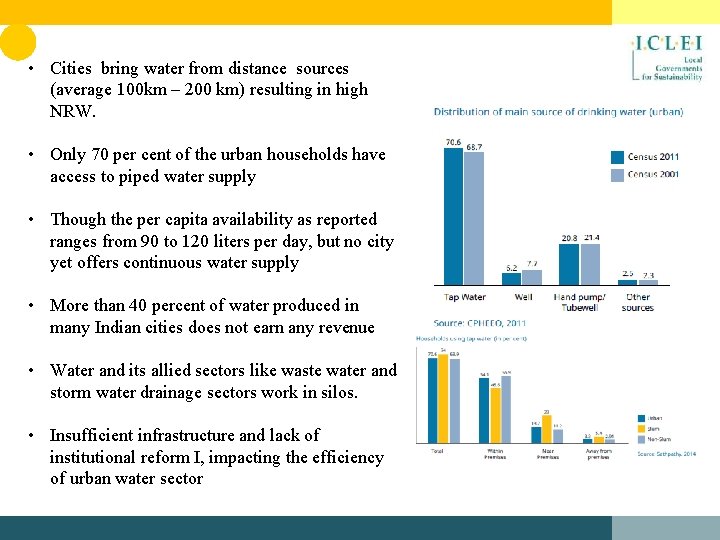
• Cities bring water from distance sources (average 100 km – 200 km) resulting in high NRW. • Only 70 per cent of the urban households have access to piped water supply • Though the per capita availability as reported ranges from 90 to 120 liters per day, but no city yet offers continuous water supply • More than 40 percent of water produced in many Indian cities does not earn any revenue • Water and its allied sectors like waste water and storm water drainage sectors work in silos. • Insufficient infrastructure and lack of institutional reform I, impacting the efficiency of urban water sector
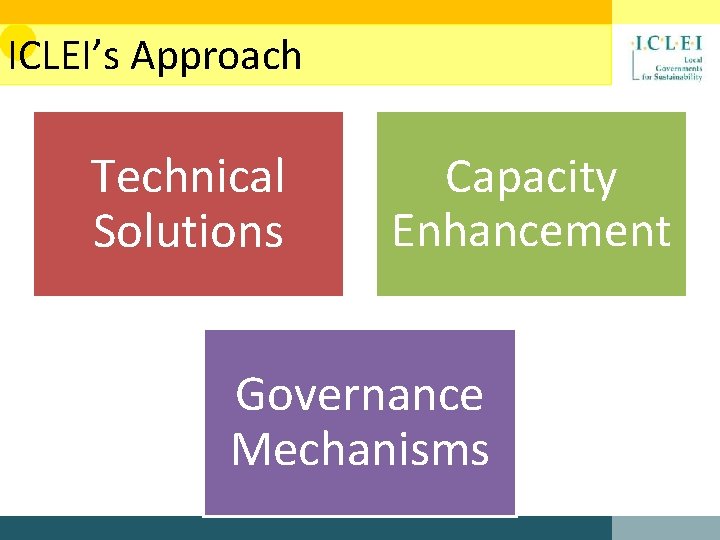
ICLEI’s Approach Technical Solutions Capacity Enhancement Governance Mechanisms
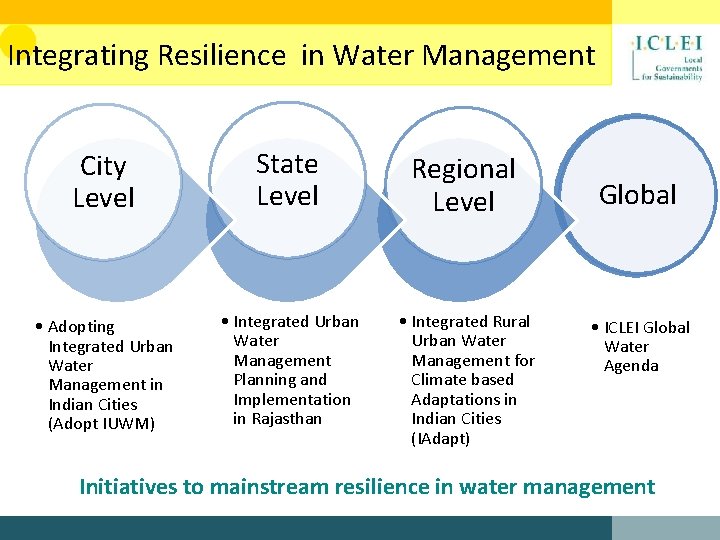
Integrating Resilience in Water Management City Level State Level Regional Level • Adopting Integrated Urban Water Management in Indian Cities (Adopt IUWM) • Integrated Urban Water Management Planning and Implementation in Rajasthan • Integrated Rural Urban Water Management for Climate based Adaptations in Indian Cities (IAdapt) Global • ICLEI Global Water Agenda Initiatives to mainstream resilience in water management
Technical Solutions • Developing toolkits to support integrated water • • management – Adopt. IUWM Toolkit Development toolkits for climate adaptive water management – IAdapt Framework Support cities to develop IUWM action plans and implement pilots to showcase IUWM practices Support development of catchment level water management plans Collaborate with partners such as IIT for local climate projections
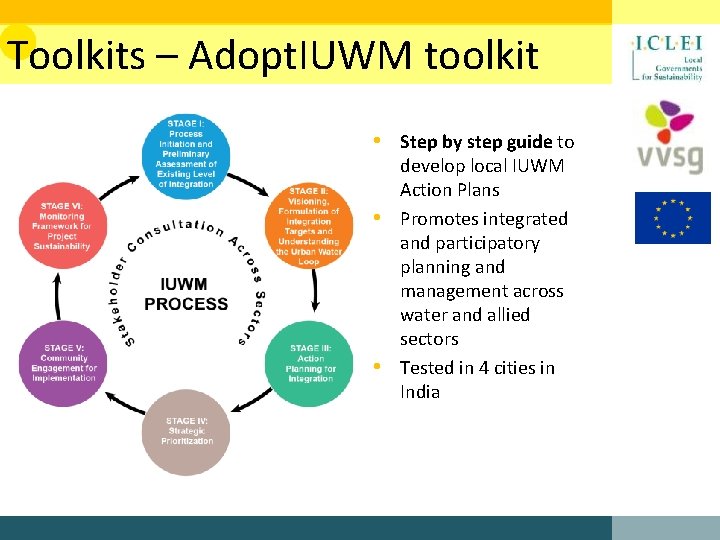
Toolkits – Adopt. IUWM toolkit • Step by step guide to • • develop local IUWM Action Plans Promotes integrated and participatory planning and management across water and allied sectors Tested in 4 cities in India
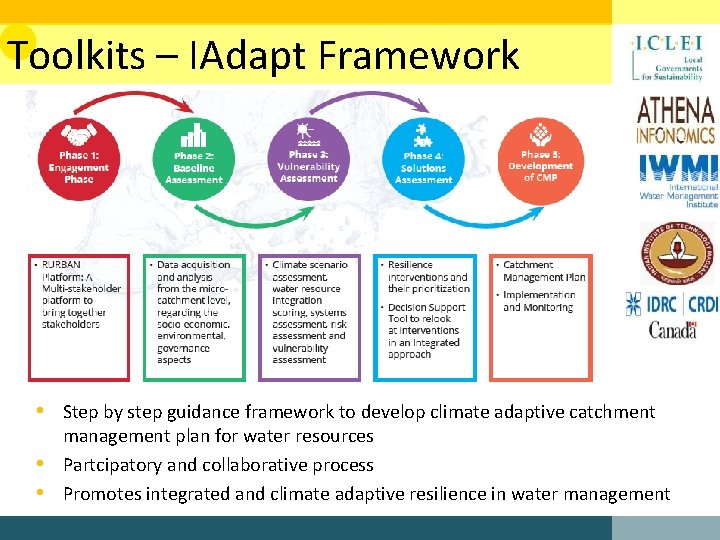
Toolkits – IAdapt Framework • Step by step guidance framework to develop climate adaptive catchment • • management plan for water resources Partcipatory and collaborative process Promotes integrated and climate adaptive resilience in water management
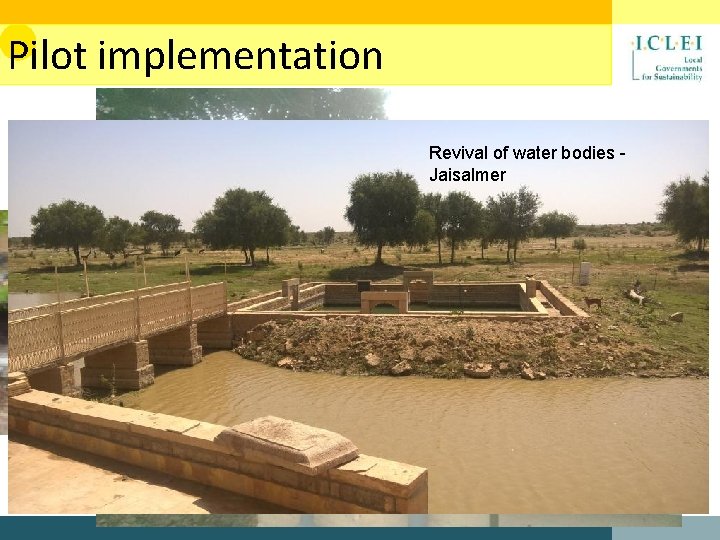
Pilot implementation Rain water harvesting for borewell Revival of water bodies recharge - Solapur Jaisalmer
Capacity Enhancement • Provide technical capacity building through • • trainings, workshops, handholding support Training modules developed for climate adaptive water management plans Provide solution specific trainings on demand from cities – such as on rain water harvesting techniques, water leak detection systems
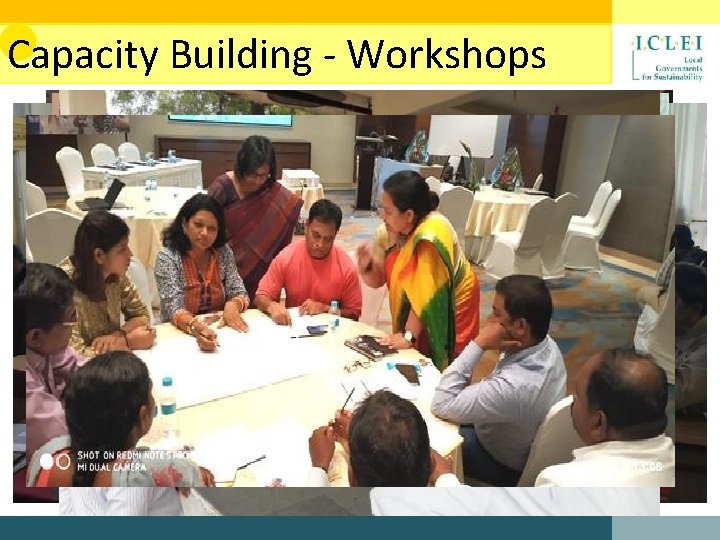
Capacity Building - Workshops
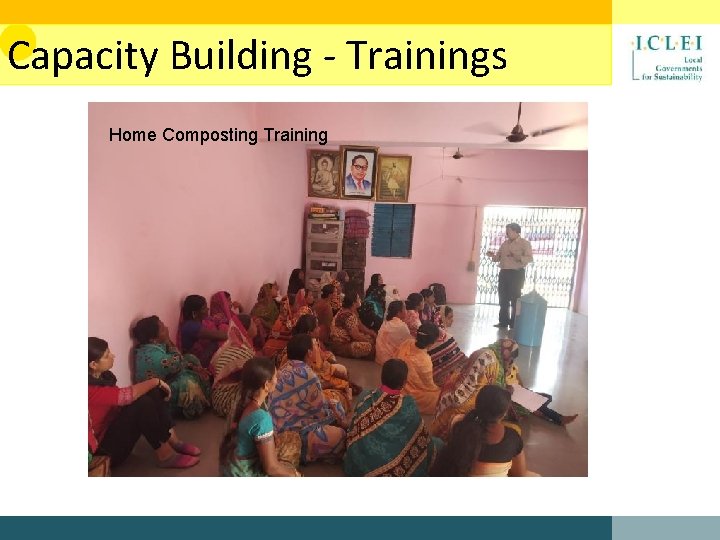
Capacity Building - Trainings Leak Detection Training Home Composting Training
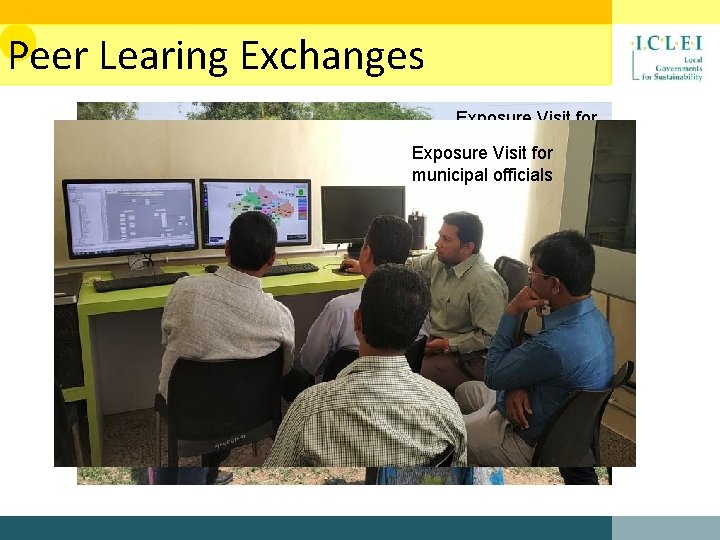
Peer Learing Exchanges Exposure Visit for Panchayats Exposure Visit for municipal officials
Governance Mechanisms • Approach water management in an integrated • • manner by engaging with all users – both rural and urban to look at catchment level management of resources Creation of RURBAN Platform – as a formal method of engaging with rural and urban stakeholders for collaborative planning Promoting cross sectoral approaches to water management – bringing together water, waste water, storm water and solid waste sectors
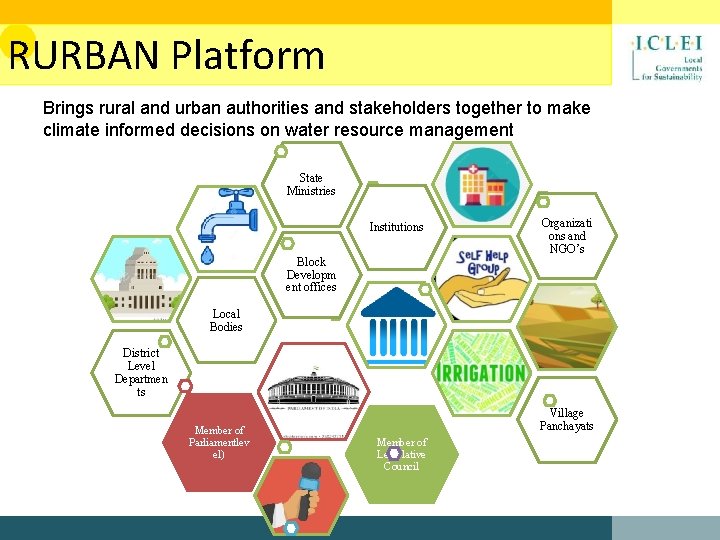
RURBAN Platform Brings rural and urban authorities and stakeholders together to make climate informed decisions on water resource management State Ministries Institutions Block Developm ent offices Organizati ons and NGO’s Local Bodies District Level Departmen ts Member of Parliamentlev el) Village Panchayats Member of Legislative Council
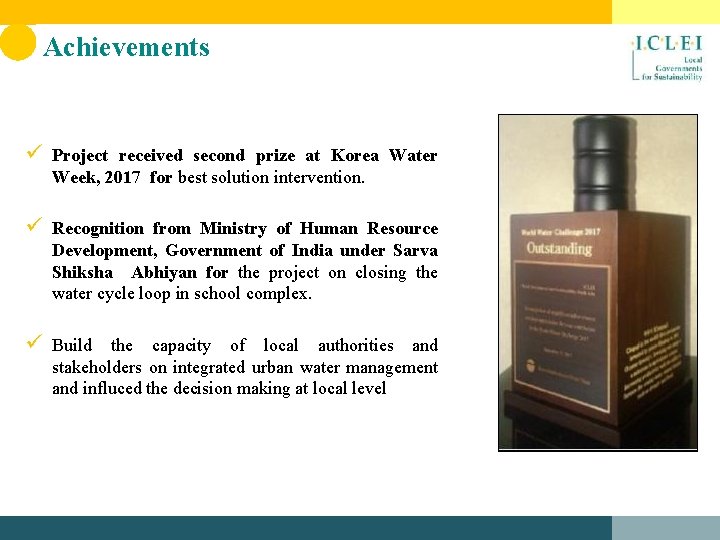
Achievements ü Project received second prize at Korea Water Week, 2017 for best solution intervention. ü Recognition from Ministry of Human Resource Development, Government of India under Sarva Shiksha Abhiyan for the project on closing the water cycle loop in school complex. ü Build the capacity of local authorities and stakeholders on integrated urban water management and influced the decision making at local level
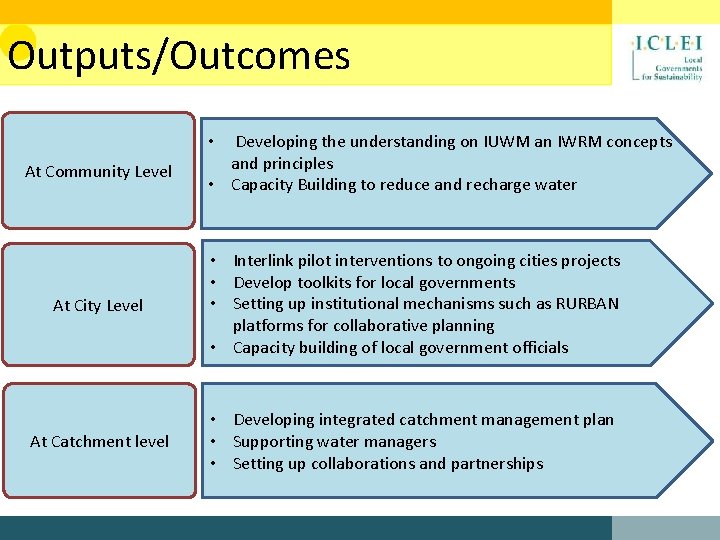
Outputs/Outcomes Developing the understanding on IUWM an IWRM concepts and principles • Capacity Building to reduce and recharge water • At Community Level At City Level • Interlink pilot interventions to ongoing cities projects • Develop toolkits for local governments • Setting up institutional mechanisms such as RURBAN platforms for collaborative planning • Capacity building of local government officials At Catchment level • Developing integrated catchment management plan • Supporting water managers • Setting up collaborations and partnerships
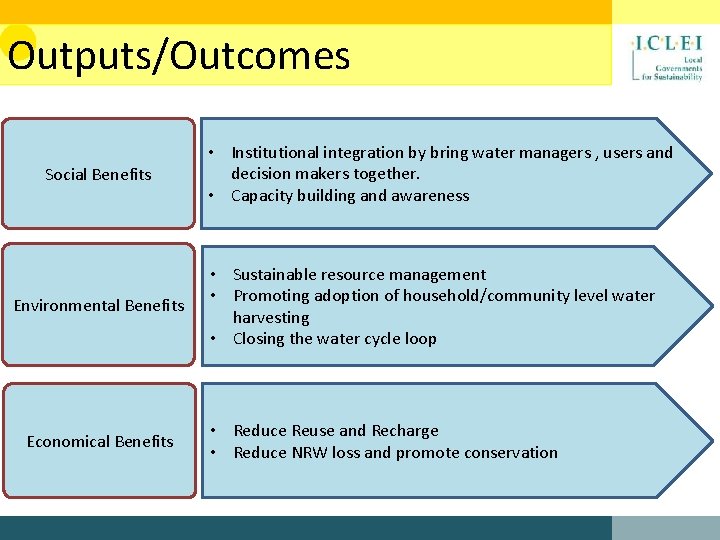
Outputs/Outcomes Social Benefits Environmental Benefits Economical Benefits • Institutional integration by bring water managers , users and decision makers together. • Capacity building and awareness • Sustainable resource management • Promoting adoption of household/community level water harvesting • Closing the water cycle loop • Reduce Reuse and Recharge • Reduce NRW loss and promote conservation
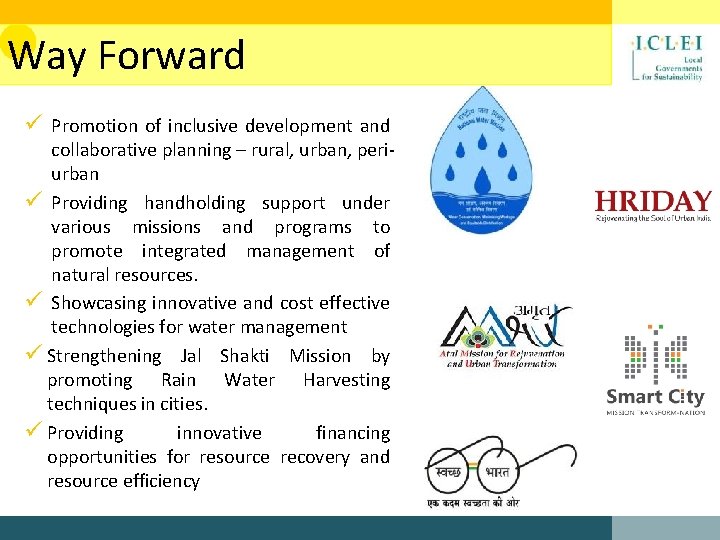
Way Forward ü Promotion of inclusive development and collaborative planning – rural, urban, periurban ü Providing handholding support under various missions and programs to promote integrated management of natural resources. ü Showcasing innovative and cost effective technologies for water management ü Strengthening Jal Shakti Mission by promoting Rain Water Harvesting techniques in cities. ü Providing innovative financing opportunities for resource recovery and resource efficiency
Thank you Emani Kumar, Deputy Secretary General, ICLEI and Executive Director, ICLEI South Asia E-Mail: emani. kumar@iclei. org www. iclei. org, www. southasia. iclei. org For more information on the project please visit project website at http: //iuwm. urbanwatermanagementindia. org/ 25