INFSY 540 Information Resources in Management Lesson 12



- Slides: 30
INFSY 540 Information Resources in Management Lesson 12 Chapter 11 Strategic Analysis Strategy Tactics Operations 1
Outline Ø Ø Ø Operations, Tactics, Strategy and Change The Competitive Environment External Agents v v Ø Methods to Gain Competitive Advantage v Ø How IS can help The Search for Innovation v Ø Customers Suppliers Rivals (new entrants. Substitute products) Government Regulations How IS can help Costs and Dangers of Strategies v How IS can hurt 2
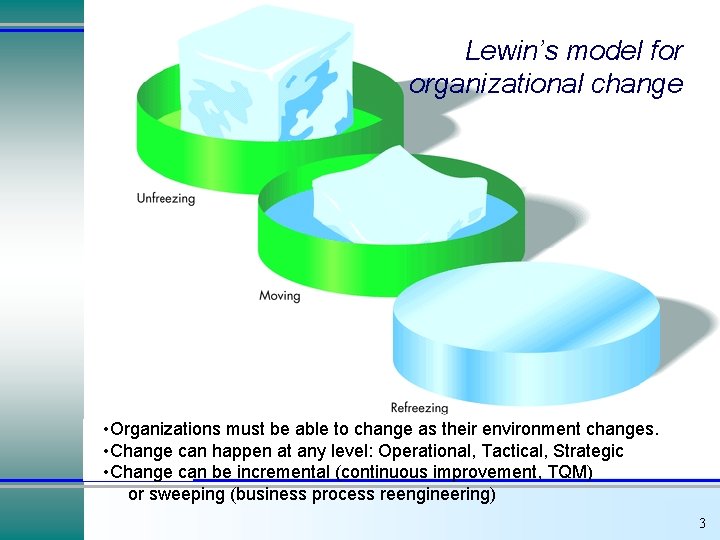
Lewin’s model for organizational change • Organizations must be able to change as their environment changes. • Change can happen at any level: Operational, Tactical, Strategic • Change can be incremental (continuous improvement, TQM) or sweeping (business process reengineering) 3
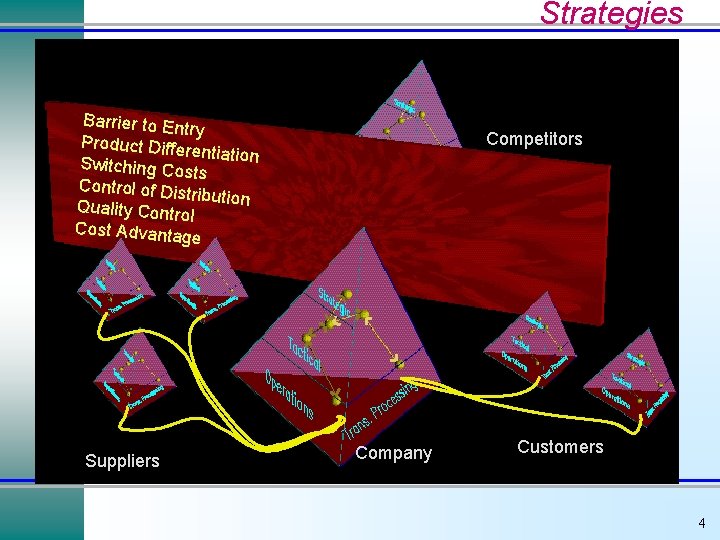
Strategies Barrier to Entr y Product Diffe rentiation Switching Co sts Control of Dis tribution Quality Contr ol Cost Advanta ge Suppliers Competitors Company Customers 4
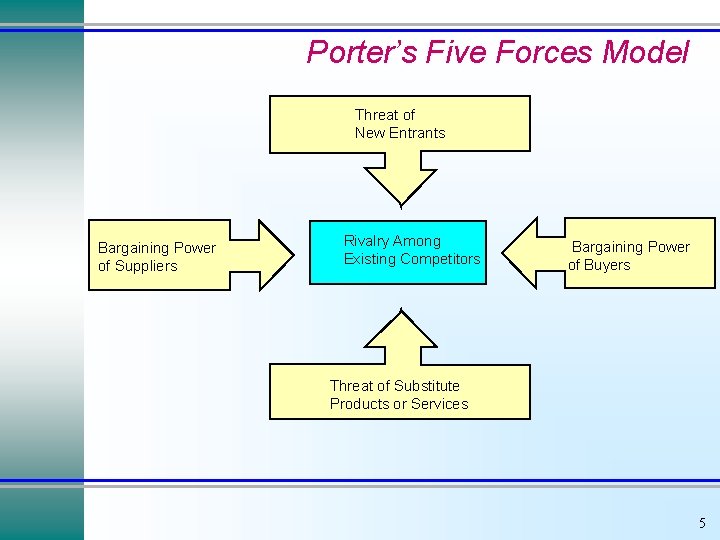
Porter’s Five Forces Model Threat of New Entrants Bargaining Power of Suppliers Rivalry Among Existing Competitors Bargaining Power of Buyers Threat of Substitute Products or Services 5
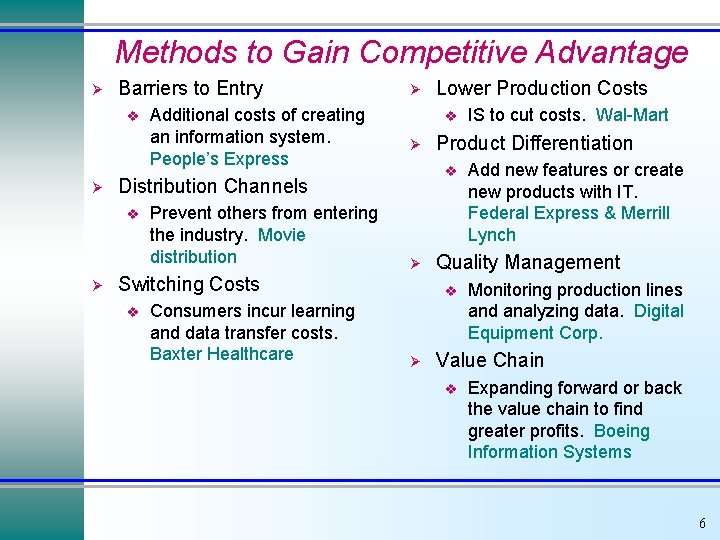
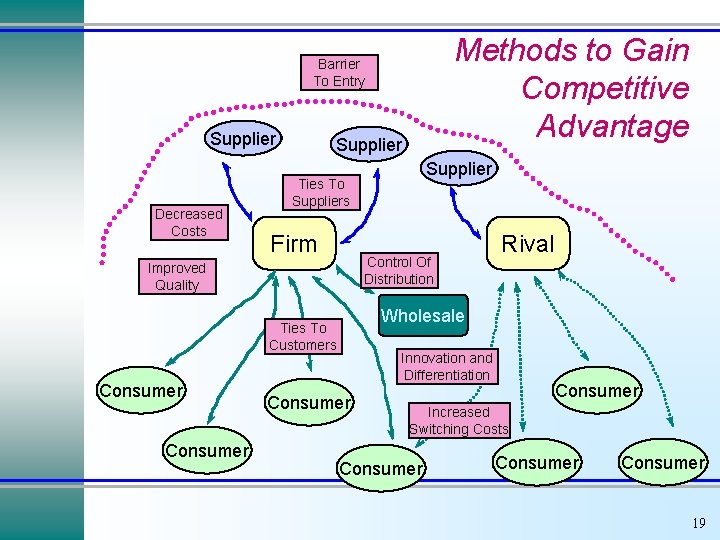
Methods to Gain Competitive Advantage Ø Barriers to Entry v Ø Prevent others from entering the industry. Movie distribution Ø Ø Consumers incur learning and data transfer costs. Baxter Healthcare Add new features or create new products with IT. Federal Express & Merrill Lynch Quality Management v Ø IS to cut costs. Wal-Mart Product Differentiation v Switching Costs v Lower Production Costs v Distribution Channels v Ø Additional costs of creating an information system. People’s Express Ø Monitoring production lines and analyzing data. Digital Equipment Corp. Value Chain v Expanding forward or back the value chain to find greater profits. Boeing Information Systems 6
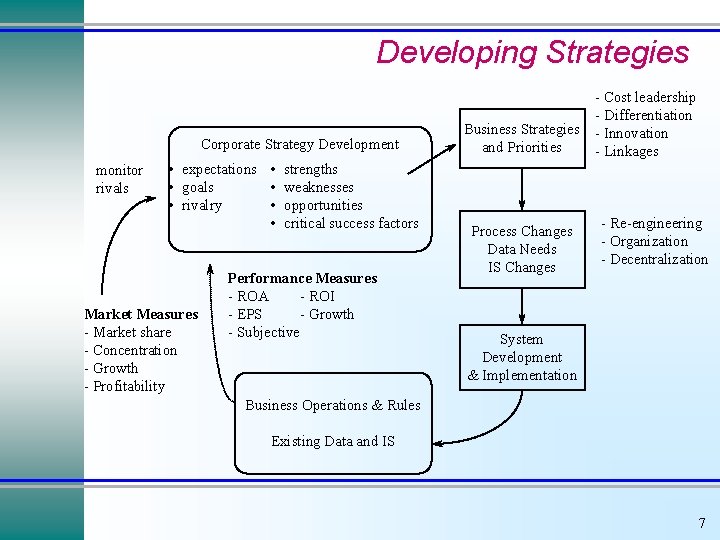
Developing Strategies Corporate Strategy Development monitor rivals • expectations • strengths • weaknesses • goals • opportunities • rivalry • critical success factors Market Measures - Market share - Concentration - Growth - Profitability Performance Measures - ROA - ROI - EPS - Growth - Subjective Business Strategies and Priorities Process Changes Data Needs IS Changes - Cost leadership - Differentiation - Innovation - Linkages - Re-engineering - Organization - Decentralization System Development & Implementation Business Operations & Rules Existing Data and IS 7
Search for Innovation Ø Research v Ø Ø Analysis & modeling, project management, work group support, databases, decision support. Manufacturing v Engineering & Design v CAD/CAM, testing, networks, work group support. Ø Mass customization, links to customers & suppliers, quality monitoring, expert systems for maintenance, production databases, business integration. Logistics & Supply v Just-in-time linkages, forecasts, models, links for design, transaction processing. 8
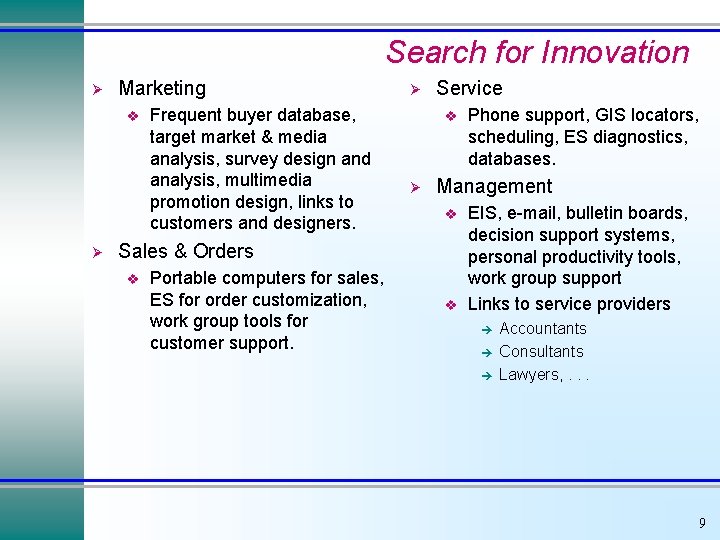
Search for Innovation Ø Marketing v Ø Frequent buyer database, target market & media analysis, survey design and analysis, multimedia promotion design, links to customers and designers. Ø Service v Ø Management v Sales & Orders v Portable computers for sales, ES for order customization, work group tools for customer support. Phone support, GIS locators, scheduling, ES diagnostics, databases. v EIS, e-mail, bulletin boards, decision support systems, personal productivity tools, work group support Links to service providers è è è Accountants Consultants Lawyers, . . . 9
Dangers 10
Conclusions 11
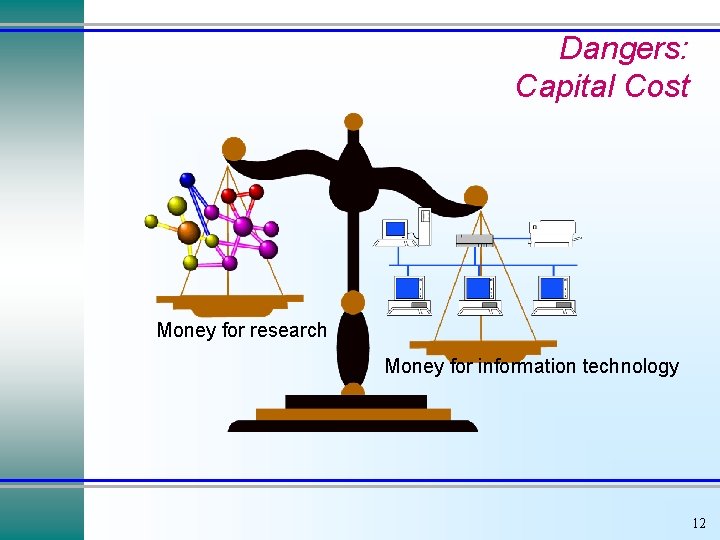
Dangers: Capital Cost Money for research Money for information technology 12
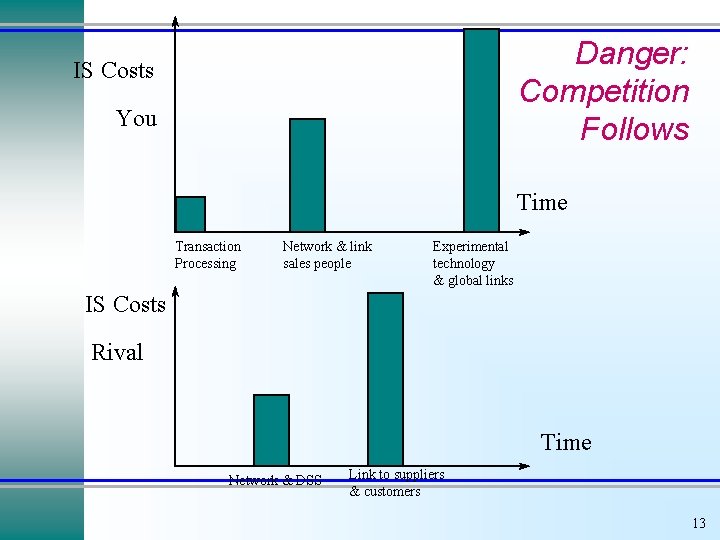
Danger: Competition Follows IS Costs You Time Transaction Processing Network & link sales people Experimental technology & global links IS Costs Rival Time Network & DSS Link to suppliers & customers 13
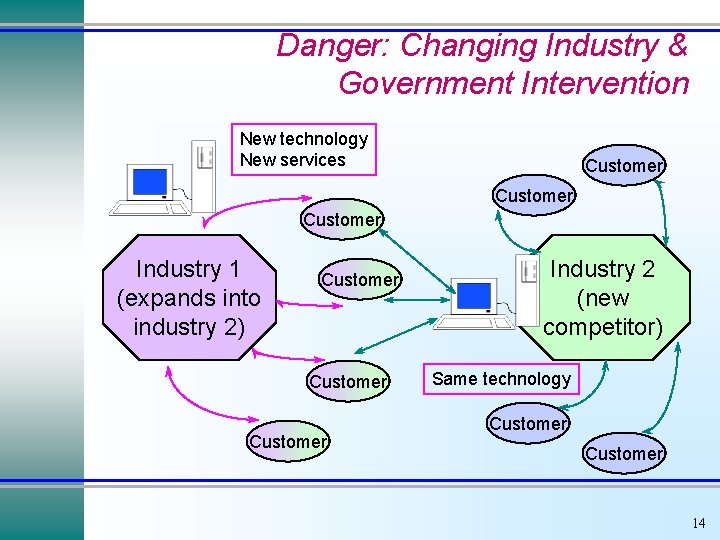
Danger: Changing Industry & Government Intervention New technology New services Customer Industry 1 (expands into industry 2) Customer Industry 2 (new competitor) Same technology Customer 14
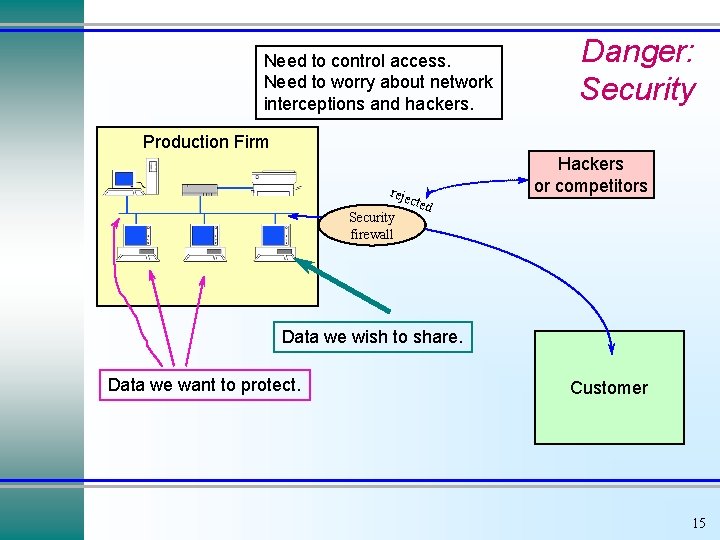
Need to control access. Need to worry about network interceptions and hackers. Danger: Security Production Firm reje c Security firewall ted Hackers or competitors Data we wish to share. Data we want to protect. Customer 15
Conclusions? Ø Ø Ø IT can help achieve strategic competitive advantage. Use of IS to add value is strongly influenced by organizational structure, culture and change. Oftentimes, IT is a smokescreen for the action that provides the real strategic competitive advantage. IS can provide more value than just cost cutting Strategic gains based on IT solutions are often fleeting and require continual improvements. Others. . . 16
Questions about Strategic Analysis ? 17
Questions to Consider Ø Ø How do companies compete? What are the ways to achieve competitive advantage? How can IT be used to help achieve competitive advantage? What are the costs and risks of using these methods? 18
Methods to Gain Competitive Advantage Barrier To Entry Supplier Decreased Costs Supplier Ties To Suppliers Firm Control Of Distribution Improved Quality Consumer Rival Wholesale Ties To Customers Consumer Supplier Innovation and Differentiation Consumer Increased Switching Costs Consumer 19
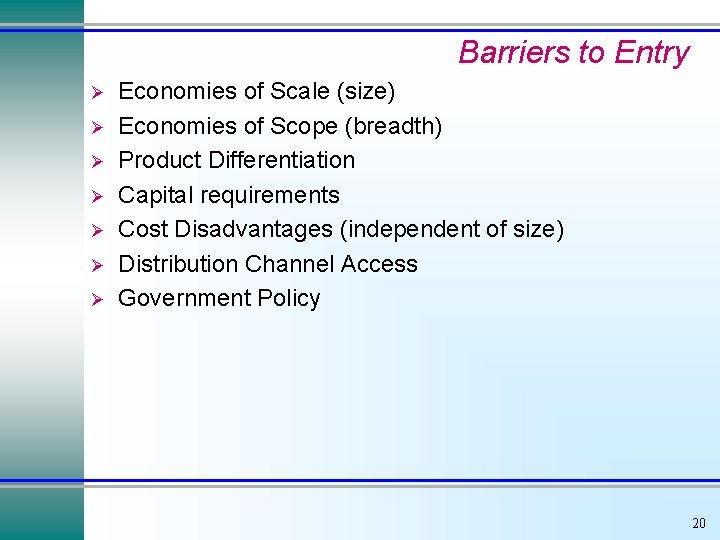
Barriers to Entry Ø Ø Ø Ø Economies of Scale (size) Economies of Scope (breadth) Product Differentiation Capital requirements Cost Disadvantages (independent of size) Distribution Channel Access Government Policy 20
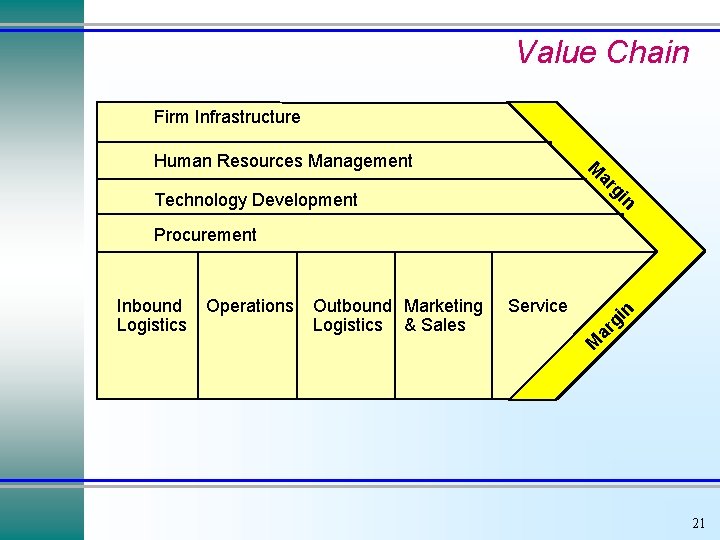
Value Chain Firm Infrastructure ar M Human Resources Management n gi Technology Development Procurement Service gi n Outbound Marketing Logistics & Sales ar Operations M Inbound Logistics 21
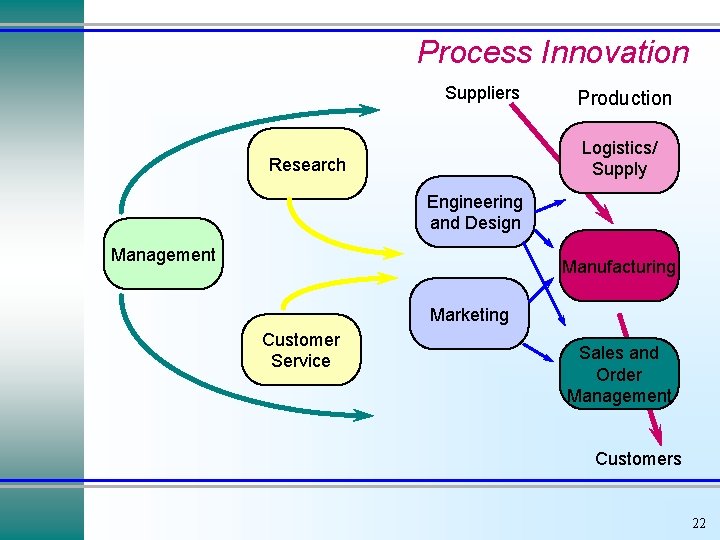
Process Innovation Suppliers Production Logistics/ Supply Research Engineering and Design Management Manufacturing Marketing Customer Service Sales and Order Management Customers 22
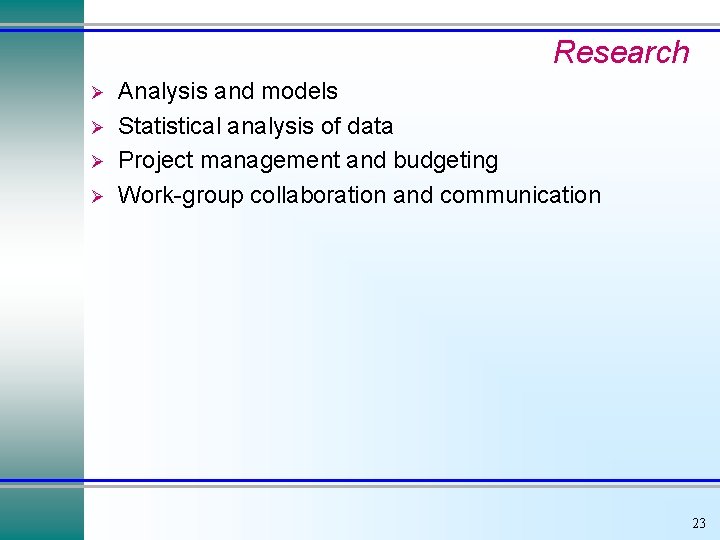
Research Ø Ø Analysis and models Statistical analysis of data Project management and budgeting Work-group collaboration and communication 23
Engineering and Design Ø Ø Ø CAD/CAM Integrated design database Production databases and model testing Expert Systems for manufacturability Work group communication 24
Manufacturing Ø Ø Ø Links to customers Links to suppliers Mass customization Robotics Diagnostic Expert Systems Quality monitoring and control 25
Logistics and Supply Ø Ø Ø Just-In-Time Inventory and EDI Configuration and design Searching for availability, pricing, . . . networks 26
Marketing Ø Ø Ø Frequent buyer databases Point-of-Sale and trends Statistical analysis of data Geographic Information Systems Links to external marketing agencies Multimedia development of promotions 27
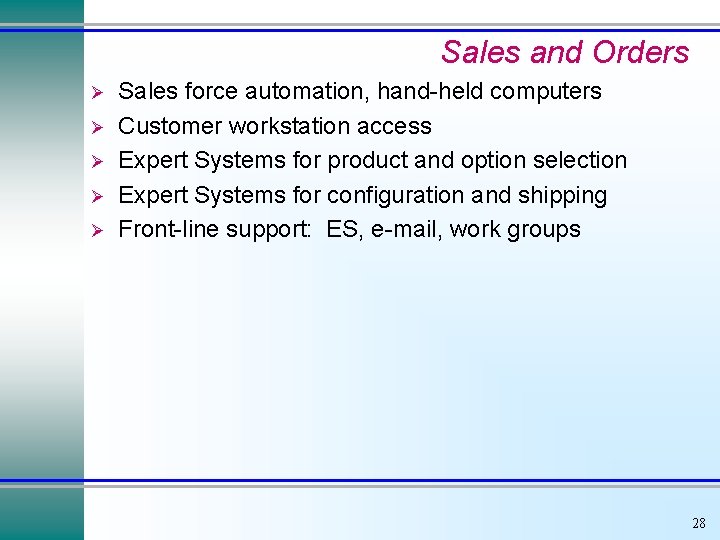
Sales and Orders Ø Ø Ø Sales force automation, hand-held computers Customer workstation access Expert Systems for product and option selection Expert Systems for configuration and shipping Front-line support: ES, e-mail, work groups 28
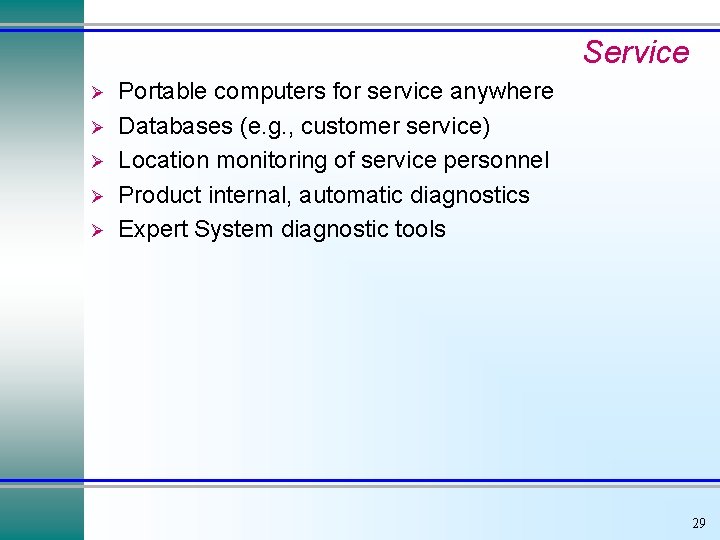
Service Ø Ø Ø Portable computers for service anywhere Databases (e. g. , customer service) Location monitoring of service personnel Product internal, automatic diagnostics Expert System diagnostic tools 29
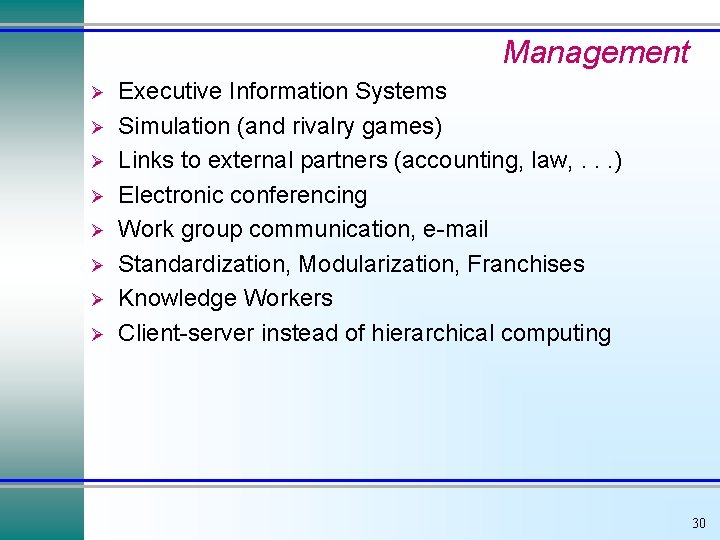
Management Ø Ø Ø Ø Executive Information Systems Simulation (and rivalry games) Links to external partners (accounting, law, . . . ) Electronic conferencing Work group communication, e-mail Standardization, Modularization, Franchises Knowledge Workers Client-server instead of hierarchical computing 30