Inclusion for Preschool Children What We Know and
- Slides: 26
Inclusion for Preschool Children: What We Know and What We Should Be Doing Kristie Lofland, M. S. Educational Consultant and Research Associate Indiana Resource Center for Autism Indiana Institute on Disability and Community klofland@Indiana. edu
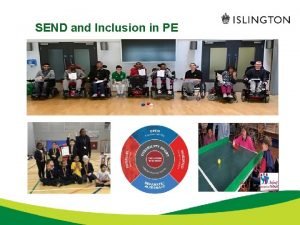
• For more than 35 years, IDEA has encouraged education services for preschool children with disabilities to be delivered in general education classrooms with typically peers. • In fact, IDEA states that the removal of children from the regular education setting can be done only if the regular education placement is not satisfactory even with the provision of supplementary aids and services (34 CFR 300. 11) and technical assistance for administrators and teachers (34 CFR 300. 119). • In 2012, fewer than half of children with disabilities , aged 3 -5 years, received their special education and related services in a regular EC classroom.
What We Know • No study that has assessed social outcome for children in inclusive settings versus developmentally segregated settings has found segregated settings to be superior. • What developmental outcomes are most likely to lead to successful post-school adjustment? Social skills is always the answer. • The positive social outcomes attributable to inclusive settings, however, have been seen only when social interaction is frequent, planned, and carefully promoted by teachers.
What We Know • Typically developing children have shown only positive developmental, educational and attitudinal outcomes from inclusive experiences. • There is no evidence that children with disabilities are poor candidates for inclusion. • On measures of how well children maintain skills after some initial teaching, segregated settings have been show to have a poor outcome (i. e. in segregated classrooms the children tend not to use newly learn skills whereas they are much more likely to us these same skills in inclusive settings). • Programs in inclusive service delivery tend to be state-of-the-art on a variety of other dimensions such as parent involvement; highly developed scope and sequence, method of instruction; outcome assessments).
Bottom Line Considerations… • High quality inclusive settings are the only environments with data consistently supporting children’s superior learning AND non-inclusive environments have been shown to negatively impact children’s learning. • Fully inclusive options beat the alternative at a ratio of about 15 to 1.
Bottom Line Considerations… • Fully inclusive options have been shown to work for children across disability groups and levels of severity (children with developmental delays, mild to severe; children with ASD; children with multiple disabilities; children with significant social and emotional needs; children with hearing impairment; children with limited mobility).
Bottom Line Considerations… • Fully inclusive options tend to be of higher quality in general • Greatest magnitude of effect is social (but also significant differences in communicative and cognitive skills)
What Having A Friend In Preschool Means For Later In Life Success �Better academic skills �Higher high school graduation rates �Fewer special education services �Better adult employment status �Greater chance of independent living �Better adult mental health
Here is what friends do for each other • Always involve and include their friend • Look out for their friend’s best interest • Encourage exploration/learning new things
And What About Typically Developing Children? • Equal or greater cognitive and language skills • Fewer challenging behaviors • More advanced social skills • More accepting attitudes toward individuals who are different
What We Should Be Doing • Maximizes instructional generalization opportunities • IEP goals get addressed everyday all day • Maximizes consistency of adult-child interactions • Transdisciplinary service model
Full Utilization of Peer Influence • Initiate social interactions • Invite others to activities • Take their hand lead them there • Respond to social bids • Pass-out & Pick-up materials, props • Model desired actions • Praise, compliment peers • Give play directions • Help others complete a task/activity (give assistance)
Hundreds of Learning Opportunities Embedded Across the Day
Basis for Effective Communication and Social Intervention • Practitioners must: • understand use the guiding principles of intervention for individuals with ASD. • have expertise in instructional strategies that promote skill acquisition and decrease challenging behaviors that interfere with learning. • be able to create optimal learning environments for children and youth with ASD • use evidence-based practices.
Intense World Hypothesis • Henry & Kamila Markram, Swiss Researchers; 2007 • Questioned whether autism was really about a lack of empathy or theory of mind • Began studying the brain at the circuitry level • VPA rats – is wasn’t that they couldn’t learn, but they learned too quickly, with too much fear and irreversibly • Amygdala and cortex hyper-responsive to external stimuli • Social difficulties aren’t caused by social processing defects but total information overload—like being sleepless, jetlagged and hung over all at once.
Intense World Hypothesis • Babies can’t flee. They can cry, rock, avoid touch, eye contact and other powerful experiences. • If infants, try to withdraw to cope, they will miss “sensitive period” – a developmental phase when the brain is particulary responsive to and rapidly assimilates certain kinds of external stimulation • Language stimulation. If babies aren’t exposed to speech in the first three years, their verbal abilities can be permanently stunted • Problem isn’t a defective language area but denied linguistic stimuli at a critical time. Same for social difficulties.
Parent Training • Parent training is a necessary practice for intervention with young children with autism (National Research Council, 2001). • Parents can learn all the major interventions at a high level of fidelity, deliver them at home and improve their children’s language abilities. • Parents have to receive ongoing individual coaching sessions. • Interventions that embed instruction in the natural family routines and child care practices are especially effective. Rogers (2006)
Young children with ASD lack these building blocks and do not use non-verbal communication behaviors or seem aware of them or comprehend their meaning: • Reciprocity • Emotion Sharing • Eye gaze • Gestures • Vocalizations • Facial expressions • Joint attention Rogers (2006)
Essential Features of Language Development • Social initiative • Joint attention • Social and emotion reciprocity • Use of early gestures to coordinate social exchanges Remember: Very young children with autism lack, or have delayed onset, of these skills. Rogers (2006)
Capacity for Spoken Language • 75 -90% of young children with autism will acquire functional spoken language if they receive appropriate treatment during the preschool years (Smith et. al. , 2000; Mc. Gee et. al. , 1999). • No study of any AAC system reveals improved general outcome at more than rudimentary level. Rogers (2006)
Because functional spoken language predicts better outcomes for preschoolers with autism, and because the large majority of young children with autism apparently can master speech, should teaching children to understand use speech be a main priority of every early intervention program for children with autism? YES!!
Choice of Treatment • No data that supports that there is one best approach for all children, to teach all skills • Some research demonstrating the efficacy of both didactic and naturalistic behavioral models and a few comparative studies • Comparative studies from the developmental pragmatic model suggested this model was more effective in young children with ASD. (Ingersoll, 2009). Rogers (2006)
• Child characteristics interact with treatment choices • Children with some speech appear to progress more rapidly than those who don’t • Those with certain profile characteristics may respond better to one type of treatment than another • For children who are nonverbal, naturalistic behavioral are the most powerful for teaching functional communication and shaping speech with spontaneity, generalization and motivation to speak Rogers (2006)
Should all nonverbal children with autism immediately have AAC taught to them? • No empirical evidence that the use of AAC will accelerate the development of spoken language • Time spent on AAC training is not time spent on learning to use and understand speech and it takes considerable time to learn the AAC system. • AAC does have a crucial role as a primary communication system for some children with autism but not necessary to develop useful, communicative speech Rogers (2006)
By 18 months, babies have heard 4, 380 hours of spoken language and we don’t expect them to be fluent speakers YET If AAC learners only see symbols modeled for communication twice weekly for 20 -30 minutes, it will take 84 YEARS For them to have the same exposure to aided language as an 18 month old has to spoken language. Jane Korsten- QIAT Listerv 2011
“The gap is immense between the language treatments most children with autism receive and what connotes the state of the science in language intervention for children with autism. ” Sally J. Rogers