IDEAL Trial Incremental Decrease in Clinical Endpoints Through
- Slides: 9
IDEAL Trial Incremental Decrease in Clinical Endpoints Through Aggressive Lipid Lowering (IDEAL) Trial Presented at The American Heart Association Scientific Session 2005 Presented by Dr. Terje Pedersen
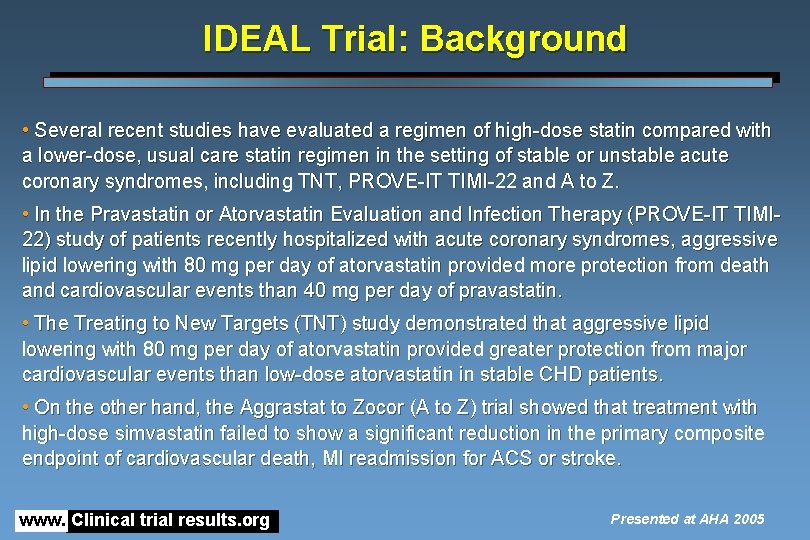
IDEAL Trial: Background • Several recent studies have evaluated a regimen of high-dose statin compared with a lower-dose, usual care statin regimen in the setting of stable or unstable acute coronary syndromes, including TNT, PROVE-IT TIMI-22 and A to Z. • In the Pravastatin or Atorvastatin Evaluation and Infection Therapy (PROVE-IT TIMI 22) study of patients recently hospitalized with acute coronary syndromes, aggressive lipid lowering with 80 mg per day of atorvastatin provided more protection from death and cardiovascular events than 40 mg per day of pravastatin. • The Treating to New Targets (TNT) study demonstrated that aggressive lipid lowering with 80 mg per day of atorvastatin provided greater protection from major cardiovascular events than low-dose atorvastatin in stable CHD patients. • On the other hand, the Aggrastat to Zocor (A to Z) trial showed that treatment with high-dose simvastatin failed to show a significant reduction in the primary composite endpoint of cardiovascular death, MI readmission for ACS or stroke. www. Clinical trial results. org Presented at AHA 2005
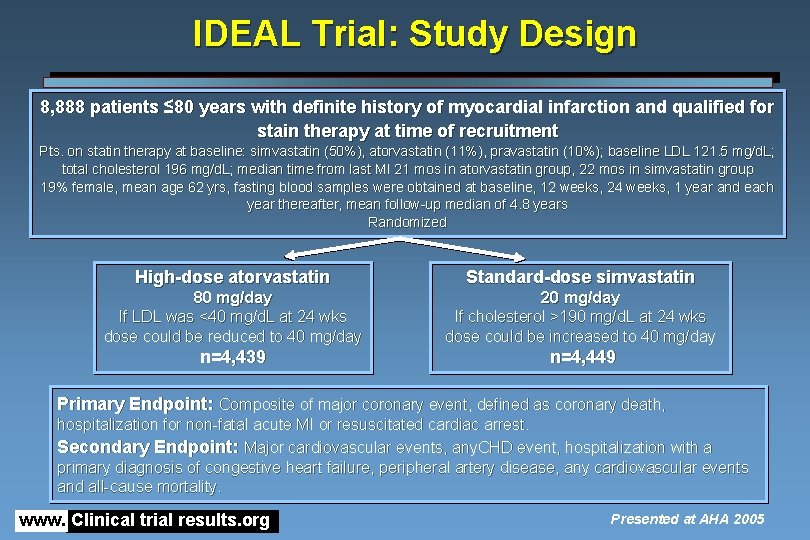
IDEAL Trial: Study Design 8, 888 patients ≤ 80 years with definite history of myocardial infarction and qualified for stain therapy at time of recruitment Pts. on statin therapy at baseline: simvastatin (50%), atorvastatin (11%), pravastatin (10%); baseline LDL 121. 5 mg/d. L; total cholesterol 196 mg/d. L; median time from last MI 21 mos in atorvastatin group, 22 mos in simvastatin group 19% female, mean age 62 yrs, fasting blood samples were obtained at baseline, 12 weeks, 24 weeks, 1 year and each year thereafter, mean follow-up median of 4. 8 years Randomized High-dose atorvastatin Standard-dose simvastatin 80 mg/day If LDL was <40 mg/d. L at 24 wks dose could be reduced to 40 mg/day 20 mg/day If cholesterol >190 mg/d. L at 24 wks dose could be increased to 40 mg/day n=4, 439 n=4, 449 Primary Endpoint: Composite of major coronary event, defined as coronary death, hospitalization for non-fatal acute MI or resuscitated cardiac arrest. Secondary Endpoint: Major cardiovascular events, any. CHD event, hospitalization with a primary diagnosis of congestive heart failure, peripheral artery disease, any cardiovascular events and all-cause mortality. www. Clinical trial results. org Presented at AHA 2005
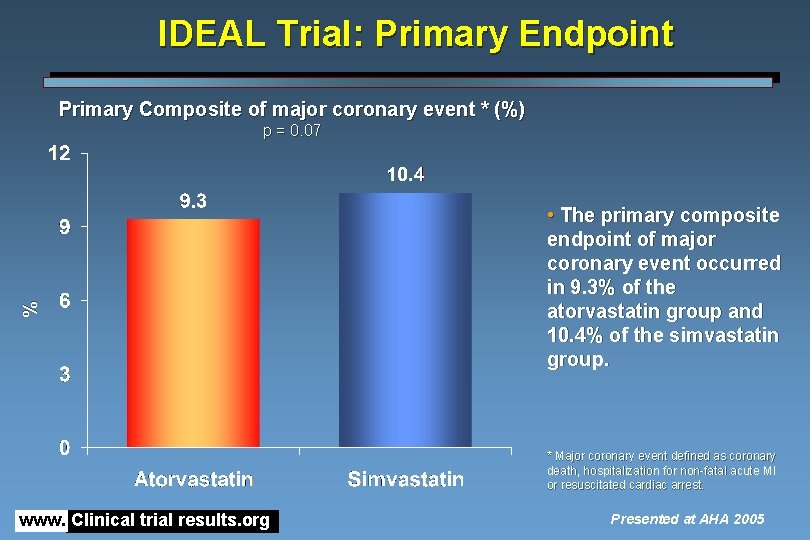
IDEAL Trial: Primary Endpoint Primary Composite of major coronary event * (%) % p = 0. 07 • The primary composite endpoint of major coronary event occurred in 9. 3% of the atorvastatin group and 10. 4% of the simvastatin group. * Major coronary event defined as coronary death, hospitalization for non-fatal acute MI or resuscitated cardiac arrest. www. Clinical trial results. org Presented at AHA 2005
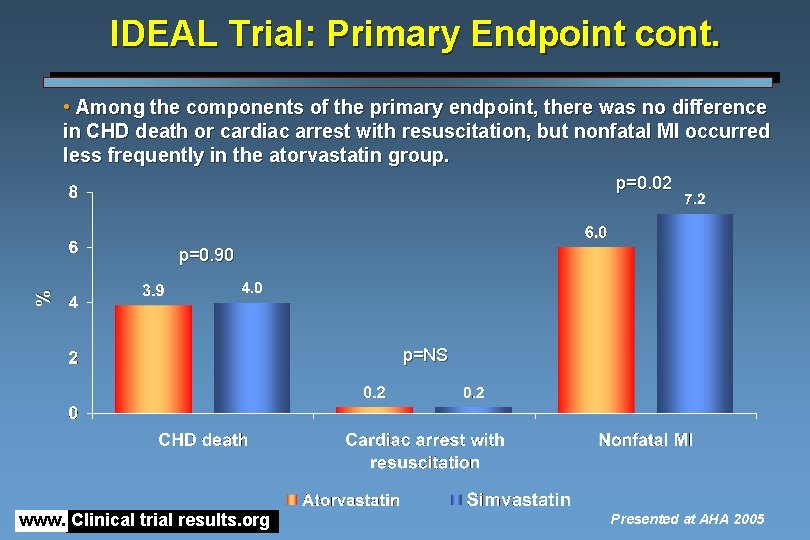
IDEAL Trial: Primary Endpoint cont. • Among the components of the primary endpoint, there was no difference in CHD death or cardiac arrest with resuscitation, but nonfatal MI occurred less frequently in the atorvastatin group. p=0. 02 % p=0. 90 p=NS www. Clinical trial results. org Presented at AHA 2005
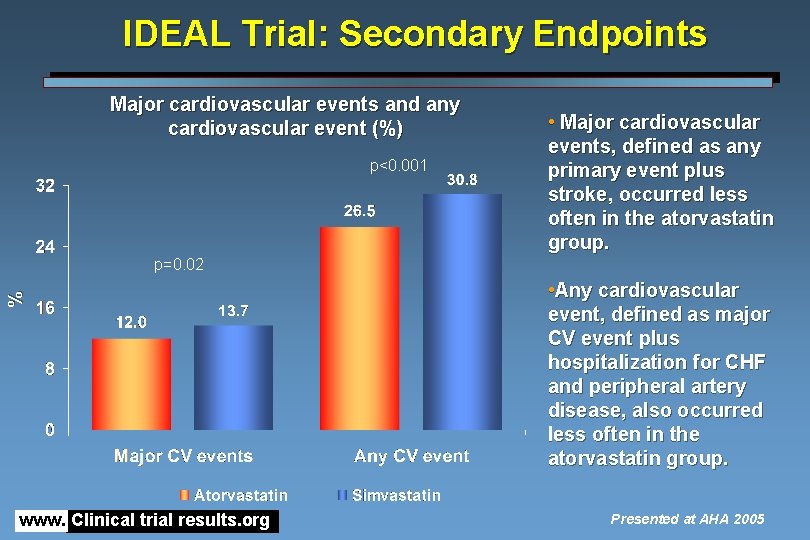
IDEAL Trial: Secondary Endpoints Major cardiovascular events and any cardiovascular event (%) p<0. 001 • Major cardiovascular events, defined as any primary event plus stroke, occurred less often in the atorvastatin group. % p=0. 02 www. Clinical trial results. org • Any cardiovascular event, defined as major CV event plus hospitalization for CHF and peripheral artery disease, also occurred less often in the atorvastatin group. Presented at AHA 2005
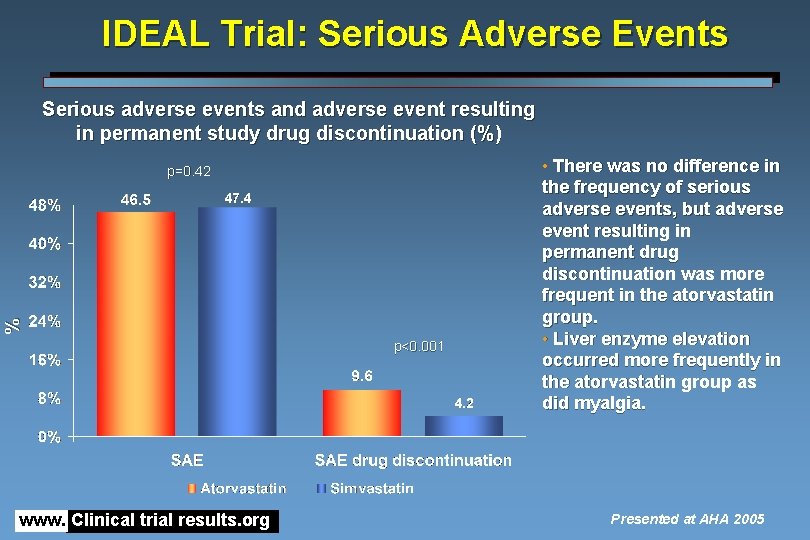
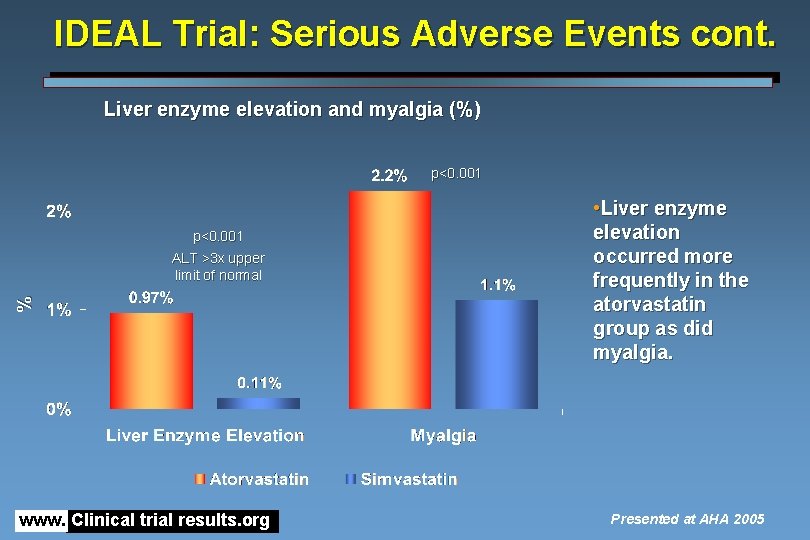
IDEAL Trial: Serious Adverse Events Serious adverse events and adverse event resulting in permanent study drug discontinuation (%) % p=0. 42 p<0. 001 www. Clinical trial results. org • There was no difference in the frequency of serious adverse events, but adverse event resulting in permanent drug discontinuation was more frequent in the atorvastatin group. • Liver enzyme elevation occurred more frequently in the atorvastatin group as did myalgia. Presented at AHA 2005
IDEAL Trial: Serious Adverse Events cont. Liver enzyme elevation and myalgia (%) p<0. 001 % ALT >3 x upper limit of normal www. Clinical trial results. org • Liver enzyme elevation occurred more frequently in the atorvastatin group as did myalgia. Presented at AHA 2005
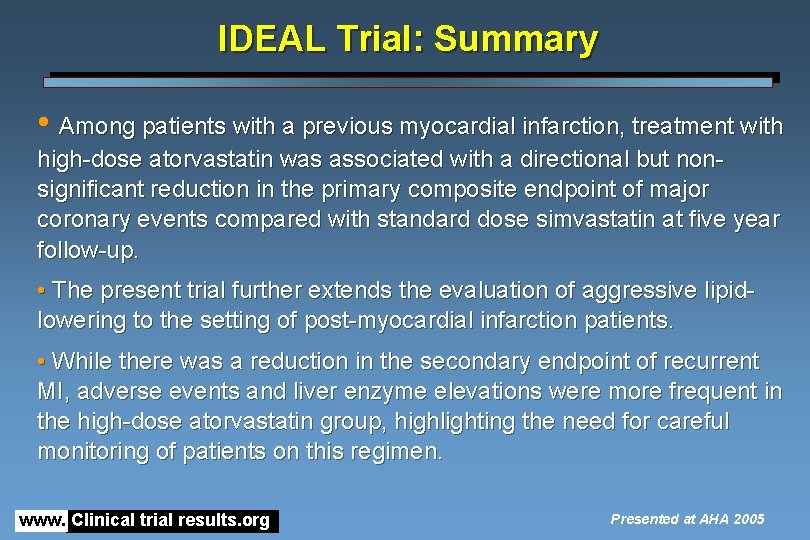
IDEAL Trial: Summary • Among patients with a previous myocardial infarction, treatment with high-dose atorvastatin was associated with a directional but nonsignificant reduction in the primary composite endpoint of major coronary events compared with standard dose simvastatin at five year follow-up. • The present trial further extends the evaluation of aggressive lipidlowering to the setting of post-myocardial infarction patients. • While there was a reduction in the secondary endpoint of recurrent MI, adverse events and liver enzyme elevations were more frequent in the high-dose atorvastatin group, highlighting the need for careful monitoring of patients on this regimen. www. Clinical trial results. org Presented at AHA 2005