I tell you the truth whoever hears my
- Slides: 11
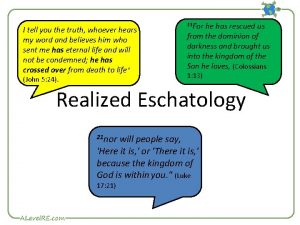
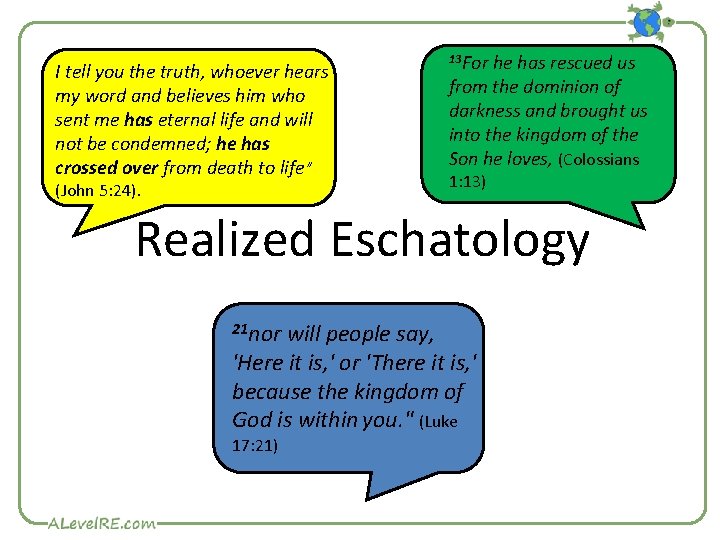
I tell you the truth, whoever hears my word and believes him who sent me has eternal life and will not be condemned; he has crossed over from death to life” (John 5: 24). 13 For he has rescued us from the dominion of darkness and brought us into the kingdom of the Son he loves, (Colossians 1: 13) Realized Eschatology 21 nor will people say, 'Here it is, ' or 'There it is, ' because the kingdom of God is within you. " (Luke 17: 21)
Definition / Key Ideas • The eschatological message of Jesus did not refer to a future event, but the present time • Entry to the “Kingdom” is not a future event – it transcends time – those who accept God’s word are already in the Kingdom • Living in the right way & aiming to establish God’s kingdom on earth is more important than any apocalyptic expectation • Judgement is immediate from the moment someone hears God’s word – it is not a future event.
“I Biblical Basis? tell you the truth, whoever hears my word and believes him who sent me has eternal life and will not be condemned; he has crossed over from death to life” (John 5: 24). • 13 For he has rescued us from the dominion of darkness and brought us into the kingdom of the Son he loves, (Colossians 1: 13) • 21 nor will people say, 'Here it is, ' or 'There it is, ' because the kingdom of God is within you. " (Luke 17: 21) • The implication here is that it has already happened – anyone who believes in Christ are already in the Kingdom of God.
Influence • The ideas here are far less Jewish – they are rooted in Greek philosophy: • God & the Kingdom of God transcend time – it is an eternal Kingdom rather than a temporal one • The ideas are Dualist – in death we simply lose the cloak of our outer bodies as our soul is already in Christ. • Far more in line with a Liberalist interpretation of the Bible
Key Scholars: CH Dodd & Rudolf Bultmann • Dodd argued that the Kingdom of God is a present reality rather than a future event • Bultmann argued that all the imagery we find in the Bible is supposed to be interpreted symbolically – final judgement, the battle of Armageddon, the Second Coming, resurrection of the dead etc.
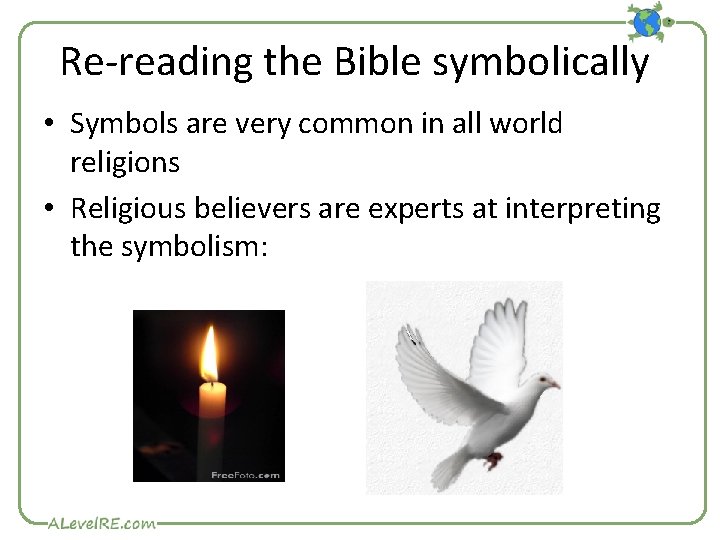
Re-reading the Bible symbolically • Symbols are very common in all world religions • Religious believers are experts at interpreting the symbolism:
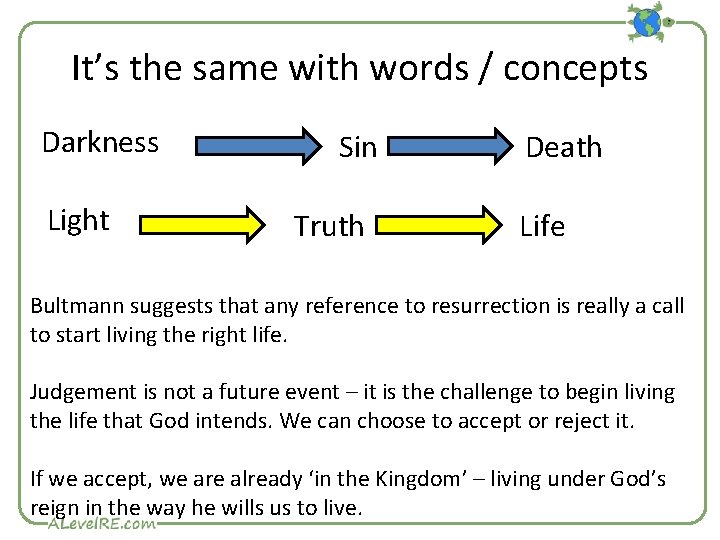
It’s the same with words / concepts Darkness Light Sin Truth Death Life Bultmann suggests that any reference to resurrection is really a call to start living the right life. Judgement is not a future event – it is the challenge to begin living the life that God intends. We can choose to accept or reject it. If we accept, we are already ‘in the Kingdom’ – living under God’s reign in the way he wills us to live.
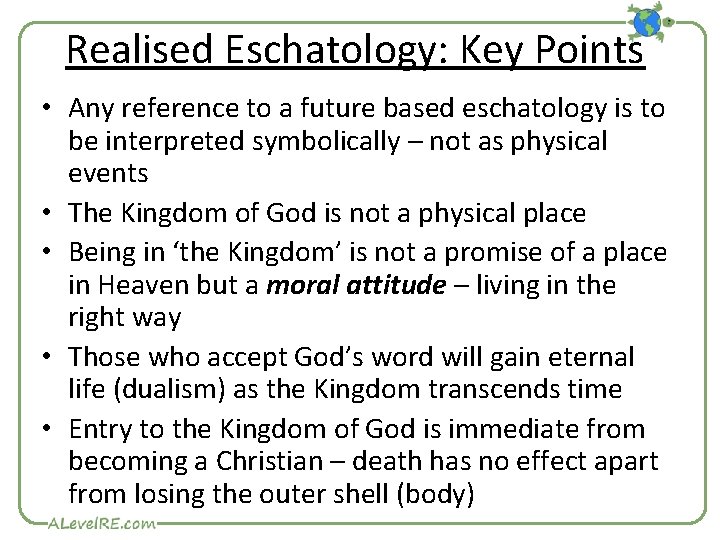
Realised Eschatology: Key Points • Any reference to a future based eschatology is to be interpreted symbolically – not as physical events • The Kingdom of God is not a physical place • Being in ‘the Kingdom’ is not a promise of a place in Heaven but a moral attitude – living in the right way • Those who accept God’s word will gain eternal life (dualism) as the Kingdom transcends time • Entry to the Kingdom of God is immediate from becoming a Christian – death has no effect apart from losing the outer shell (body)
WRITTEN TASK: • Describe in your own words what Realised Eschatology is • Why do you think Realised Eschatology may appeal to some modern Christians? • Why might other more traditional Christians object to Realised Eschatology?
C. H. Dodd • According to Dodd all that had been prophesied about Christ had been achieved – there was nothing more that God can do except give people the choice about whether to believe in him or not. In this sense there is a finality – the “zero hour” of the world is the “zero hour” for the individual – a call to believe. • Matthew 12: 28, “Then the kingdom of God is come unto you, ” • Mark 1: 15, “The kingdom of God is at hand. ”
Jurgen Moltmann • Criticised Dodd’s entirely realised interpretation of eschatological references in the Bible • Moltmann argued that a spiritual kingdom was indeed introduced by Christ in His first coming (his life), but that a literal kingdom was still a future eschatological event, • Eschatological language indicates that the King (Christ) was present but that the kingdom promises were not yet fulfilled • The onus is on the Church to pave the way to enable the future, physical Kingdom of God – by living “in the Kingdom” now, the future based events will be brought into the present.