I Physikalisches Institut Susanne Pfalzner Christoph Olczak David
- Slides: 15
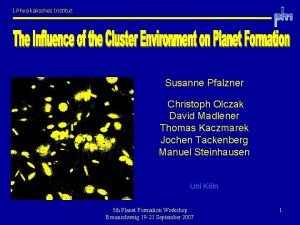
I. Physikalisches Institut Susanne Pfalzner Christoph Olczak David Madlener Thomas Kaczmarek Jochen Tackenberg Manuel Steinhausen Uni Köln 5 th Planet Formation Workshop Braunschweig 19 -21 September 2007 1
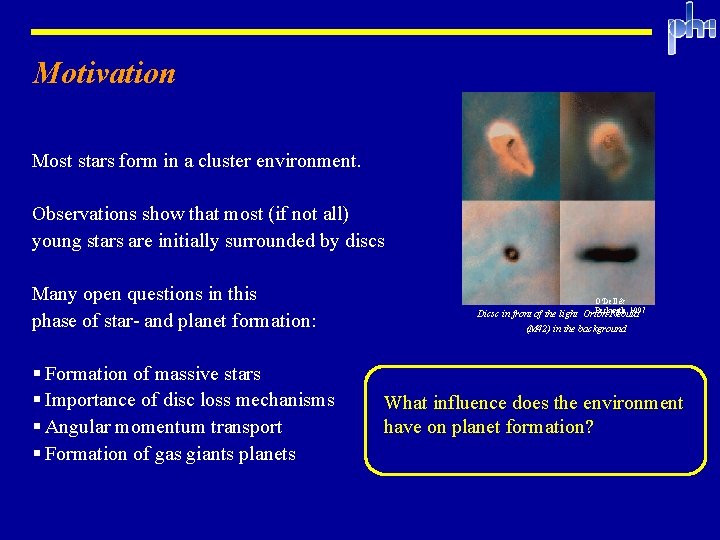
Motivation Most stars form in a cluster environment. Observations show that most (if not all) young stars are initially surrounded by discs Many open questions in this phase of star- and planet formation: § Formation of massive stars § Importance of disc loss mechanisms § Angular momentum transport § Formation of gas giants planets O‘Dell & Beckwith, 1997 Orion-Nebula Dicsc in front of the light (M 42) in the background What influence does the environment have on planet formation?
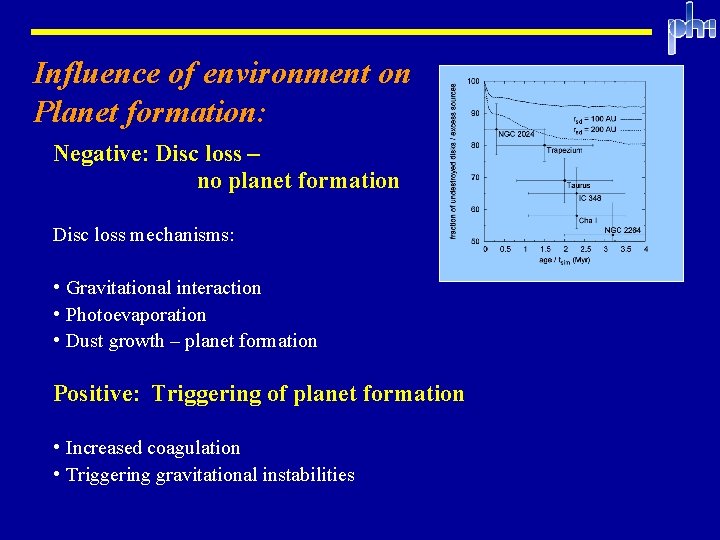
Influence of environment on Planet formation: Negative: Disc loss – no planet formation Disc loss mechanisms: • Gravitational interaction • Photoevaporation • Dust growth – planet formation Positive: Triggering of planet formation • Increased coagulation • Triggering gravitational instabilities
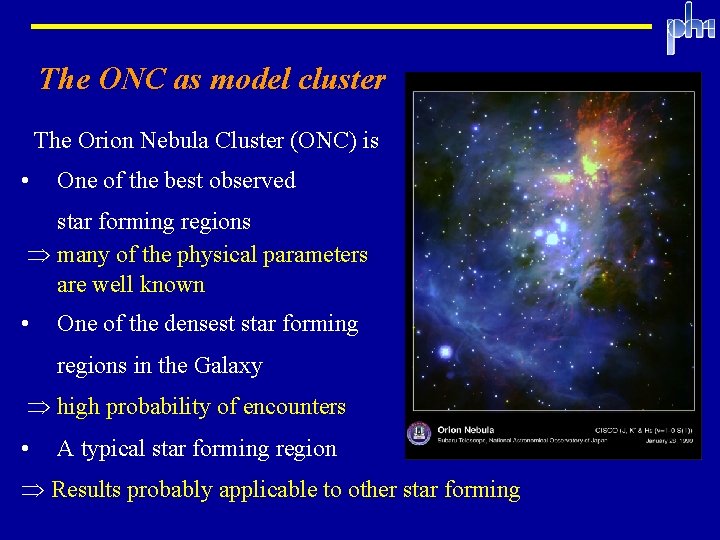
The ONC as model cluster The Orion Nebula Cluster (ONC) is • One of the best observed star forming regions many of the physical parameters are well known • One of the densest star forming regions in the Galaxy high probability of encounters • A typical star forming region Results probably applicable to other star forming
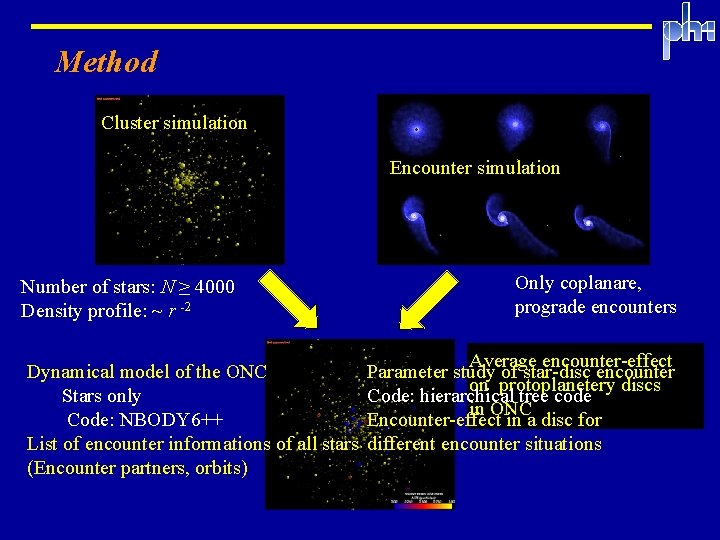
Method Cluster simulation Encounter simulation Number of stars: N ≥ 4000 Density profile: ~ r -2 Dynamical model of the ONC Stars only Code: NBODY 6++ List of encounter informations of all stars (Encounter partners, orbits) Only coplanare, prograde encounters Average encounter-effect Parameter study of star-disc encounter on protoplanetery discs Code: hierarchical tree code in ONC Encounter-effect in a disc for different encounter situations
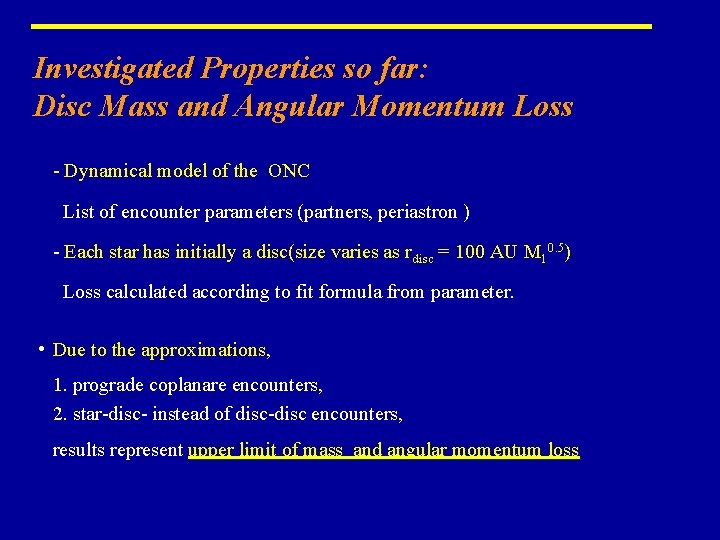
Investigated Properties so far: Disc Mass and Angular Momentum Loss - Dynamical model of the ONC List of encounter parameters (partners, periastron ) - Each star has initially a disc(size varies as rdisc = 100 AU M 10. 5) Loss calculated according to fit formula from parameter. • Due to the approximations, 1. prograde coplanare encounters, 2. star-disc- instead of disc-disc encounters, results represent upper limit of mass and angular momentum loss
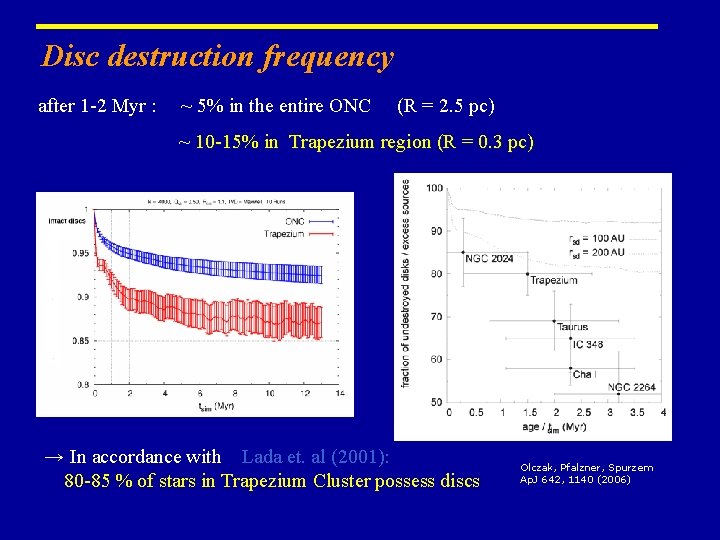
Disc destruction frequency after 1 -2 Myr : ~ 5% in the entire ONC (R = 2. 5 pc) ~ 10 -15% in Trapezium region (R = 0. 3 pc) → In accordance with Lada et. al (2001): 80 -85 % of stars in Trapezium Cluster possess discs Olczak, Pfalzner, Spurzem Ap. J 642, 1140 (2006)
Importance of massive stars Massive stars are mostly (not always) found near cluster center (Mass segregation) Densest part In estimates of encounter relevance commonly two mistake are made: a) Uniform distribution b) All stars have the same mass Often missed: Massive stars function as gravitational foci
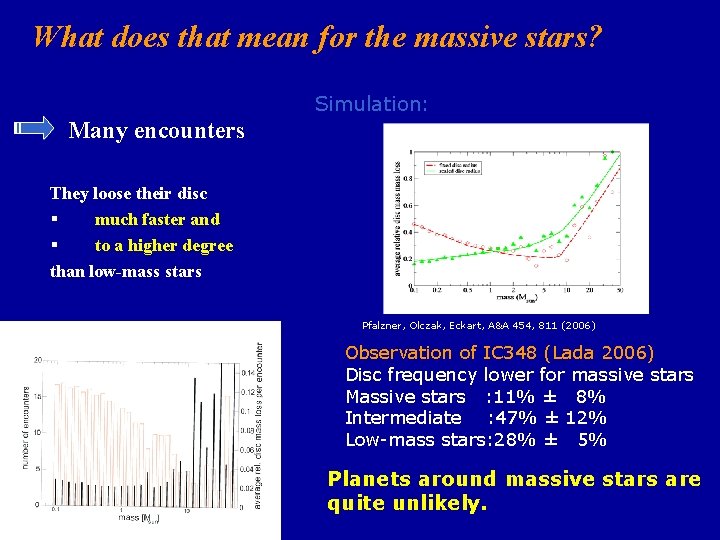
What does that mean for the massive stars? Simulation: Many encounters They loose their disc § much faster and § to a higher degree than low-mass stars Pfalzner, Olczak, Eckart, A&A 454, 811 (2006) Observation of IC 348 (Lada 2006) Disc frequency lower for massive stars Massive stars : 11% ± 8% Intermediate : 47% ± 12% Low-mass stars: 28% ± 5% Planets around massive stars are quite unlikely.
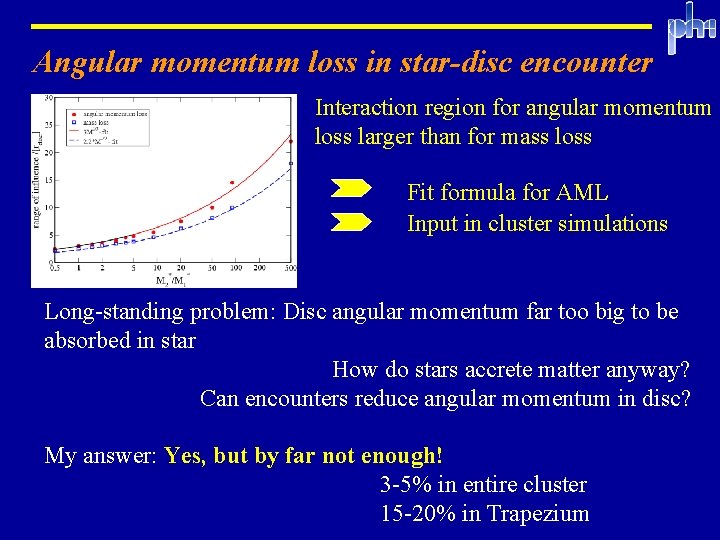
Angular momentum loss in star-disc encounter Interaction region for angular momentum loss larger than for mass loss Fit formula for AML Input in cluster simulations Long-standing problem: Disc angular momentum far too big to be absorbed in star How do stars accrete matter anyway? Can encounters reduce angular momentum in disc? My answer: Yes, but by far not enough! 3 -5% in entire cluster 15 -20% in Trapezium
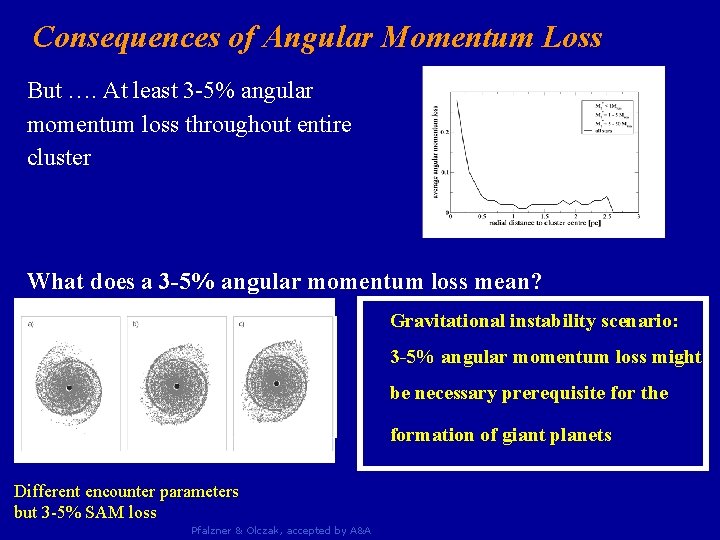
Consequences of Angular Momentum Loss But …. At least 3 -5% angular momentum loss throughout entire cluster What does a 3 -5% angular momentum loss mean? Gravitational instability scenario: 3 -5% angular momentum loss might be necessary prerequisite for the formation of giant planets Different encounter parameters but 3 -5% SAM loss Pfalzner & Olczak, accepted by A&A
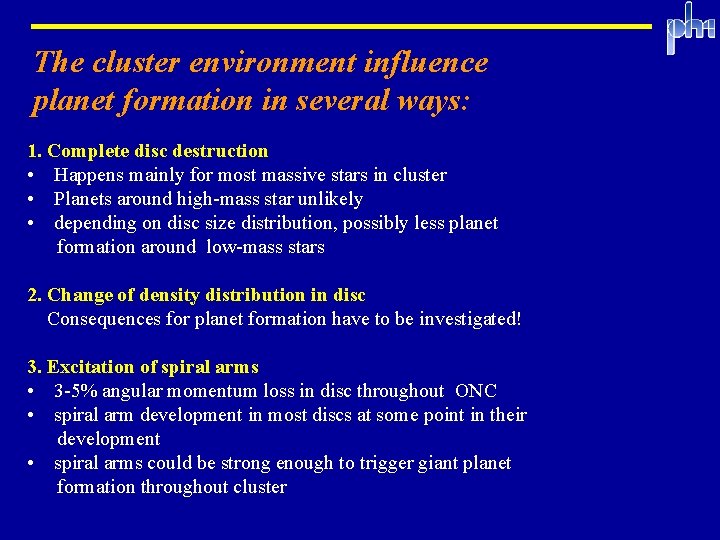
The cluster environment influence planet formation in several ways: 1. Complete disc destruction • Happens mainly for most massive stars in cluster • Planets around high-mass star unlikely • depending on disc size distribution, possibly less planet formation around low-mass stars 2. Change of density distribution in disc Consequences for planet formation have to be investigated! 3. Excitation of spiral arms • 3 -5% angular momentum loss in disc throughout ONC • spiral arm development in most discs at some point in their development • spiral arms could be strong enough to trigger giant planet formation throughout cluster
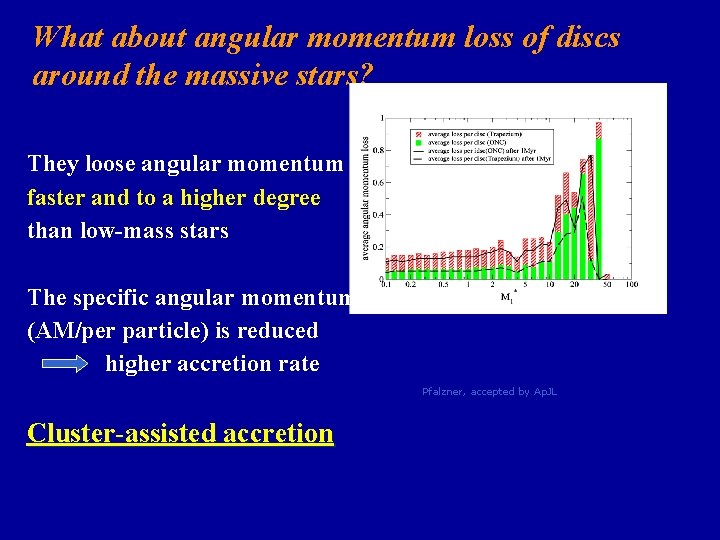
What about angular momentum loss of discs around the massive stars? They loose angular momentum faster and to a higher degree than low-mass stars The specific angular momentum (AM/per particle) is reduced higher accretion rate Pfalzner, accepted by Ap. JL Cluster-assisted accretion
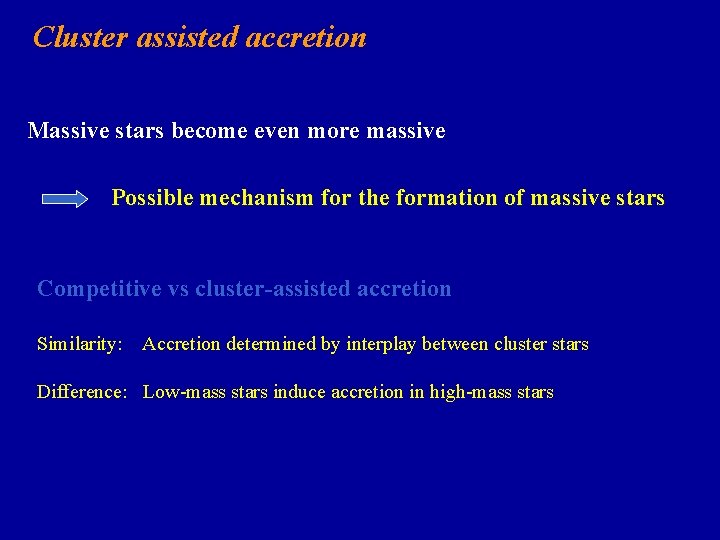
Cluster assisted accretion Massive stars become even more massive Possible mechanism for the formation of massive stars Competitive vs cluster-assisted accretion Similarity: Accretion determined by interplay between cluster stars Difference: Low-mass stars induce accretion in high-mass stars
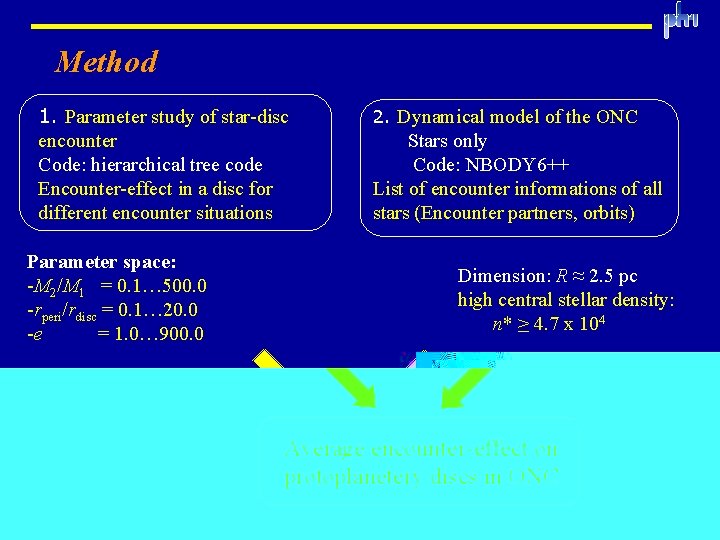
Method 1. Parameter study of star-disc encounter Code: hierarchical tree code Encounter-effect in a disc for different encounter situations Parameter space: -M 2/M 1 = 0. 1… 500. 0 -rperi/rdisc = 0. 1… 20. 0 -e = 1. 0… 900. 0 2. Dynamical model of the ONC Stars only Code: NBODY 6++ List of encounter informations of all stars (Encounter partners, orbits) Dimension: R ≈ 2. 5 pc high central stellar density: n* ≥ 4. 7 x 10⁴ Average encounter-effect on protoplanetery discs in ONC