HOW TO SUPPORT SELFREGULATED LEARNING Merilyn Meristo Estonia


- Slides: 8
HOW TO SUPPORT SELF-REGULATED LEARNING Merilyn Meristo, Estonia merilyn. meristo@tlu. ee 08 April, 2015 Tallinn
HUMAN’S THREE BASIC NEEDS 4 Self-Determination Theory 4 AUTONOMY 4 RELATEDNESS 4 COMPETENCE
4 Autonomy-supportive teachers 4 Controlling teachers 4 Structered teachers 4 Chaotic teachers (Vansteenkiste 2012, Deci & Ryan, 2001)
General Description 4 Autonomy-supportive teachers, school boards, and student counselors work from the students perspective and try to stimulate intiative within the students. Students may not complete assignments which are boring and routine (Pasi, 2006) 4 Controlling teachers, school boards, and student counselors force students to think, act, or feel in prescribed ways, such that students feel as if they have no other choice than to obey and put effort in their studies.
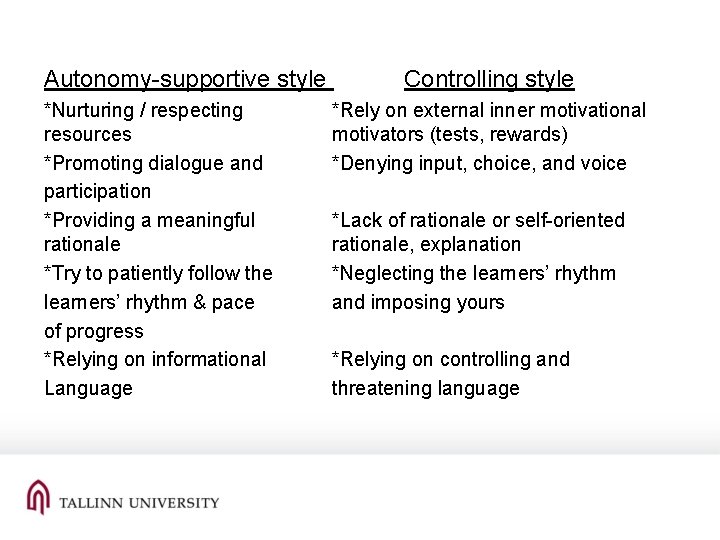
Autonomy-supportive style *Nurturing / respecting resources *Promoting dialogue and participation *Providing a meaningful rationale *Try to patiently follow the learners’ rhythm & pace of progress *Relying on informational Language Controlling style *Rely on external inner motivational motivators (tests, rewards) *Denying input, choice, and voice *Lack of rationale or self-oriented rationale, explanation *Neglecting the learners’ rhythm and imposing yours *Relying on controlling and threatening language
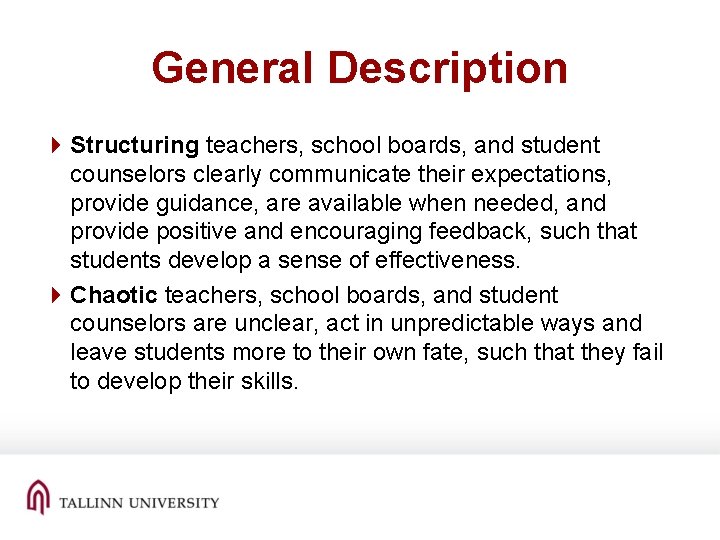
General Description 4 Structuring teachers, school boards, and student counselors clearly communicate their expectations, provide guidance, are available when needed, and provide positive and encouraging feedback, such that students develop a sense of effectiveness. 4 Chaotic teachers, school boards, and student counselors are unclear, act in unpredictable ways and leave students more to their own fate, such that they fail to develop their skills.
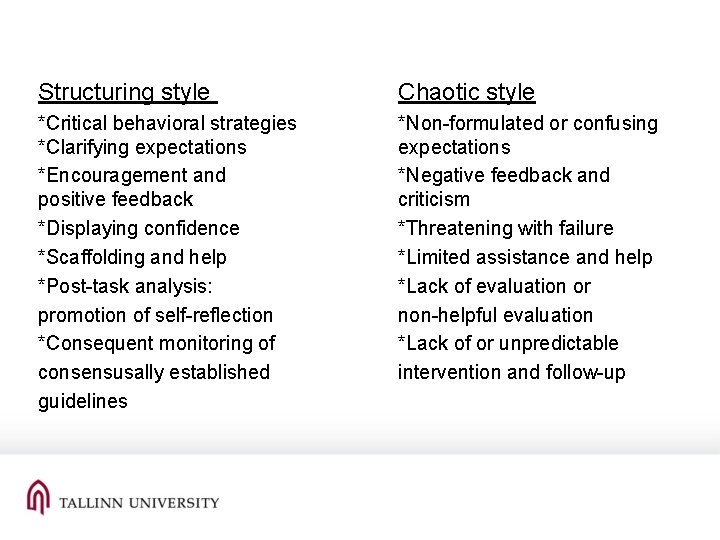
Structuring style Chaotic style *Critical behavioral strategies *Clarifying expectations *Encouragement and positive feedback *Displaying confidence *Scaffolding and help *Post-task analysis: promotion of self-reflection *Consequent monitoring of consensusally established guidelines *Non-formulated or confusing expectations *Negative feedback and criticism *Threatening with failure *Limited assistance and help *Lack of evaluation or non-helpful evaluation *Lack of or unpredictable intervention and follow-up
Thank you!