HOW LANGUAGES MEAN The Language Detective Villiers Park
- Slides: 16
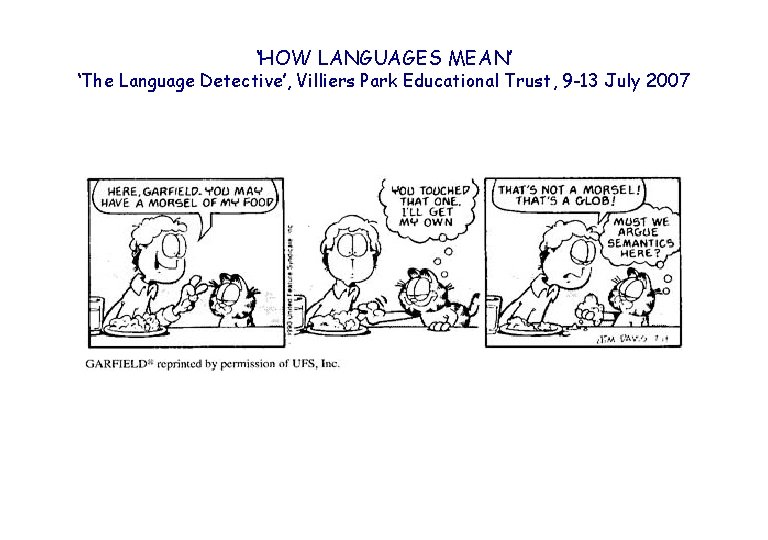
‘HOW LANGUAGES MEAN’ ‘The Language Detective’, Villiers Park Educational Trust, 9 -13 July 2007
Aims of the session To think about how languages �� communicate meanings and how we can investigate this
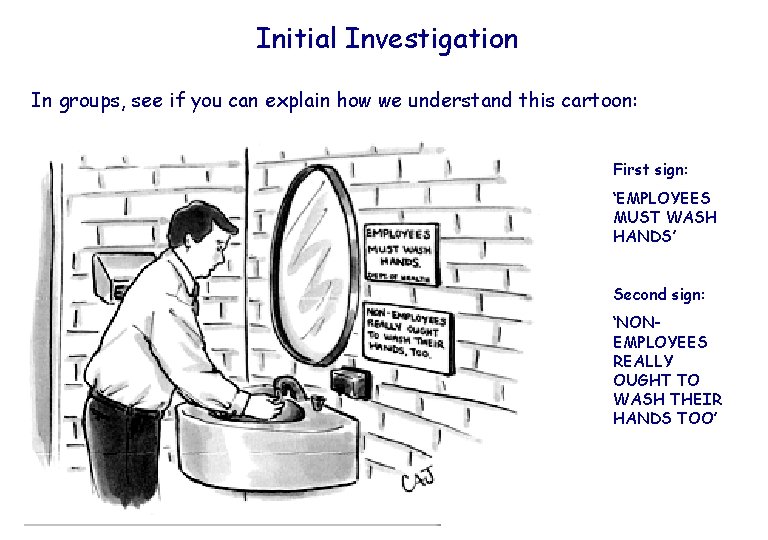
Initial Investigation In groups, see if you can explain how we understand this cartoon: First sign: ‘EMPLOYEES MUST WASH HANDS’ Second sign: ‘NONEMPLOYEES REALLY OUGHT TO WASH THEIR HANDS TOO’
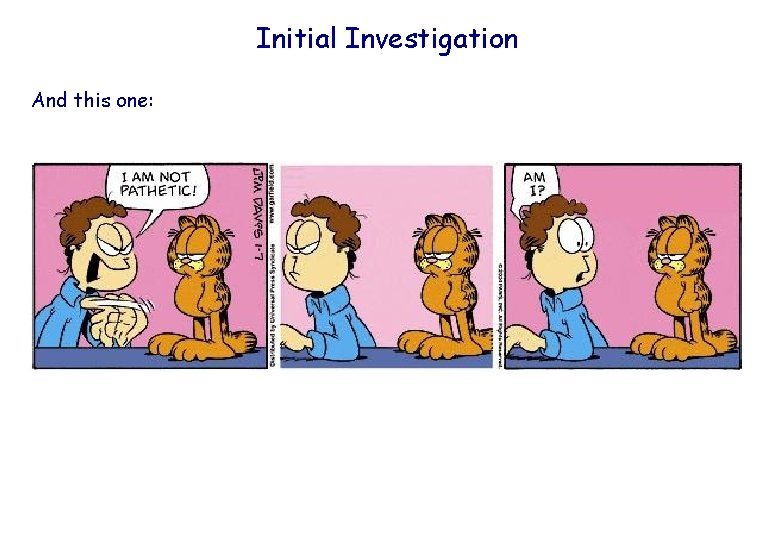
Initial Investigation And this one:
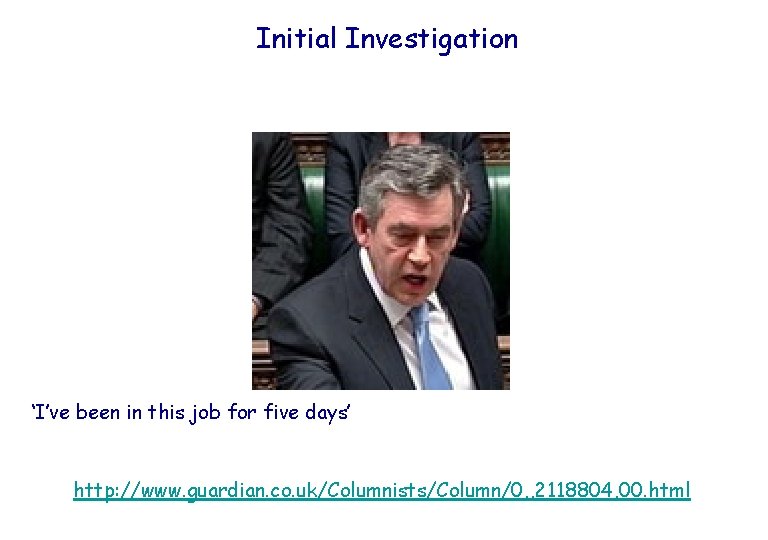
Initial Investigation And this utterance: ‘I’ve been in this job for five days’
Initial Investigation ‘I’ve been in this job for five days’ http: //www. guardian. co. uk/Columnists/Column/0, , 2118804, 00. html
So how do languages mean? Most people would first think about word meanings. But what exactly is a word meaning? And is there anything else? Do different languages have different ways of meaning? Look at the examples on the handout from other languages and decide in what ways these languages are different from English in the ways they communicate meanings.
Some Early Conclusions We can make a distinction between linguistically encoded meaning (this is what ‘linguistic semantics’ is about) and meanings we work out based on assumptions about the non-linguistic context, including the assumptions and intentions of the speaker (this is what ‘pragmatics’ is about). Some languages encode things which other languages do not (e. g. there are markers in English to indicate whether nouns are singular or plural but not in varieties of Chinese). Some languages (‘tone languages’) use pitch movement to differentiate different words. Most Chinese languages are tone languages� while English not. Some linguists recognise a third category of ‘pitch accent languages’.
Components of Language/Linguistics If we’re going to look more systematically at how languages communicate meanings, we need to start by making clear what kinds of things languages are composed of. A simple way to think of this would be to say that languages are made up of sounds/signs, structures and meanings. More technically, the main components usually recognised are: phonetics phonology morphology syntax semantics pragmatics lexicon (vocabulary)
Phonetics and Phonology The study of language sounds is usually divided into phonetics and phonology. Roughly, phonetics looks in detail at the specific sounds we produce when speaking while phonology looks at the system of sounds. Try the exercises on the handout which should help you to notice differences between sounds which we don’t usually think about in everyday conversations.
Phonetics and Phonology This is still just a rough indication, but we can begin by thinking of phonetics as concerned with details of specific sounds produced, e. g the difference between the /l/ in leap and the /l/ in pool, while phonology is concerned with the system of sounds. The two /l/ sounds are two different ways of realising the same underlying ’phoneme’. Linguists would refer to these as two ‘allophones’ of the phoneme /l/ Note: not everyone here necessarily makes this distinction. In the variety I grew up speaking (near Aberdeen, in North-East Scotland), we pronounced both of these more or less like the /l/ in pool for other speakers.
Morphology is concerned with the meaningful components which words are made up of. Try the exercise on the handout which should help you to establish the difference between ‘morphemes’ and ‘words’.
Morphology Morphemes are sometimes described as the ‘smallest meaningful units’ in a language. Every word in a language is made up of one or more morphemes. Strictly speaking, it is morpheme meanings rather than word meanings which we need to explain if we want to account for how languages communicate meanings.
Syntax is concerned with how words are combined into larger units: phrases or clauses. Try the exercise on the handout which should help you to understand how sentences with the same words can have different meanings if they are structured differently.
Semantics and Pragmatics Linguistic semantics is concerned with the meanings encoded by particular linguistic forms. So far, we’ve established that these forms include: morpheme meanings, syntactic meanings, intonational meanings Pragmatics is concerned with how we construct meanings in context based on linguistically encoded meanings. We’ll leave pragmatics to one side for now.
Investigating Further To finish, discuss how you might find out more about these questions: a) b) c) d) e) f) g) What does innit mean? What do the following mean in Billy’s dialect? I ken I dinna ken I doubt it’ll rain You feart me