Historical Thinking Skills APUSH Slides adapted from AP

- Slides: 14
Historical Thinking Skills APUSH Slides adapted from AP U. S. History Curriculum Framework
Skill Type I: Chronological Reasoning • Historical Causation • Patterns of continuity and Change over Time • Periodization
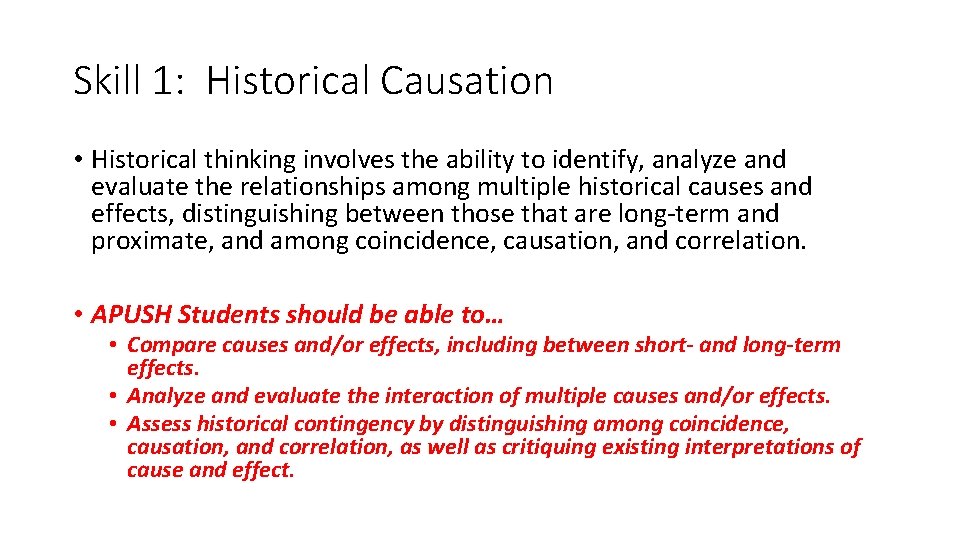
Skill 1: Historical Causation • Historical thinking involves the ability to identify, analyze and evaluate the relationships among multiple historical causes and effects, distinguishing between those that are long-term and proximate, and among coincidence, causation, and correlation. • APUSH Students should be able to… • Compare causes and/or effects, including between short- and long-term effects. • Analyze and evaluate the interaction of multiple causes and/or effects. • Assess historical contingency by distinguishing among coincidence, causation, and correlation, as well as critiquing existing interpretations of cause and effect.
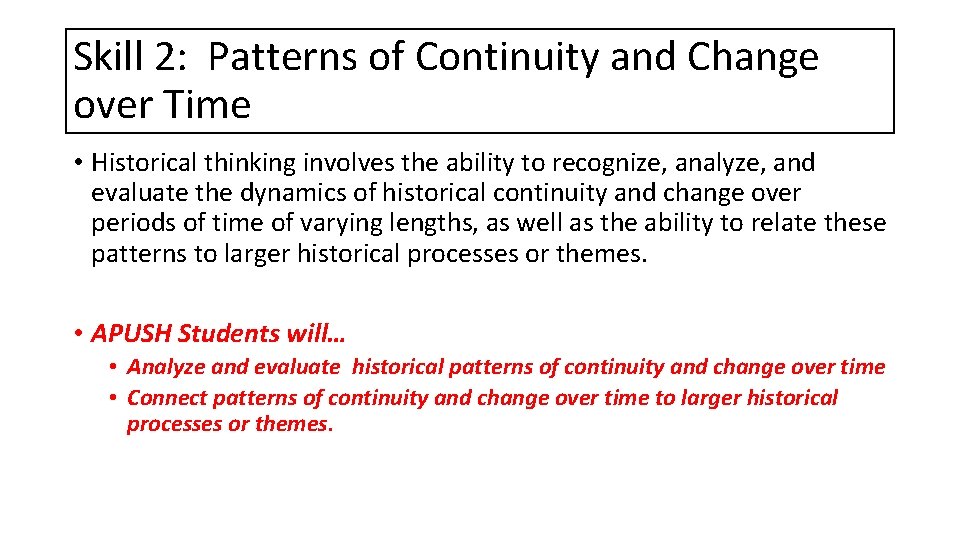
Skill 2: Patterns of Continuity and Change over Time • Historical thinking involves the ability to recognize, analyze, and evaluate the dynamics of historical continuity and change over periods of time of varying lengths, as well as the ability to relate these patterns to larger historical processes or themes. • APUSH Students will… • Analyze and evaluate historical patterns of continuity and change over time • Connect patterns of continuity and change over time to larger historical processes or themes.
Skill 3: Periodization • Historical thinking involves the ability to describe, analyze, evaluate, and construct models that historians use to organize history into discrete periods and that those models involve choice by the historian placing value upon certain aspects of history over others. Changing periodization can change the historical narrative. • APUSH Students should be able to… • Explain ways that historical events and processes can be organized within blocks of time. • Analyze and evaluate competing models of periodization of U. S. history.
Skill Type II: Comparison and Contextualization
Skill 4: Comparison • Historical thinking involves the ability to describe, compare, and evaluate multiple historical developments within one society, between different societies, and for various chronological and geographical contexts. It also involves the ability to identify, compare, and evaluate multiple perspectives on a given historical experience. • APUSH Students should be able to… • Compare related historical developments and processes across place, time, and/or different societies or within one society. • Explain and evaluate multiple and differing perspectives on a given historical phenomenon.
Skill 5: Contextualization • Historical thinking involves the ability to connect historical events and processes to specific circumstances of time and place and to broader regional, national, or global processes. • APUSH students should be able to… • Explain and evaluate ways in which specific historical phenomena, events, or processes connect to broader regional, national, or global processes occurring at the same time. • Explain and evaluate was in which a phenomenon, event, or process connects to other, similar historical phenomena across time and place.
Skill Type 3: Crafting Historical Arguments from Historical Evidence
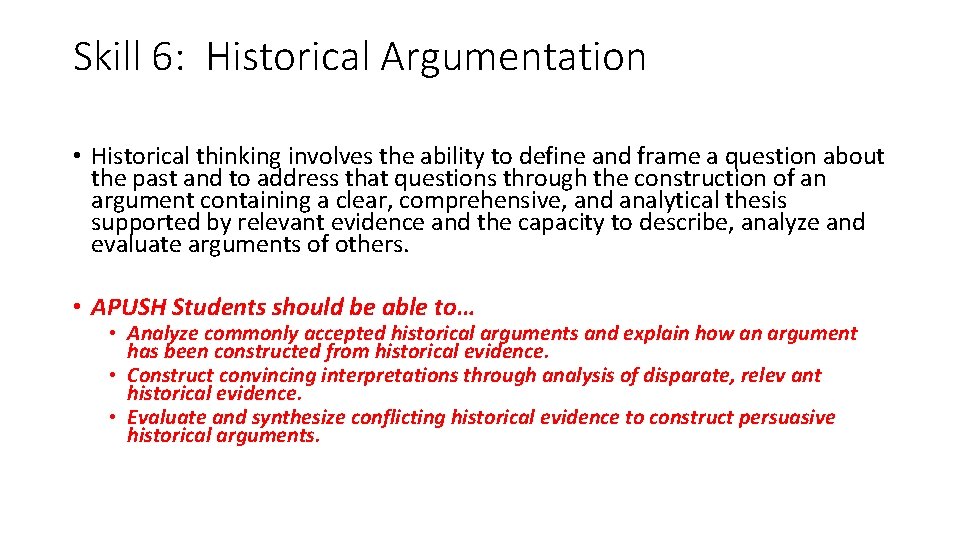
Skill 6: Historical Argumentation • Historical thinking involves the ability to define and frame a question about the past and to address that questions through the construction of an argument containing a clear, comprehensive, and analytical thesis supported by relevant evidence and the capacity to describe, analyze and evaluate arguments of others. • APUSH Students should be able to… • Analyze commonly accepted historical arguments and explain how an argument has been constructed from historical evidence. • Construct convincing interpretations through analysis of disparate, relev ant historical evidence. • Evaluate and synthesize conflicting historical evidence to construct persuasive historical arguments.
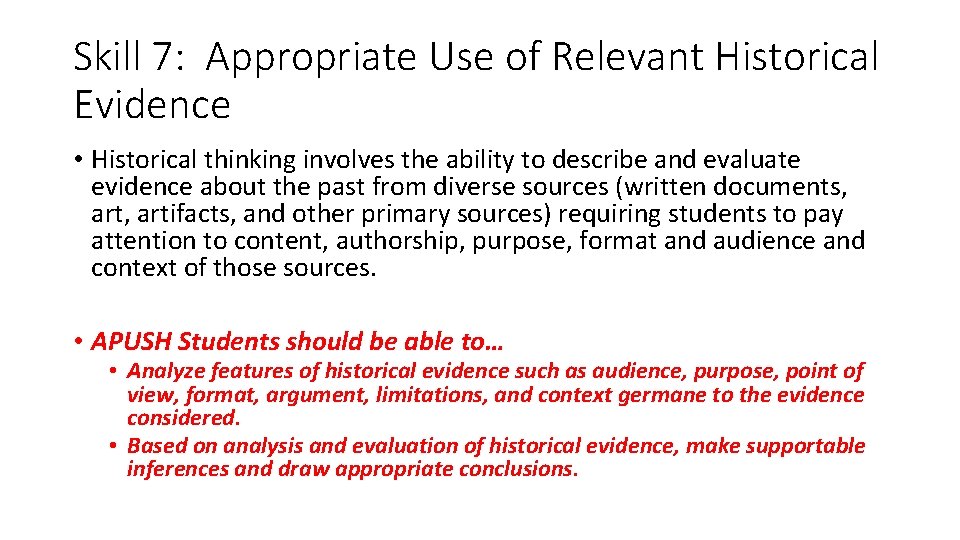
Skill 7: Appropriate Use of Relevant Historical Evidence • Historical thinking involves the ability to describe and evaluate evidence about the past from diverse sources (written documents, artifacts, and other primary sources) requiring students to pay attention to content, authorship, purpose, format and audience and context of those sources. • APUSH Students should be able to… • Analyze features of historical evidence such as audience, purpose, point of view, format, argument, limitations, and context germane to the evidence considered. • Based on analysis and evaluation of historical evidence, make supportable inferences and draw appropriate conclusions.
Skill Type IV: Historical Interpretation and Synthesis
Skill 8: Interpretation • Historical thinking involves the ability to describe, analyze, evaluate, and construct diverse interpretations of the past, and being aware of how particular circumstances and contexts in which historians work and write also shape interpretation of past events. • APUSH Students should be able to… • Analyze diverse historical interpretations. • Evaluate how historians’ perspectives influence their interpretaitons and how models of historical interpretation change over time.
Skill 9: Synthesis • Historical thinking involves the ability to develop meaningful and persuasive new understandings of the past by applying all of the other historical thinking skills, by drawing appropriately on ideas and methods from different fields of inquiry and by creatively fusing disparate, relevant, and sometimes contradictory evidence from primary sources and secondary works. Synthesis may involve applying insights about the past to other contexts or circumstances, including the present. • APUSH Students should be able to… • Combine disparate, sometimes contradictory evidence from primary sources and secondary works in order to create a persuasive understanding of the past. • Apply insights about the past to other historical contexts or circumstances, including the present.