High participation systems of higher education The growing

- Slides: 16
High participation systems of higher education: The growing obstacles to strategies of social equalisation Prepared for the International Symposium of the Frontiers of the Study of social inequality Program, Tohoku University, Japan, 2 March 2019 Simon Marginson ESRC/OFSRE Centre for Global Higher Education Department of Education, University of Oxford, UK
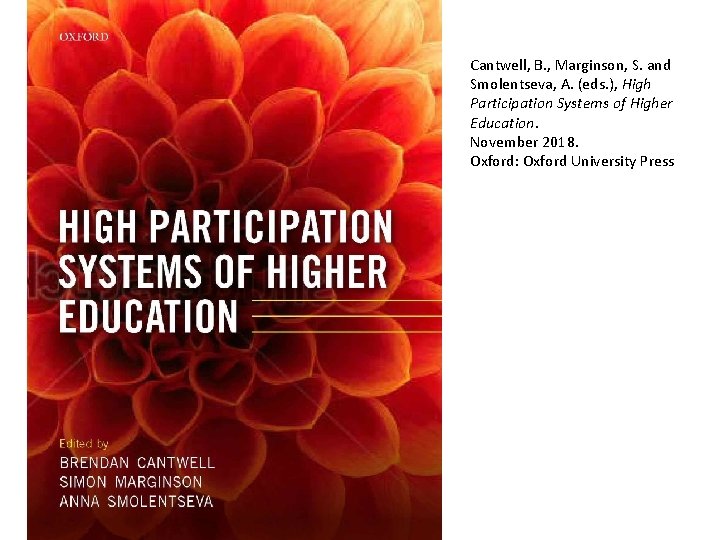
Cantwell, B. , Marginson, S. and Smolentseva, A. (eds. ), High Participation Systems of Higher Education. November 2018. Oxford: Oxford University Press
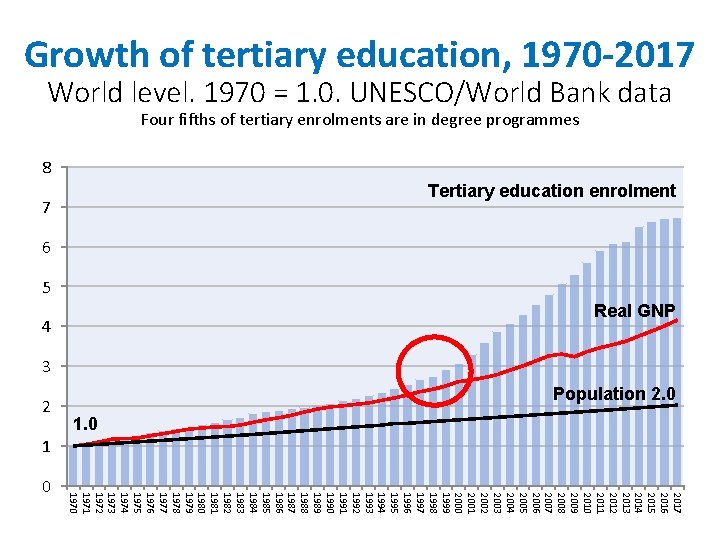
Growth of tertiary education, 1970 -2017 World level. 1970 = 1. 0. UNESCO/World Bank data Four fifths of tertiary enrolments are in degree programmes 8 Tertiary education enrolment 7 6 5 Real GNP 4 3 2 Population 2. 0 1 2017 2016 2015 2014 2013 2012 2011 2010 2009 2008 2007 2006 2005 2004 2003 2002 2001 2000 1999 1998 1997 1996 1995 1994 1993 1992 1991 1990 1989 1988 1987 1986 1985 1984 1983 1982 1981 1980 1979 1978 1977 1976 1975 1974 1973 1972 1971 1970 0
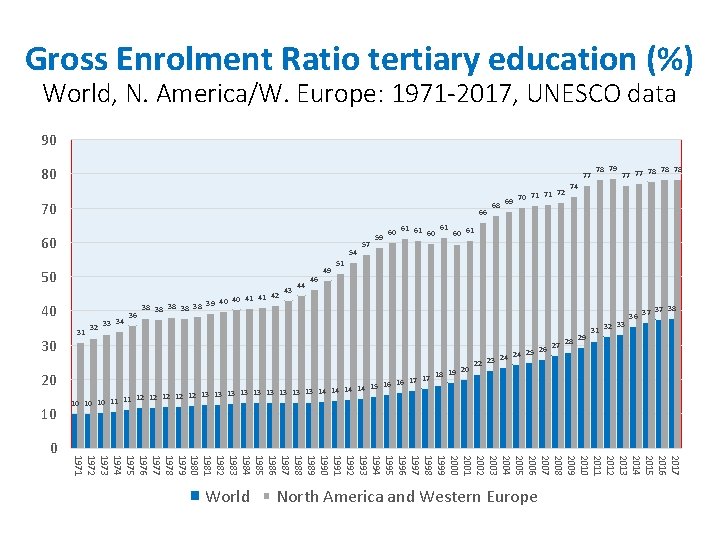
Gross Enrolment Ratio tertiary education (%) World, N. America/W. Europe: 1971 -2017, UNESCO data 90 80 77 70 66 60 54 50 40 30 20 10 36 44 46 78 78 77 77 78 74 61 60 61 61 60 60 61 51 19 20 17 18 17 16 14 15 16 13 13 14 14 14 13 13 12 12 12 11 12 12 10 10 10 11 28 26 27 24 25 24 22 23 29 31 32 33 37 38 36 37 2016 2015 2014 2013 2012 2011 2010 2009 2008 2007 2006 2005 2004 2003 2002 2001 2000 1999 1998 1997 1996 1995 1994 1993 1992 1991 1990 1989 1988 1987 1986 1985 1984 1983 1982 1981 1980 1979 1978 1977 1976 1975 1974 1973 1972 1971 0 31 34 32 33 41 41 42 39 40 40 38 38 38 43 49 57 59 72 70 71 71 68 69 78 79 World North America and Western Europe
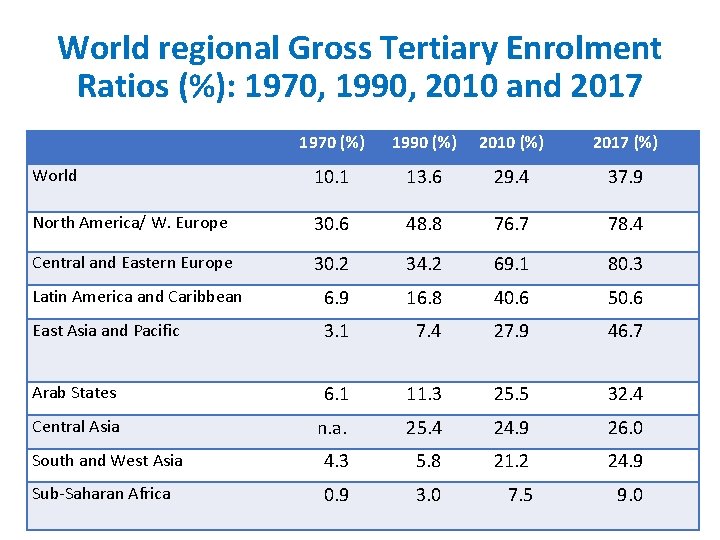
World regional Gross Tertiary Enrolment Ratios (%): 1970, 1990, 2010 and 2017 1970 (%) 1990 (%) 2017 (%) World North America/ W. Europe 10. 1 13. 6 29. 4 37. 9 30. 6 48. 8 76. 7 78. 4 Central and Eastern Europe 30. 2 34. 2 69. 1 80. 3 Latin America and Caribbean 6. 9 16. 8 40. 6 50. 6 East Asia and Pacific 3. 1 7. 4 27. 9 46. 7 Arab States 6. 1 11. 3 25. 5 32. 4 Central Asia n. a. 25. 4 24. 9 26. 0 South and West Asia 4. 3 5. 8 21. 2 24. 9 Sub-Saharan Africa 0. 9 3. 0 7. 5 9. 0
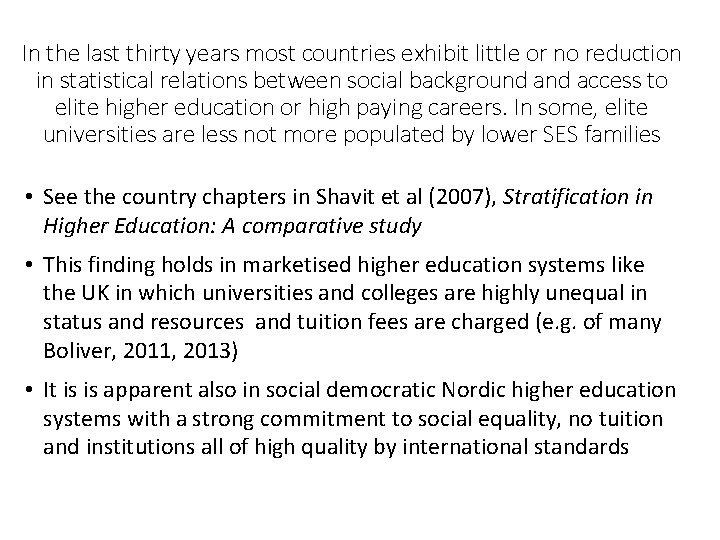
In the last thirty years most countries exhibit little or no reduction in statistical relations between social background access to elite higher education or high paying careers. In some, elite universities are less not more populated by lower SES families • See the country chapters in Shavit et al (2007), Stratification in Higher Education: A comparative study • This finding holds in marketised higher education systems like the UK in which universities and colleges are highly unequal in status and resources and tuition fees are charged (e. g. of many Boliver, 2011, 2013) • It is is apparent also in social democratic Nordic higher education systems with a strong commitment to social equality, no tuition and institutions all of high quality by international standards
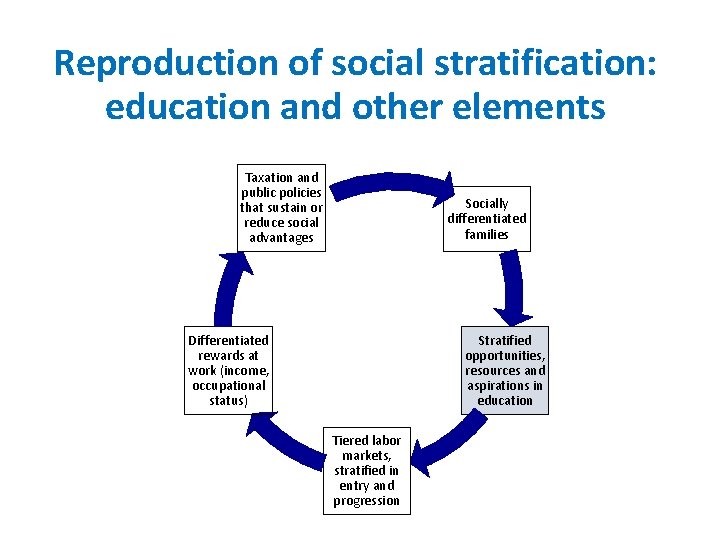
Reproduction of social stratification: education and other elements Taxation and public policies that sustain or reduce social advantages Socially differentiated families Differentiated rewards at work (income, occupational status) Stratified opportunities, resources and aspirations in education Tiered labor markets, stratified in entry and progression
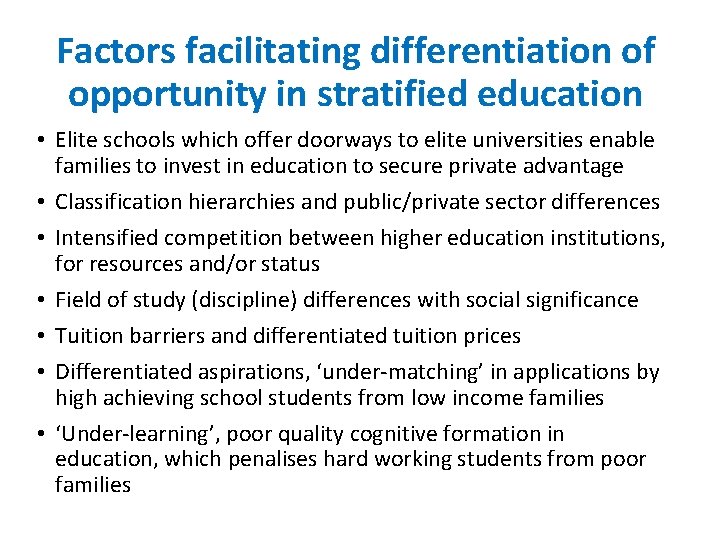
Factors facilitating differentiation of opportunity in stratified education • Elite schools which offer doorways to elite universities enable families to invest in education to secure private advantage • Classification hierarchies and public/private sector differences • Intensified competition between higher education institutions, for resources and/or status • Field of study (discipline) differences with social significance • Tuition barriers and differentiated tuition prices • Differentiated aspirations, ‘under-matching’ in applications by high achieving school students from low income families • ‘Under-learning’, poor quality cognitive formation in education, which penalises hard working students from poor families
Expansion in itself fosters stratification • The expansion of participation in higher education is associated with an enhanced tendency to bifurcation (c/f Bourdieu) between elite selective institutions and mass demand-absorbing institutions • This tendency to bi-furcation drives continuing vertical stratification in the value of higher education, all else equal • The more intense ‘hierarchisation’ is the natural outcome of the growing positional shortage of elite opportunities – places in elite universities, high status occupations, high income earning careers – relative to the expanding number of higher education students. When social competition for the increasingly scarce places becomes magnified, in this more competitive setting, the advantages of the affluent middle class become increasingly determining of education and social outcomes. The social elite crowd out the most sought-after higher education institutions
Higher education as differentiation: immiseration effects • As social participation reaches 50 per cent and moves beyond, it is unclear that higher education will provide security, or graduate skills will be fully used, but the stakes in participation are raised. Higher education becomes a defensive necessity, a hedge against both social exclusion and downward mobility • In societies with high participation in higher education, nonparticipation is a growing disadvantage. A shrinking proportion of jobs are accessible to those without qualifications. The social capital associated with higher education provides routes of navigation and cultural capital provides tools of navigation • In 2016 there was a strong correlation between voting for Trump and Brexit, and low levels of educational attainment
Stratification and competition policy • Policy can counter the secular tendency to greater stratification if there is the political will to do so. Most governments have gone the other way, fostering neo-liberal competition in quasi-markets • All else being equal, neo-liberal competition between institutions is associated with a growing stratification of resources and status over time—e. g. in North America see Davies and Zarifa (2012) • The World-Class University (WCU) movement further fosters stratification. More so because it is often accompanied by underfunding of public systems, and in some countries low-cost expedients like MOOCs in place of face-to-face learning, and the expanding role of low quality for-profit sectors
Findings of study: stratification • The expansion of participation towards and beyond the High Participation Systems (HPS) stage is associated with a tendency to bifurcation and vertical stratification in the value of higher education, between elite (selective) institutions and mass (demand-absorbing) institutions • The tendency to institutional stratification is magnified by features common though not universal among HPS including (a) intensified social competition for the most valuable student places, (b) variable tuition charges, and/or (c) intensified competition between institutions
Findings: social equality • As participation expands, equity associal inclusion is enhanced. But the immiseration of those not higher educated increases • Because the growth of participation is associated with enhanced stratification, and intensified competition at key transition points, all else being equal (i. e. without compensatory policy) the expansion of participation is associated with a secular tendency to greater social inequality in educational outcomes • As participation expands, all else equal the positional structure of higher education merges with that of society. The HPS is more iimplicated in the reproduction of existing social inequality. • As the boundary of participation expands it is more difficult for the state to secure a social redistribution of educational opportunities
Stratification in the eight countries • The bifurcation between elite and mass sub-sectors, and tendency to greater stratification (calibrated in research funding and outcomes, student selectivity, etc), was apparent in all cases, including Norway - except in Finland where an egalitarian system is firmly maintained by government policy and regulation. • Institutional competition fosters stratification in non neoliberal regimes (e. g. Canada), and more so in neoliberal systems (e. g. Australia, Russia). Government policy and regulation can closely shape forms of stratification, e. g. Australia, Japan • All university hierarchies are stable at the top, despite neoliberalism • In the Nordic countries social stratification primarily plays out in social contest over entry into elite disciplines, not universities
Equality in the eight countries • Expansion clearly associated with greater social inclusion but the social cost of non-participation has increased • In all countries high participation higher education converges with society, whether unequal USA or relatively equal Finland • Easier for states to expand the base of educational participation than to open up social access to the top of the pyramid • In five of eight cases (exceptions Nordics, Poland), sharper stratification and intensified competition for powerful places in higher education have become combined with (1) greater social inequality in higher education in access to top universities, (2) growing economic and social inequality, though the country cases do not determine whether (1) is causal for (2)
What can be done to advance social equality in higher education? • Pluralise the points of entry into elite universities • Modify orthodox academic selection by moving to contextualized admissions that take student background factors into account, and provide separate places for the most disadvantaged students • Modify the tertiary education hierarchy so that there is less at stake in access to the different kinds of institution – elevate the resources and status of vocational education, and the lower and middle tier universities, so that they move closer to the top universities