High impact philanthropy Steve Kirsch www kirschfoundation org

- Slides: 31
High impact philanthropy Steve Kirsch www. kirschfoundation. org
Agenda • About our foundation • Why give • 13 guiding principles for high impact philanthropy
What is the Kirsch Foundation? • 501(c)3 CFSV supporting organization • $13 M in assets • Give $3 M+/year, 100+ grants, 5 FT staff • Goals: ensure world safety, cure all major diseases, restore the environment, improve politics, reform education, support the local community, encourage philanthropy • Treat the cause, not the symptom • Wide range of activities: clean air legislation (ZEV, CO 2, RPS), nuclear disarmament, SORT treaty, NEOS, hair loss, diabetes, glaucoma, SCNT advocacy, campaign finance reform, …
Agenda • About our foundation • Why give • 13 guiding principles for high impact philanthropy
Why give? • Enlightened self-interest -To benefit everyone (including ourselves) -To achieve certain goals we think are important to make the world a better place • Ideal investment is both - High leverage (ROI) and - High impact • Example: NEOS research • Occasional fringe benefits: I get the first call!
The best things in life aren’t all that expensive • House • Car • Vacations • Subscription to Fortune • Replay/Tivo box • Private jet • Assets for guaranteed income for rest of your life So now what?
So we had a choice. . . • Sit on our assets or • Put those assets to work in a way that will benefit: - ourselves - our kids - future generations of our family - our friends and community
Agenda • About our foundation • Why give • 13 guiding principles for high impact philanthropy
#1: Diversify your endowment • To have high impact, you must first ensure your longevity • Many burned by investing large part of endowment in high tech
#2: Look for market opportunities • Finding and funding the “gaps” (worthwhile projects that don’t have funding) can be very rewarding • Do your homework. Abundant new opportunities worldwide for high ROI: - Gates: Vaccinations - Funding campaign finance reform - NEOS - CFC: Collaboration in medical research between researchers in different fields on a single project - Hair loss research
#3: Be strategic, not reactive • Decide on a vision you are passionate about -“Restore the environment” • Decide on a top goal - “Get California air quality into compliance with state and federal standards by 2030” • Figure out what strategies you will use to achieve the goal Higher CAFE standards California CO 2 standards Incentives for commercialization of H 2 FCV technology RPS legislation Congressional commitment behind a business plan for reducing our oil dependence -
#4: Get involved in influencing public policy • I spend 90% of my time on public policy • All your hard work may be inconsequential • • • otherwise Often well-funded commercial special interest(s) in opposition Hard, time consuming, easy to waste money Hiring lobbyist seldom the best approach; better is to connect with a successful collaboration and learn Breakthroughs are worth waiting for, e. g. , recognition of the lack of any long term goals Can be very frustrating… 100 Nobel winners say “SCNT is good, ” but Congress may criminalize it
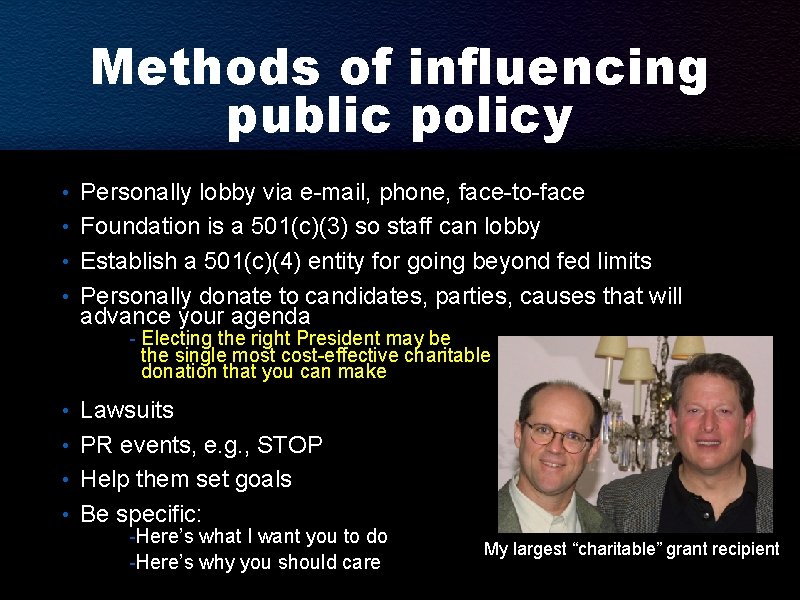
Methods of influencing public policy • Personally lobby via e-mail, phone, face-to-face • Foundation is a 501(c)(3) so staff can lobby • Establish a 501(c)(4) entity for going beyond fed limits • Personally donate to candidates, parties, causes that will advance your agenda - Electing the right President may be the single most cost-effective charitable donation that you can make • Lawsuits • PR events, e. g. , STOP • Help them set goals • Be specific: -Here’s what I want you to do -Here’s why you should care My largest “charitable” grant recipient
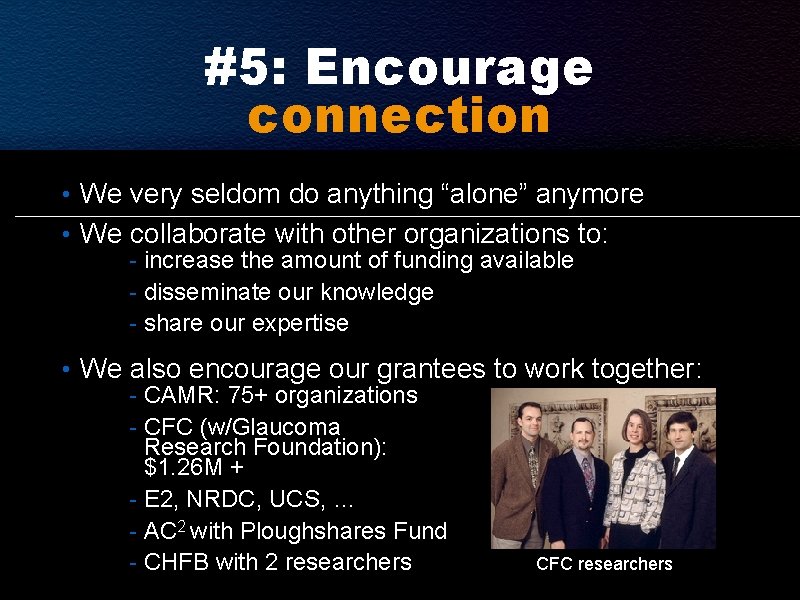
#5: Encourage connection • We very seldom do anything “alone” anymore • We collaborate with other organizations to: - increase the amount of funding available - disseminate our knowledge - share our expertise • We also encourage our grantees to work together: - CAMR: 75+ organizations - CFC (w/Glaucoma Research Foundation): $1. 26 M + - E 2, NRDC, UCS, … - AC 2 with Ploughshares Fund - CHFB with 2 researchers CFC researchers
#6: Leverage your endowment • Program Related Investments (PRIs) give you a double-whammy impact: - Best way to solve a “charitable” problem may be commercial! - Make money to use for the next problem • Examples
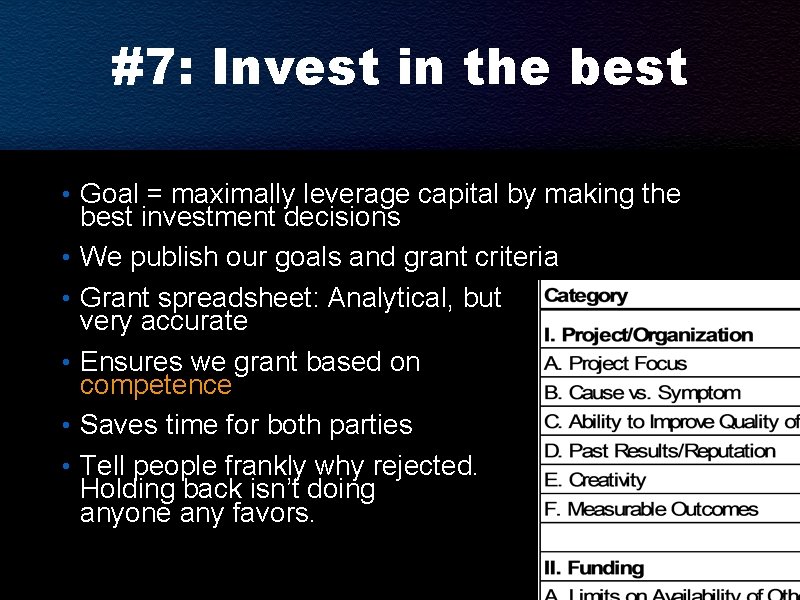
#7: Invest in the best • Goal = maximally leverage capital by making the • • • best investment decisions We publish our goals and grant criteria Grant spreadsheet: Analytical, but very accurate Ensures we grant based on competence Saves time for both parties Tell people frankly why rejected. Holding back isn’t doing anyone any favors.
#8: Be patient • Don’t get discouraged if at first you don’t succeed • Significant change takes time • The bigger the impact, the longer you should expect it will take
#9: Make a long term commitment • If you are doing something meaningful, it probably can’t be done overnight • Without a long term commitment, grantees will spend a lot of time fundraising • Example: Medical research - Researchers spend a significant fraction of their time writing grant proposals
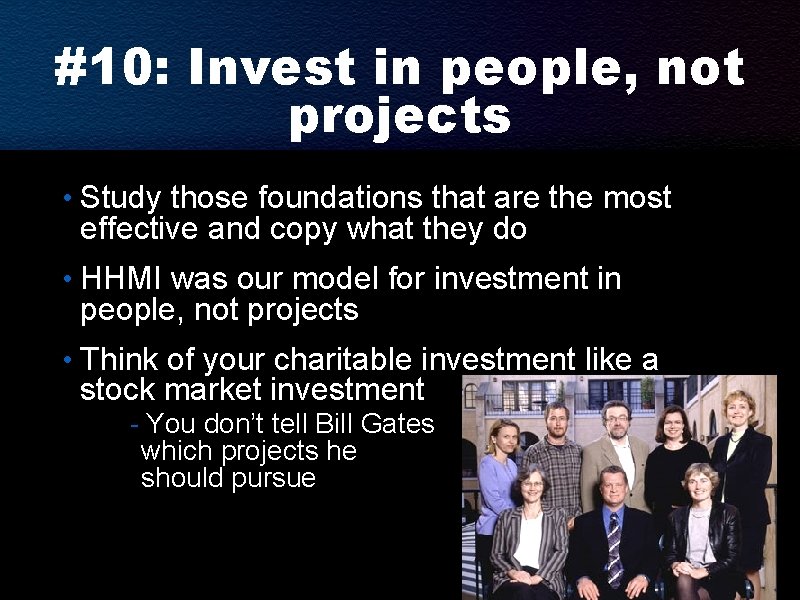
#10: Invest in people, not projects • Study those foundations that are the most effective and copy what they do • HHMI was our model for investment in people, not projects • Think of your charitable investment like a stock market investment - You don’t tell Bill Gates which projects he should pursue
#11: Stay focused • Don’t try to do too much • You will be much more efficient if you pick just one important goal and nail it • Example: Due to lack of funds and staff, we put our medical science research grant programs on hold
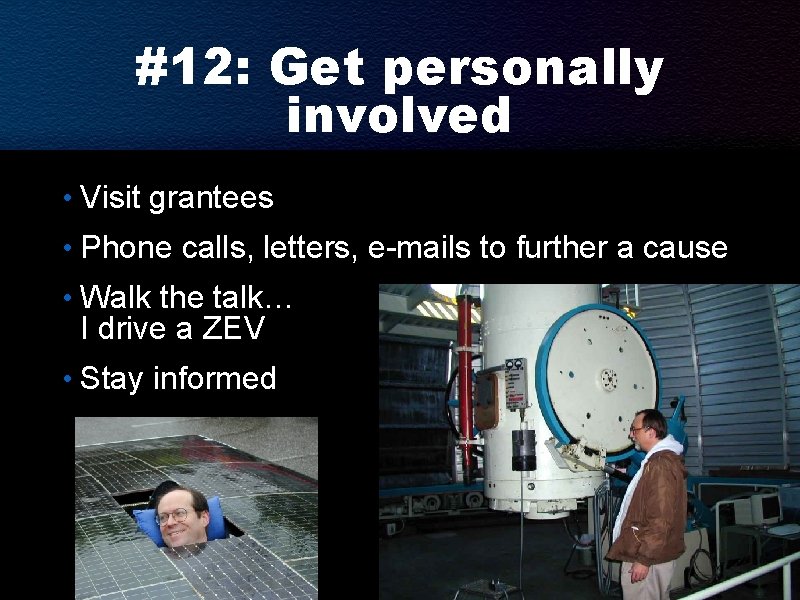
#12: Get personally involved • Visit grantees • Phone calls, letters, e-mails to further a cause • Walk the talk… I drive a ZEV • Stay informed
#13: Challenge yourself to make the biggest difference • You don’t have to follow my rules • Challenge yourself to find the opportunities to make the biggest difference • Look at your results and challenge yourself: - What did I learn? How could I have been more effective? Is my timing right? Should I be investing more today? Am I playing at a high enough level? • Example: - High impact causes are almost always played at the federal level
Summary • Be proactive, not reactive • Get involved in the public sector • Invest in the most competent people, not projects • Be patient and make a long-term commitment • Encourage connection • Challenge yourself to make the biggest difference… are you playing at the right level?
Why don’t people give? • Just earned it/want to enjoy it • Risk averse; want to ensure lavish lifestyle for rest of life, • Lack of understanding of enlightened self interest • If I don’t, someone else will, so why should I? • Focus: all cycles on growing business • Greedy/ego: Measure self worth by net worth • Lack of time • Like writing your will or going to dentist; it’s good for you, but low on the priority list • Lack of knowledge of how to do it • Never really thought of a cause that resonated • Fear of making a mistake…”hit reply if you support clean air”
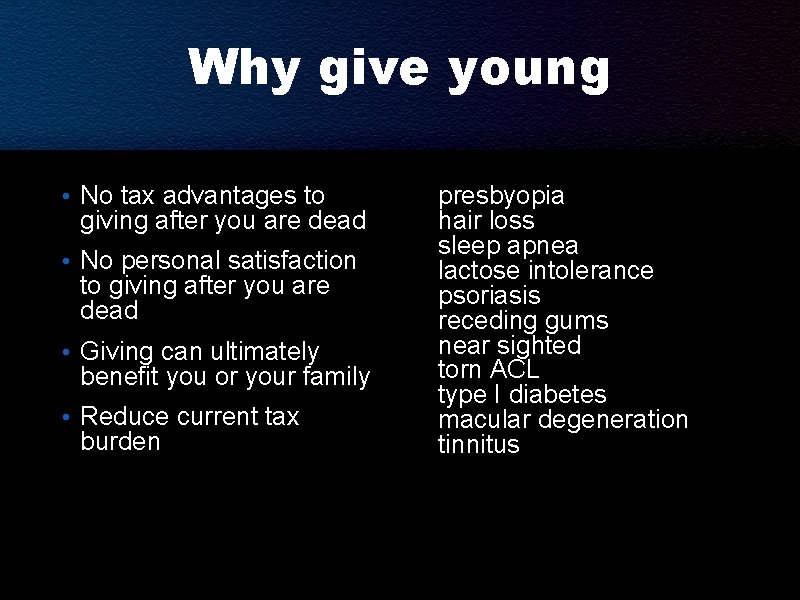
Why give young • No tax advantages to giving after you are dead • No personal satisfaction to giving after you are dead • Giving can ultimately benefit you or your family • Reduce current tax burden presbyopia hair loss sleep apnea lactose intolerance psoriasis receding gums near sighted torn ACL type I diabetes macular degeneration tinnitus
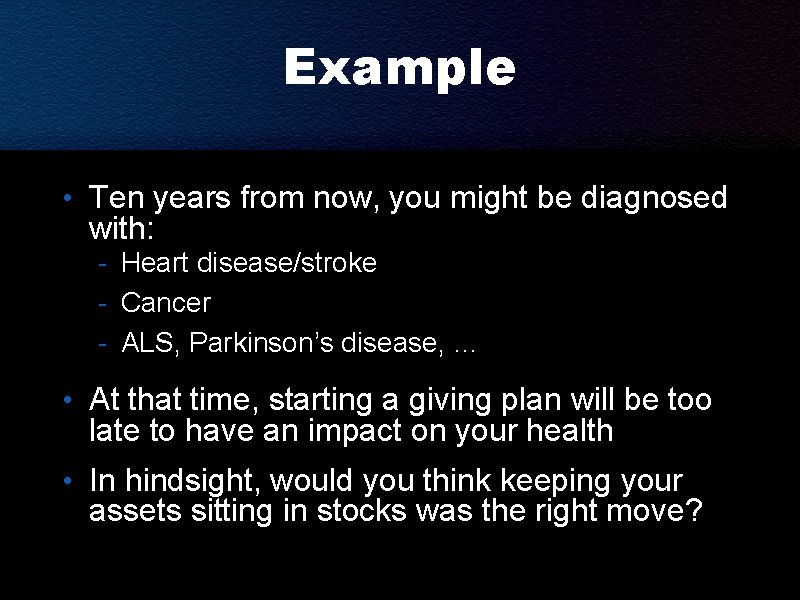
Example • Ten years from now, you might be diagnosed with: - Heart disease/stroke - Cancer - ALS, Parkinson’s disease, … • At that time, starting a giving plan will be too late to have an impact on your health • In hindsight, would you think keeping your assets sitting in stocks was the right move?
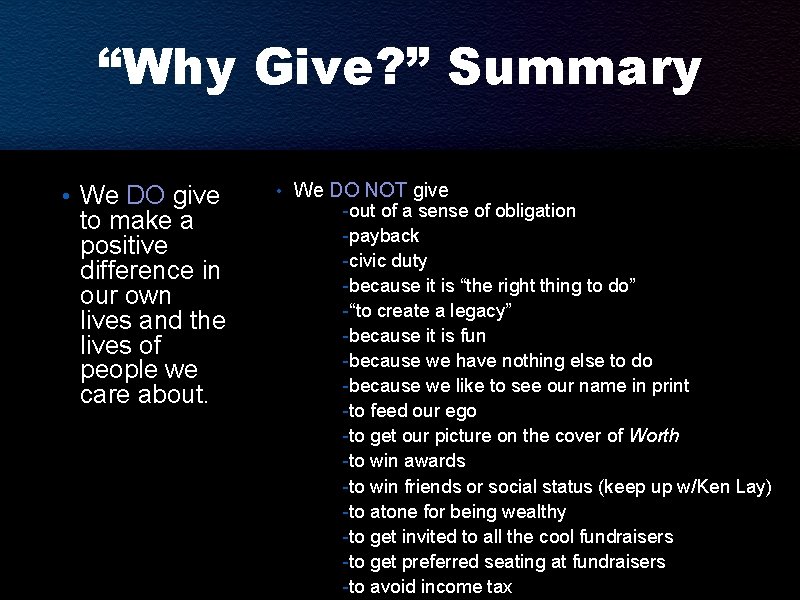
“Why Give? ” Summary • We DO give to make a positive difference in our own lives and the lives of people we care about. • We DO NOT give -out of a sense of obligation -payback -civic duty -because it is “the right thing to do” -“to create a legacy” -because it is fun -because we have nothing else to do -because we like to see our name in print -to feed our ego -to get our picture on the cover of Worth -to win awards -to win friends or social status (keep up w/Ken Lay) -to atone for being wealthy -to get invited to all the cool fundraisers -to get preferred seating at fundraisers -to avoid income tax
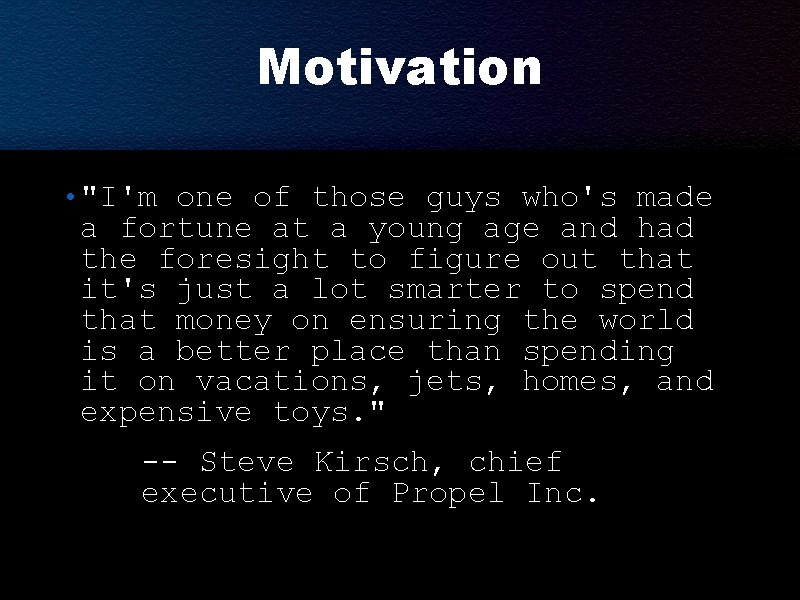
Motivation • "I'm one of those guys who's made a fortune at a young age and had the foresight to figure out that it's just a lot smarter to spend that money on ensuring the world is a better place than spending it on vacations, jets, homes, and expensive toys. " -- Steve Kirsch, chief executive of Propel Inc.
Another viewpoint • “what's wrong with jets, vacations and a nice home? ” - Michele Kirsch