Hesss Law The change in enthalpy for any


- Slides: 6
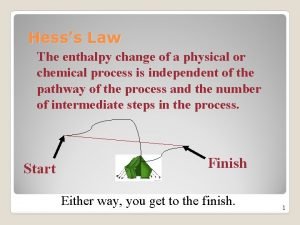
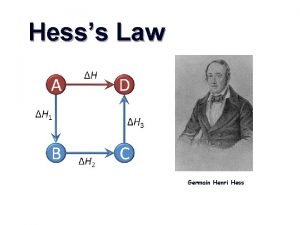
Hess’s Law The change in enthalpy for any chemical reaction is constant, whether the reaction occurs in one step, or a series of steps. The overall enthalpy change in a reaction is equal to the sum of the enthalpy changes for the individual steps in the process. In going from a particular set of reactants to a particular set of products, the change in enthalpy is the same whether the reaction takes place in one step or in a series of steps.
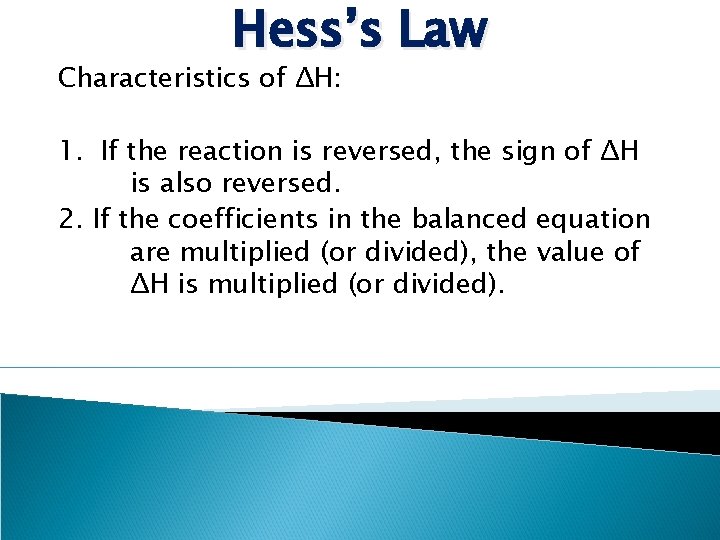
Hess’s Law Characteristics of ΔH: 1. If the reaction is reversed, the sign of ΔH is also reversed. 2. If the coefficients in the balanced equation are multiplied (or divided), the value of ΔH is multiplied (or divided).
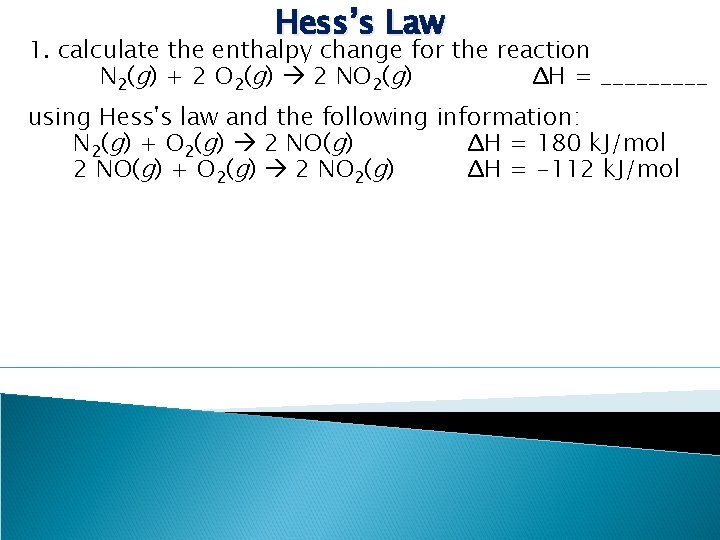
Hess’s Law 1. calculate the enthalpy change for the reaction N 2(g) + 2 O 2(g) 2 NO 2(g) ΔH = _____ using Hess's law and the following information: N 2(g) + O 2(g) 2 NO(g) ΔH = 180 k. J/mol 2 NO(g) + O 2(g) 2 NO 2(g) ΔH = -112 k. J/mol
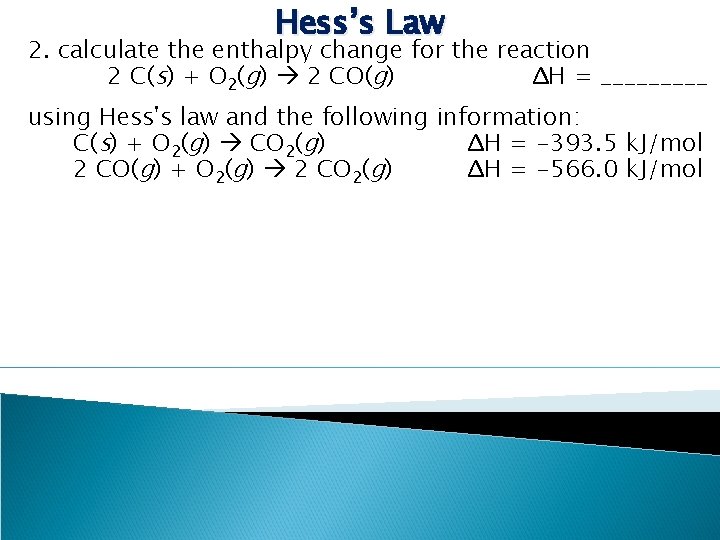
Hess’s Law 2. calculate the enthalpy change for the reaction 2 C(s) + O 2(g) 2 CO(g) ΔH = _____ using Hess's law and the following information: C(s) + O 2(g) CO 2(g) ΔH = -393. 5 k. J/mol 2 CO(g) + O 2(g) 2 CO 2(g) ΔH = -566. 0 k. J/mol
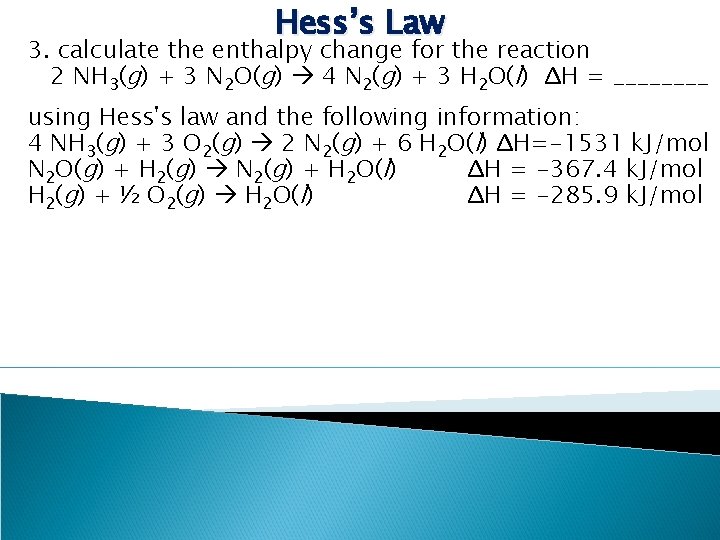
Hess’s Law 3. calculate the enthalpy change for the reaction 2 NH 3(g) + 3 N 2 O(g) 4 N 2(g) + 3 H 2 O(l) ΔH = ____ using Hess's law and the following information: 4 NH 3(g) + 3 O 2(g) 2 N 2(g) + 6 H 2 O(l) ΔH=-1531 k. J/mol N 2 O(g) + H 2(g) N 2(g) + H 2 O(l) ΔH = -367. 4 k. J/mol H 2(g) + ½ O 2(g) H 2 O(l) ΔH = -285. 9 k. J/mol