Harmonic Motion 2010 2011 2013 Eric Freudenthal and
- Slides: 9
Harmonic Motion © 2010, 2011, 2013 Eric Freudenthal and Art Duval
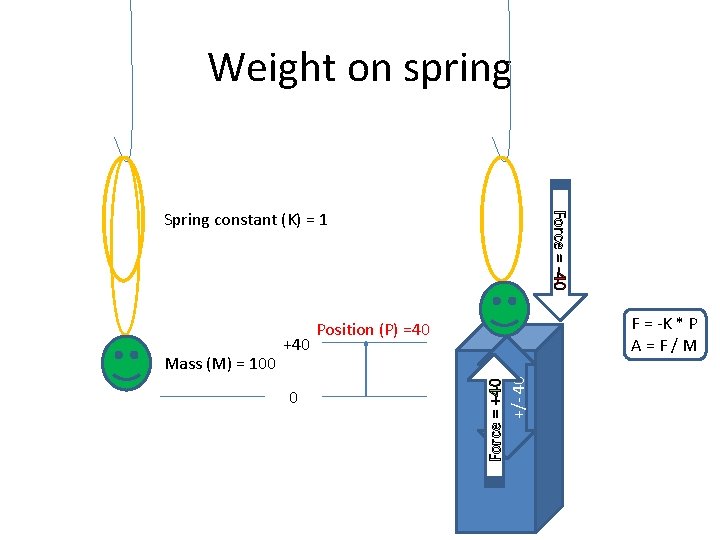
Weight on spring 0 F = -K * P A = F / M Position (P) =40 Force = +40 Bounces +/- 40 Mass (M) = 100 +40 Force = -40 Spring constant (K) = 1
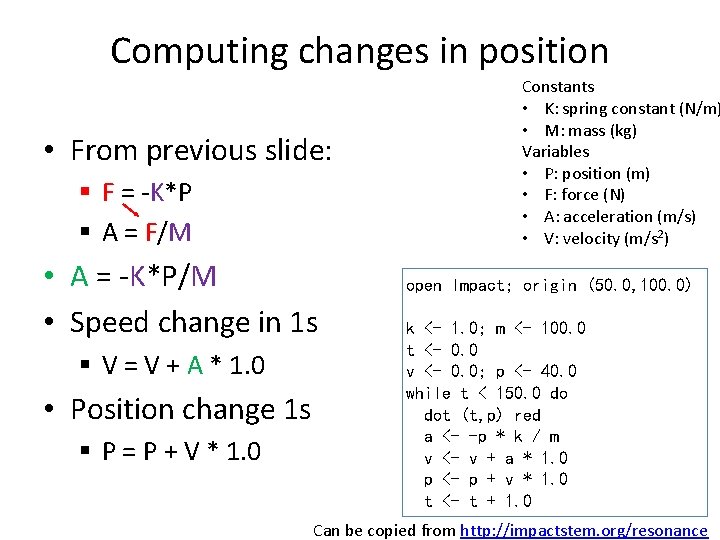
Computing changes in position • From previous slide: § F = -K*P § A = F/M • A = -K*P/M • Speed change in 1 s § V = V + A * 1. 0 • Position change 1 s § P = P + V * 1. 0 Constants • K: spring constant (N/m) • M: mass (kg) Variables • P: position (m) • F: force (N) • A: acceleration (m/s) • V: velocity (m/s 2) open Impact; origin (50. 0, 100. 0) k <- 1. 0; m <- 100. 0 t <- 0. 0 v <- 0. 0; p <- 40. 0 while t < 150. 0 do dot (t, p) red a <- -p * k / m v <- v + a * 1. 0 p <- p + v * 1. 0 t <- t + 1. 0 Can be copied from http: //impactstem. org/resonance
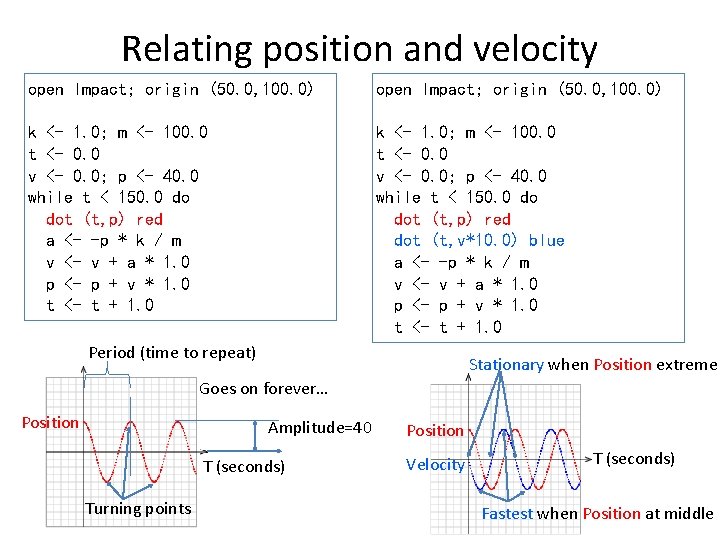
Relating position and velocity open Impact; origin (50. 0, 100. 0) k <- 1. 0; m <- 100. 0 t <- 0. 0 v <- 0. 0; p <- 40. 0 while t < 150. 0 do dot (t, p) red a <- -p * k / m v <- v + a * 1. 0 p <- p + v * 1. 0 t <- t + 1. 0 open Impact; origin (50. 0, 100. 0) k <- 1. 0; m <- 100. 0 t <- 0. 0 v <- 0. 0; p <- 40. 0 while t < 150. 0 do dot (t, p) red dot (t, v*10. 0) blue a <- -p * k / m v <- v + a * 1. 0 p <- p + v * 1. 0 t <- t + 1. 0 Period (time to repeat) Stationary when Position extreme Goes on forever… Position Amplitude=40 T (seconds) Turning points Position Velocity T (seconds) Fastest when Position at middle
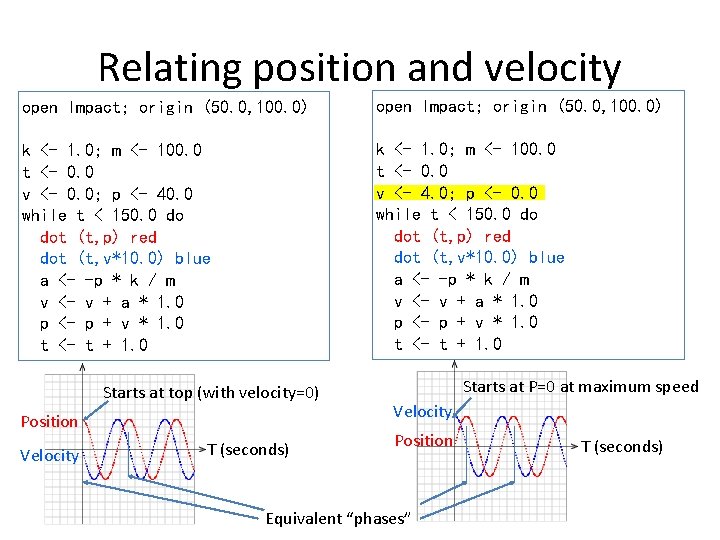
Relating position and velocity open Impact; origin (50. 0, 100. 0) k <- 1. 0; m <- 100. 0 t <- 0. 0 v <- 0. 0; p <- 40. 0 while t < 150. 0 do dot (t, p) red dot (t, v*10. 0) blue a <- -p * k / m v <- v + a * 1. 0 p <- p + v * 1. 0 t <- t + 1. 0 k <- 1. 0; m <- 100. 0 t <- 0. 0 v <- 4. 0; p <- 0. 0 while t < 150. 0 do dot (t, p) red dot (t, v*10. 0) blue a <- -p * k / m v <- v + a * 1. 0 p <- p + v * 1. 0 t <- t + 1. 0 Starts at top (with velocity=0) Position Velocity T (seconds) Starts at P=0 at maximum speed Velocity Position Equivalent “phases” T (seconds)
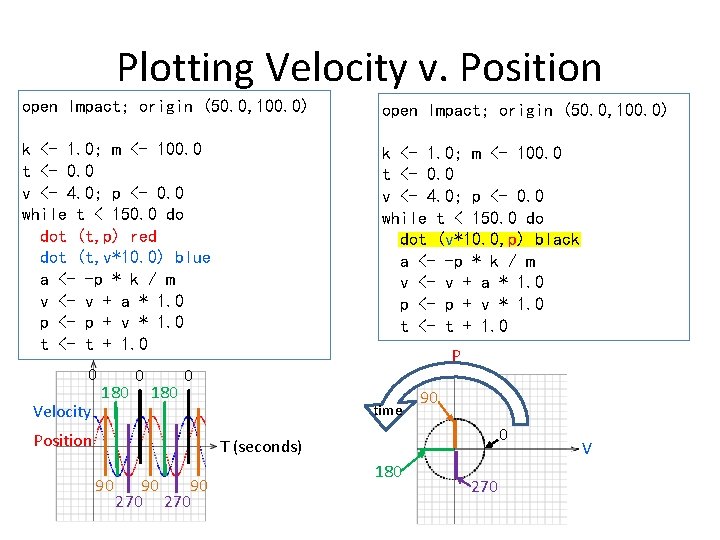
Plotting Velocity v. Position open Impact; origin (50. 0, 100. 0) k <- 1. 0; m <- 100. 0 t <- 0. 0 v <- 4. 0; p <- 0. 0 while t < 150. 0 do dot (t, p) red dot (t, v*10. 0) blue a <- -p * k / m v <- v + a * 1. 0 p <- p + v * 1. 0 t <- t + 1. 0 k <- 1. 0; m <- 100. 0 t <- 0. 0 v <- 4. 0; p <- 0. 0 while t < 150. 0 do dot (v*10. 0, p) black a <- -p * k / m v <- v + a * 1. 0 p <- p + v * 1. 0 t <- t + 1. 0 0 Velocity 180 0 180 P 0 Position time 90 0 T (seconds) 90 90 90 270 180 270 V
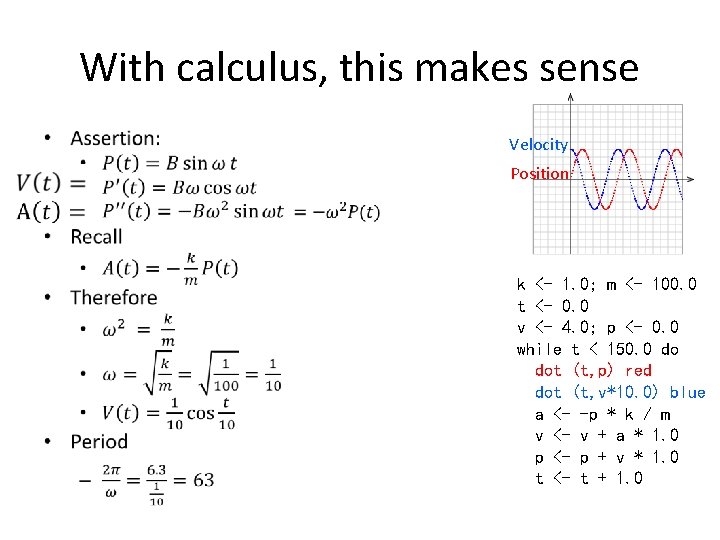
With calculus, this makes sense • Velocity Position k <- 1. 0; m <- 100. 0 t <- 0. 0 v <- 4. 0; p <- 0. 0 while t < 150. 0 do dot (t, p) red dot (t, v*10. 0) blue a <- -p * k / m v <- v + a * 1. 0 p <- p + v * 1. 0 t <- t + 1. 0
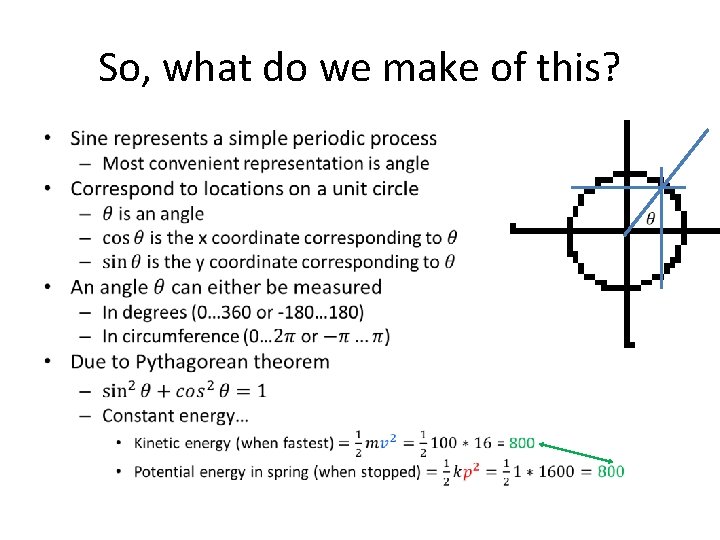
So, what do we make of this? •
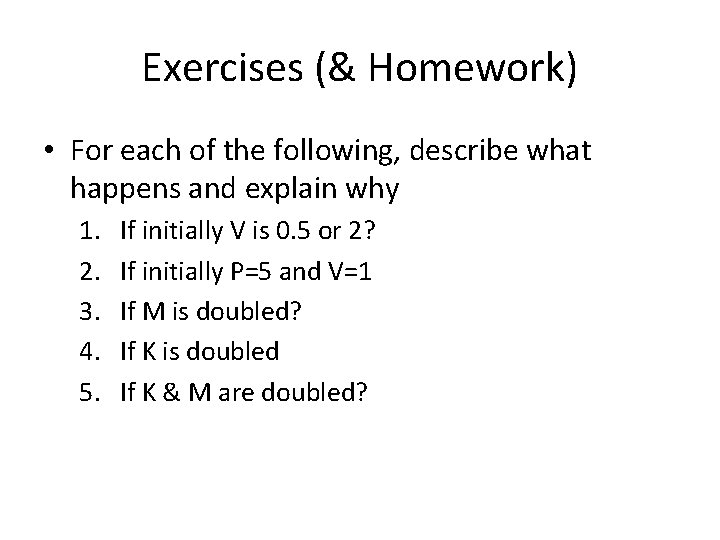
Exercises (& Homework) • For each of the following, describe what happens and explain why 1. 2. 3. 4. 5. If initially V is 0. 5 or 2? If initially P=5 and V=1 If M is doubled? If K is doubled If K & M are doubled?