Hammonds Postulate If two states for example a

- Slides: 8
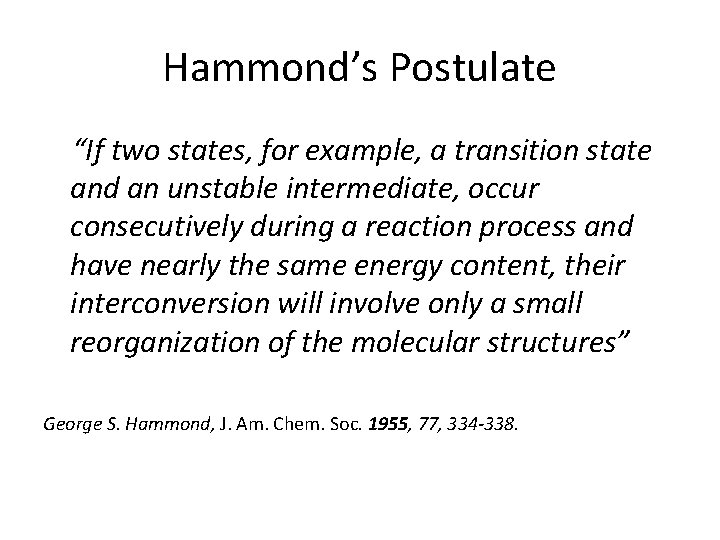
Hammond’s Postulate “If two states, for example, a transition state and an unstable intermediate, occur consecutively during a reaction process and have nearly the same energy content, their interconversion will involve only a small reorganization of the molecular structures” George S. Hammond, J. Am. Chem. Soc. 1955, 77, 334 -338.
Hammond’s Postulate “The structure of the transition state for an exothermic reaction is reached early in the reaction, so it resembles reactants more than products. Conversely, the structure of the transition state for an endothermic reaction step is reached relatively late, so it resembles products more then reactants. ” – From your Textbook
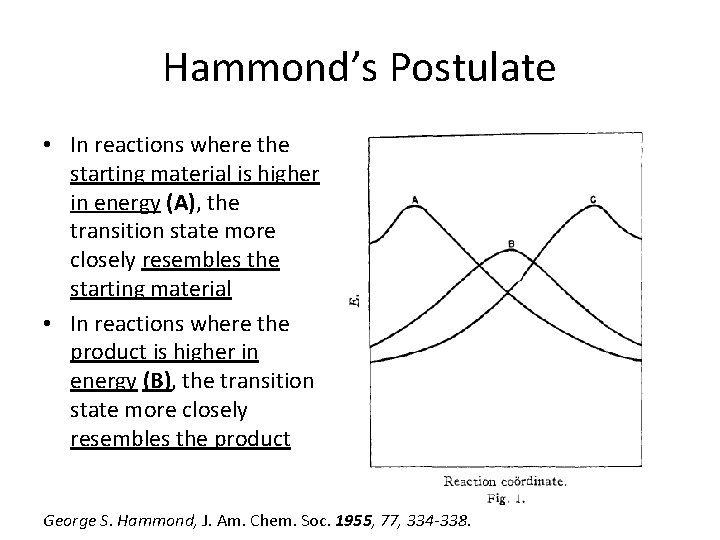
Hammond’s Postulate • In reactions where the starting material is higher in energy (A), the transition state more closely resembles the starting material • In reactions where the product is higher in energy (B), the transition state more closely resembles the product George S. Hammond, J. Am. Chem. Soc. 1955, 77, 334 -338.
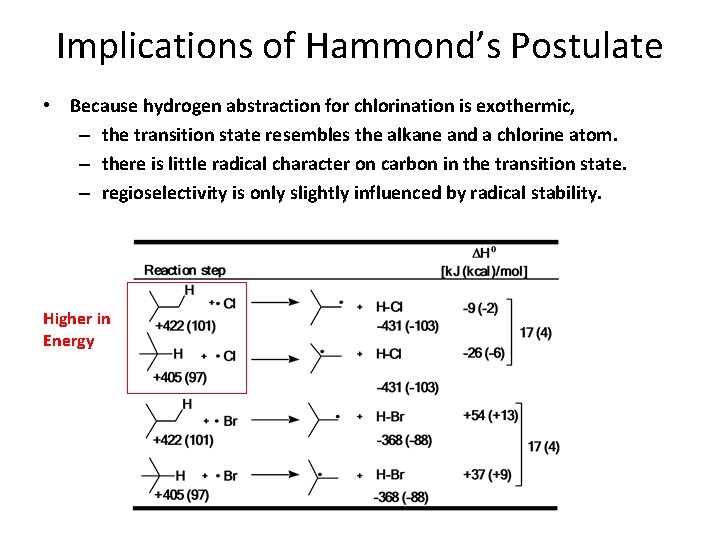
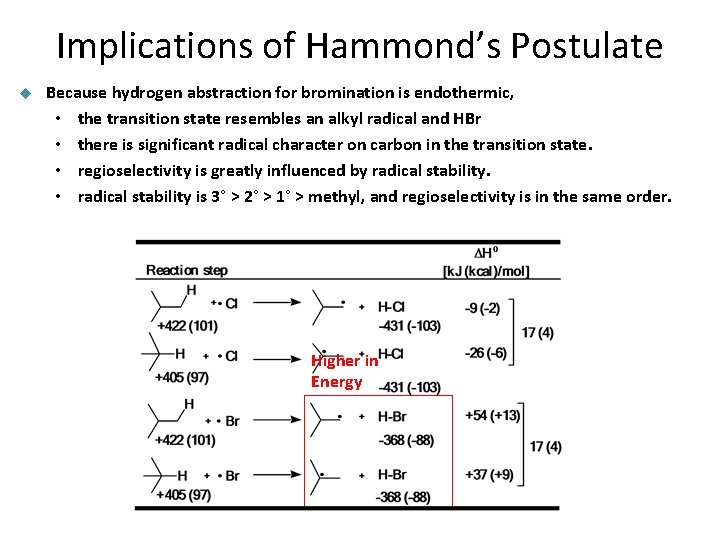
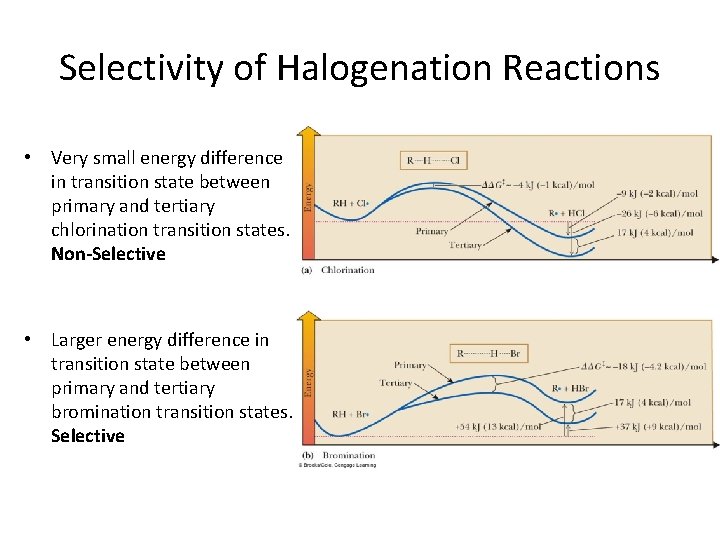
Implications of Hammond’s Postulate • In the halogenation of an alkane, hydrogen abstraction (the rate-determining step) is exothermic for chlorination but endothermic for bromination
Implications of Hammond’s Postulate • Because hydrogen abstraction for chlorination is exothermic, – the transition state resembles the alkane and a chlorine atom. – there is little radical character on carbon in the transition state. – regioselectivity is only slightly influenced by radical stability. Higher in Energy
Implications of Hammond’s Postulate u Because hydrogen abstraction for bromination is endothermic, • the transition state resembles an alkyl radical and HBr • there is significant radical character on carbon in the transition state. • regioselectivity is greatly influenced by radical stability. • radical stability is 3° > 2° > 1° > methyl, and regioselectivity is in the same order. Higher in Energy
Selectivity of Halogenation Reactions • Very small energy difference in transition state between primary and tertiary chlorination transition states. Non-Selective • Larger energy difference in transition state between primary and tertiary bromination transition states. Selective
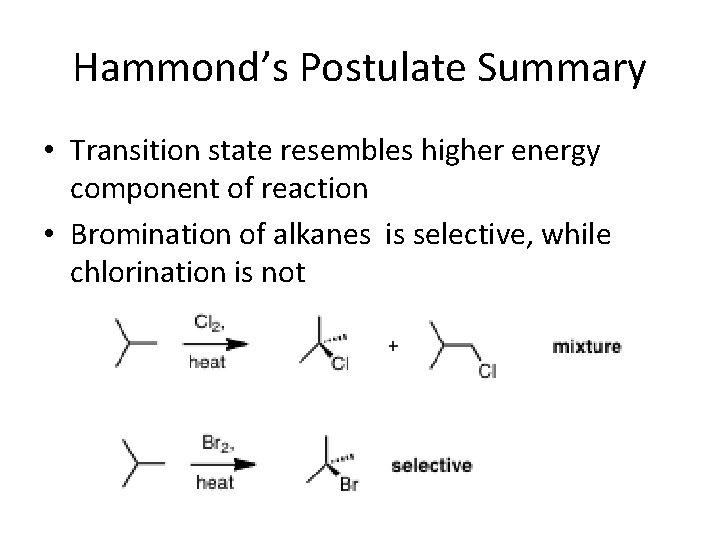
Hammond’s Postulate Summary • Transition state resembles higher energy component of reaction • Bromination of alkanes is selective, while chlorination is not