Graph Programs for Graph Algorithms Sandra Steinert and

- Slides: 11
Graph Programs for Graph Algorithms Sandra Steinert and Detlef Plump The University of York 22/03/05
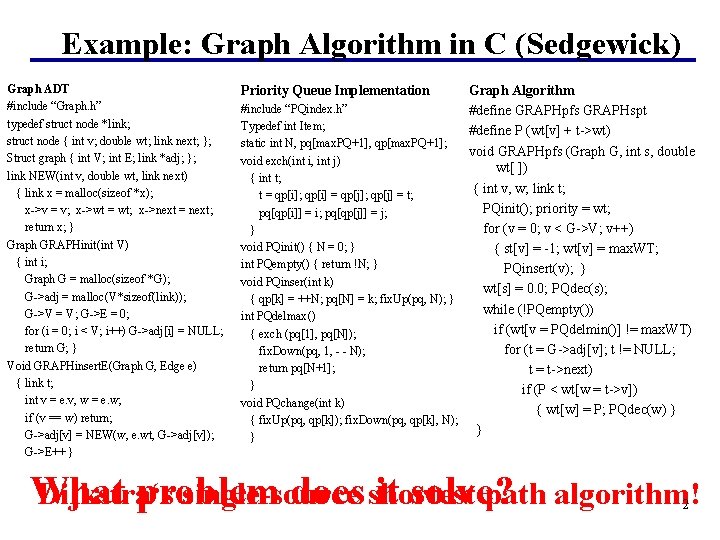
Example: Graph Algorithm in C (Sedgewick) Graph ADT #include “Graph. h” typedef struct node *link; struct node { int v; double wt; link next; }; Struct graph { int V; int E; link *adj; }; link NEW(int v, double wt, link next) { link x = malloc(sizeof *x); x->v = v; x->wt = wt; x->next = next; return x; } Graph GRAPHinit(int V) { int i; Graph G = malloc(sizeof *G); G->adj = malloc(V*sizeof(link)); G->V = V; G->E = 0; for (i = 0; i < V; i++) G->adj[i] = NULL; return G; } Void GRAPHinsert. E(Graph G, Edge e) { link t; int v = e. v, w = e. w; if (v == w) return; G->adj[v] = NEW(w, e. wt, G->adj[v]); G->E++ } Priority Queue Implementation Graph Algorithm #include “PQindex. h” #define GRAPHpfs GRAPHspt Typedef int Item; #define P (wt[v] + t->wt) static int N, pq[max. PQ+1], qp[max. PQ+1]; void GRAPHpfs (Graph G, int s, double void exch(int i, int j) wt[ ]) { int t; { int v, w; link t; t = qp[i]; qp[i] = qp[j]; qp[j] = t; PQinit(); priority = wt; pq[qp[i]] = i; pq[qp[j]] = j; for (v = 0; v < G->V; v++) } void PQinit() { N = 0; } { st[v] = -1; wt[v] = max. WT; int PQempty() { return !N; } PQinsert(v); } void PQinser(int k) wt[s] = 0. 0; PQdec(s); { qp[k] = ++N; pq[N] = k; fix. Up(pq, N); } while (!PQempty()) int PQdelmax() if (wt[v = PQdelmin()] != max. WT) { exch (pq[1], pq[N]); for (t = G->adj[v]; t != NULL; fix. Down(pq, 1, - - N); return pq[N+1]; t = t->next) } if (P < wt[w = t->v]) void PQchange(int k) { wt[w] = P; PQdec(w) } { fix. Up(pq, qp[k]); fix. Down(pq, qp[k], N); } } What problem does shortest it solve? Dijkstra‘s single-source path algorithm! 2
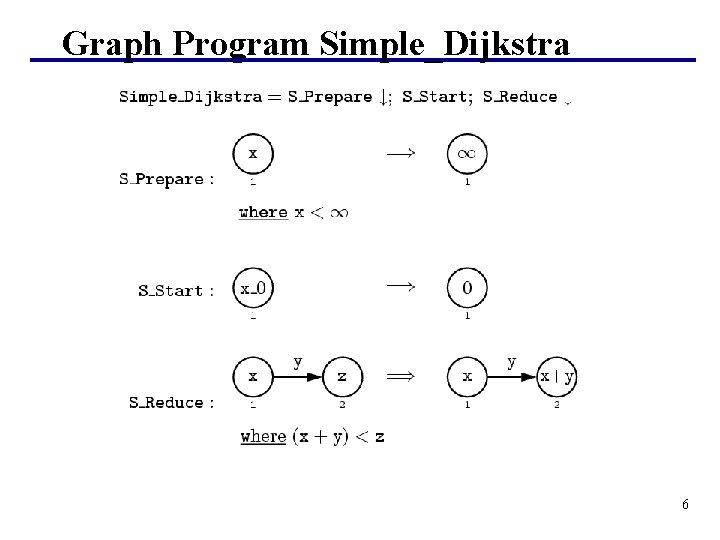
Graph Program Simple_Dijkstra 3
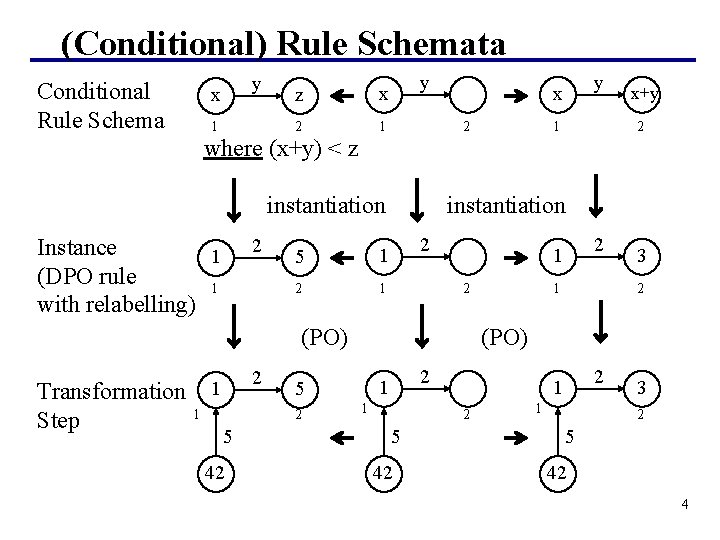
(Conditional) Rule Schemata Conditional Rule Schema y x 1 z x 2 1 y y x 2 1 x+y 2 where (x+y) < z instantiation Instance 1 (DPO rule 1 with relabelling) 2 5 1 2 1 instantiation 2 2 (PO) Transformation 1 Step 2 1 5 42 1 3 2 (PO) 2 1 5 2 2 1 1 2 5 42 2 1 1 3 2 5 42 4
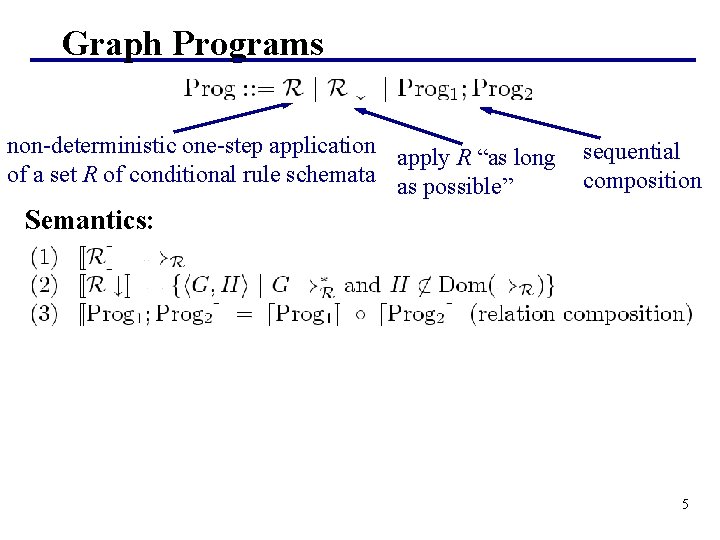
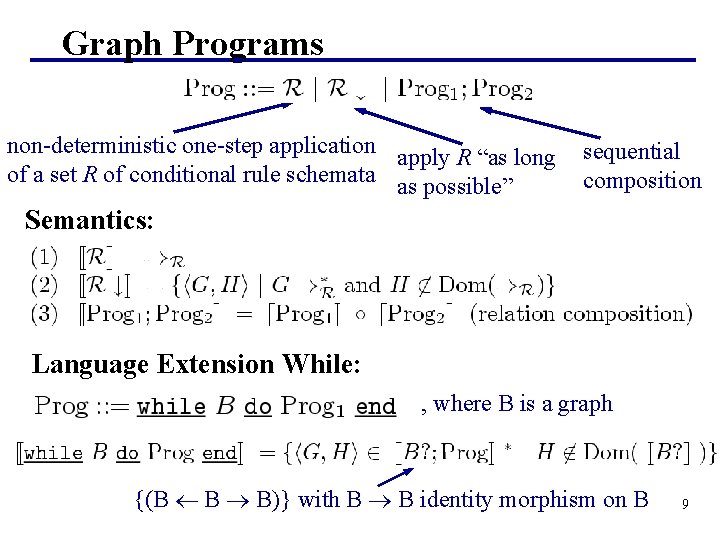
Graph Programs non-deterministic one-step application apply R “as long of a set R of conditional rule schemata as possible” sequential composition Semantics: 5
Graph Program Simple_Dijkstra 6
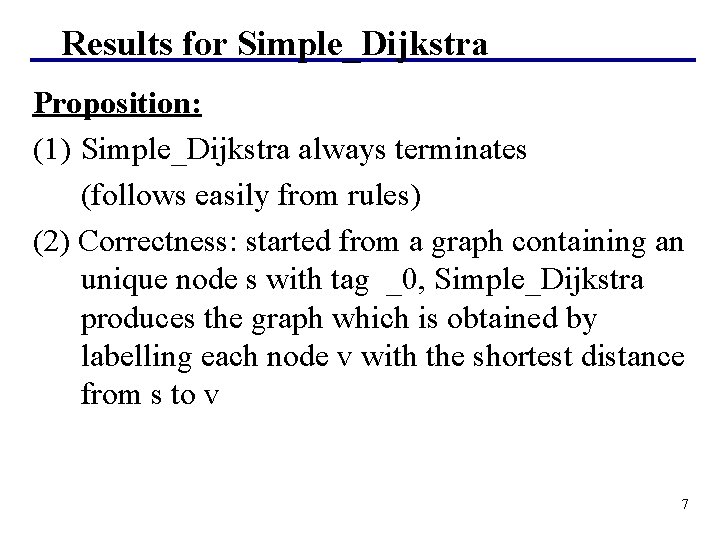
Results for Simple_Dijkstra Proposition: (1) Simple_Dijkstra always terminates (follows easily from rules) (2) Correctness: started from a graph containing an unique node s with tag _0, Simple_Dijkstra produces the graph which is obtained by labelling each node v with the shortest distance from s to v 7
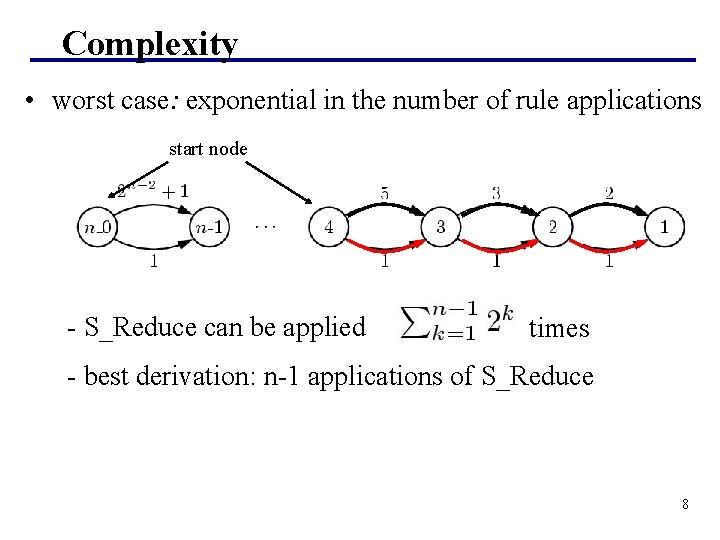
Complexity • worst case: exponential in the number of rule applications start node - S_Reduce can be applied times - best derivation: n-1 applications of S_Reduce 8
Graph Programs non-deterministic one-step application apply R “as long of a set R of conditional rule schemata as possible” sequential composition Semantics: Language Extension While: , where B is a graph {(B B B)} with B B identity morphism on B 9
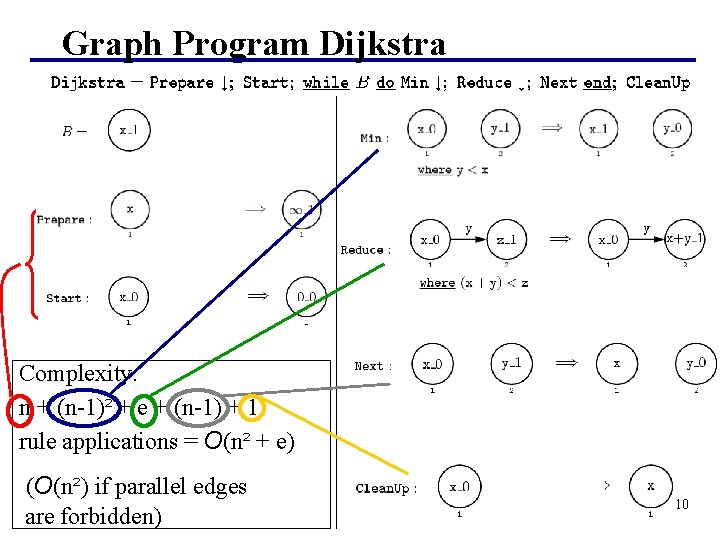
Graph Program Dijkstra Complexity: n + (n-1)² + e + (n-1) + 1 rule applications = O(n² + e) (O(n²) if parallel edges are forbidden) 10
Conclusion • GP is a simple, semantics-based language • Dijkstra’s single-source shortest-path algorithm as case study: succinct programs, easy to understand; simple semantics supports formal reasoning Outlook • example-driven development of GP: procedures, graph types, … • more case studies in graph algorithms (e. g. Floyd-Warshall’s shortest path algorithm, vertex colouring) and other domains • development of general proof patterns for termination, correctness and complexity • implementation of GP (Greg Manning, The University of York) 11