Graduate Computer Architecture I Lecture 6 Exceptions and


- Slides: 22
Graduate Computer Architecture I Lecture 6: Exceptions and Interrupts Young Cho
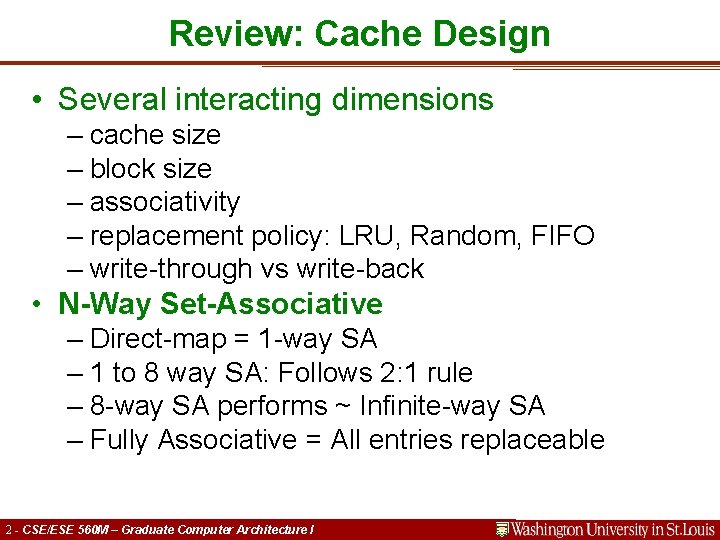
Review: Cache Design • Several interacting dimensions – cache size – block size – associativity – replacement policy: LRU, Random, FIFO – write-through vs write-back • N-Way Set-Associative – Direct-map = 1 -way SA – 1 to 8 way SA: Follows 2: 1 rule – 8 -way SA performs ~ Infinite-way SA – Fully Associative = All entries replaceable 2 - CSE/ESE 560 M – Graduate Computer Architecture I
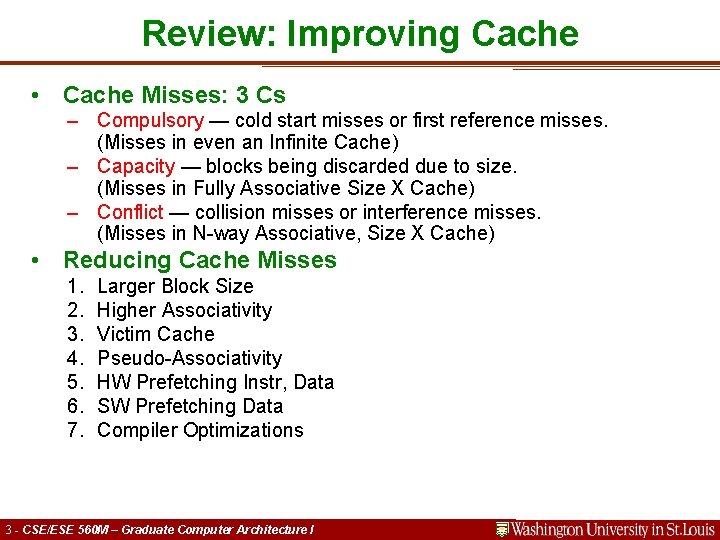
Review: Improving Cache • Cache Misses: 3 Cs – Compulsory — cold start misses or first reference misses. (Misses in even an Infinite Cache) – Capacity — blocks being discarded due to size. (Misses in Fully Associative Size X Cache) – Conflict — collision misses or interference misses. (Misses in N-way Associative, Size X Cache) • Reducing Cache Misses 1. 2. 3. 4. 5. 6. 7. Larger Block Size Higher Associativity Victim Cache Pseudo-Associativity HW Prefetching Instr, Data SW Prefetching Data Compiler Optimizations 3 - CSE/ESE 560 M – Graduate Computer Architecture I
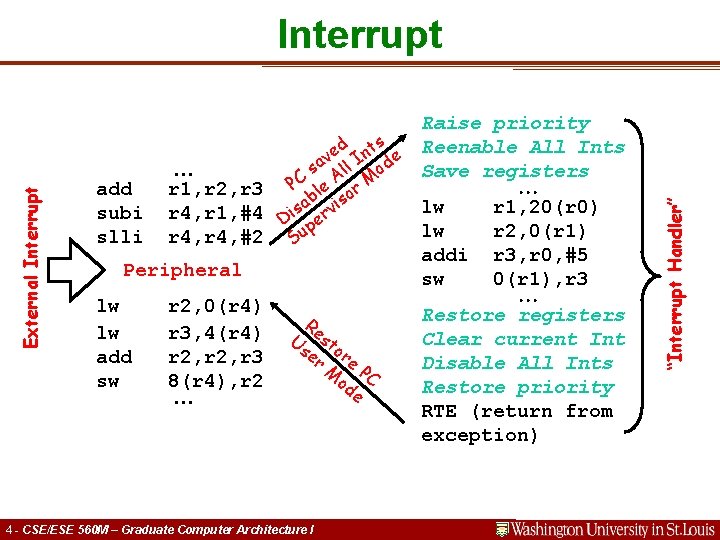
add subi slli r 1, r 2, r 3 r 4, r 1, #4 r 4, #2 Peripheral lw lw add sw r 2, 0(r 4) r 3, 4(r 4) r 2, r 3 8(r 4), r 2 Raise priority s ed Int e Reenable All Ints v sa ll od Save registers PC le A r M o b s lw r 1, 20(r 0) sa rvi i D pe lw r 2, 0(r 1) Su addi r 3, r 0, #5 sw 0(r 1), r 3 Restore registers Re Us sto Clear current Int er re Disable All Ints M PC od Restore priority e RTE (return from exception) 4 - CSE/ESE 560 M – Graduate Computer Architecture I “Interrupt Handler” External Interrupt
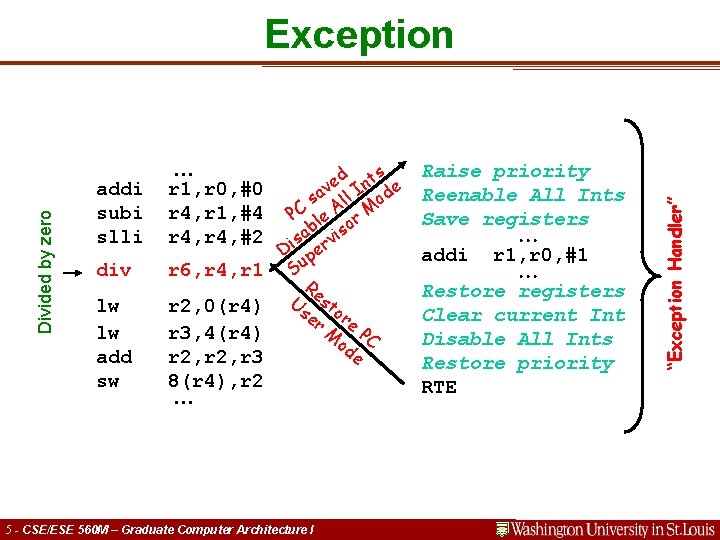
addi subi slli r 1, r 0, #0 r 4, r 1, #4 r 4, #2 div r 6, r 4, r 1 lw lw add sw r 2, 0(r 4) r 3, 4(r 4) r 2, r 3 8(r 4), r 2 d nts e e v sa ll I od PC le A r M b iso a v s Di per Su Re Us sto er re M PC od e 5 - CSE/ESE 560 M – Graduate Computer Architecture I Raise priority Reenable All Ints Save registers addi r 1, r 0, #1 Restore registers Clear current Int Disable All Ints Restore priority RTE “Exception Handler” Divided by zero Exception
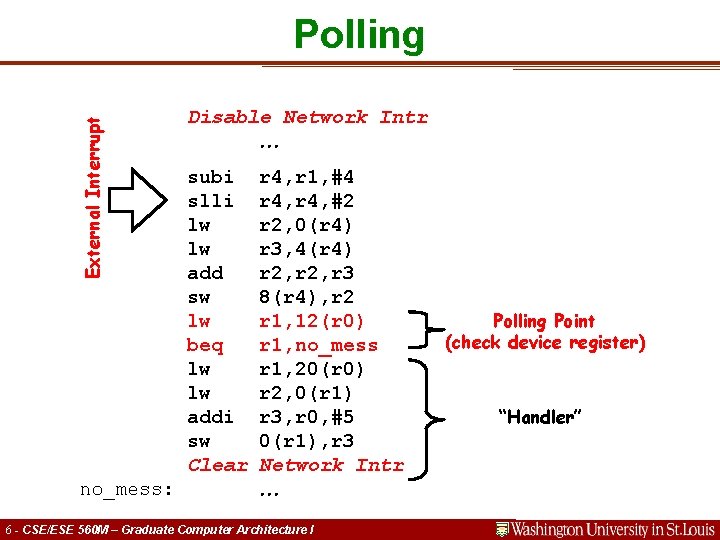
External Interrupt Polling no_mess: Disable Network Intr subi slli lw lw add sw lw beq lw lw addi sw Clear r 4, r 1, #4 r 4, #2 r 2, 0(r 4) r 3, 4(r 4) r 2, r 3 8(r 4), r 2 r 1, 12(r 0) r 1, no_mess r 1, 20(r 0) r 2, 0(r 1) r 3, r 0, #5 0(r 1), r 3 Network Intr 6 - CSE/ESE 560 M – Graduate Computer Architecture I Polling Point (check device register) “Handler”
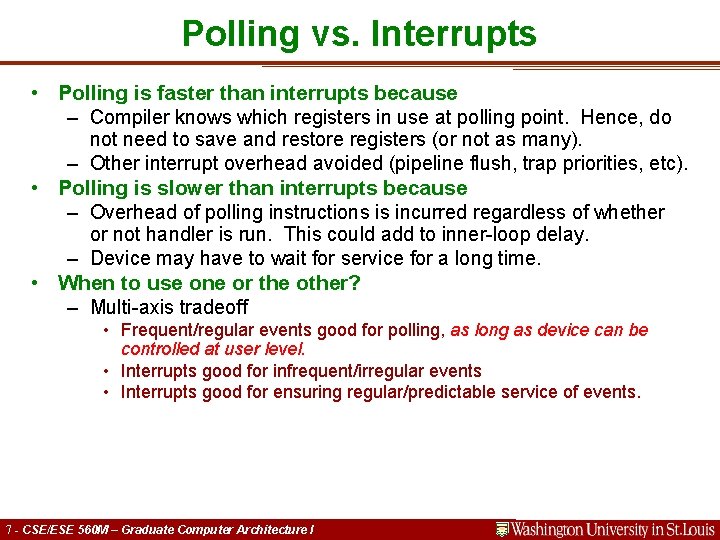
Polling vs. Interrupts • Polling is faster than interrupts because – Compiler knows which registers in use at polling point. Hence, do not need to save and restore registers (or not as many). – Other interrupt overhead avoided (pipeline flush, trap priorities, etc). • Polling is slower than interrupts because – Overhead of polling instructions is incurred regardless of whether or not handler is run. This could add to inner-loop delay. – Device may have to wait for service for a long time. • When to use one or the other? – Multi-axis tradeoff • Frequent/regular events good for polling, as long as device can be controlled at user level. • Interrupts good for infrequent/irregular events • Interrupts good for ensuring regular/predictable service of events. 7 - CSE/ESE 560 M – Graduate Computer Architecture I
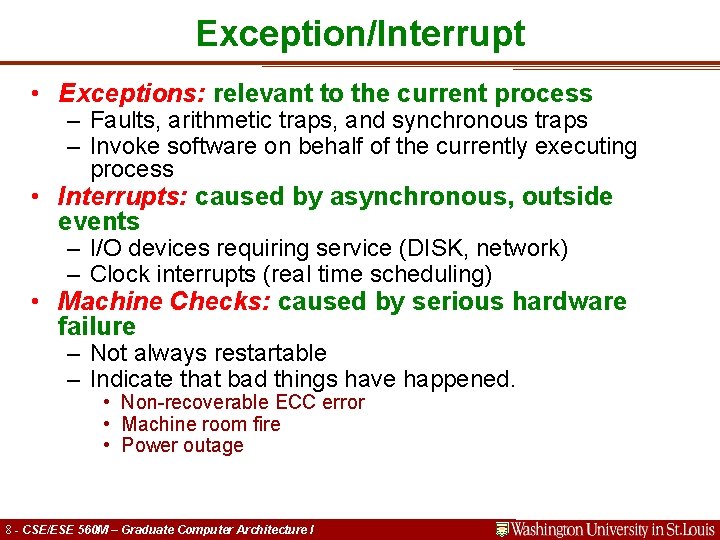
Exception/Interrupt • Exceptions: relevant to the current process – Faults, arithmetic traps, and synchronous traps – Invoke software on behalf of the currently executing process • Interrupts: caused by asynchronous, outside events – I/O devices requiring service (DISK, network) – Clock interrupts (real time scheduling) • Machine Checks: caused by serious hardware failure – Not always restartable – Indicate that bad things have happened. • Non-recoverable ECC error • Machine room fire • Power outage 8 - CSE/ESE 560 M – Graduate Computer Architecture I
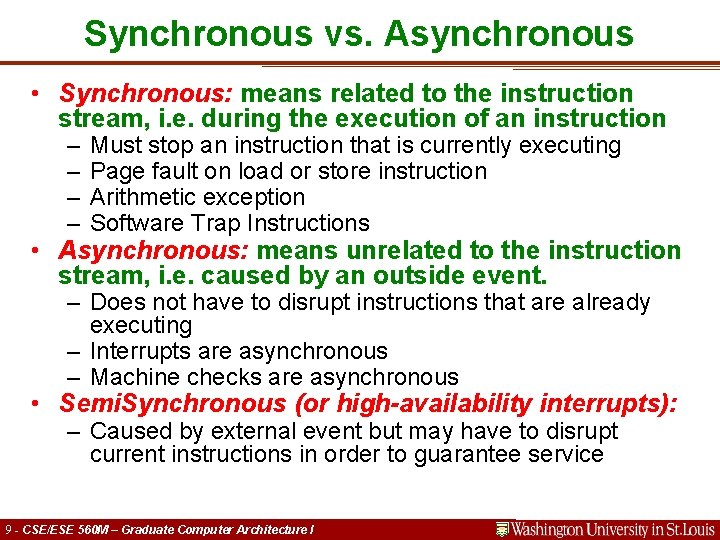
Synchronous vs. Asynchronous • Synchronous: means related to the instruction stream, i. e. during the execution of an instruction – – Must stop an instruction that is currently executing Page fault on load or store instruction Arithmetic exception Software Trap Instructions • Asynchronous: means unrelated to the instruction stream, i. e. caused by an outside event. – Does not have to disrupt instructions that are already executing – Interrupts are asynchronous – Machine checks are asynchronous • Semi. Synchronous (or high-availability interrupts): – Caused by external event but may have to disrupt current instructions in order to guarantee service 9 - CSE/ESE 560 M – Graduate Computer Architecture I
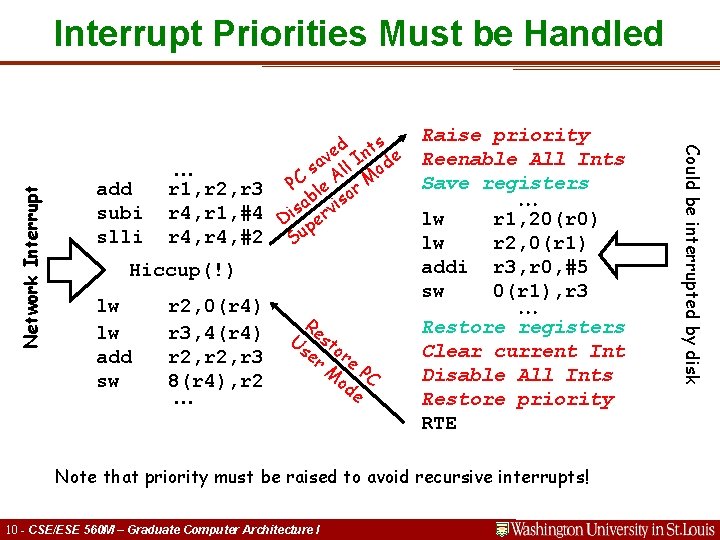
add subi slli r 1, r 2, r 3 r 4, r 1, #4 r 4, #2 s ed Int e v sa ll od PC le A r M b iso a v s Di per Su Hiccup(!) lw lw add sw r 2, 0(r 4) r 3, 4(r 4) r 2, r 3 8(r 4), r 2 Re Us sto er re M PC od e Raise priority Reenable All Ints Save registers lw r 1, 20(r 0) lw r 2, 0(r 1) addi r 3, r 0, #5 sw 0(r 1), r 3 Restore registers Clear current Int Disable All Ints Restore priority RTE Note that priority must be raised to avoid recursive interrupts! 10 - CSE/ESE 560 M – Graduate Computer Architecture I Could be interrupted by disk Network Interrupt Priorities Must be Handled
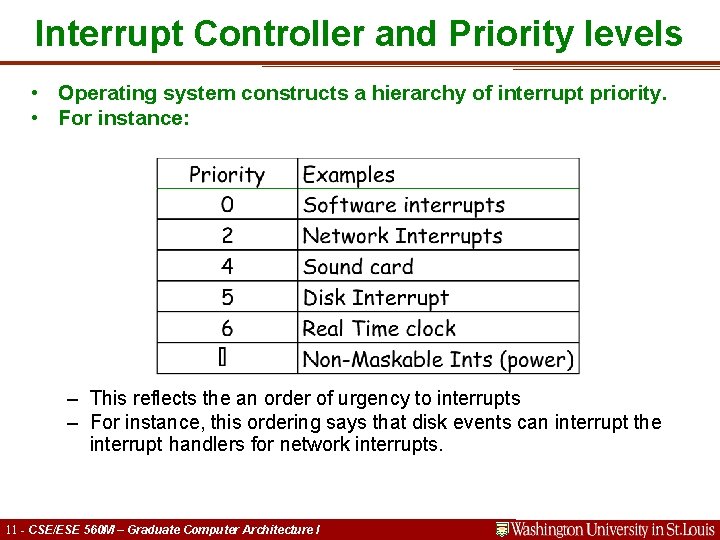
Interrupt Controller and Priority levels • Operating system constructs a hierarchy of interrupt priority. • For instance: – This reflects the an order of urgency to interrupts – For instance, this ordering says that disk events can interrupt the interrupt handlers for network interrupts. 11 - CSE/ESE 560 M – Graduate Computer Architecture I
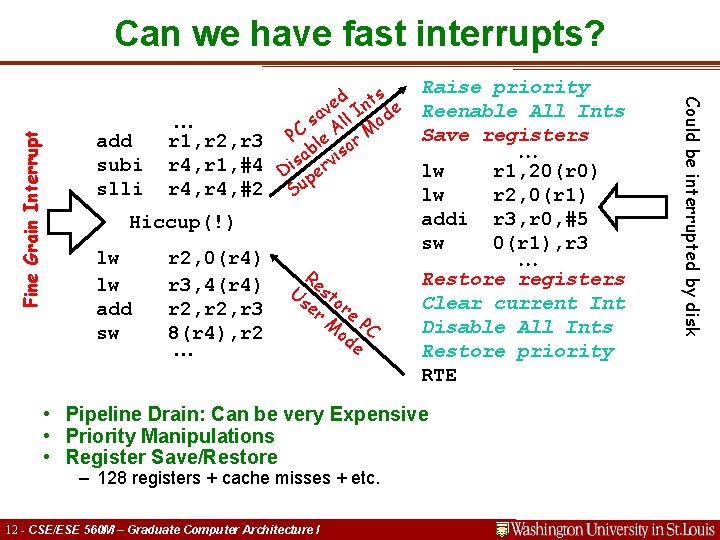
add subi slli r 1, r 2, r 3 r 4, r 1, #4 r 4, #2 s ed Int e v sa ll od PC le A r M b iso a v s Di per Su Hiccup(!) lw lw add sw r 2, 0(r 4) r 3, 4(r 4) r 2, r 3 8(r 4), r 2 Re Us sto er re M PC od e Raise priority Reenable All Ints Save registers lw r 1, 20(r 0) lw r 2, 0(r 1) addi r 3, r 0, #5 sw 0(r 1), r 3 Restore registers Clear current Int Disable All Ints Restore priority RTE • Pipeline Drain: Can be very Expensive • Priority Manipulations • Register Save/Restore – 128 registers + cache misses + etc. 12 - CSE/ESE 560 M – Graduate Computer Architecture I Could be interrupted by disk Fine Grain Interrupt Can we have fast interrupts?
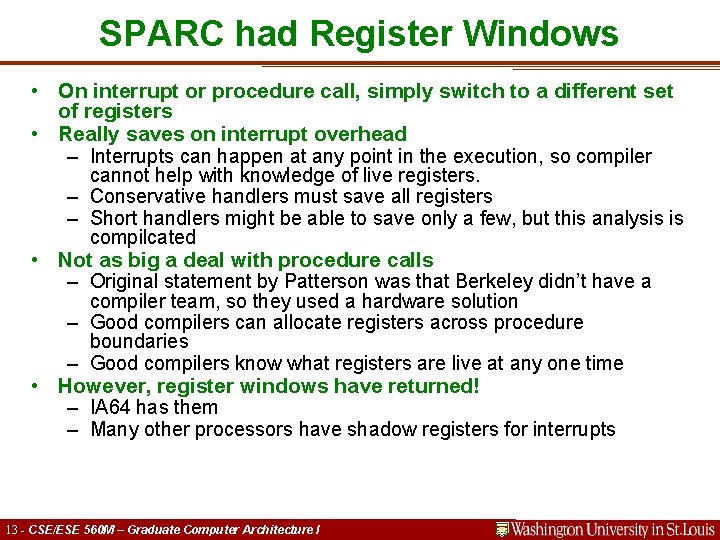
SPARC had Register Windows • On interrupt or procedure call, simply switch to a different set of registers • Really saves on interrupt overhead – Interrupts can happen at any point in the execution, so compiler cannot help with knowledge of live registers. – Conservative handlers must save all registers – Short handlers might be able to save only a few, but this analysis is compilcated • Not as big a deal with procedure calls – Original statement by Patterson was that Berkeley didn’t have a compiler team, so they used a hardware solution – Good compilers can allocate registers across procedure boundaries – Good compilers know what registers are live at any one time • However, register windows have returned! – IA 64 has them – Many other processors have shadow registers for interrupts 13 - CSE/ESE 560 M – Graduate Computer Architecture I
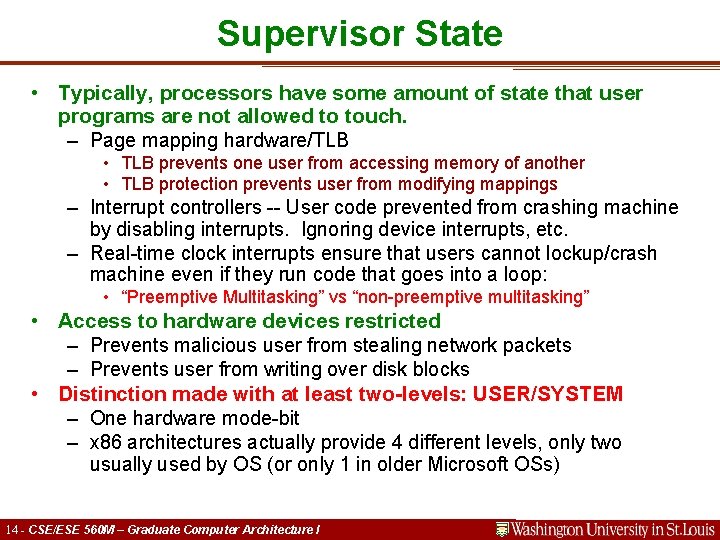
Supervisor State • Typically, processors have some amount of state that user programs are not allowed to touch. – Page mapping hardware/TLB • TLB prevents one user from accessing memory of another • TLB protection prevents user from modifying mappings – Interrupt controllers -- User code prevented from crashing machine by disabling interrupts. Ignoring device interrupts, etc. – Real-time clock interrupts ensure that users cannot lockup/crash machine even if they run code that goes into a loop: • “Preemptive Multitasking” vs “non-preemptive multitasking” • Access to hardware devices restricted – Prevents malicious user from stealing network packets – Prevents user from writing over disk blocks • Distinction made with at least two-levels: USER/SYSTEM – One hardware mode-bit – x 86 architectures actually provide 4 different levels, only two usually used by OS (or only 1 in older Microsoft OSs) 14 - CSE/ESE 560 M – Graduate Computer Architecture I
Entry into Supervisor Mode • • Entry into supervisor mode typically happens on interrupts, exceptions, and special trap instructions. Entry goes through kernel instructions: – interrupts, exceptions, and trap instructions change to supervisor mode, then jump (indirectly) through table of instructions in kernel • intvec: j handle_int 0 j handle_int 1 … j handle_fp_except 0 … j handle_trap 0 j handle_trap 1 – OS “System Calls” are just trap instructions: read(fd, buffer, count) => st st st trap 20(r 0), r 1 24(r 0), r 2 28(r 0), r 3 $READ OS overhead can be serious concern for achieving fast interrupt behavior. 15 - CSE/ESE 560 M – Graduate Computer Architecture I
Precise Interrupts/Exceptions • An interrupt or exception is considered precise if there is a single instruction (or interrupt point) for which: – All instructions before that have committed their state – No following instructions (including the interrupting instruction) have modified any state. • This means, that you can restart execution at the interrupt point and “get the right answer” – Implicit in our previous example of a device interrupt: add subi slli lw lw add sw r 1, r 2, r 3 r 4, r 1, #4 r 4, #2 r 2, 0(r 4) r 3, 4(r 4) r 2, r 3 8(r 4), r 2 16 - CSE/ESE 560 M – Graduate Computer Architecture I ed nts I e PC All Mod ble isor a s i v v sa D er p Su Re s Us tore er Mo PC de Int handler External Interrupt • Interrupt point is at first lw instruction
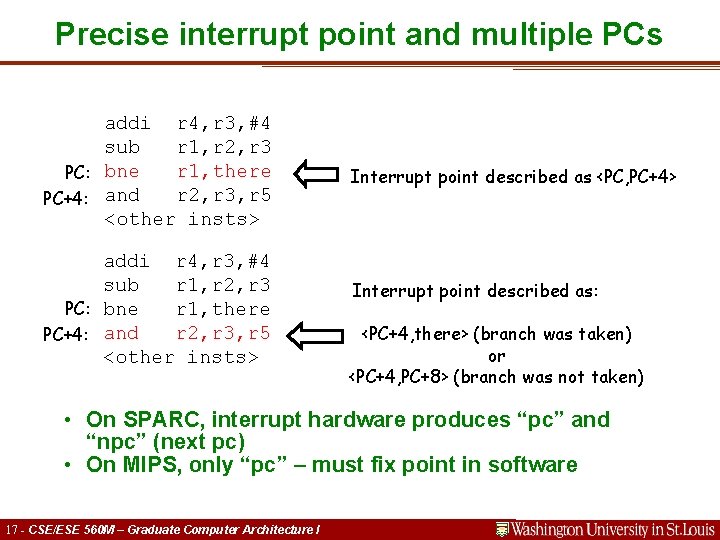
Precise interrupt point and multiple PCs addi r 4, r 3, #4 sub r 1, r 2, r 3 r 1, there PC: bne r 2, r 3, r 5 PC+4: and <other insts> addi r 4, r 3, #4 sub r 1, r 2, r 3 PC: bne r 1, there r 2, r 3, r 5 PC+4: and <other insts> Interrupt point described as <PC, PC+4> Interrupt point described as: <PC+4, there> (branch was taken) or <PC+4, PC+8> (branch was not taken) • On SPARC, interrupt hardware produces “pc” and “npc” (next pc) • On MIPS, only “pc” – must fix point in software 17 - CSE/ESE 560 M – Graduate Computer Architecture I
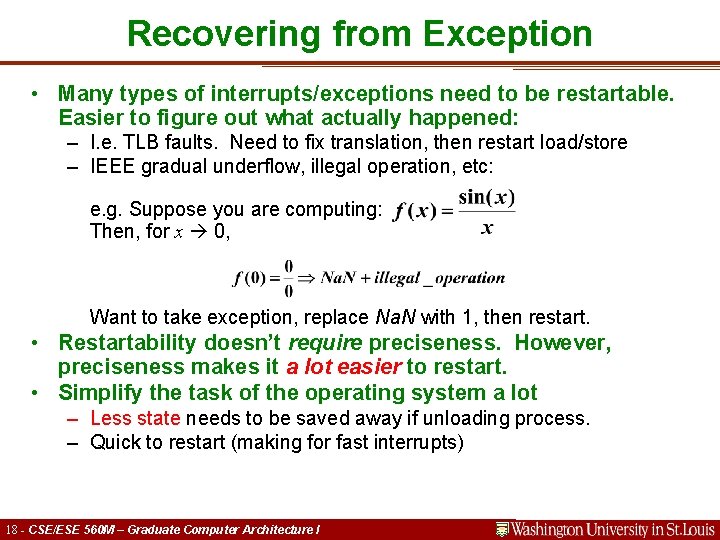
Recovering from Exception • Many types of interrupts/exceptions need to be restartable. Easier to figure out what actually happened: – I. e. TLB faults. Need to fix translation, then restart load/store – IEEE gradual underflow, illegal operation, etc: e. g. Suppose you are computing: Then, for x 0, Want to take exception, replace Na. N with 1, then restart. • Restartability doesn’t require preciseness. However, preciseness makes it a lot easier to restart. • Simplify the task of the operating system a lot – Less state needs to be saved away if unloading process. – Quick to restart (making for fast interrupts) 18 - CSE/ESE 560 M – Graduate Computer Architecture I
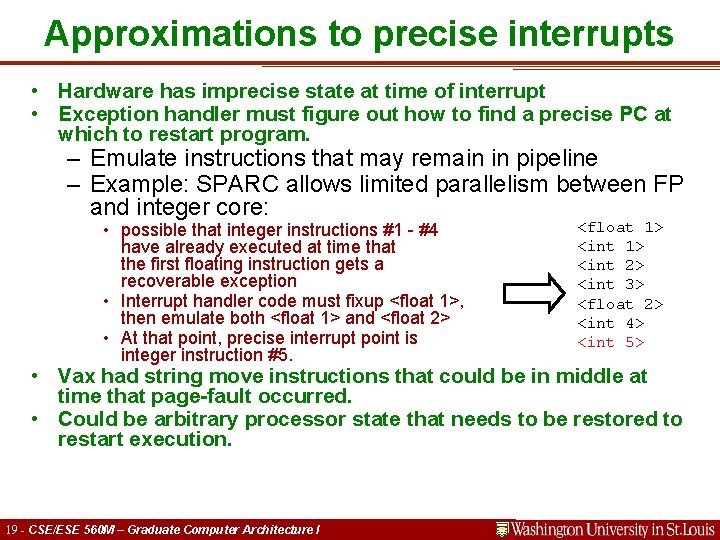
Approximations to precise interrupts • Hardware has imprecise state at time of interrupt • Exception handler must figure out how to find a precise PC at which to restart program. – Emulate instructions that may remain in pipeline – Example: SPARC allows limited parallelism between FP and integer core: • possible that integer instructions #1 - #4 have already executed at time that the first floating instruction gets a recoverable exception • Interrupt handler code must fixup <float 1>, then emulate both <float 1> and <float 2> • At that point, precise interrupt point is integer instruction #5. <float 1> <int 2> <int 3> <float 2> <int 4> <int 5> • Vax had string move instructions that could be in middle at time that page-fault occurred. • Could be arbitrary processor state that needs to be restored to restart execution. 19 - CSE/ESE 560 M – Graduate Computer Architecture I
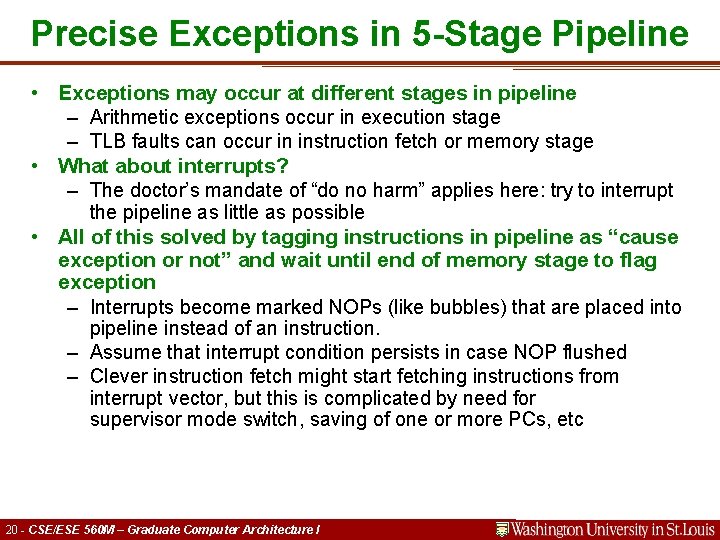
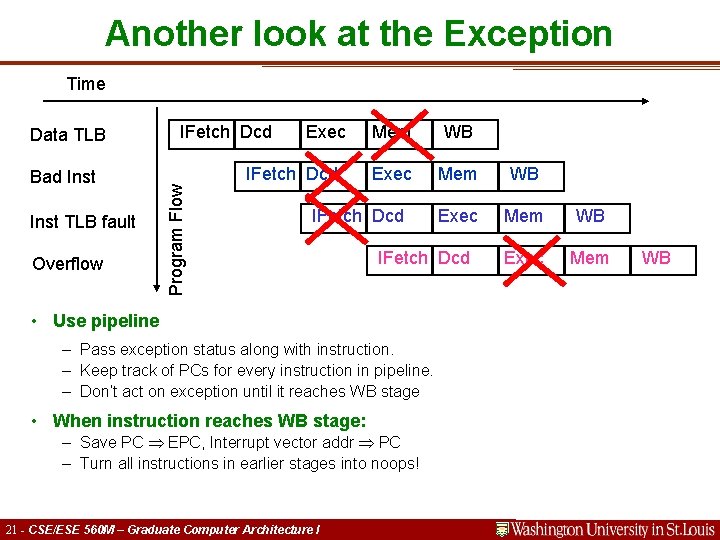
Precise Exceptions in 5 -Stage Pipeline • Exceptions may occur at different stages in pipeline – Arithmetic exceptions occur in execution stage – TLB faults can occur in instruction fetch or memory stage • What about interrupts? – The doctor’s mandate of “do no harm” applies here: try to interrupt the pipeline as little as possible • All of this solved by tagging instructions in pipeline as “cause exception or not” and wait until end of memory stage to flag exception – Interrupts become marked NOPs (like bubbles) that are placed into pipeline instead of an instruction. – Assume that interrupt condition persists in case NOP flushed – Clever instruction fetch might start fetching instructions from interrupt vector, but this is complicated by need for supervisor mode switch, saving of one or more PCs, etc 20 - CSE/ESE 560 M – Graduate Computer Architecture I
Another look at the Exception Time Bad Inst TLB fault Overflow IFetch Dcd Exec IFetch Dcd Program Flow Data TLB Mem WB Exec Mem IFetch Dcd • Use pipeline – Pass exception status along with instruction. – Keep track of PCs for every instruction in pipeline. – Don’t act on exception until it reaches WB stage • When instruction reaches WB stage: – Save PC EPC, Interrupt vector addr PC – Turn all instructions in earlier stages into noops! 21 - CSE/ESE 560 M – Graduate Computer Architecture I WB
Summary • Interrupts and Exceptions either interrupt the current instruction or happen between instructions – Possibly large quantities of state must be saved before interrupting • Machines with precise exceptions provide one single point in the program to restart execution – All instructions before that point have completed – No instructions after or including that point have completed • Hardware techniques exist for precise exceptions even in the face of out-of-order execution! – Important enabling factor for out-of-order execution 22 - CSE/ESE 560 M – Graduate Computer Architecture I