GEORGIA ADVOCACY OFFICE THE INDEPENDENT FEDERALLYMANDATED PROTECTION AND
- Slides: 34
GEORGIA ADVOCACY OFFICE THE INDEPENDENT, FEDERALLY-MANDATED PROTECTION AND ADVOCACY SYSTEM FOR PEOPLE WITH DISABILITIES IN GEORGIA PRESENTER: JOE SARRA (404)885 -1234; (800)537 -2329; INFO@THEGAO. ORG
GAO’S Vision • GAO envisions a Georgia where all people have value, visibility and voice; where even the most difficult and longlasting challenges are addressed by ordinary citizens acting voluntarily on behalf of each other; and where the perception of disability is replaced by the recognition of ability GAO’S Mission • To organize our resources and follow our values and legal mandates in ways which substantially increase the number of people who are voluntarily standing beside and for people in Georgia who have significant disabilities and mental illness GAO Georgia Advocacy Office
Our Priorities 1. To protect persons with disabilities or mental illness in Georgia from abuse and neglect 2. To respond to allegations of discrimination and legal rights violations of persons with disabilities or mental illness 3. To promote the integration and self-determination of persons with disabilities or mental illness in the community GAO Georgia Advocacy Office
GAO provides Protection and Advocacy for: • • People who experience developmental disabilities (PADD) People who experience mental illness (PAIMI) People who experience traumatic brain injury (PATBI) People in need of assistive technology (PAAT) People experiencing a violation of their individual rights (PAIR) People experiencing issues around voting rights (PAVA) People accessing Social Security benefits (PABSS) GAO Georgia Advocacy Office
GAO provides a wide range of services to people with disabilities in Georgia, including: • Information and referral • Technical assistance, advice, and support in self-advocacy • Assistance in advocacy, negotiation, or mediation on behalf of individuals • Investigation of allegations of abuse, neglect, or violations of rights (continued next slide) GAO Georgia Advocacy Office
GAO provides a wide range of services to people with disabilities in Georgia, including: • Public information and education regarding the needs and rights of people with disabilities • Legislative monitoring and technical assistance • Technical assistance to attorneys regarding disability law GAO Georgia Advocacy Office
Medicaid • Jointly funded, Federal-State health insurance program that pays for medical bills of eligible members with federal and state tax revenues • Coverage: children, people who are elderly, pregnant women, women experiencing breast or cervical cancer, and/or people with disabilities of lower income who require access to healthcare services • Administered by the Department of Community Health (DCH) (continued next slide) GAO Georgia Advocacy Office
Medicaid • Eligibility in Georgia is determined by the Division of Family and Children Services • Eligibility for Medicaid is based on household income, disability • Approval for healthcare services is handled by DCH contracting agency, the Georgia Medical Care Foundation (GMCF) GAO Georgia Advocacy Office
How to Apply for Medicaid • There are five ways to apply for Georgia Medicaid: • • In person at your local county DFCS office Online at: https: //compass. ga. gov/selfservice Online at: https: //www. peachcare. org Supplemental Security Income (SSI) applications via the Social Security Administration: https: //www. ssa. gov/ssi • In Georgia, if found eligible for SSI, you automatically qualify for Medicaid • Deeming Waiver (formerly known as the Katie Beckett Waiver)applications are accepted by the Right from the Start Medicaid Project/Centralized Katie Beckett Medicaid Team: 678 -248 -7449 GAO Georgia Advocacy Office
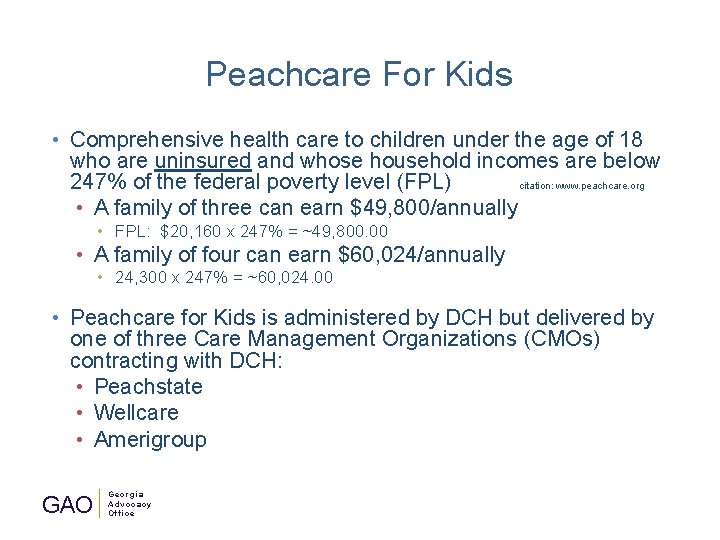
Peachcare For Kids • Comprehensive health care to children under the age of 18 who are uninsured and whose household incomes are below 247% of the federal poverty level (FPL) citation: www. peachcare. org • A family of three can earn $49, 800/annually • FPL: $20, 160 x 247% = ~49, 800. 00 • A family of four can earn $60, 024/annually • 24, 300 x 247% = ~60, 024. 00 • Peachcare for Kids is administered by DCH but delivered by one of three Care Management Organizations (CMOs) contracting with DCH: • Peachstate • Wellcare • Amerigroup GAO Georgia Advocacy Office
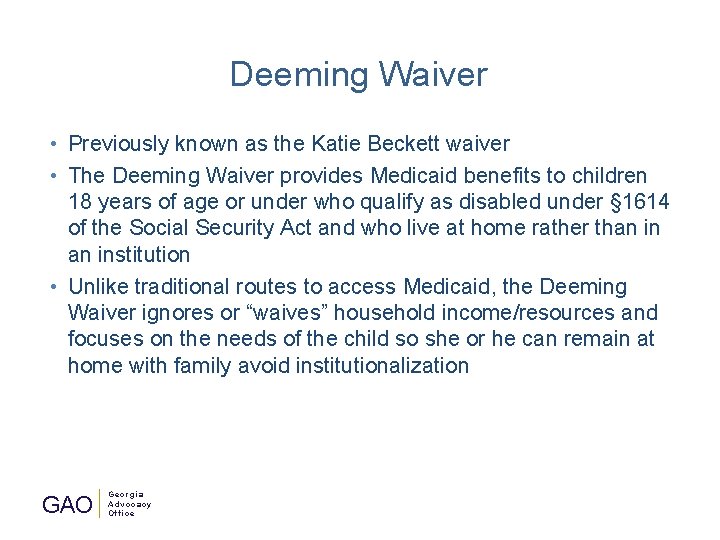
Deeming Waiver • Previously known as the Katie Beckett waiver • The Deeming Waiver provides Medicaid benefits to children 18 years of age or under who qualify as disabled under § 1614 of the Social Security Act and who live at home rather than institution • Unlike traditional routes to access Medicaid, the Deeming Waiver ignores or “waives” household income/resources and focuses on the needs of the child so she or he can remain at home with family avoid institutionalization GAO Georgia Advocacy Office
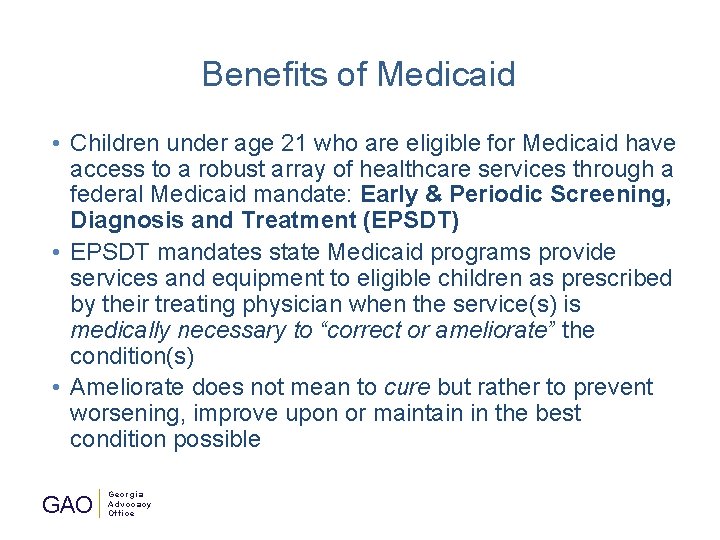
Benefits of Medicaid • Children under age 21 who are eligible for Medicaid have access to a robust array of healthcare services through a federal Medicaid mandate: Early & Periodic Screening, Diagnosis and Treatment (EPSDT) • EPSDT mandates state Medicaid programs provide services and equipment to eligible children as prescribed by their treating physician when the service(s) is medically necessary to “correct or ameliorate” the condition(s) • Ameliorate does not mean to cure but rather to prevent worsening, improve upon or maintain in the best condition possible GAO Georgia Advocacy Office
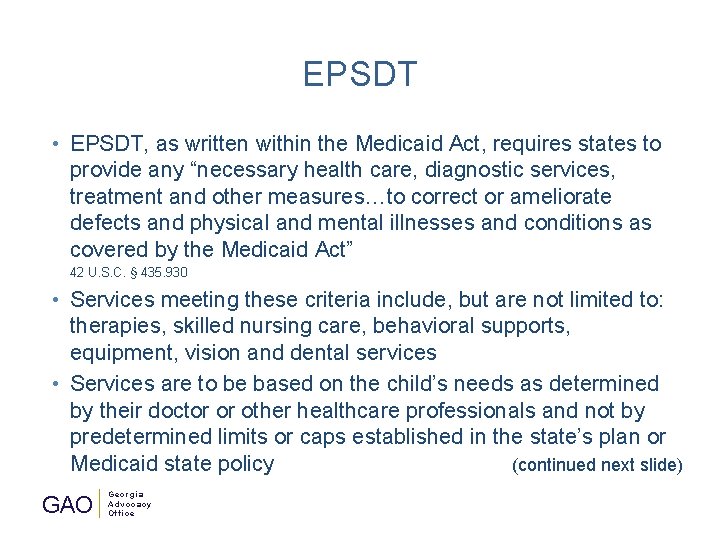
EPSDT • EPSDT, as written within the Medicaid Act, requires states to provide any “necessary health care, diagnostic services, treatment and other measures…to correct or ameliorate defects and physical and mental illnesses and conditions as covered by the Medicaid Act” 42 U. S. C. § 435. 930 • Services meeting these criteria include, but are not limited to: therapies, skilled nursing care, behavioral supports, equipment, vision and dental services • Services are to be based on the child’s needs as determined by their doctor or other healthcare professionals and not by predetermined limits or caps established in the state’s plan or Medicaid state policy (continued next slide) GAO Georgia Advocacy Office
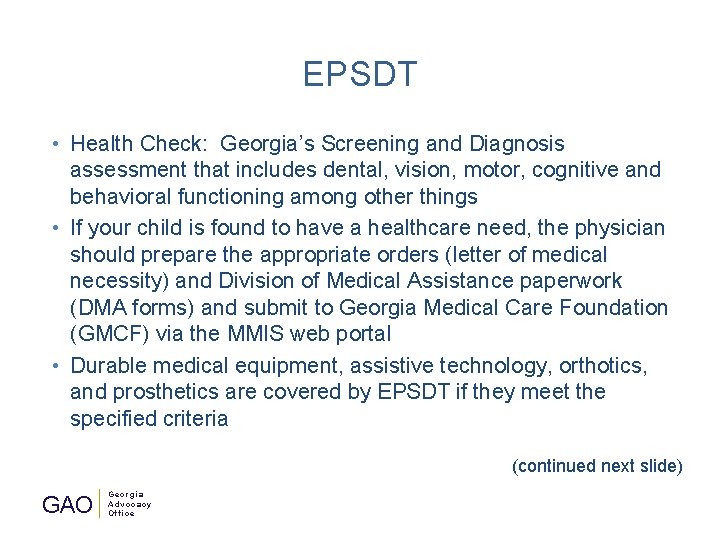
EPSDT • Health Check: Georgia’s Screening and Diagnosis assessment that includes dental, vision, motor, cognitive and behavioral functioning among other things • If your child is found to have a healthcare need, the physician should prepare the appropriate orders (letter of medical necessity) and Division of Medical Assistance paperwork (DMA forms) and submit to Georgia Medical Care Foundation (GMCF) via the MMIS web portal • Durable medical equipment, assistive technology, orthotics, and prosthetics are covered by EPSDT if they meet the specified criteria (continued next slide) GAO Georgia Advocacy Office
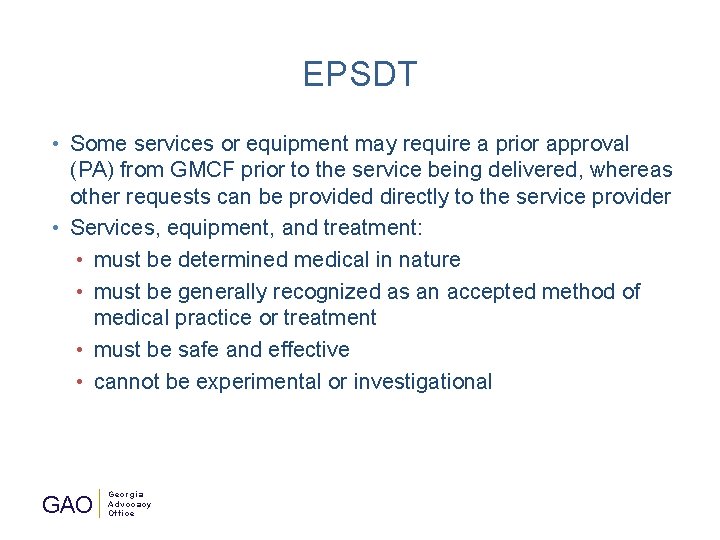
EPSDT • Some services or equipment may require a prior approval (PA) from GMCF prior to the service being delivered, whereas other requests can be provided directly to the service provider • Services, equipment, and treatment: • must be determined medical in nature • must be generally recognized as an accepted method of medical practice or treatment • must be safe and effective • cannot be experimental or investigational GAO Georgia Advocacy Office
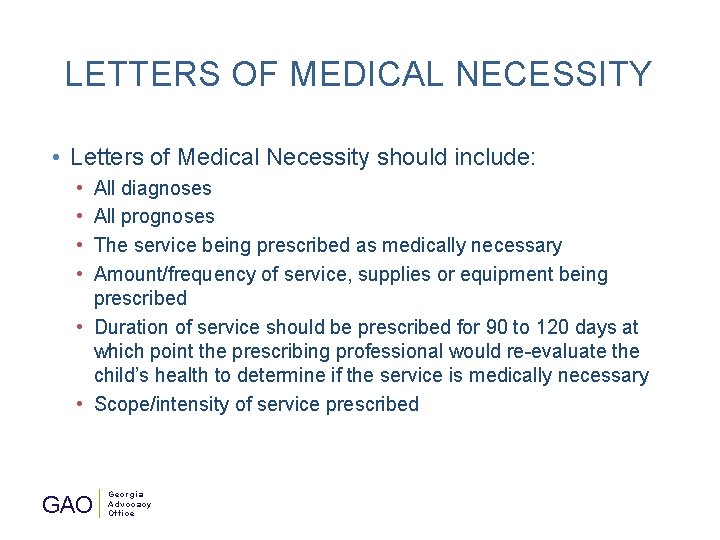
LETTERS OF MEDICAL NECESSITY • Letters of Medical Necessity should include: • • All diagnoses All prognoses The service being prescribed as medically necessary Amount/frequency of service, supplies or equipment being prescribed • Duration of service should be prescribed for 90 to 120 days at which point the prescribing professional would re-evaluate the child’s health to determine if the service is medically necessary • Scope/intensity of service prescribed GAO Georgia Advocacy Office
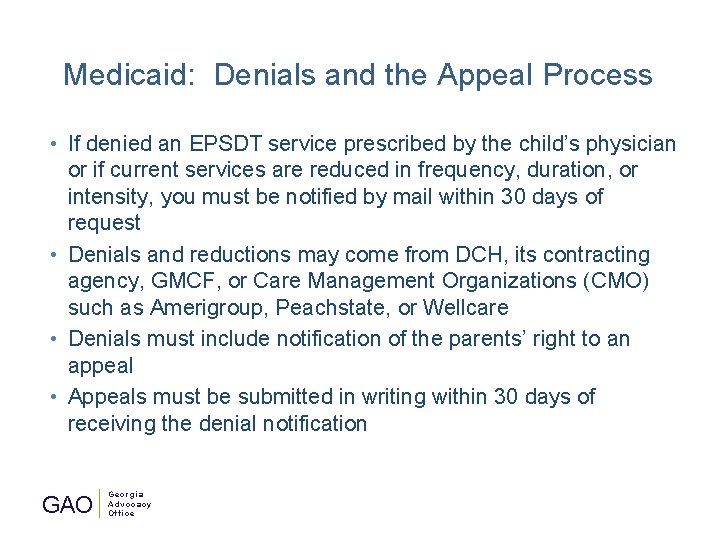
Medicaid: Denials and the Appeal Process • If denied an EPSDT service prescribed by the child’s physician or if current services are reduced in frequency, duration, or intensity, you must be notified by mail within 30 days of request • Denials and reductions may come from DCH, its contracting agency, GMCF, or Care Management Organizations (CMO) such as Amerigroup, Peachstate, or Wellcare • Denials must include notification of the parents’ right to an appeal • Appeals must be submitted in writing within 30 days of receiving the denial notification GAO Georgia Advocacy Office
Senate Bill 507 (SB 507) • SB 507 was passed by Georgia’s General Assembly in 2008 to address difficulties experienced by children with disabilities who are eligible for medical services to which they are entitled at the scope, amount and duration as prescribed • SB 507 requires the denial letter include a description of the following: • The exact treatment/services being denied • Any additional information needed by the medical provider that could change DCH/GMCF’s decision, and • The specific reason used to determine that the service is not medically necessary for that child GAO Georgia Advocacy Office
Denials and the Appeal Process • Children denied a service by DCH or its contracting agencies have the right to an appeal • The denial letter should include: • any additional information requested by DCH/contracting agencies to reconsider the denial • the mailing address to which appeals should be submitted • Appeals must be submitted in writing within 30 days of receipt of the written notice • The State has 90 days to make a final determination on the appeal; however, CMOs may have extended time frame (continued next slide) GAO Georgia Advocacy Office
Denials and the Appeal Process • If denied after the first appeal, you have the right to request an administrative hearing before the Office of State Administrative Hearings (OSAH) • Upon notifying DCH of your request for a fair hearing, DCH must send the request for a hearing to the Office of State Administrative Hearings (OSAH) promptly so OSAH can schedule a hearing within the 90 -day time frame • If you do not receive written notice of the reason(s) for denial as specified within SB 507, the state has violated the Medicaid Act GAO Georgia Advocacy Office
Home and Community-Based Services (HCBS) Available Through Georgia Medicaid GAO Georgia Advocacy Office
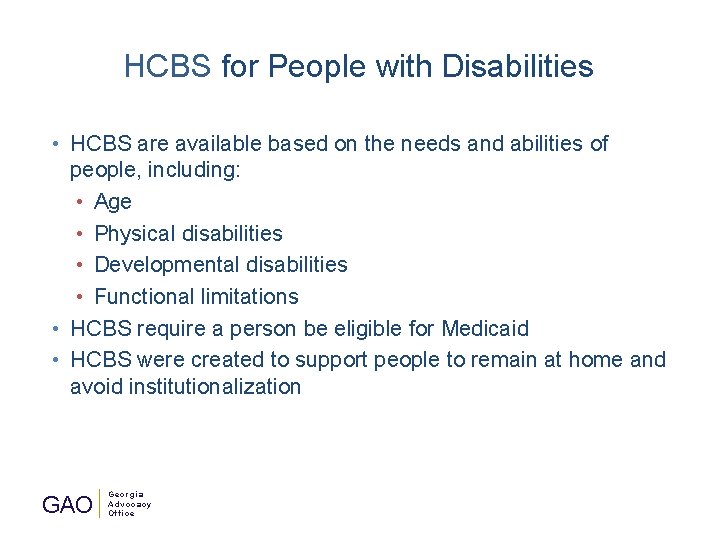
HCBS for People with Disabilities • HCBS are available based on the needs and abilities of people, including: • Age • Physical disabilities • Developmental disabilities • Functional limitations • HCBS require a person be eligible for Medicaid • HCBS were created to support people to remain at home and avoid institutionalization GAO Georgia Advocacy Office
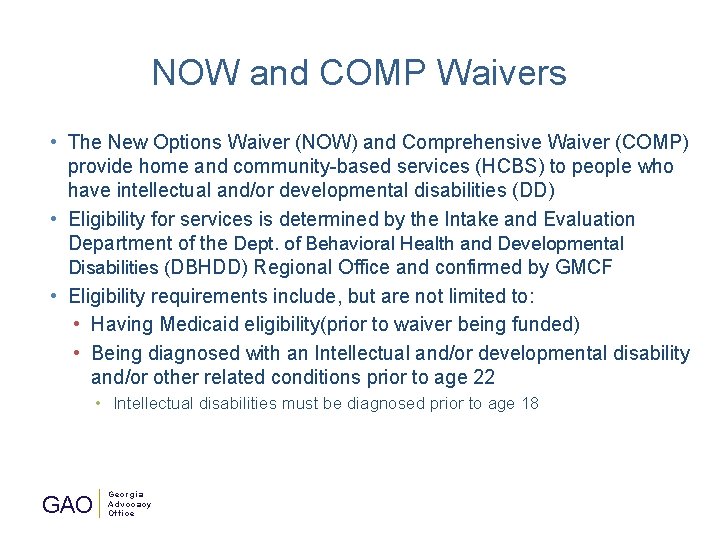
NOW and COMP Waivers • The New Options Waiver (NOW) and Comprehensive Waiver (COMP) provide home and community-based services (HCBS) to people who have intellectual and/or developmental disabilities (DD) • Eligibility for services is determined by the Intake and Evaluation Department of the Dept. of Behavioral Health and Developmental Disabilities (DBHDD) Regional Office and confirmed by GMCF • Eligibility requirements include, but are not limited to: • Having Medicaid eligibility(prior to waiver being funded) • Being diagnosed with an Intellectual and/or developmental disability and/or other related conditions prior to age 22 • Intellectual disabilities must be diagnosed prior to age 18 GAO Georgia Advocacy Office
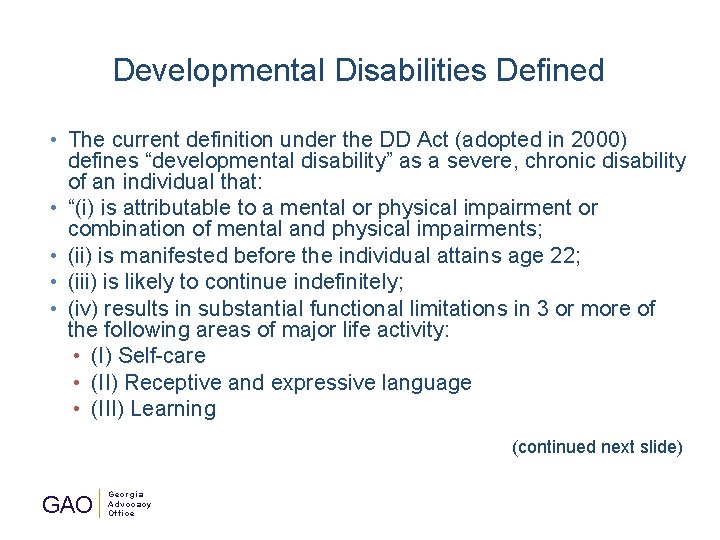
Developmental Disabilities Defined • The current definition under the DD Act (adopted in 2000) defines “developmental disability” as a severe, chronic disability of an individual that: • “(i) is attributable to a mental or physical impairment or combination of mental and physical impairments; • (ii) is manifested before the individual attains age 22; • (iii) is likely to continue indefinitely; • (iv) results in substantial functional limitations in 3 or more of the following areas of major life activity: • (I) Self-care • (II) Receptive and expressive language • (III) Learning (continued next slide) GAO Georgia Advocacy Office
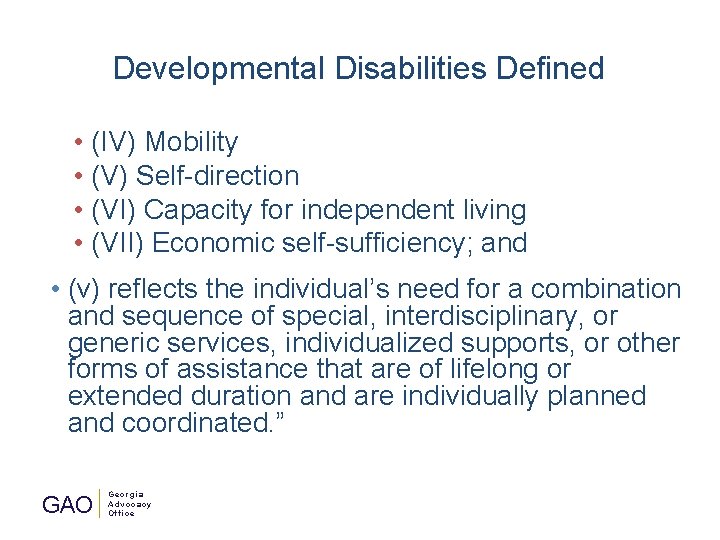
Developmental Disabilities Defined • (IV) Mobility • (V) Self-direction • (VI) Capacity for independent living • (VII) Economic self-sufficiency; and • (v) reflects the individual’s need for a combination and sequence of special, interdisciplinary, or generic services, individualized supports, or other forms of assistance that are of lifelong or extended duration and are individually planned and coordinated. ” GAO Georgia Advocacy Office
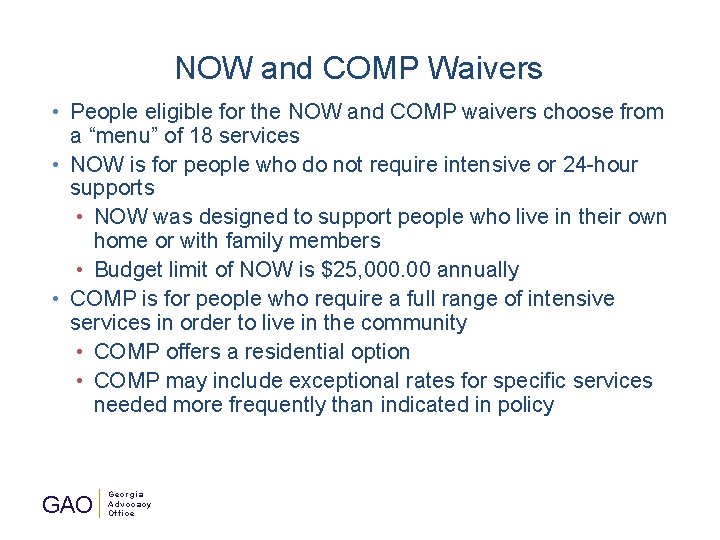
NOW and COMP Waivers • People eligible for the NOW and COMP waivers choose from a “menu” of 18 services • NOW is for people who do not require intensive or 24 -hour supports • NOW was designed to support people who live in their own home or with family members • Budget limit of NOW is $25, 000. 00 annually • COMP is for people who require a full range of intensive services in order to live in the community • COMP offers a residential option • COMP may include exceptional rates for specific services needed more frequently than indicated in policy GAO Georgia Advocacy Office
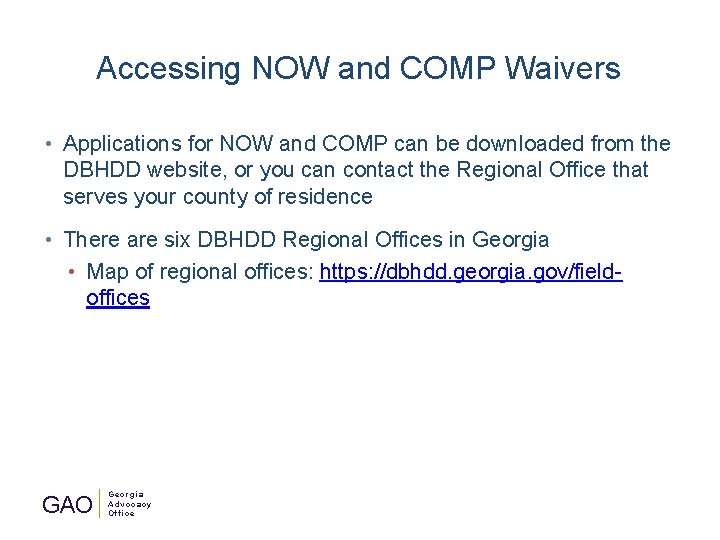
Accessing NOW and COMP Waivers • Applications for NOW and COMP can be downloaded from the DBHDD website, or you can contact the Regional Office that serves your county of residence • There are six DBHDD Regional Offices in Georgia • Map of regional offices: https: //dbhdd. georgia. gov/fieldoffices GAO Georgia Advocacy Office
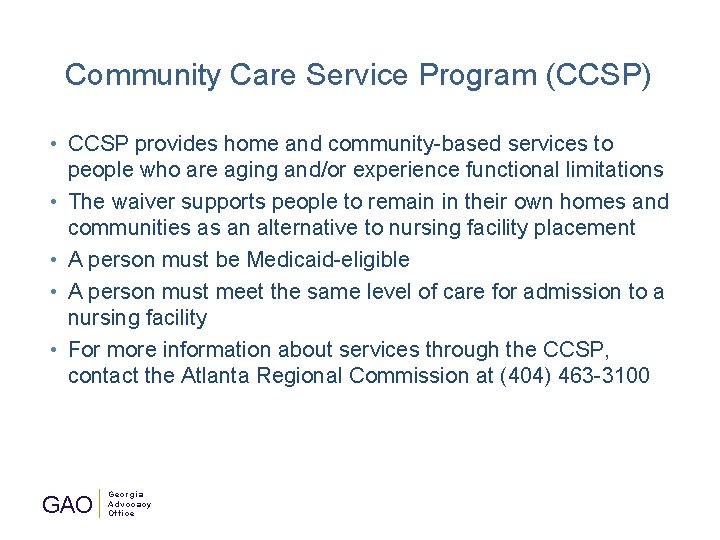
Community Care Service Program (CCSP) • CCSP provides home and community-based services to people who are aging and/or experience functional limitations • The waiver supports people to remain in their own homes and communities as an alternative to nursing facility placement • A person must be Medicaid-eligible • A person must meet the same level of care for admission to a nursing facility • For more information about services through the CCSP, contact the Atlanta Regional Commission at (404) 463 -3100 GAO Georgia Advocacy Office
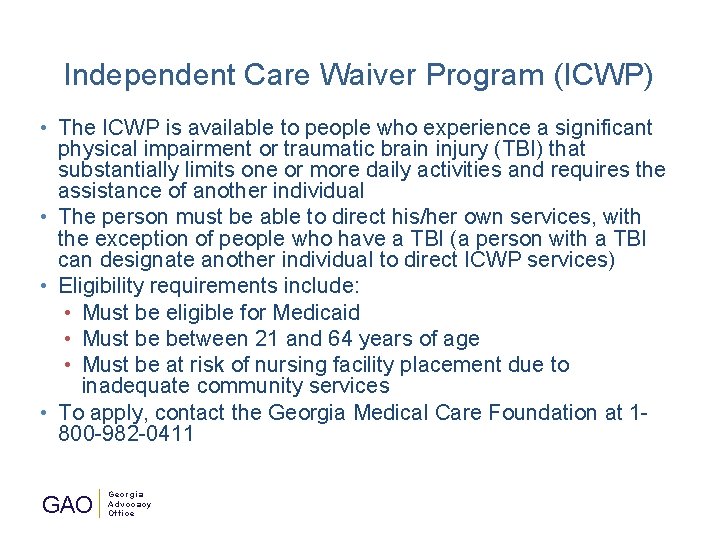
Independent Care Waiver Program (ICWP) • The ICWP is available to people who experience a significant physical impairment or traumatic brain injury (TBI) that substantially limits one or more daily activities and requires the assistance of another individual • The person must be able to direct his/her own services, with the exception of people who have a TBI (a person with a TBI can designate another individual to direct ICWP services) • Eligibility requirements include: • Must be eligible for Medicaid • Must be between 21 and 64 years of age • Must be at risk of nursing facility placement due to inadequate community services • To apply, contact the Georgia Medical Care Foundation at 1800 -982 -0411 GAO Georgia Advocacy Office
Service Options Using Resources in Community Environments (SOURCE) • SOURCE is a primary-care case management program for people who are elderly and for people with disabilities • People applying for SOURCE must receive Supplemental Security Income (SSI) • SOURCE aims to improve the health of people with chronic health conditions • SOURCE links primary medical care with support services through case managers who work with individuals and their primary-care provider (PCP) • The program’s goal is to reduce the need for long-term institutionalization and support people in their own homes and communities GAO Georgia Advocacy Office
Georgia Pediatric Program (GAPP) • The Georgia Pediatric Program (GAPP) provides skilled nursing services and personal support services when prescribed as an EPSDT service • GAPP’s skilled nursing services require a letter of medical necessity by the treating physician prescribing how many hours of skilled nursing are needed per day • Apply for GAPP by contacting one of the approved GAPP providers. For a list of providers: 404 -657 -7882 (continued next slide) GAO Georgia Advocacy Office
GAPP • GAPP hours are subject to reduction, so families must be aware of the appeal process • DCH is required to provide families with notification by mail of any reduction of hours or termination from the GAPP program • To appeal a reduction or termination of services, submit a written letter requesting an appeal within 30 days of receipt of the denial/termination letter • Families have the right to request a fair hearing with OSAH GAO Georgia Advocacy Office
Other Web Resources • Georgia Advocacy Office: www. thegao. org • Georgia Council on Developmental Disabilities: http: //gcdd. org • Parent to Parent of Georgia: http: //p 2 pga. org • Department of Behavioral Health and Developmental Disabilities: https: //dbhdd. georgia. gov • Department of Community Health: https: //dch. georgia. gov/programs GAO Georgia Advocacy Office
THANK YOU! If you have questions or concerns regarding the information presented, please contact the Georgia Advocacy Office by phone, mail, or email: Georgia Advocacy Office 1 West Court Square Suite 625 Decatur, GA 30030 (404) 885 -1234 info@thegao. org GAO Georgia Advocacy Office