General Survey Dr Wafaa Mostafa General Survey Health




- Slides: 11
General Survey Dr. Wafaa Mostafa
General Survey �Health assessment begins with a general survey that involves: 1. Observation of the client‘s general appearance. 2. Level of comfort. 3. Mental status. 4. Measurement of vital signs, height, and weight. Many components of the general survey are assessed while taking the client‘s health history, such as the client‘s body build, posture, hygiene,
Appearance and Mental Status �The general appearance and behavior of an individual must be assessed in relationship to culture, educational level, socioeconomic status, and current circumstances. �For example, an individual who has recently experienced a personal loss may appropriately appear depressed (sad expression, slumped posture). �The client‘s age, sex, and race are also useful factors in interpreting findings that suggest increased risk for known conditions.
Vital Signs �Vital signs are measured to: (a) to establish baseline data against which to compare future measurements. (b) to detect actual and potential health problems. Height and Weight � In adults, the ratio of weight to height provides a general measure of health.
Health History �The purpose of obtaining a health history is to provide you with a description of your patient‘s symptoms and how they developed. � The basic components of the complete health history include: �Chief complaint �Present health status �Past health history �Current lifestyle �Psychosocial status �Family history
Health History Systematic collection of subjective data which stated with client, and objective data which observed by the nurse.
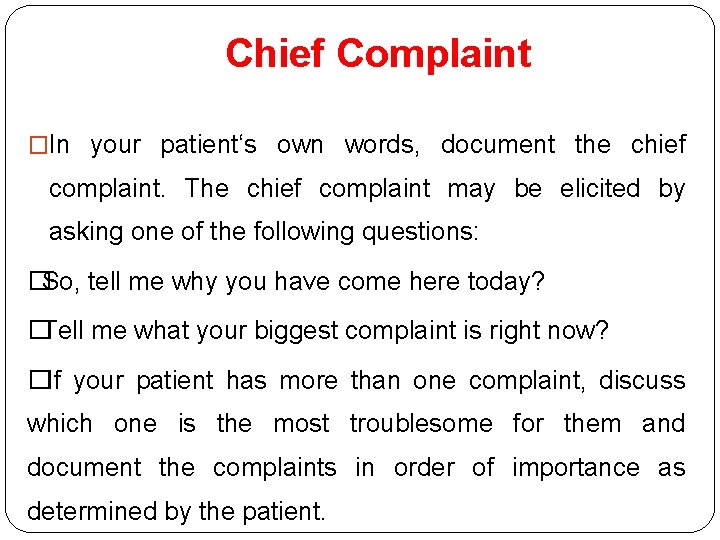
Chief Complaint �In your patient‘s own words, document the chief complaint. The chief complaint may be elicited by asking one of the following questions: �So, tell me why you have come here today? �Tell me what your biggest complaint is right now? �If your patient has more than one complaint, discuss which one is the most troublesome for them and document the complaints in order of importance as determined by the patient.
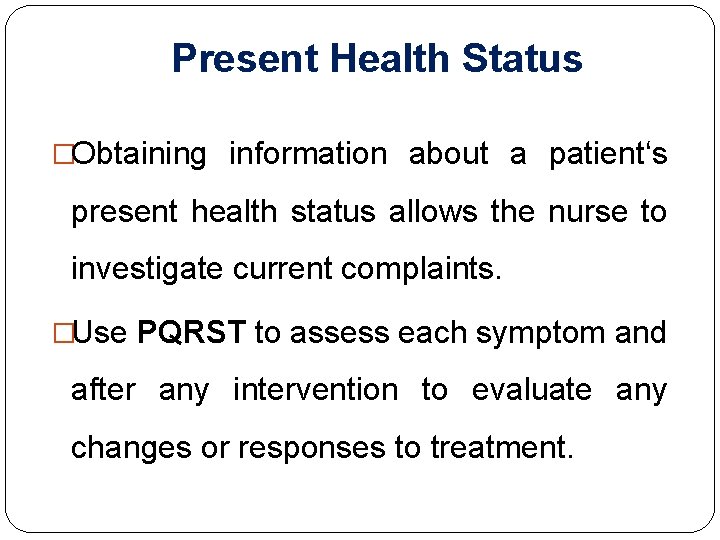
Present Health Status �Obtaining information about a patient‘s present health status allows the nurse to investigate current complaints. �Use PQRST to assess each symptom and after any intervention to evaluate any changes or responses to treatment.
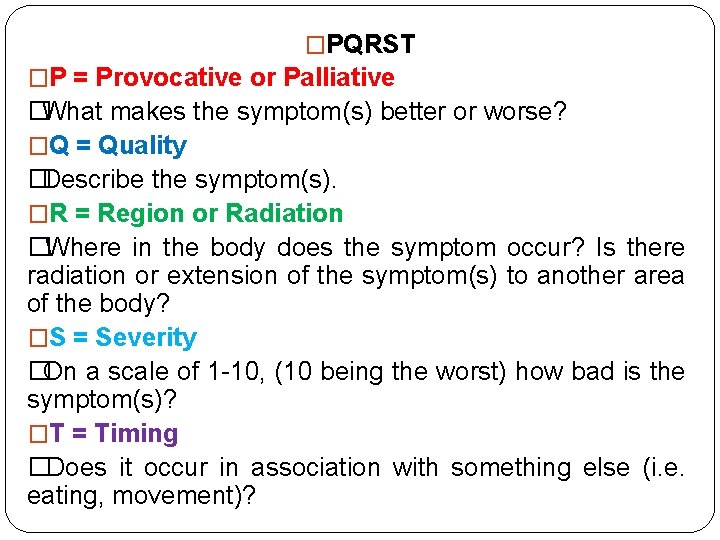
�PQRST �P = Provocative or Palliative �What makes the symptom(s) better or worse? �Q = Quality �Describe the symptom(s). �R = Region or Radiation �Where in the body does the symptom occur? Is there radiation or extension of the symptom(s) to another area of the body? �S = Severity �On a scale of 1 -10, (10 being the worst) how bad is the symptom(s)? �T = Timing �Does it occur in association with something else (i. e. eating, movement)?
Past Health History �It is important to ask questions about your patient‘s past health history. �The past health history should elicit information about the patient‘s childhood illnesses and immunizations, accidents or traumatic injuries, hospitalizations, surgeries, psychiatric or mental illnesses, allergies, and chronic illnesses. For women, include history of menstrual cycle, how many pregnancies and how many births.
THANK YOU