GENE REGULATION RESULTS IN DIFFERENTIAL GENE EXPRESSION LEADING


- Slides: 12
GENE REGULATION RESULTS IN DIFFERENTIAL GENE EXPRESSION, LEADING TO CELL SPECIALIZATION Eukaryotic DNA
Epigenetics – Ghost in Your Genes Watch to see how your environment and your choices influence inheritance… http: //www. youtube. com/watch? v=Ci. Ay. LPe. CT MU&feature=share&list=PLA 2 E 1 F 3 FFBFAE 1 CB 6
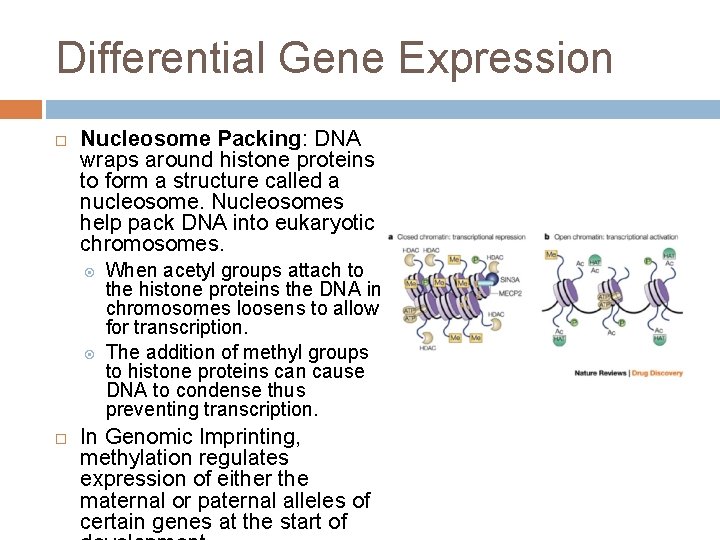
Differential Gene Expression Nucleosome Packing: DNA wraps around histone proteins to form a structure called a nucleosome. Nucleosomes help pack DNA into eukaryotic chromosomes. When acetyl groups attach to the histone proteins the DNA in chromosomes loosens to allow for transcription. The addition of methyl groups to histone proteins can cause DNA to condense thus preventing transcription. In Genomic Imprinting, methylation regulates expression of either the maternal or paternal alleles of certain genes at the start of
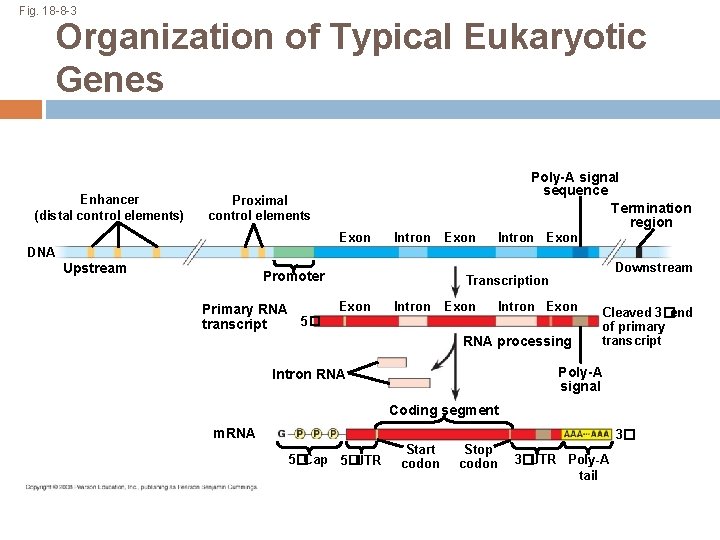
Fig. 18 -8 -3 Organization of Typical Eukaryotic Genes Enhancer (distal control elements) Poly-A signal sequence Termination region Proximal control elements Exon DNA Upstream Intron Promoter Primary RNA 5� transcript Exon Intron Exon Downstream Transcription Exon Intron Exon RNA processing Cleaved 3�end of primary transcript Poly-A signal Intron RNA Coding segment m. RNA 3� 5�Cap 5�UTR Start codon Stop codon 3�UTR Poly-A tail
The Roles of Transcription Factors Regulatory Proteins, repressors and activators, operate similarly to those in prokaryotes, influencing how readily RNA polymerase will attach to a promoter region. In many cases, numerous activators are acting in concert to influence transcription.
Fig. 18 -9 -3 Promoter Activators DNA Enhancer Distal control element Gene TATA box General transcription factors DNA-bending protein Group of mediator proteins RNA polymerase II Transcription initiation complex RNA synthesis
Coordinately controlled eukaryotic genes A particular combination of control elements can activate transcription only when the appropriate activator proteins are present. All cells of an organism have all chromosomes/genes but certain genes are only active in certain cells. The transcription factors present in the cell determine which genes will be active and which won’t (but they are both still present)
Fig. 18 -10 Enhancer Promoter Control elements Albumin gene Crystallin gene LIVER CELL NUCLEUS Available activators LENS CELL NUCLEUS Available activators Albumin gene not expressed Albumin gene expressed Crystallin gene not expressed (a) Liver cell Crystallin gene expressed (b) Lens cell
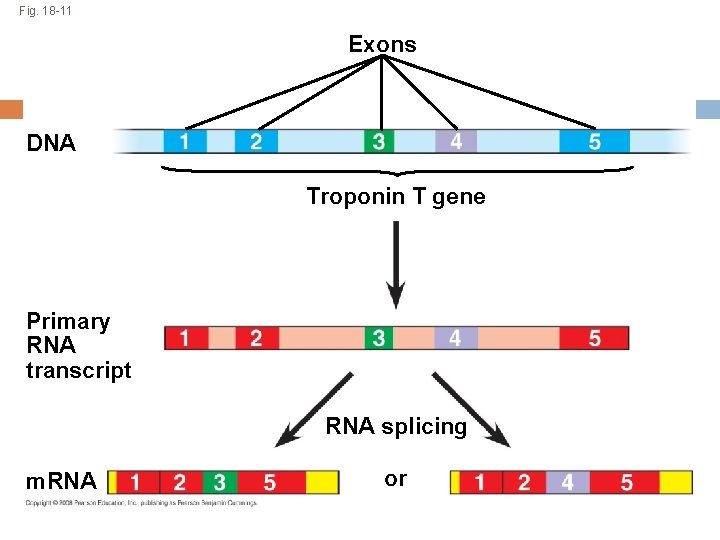
Post Transcriptional Regulation Alternate Gene Splicing - different m. RNA molecules are produced from the same primary transcript, depending on which RNA segments are treated as exons and which as introns
Fig. 18 -11 Exons DNA Troponin T gene Primary RNA transcript RNA splicing m. RNA or
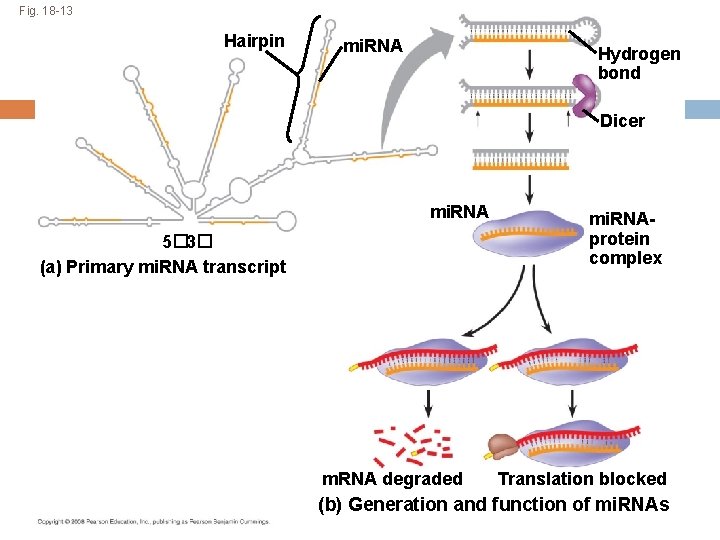
Noncoding RNAs role in gene expression RNA Interference, noncoding RNAs play multiple roles in controlling gene expression. Micro. RNAs (mi. RNAs) and Small inserting RNAs (si. RNAs) are small single-stranded RNA molecules that can bind to m. RNA. These can degrade m. RNA or block its translation. The difference between the two is that they form from different RNA precursors.
Fig. 18 -13 Hairpin mi. RNA Hydrogen bond Dicer mi. RNA 5� 3� (a) Primary mi. RNA transcript m. RNA degraded mi. RNAprotein complex Translation blocked (b) Generation and function of mi. RNAs