GCSE History An introduction to Planning Teaching and

- Slides: 39
GCSE History An introduction to Planning, Teaching and Assessing the New GCSE History Aaron Wilkes • Head of Humanities Faculty at an 11 - 16 Comp. in the West Midlands • Teacher for 19 years • KS 3 and KS 4 textbook author • New convert to AQA Follow us on Twitter @AQACPD.
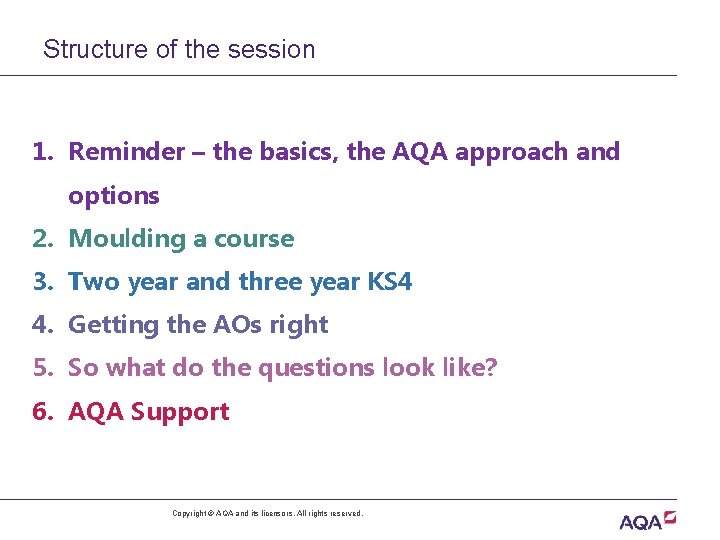
Structure of the session 1. Reminder – the basics, the AQA approach and options 2. Moulding a course 3. Two year and three year KS 4 4. Getting the AOs right 5. So what do the questions look like? 6. AQA Support Copyright © AQA and its licensors. All rights reserved.
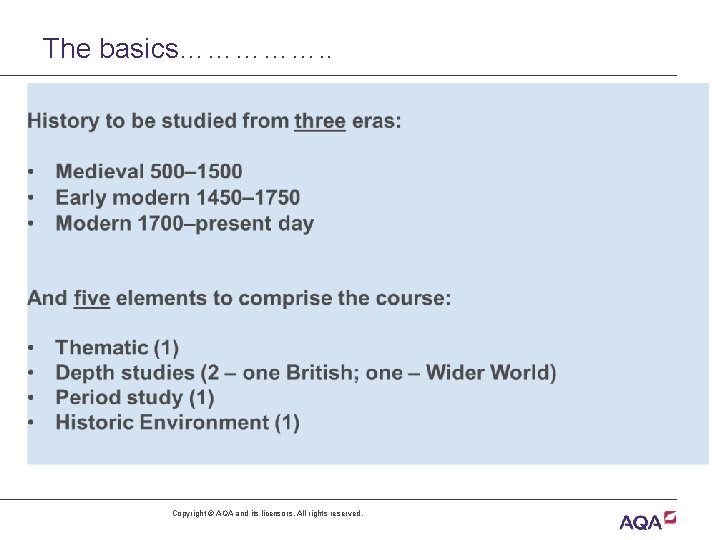
The basics……………. . • New GCSEs will be first examined in June 2018 • If a school has a TWO year Key Stage 4, you will start teaching the new GCSE in September 2016 • If you have a THREE year Key Stage 4, then you might be teaching it right now……… Copyright © AQA and its licensors. All rights reserved.
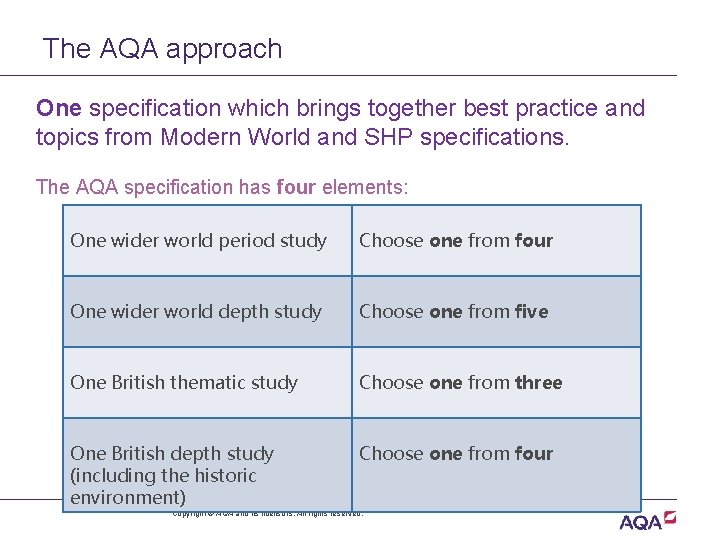
The AQA approach One specification which brings together best practice and topics from Modern World and SHP specifications. The AQA specification has four elements: One wider world period study Choose one from four One wider world depth study Choose one from five One British thematic study Choose one from three One British depth study (including the historic environment) Choose one from four Copyright © AQA and its licensors. All rights reserved.
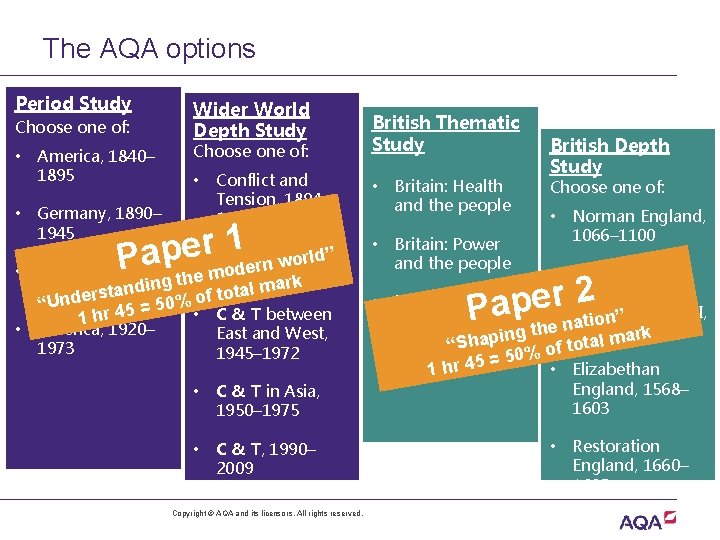
The AQA options Period Study Choose one of: • • America, 1840– 1895 Wider World Depth Study Choose one of: • Germany, 1890– 1945 Conflict and Tension, 1894– 1918 1 r e p • C & T, 1918– rld” o a w P n r Russia, 1894– ode e m 1939 th ark m l 1945 erstanding a t o of t % 0 “Und 5 = • C & T between 1 hr 45 America, 1920– 1973 East and West, 1945– 1972 • C & T in Asia, 1950– 1975 • C & T, 1990– 2009 Copyright © AQA and its licensors. All rights reserved. British Thematic Study • • • Britain: Health and the people Britain: Power and the people British Depth Study Choose one of: • Norman England, 1066– 1100 Medieval England: the Britain: reign of Edward I, Migration, tion” a n e h 1272– 1307 ing t ark empires and the “Shap % of total m people r 45 = 50 • Elizabethan 1 h England, 1568– 1603 • 2 r e p Pa • Restoration England, 1660– 1685
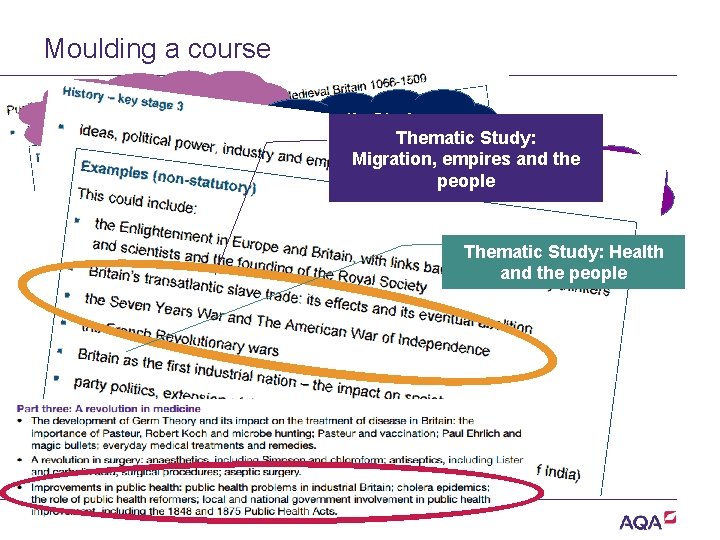
Moulding a course British Depth Study: v. The clientele: Thematic Study: Norman England Thematic Study: - Staff (opinions, interests, strengths etc) Power and the Migration, empires and the People - Students (opinions, interests, strengths etc ) British Depth people Study: Medieval England The natural progression of content, concepts & skills: v - KS 3 into 4 – think about the flexibility of KS 3 Thematic Study: Health and the people Copyright © AQA and its licensors. All rights reserved.
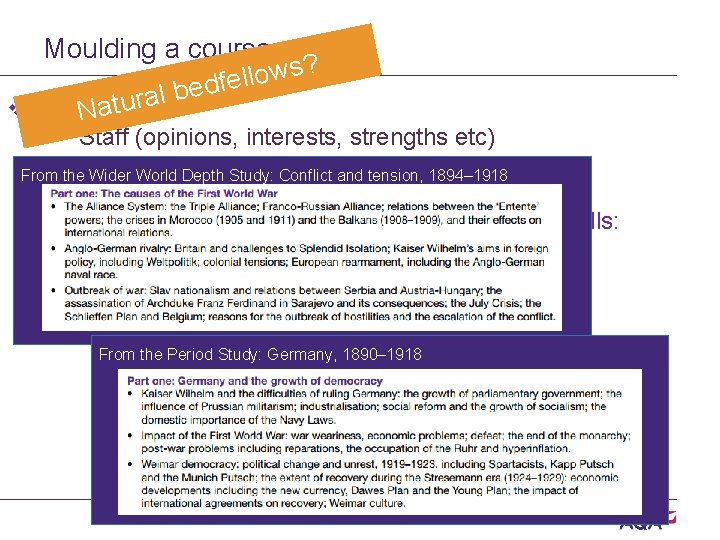
Moulding a course ? s w o l l fe d e b l a r u t v. The clientele: a N - Staff (opinions, interests, strengths etc) - Students (opinions, interests, strengths etc) From the Wider World Depth Study: Conflict and tension, 1894– 1918 v The natural progression of content, concepts & skills: - KS 3 into 4 – think about the flexibility of KS 3 - What ‘overlap’ can you ‘discover’ and use? From the Period Study: Germany, 1890– 1918 Copyright © AQA and its licensors. All rights reserved.
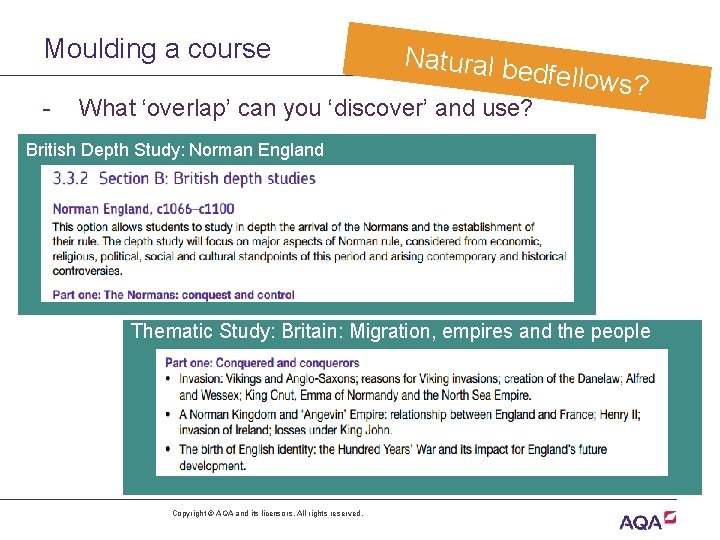
Moulding a course - Natural b edfellows What ‘overlap’ can you ‘discover’ and use? ? British Depth Study: Norman England Thematic Study: Britain: Migration, empires and the people Copyright © AQA and its licensors. All rights reserved.
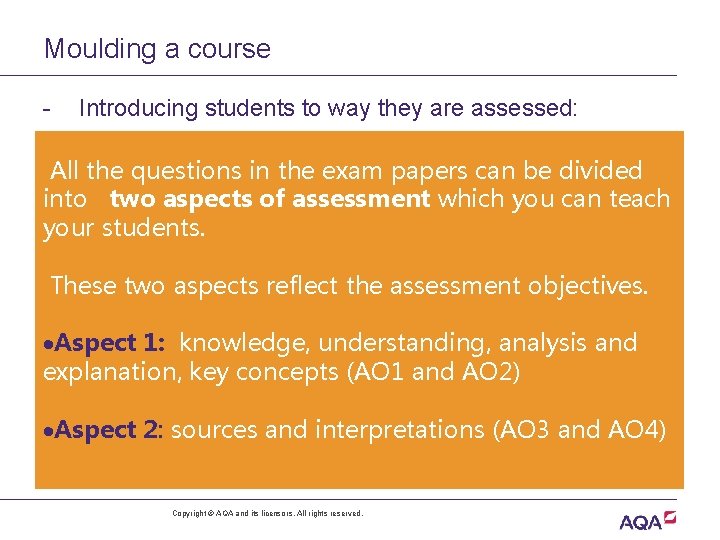
Moulding a course Introducing students to way they are assessed: All the questions in the exam papers can be divided into two aspects of assessment which you can teach your students. These two aspects reflect the assessment objectives. Aspect 1: knowledge, understanding, analysis and explanation, key concepts (AO 1 and AO 2) Aspect 2: sources and interpretations (AO 3 and AO 4) Copyright © AQA and its licensors. All rights reserved.
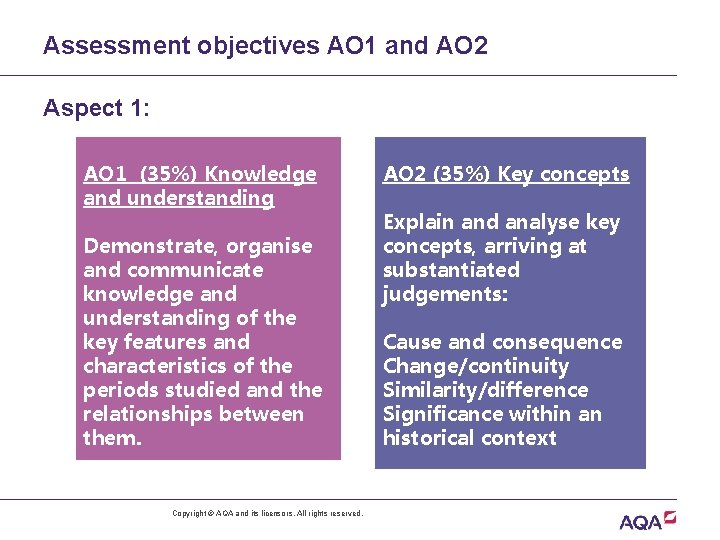
Assessment objectives AO 1 and AO 2 Aspect 1: AO 1 (35%) Knowledge and understanding Demonstrate, organise and communicate knowledge and understanding of the key features and characteristics of the periods studied and the relationships between them. Copyright © AQA and its licensors. All rights reserved. AO 2 (35%) Key concepts Explain and analyse key concepts, arriving at substantiated judgements: Cause and consequence Change/continuity Similarity/difference Significance within an historical context
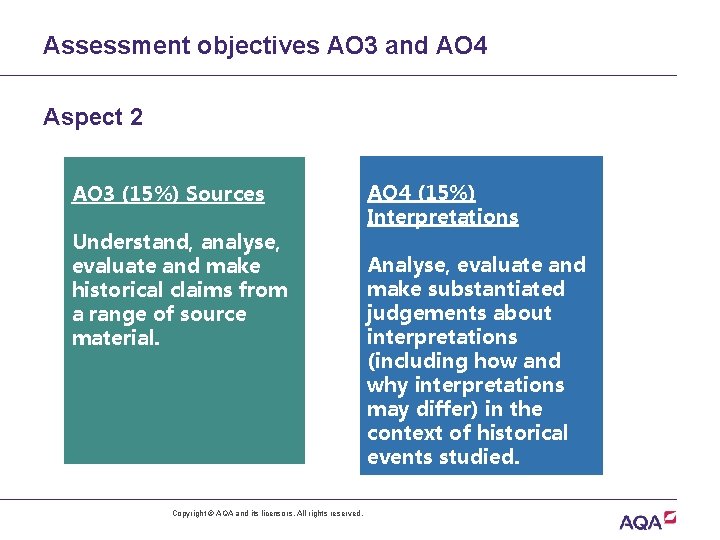
Assessment objectives AO 3 and AO 4 Aspect 2 AO 3 (15%) Sources Understand, analyse, evaluate and make historical claims from a range of source material. Copyright © AQA and its licensors. All rights reserved. AO 4 (15%) Interpretations Analyse, evaluate and make substantiated judgements about interpretations (including how and why interpretations may differ) in the context of historical events studied.
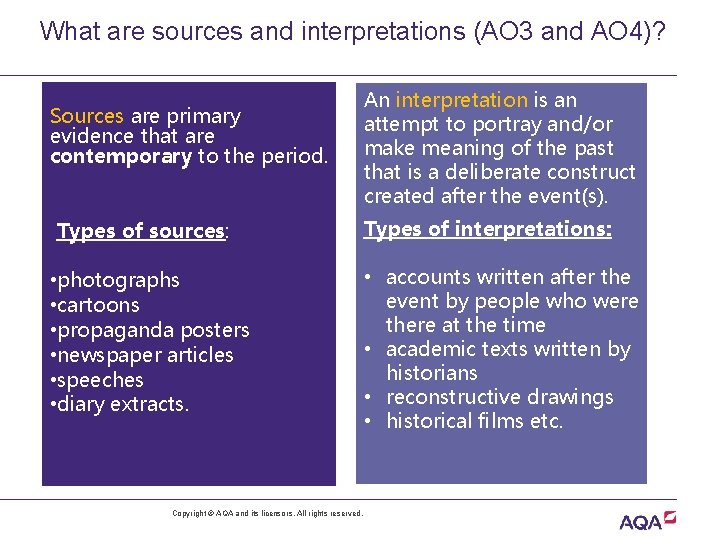
What are sources and interpretations (AO 3 and AO 4)? Sources are primary evidence that are contemporary to the period. Types of sources: • photographs • cartoons • propaganda posters • newspaper articles • speeches • diary extracts. Copyright © AQA and its licensors. All rights reserved. An interpretation is an attempt to portray and/or make meaning of the past that is a deliberate construct created after the event(s). Types of interpretations: • accounts written after the event by people who were there at the time • academic texts written by historians • reconstructive drawings • historical films etc.
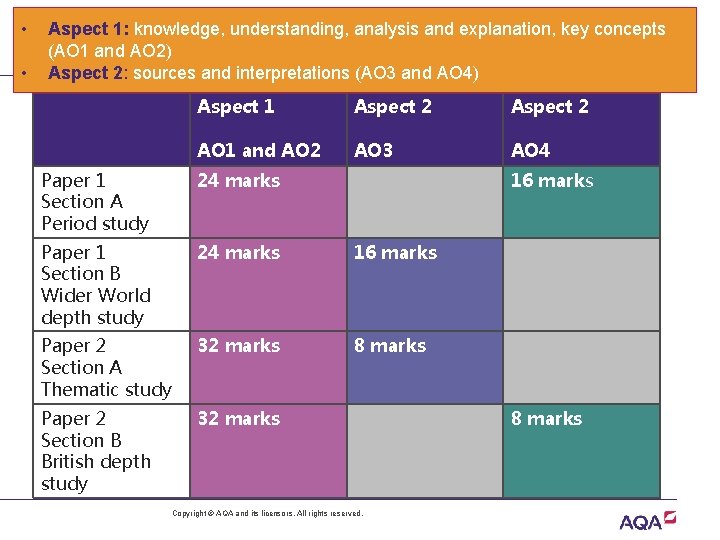
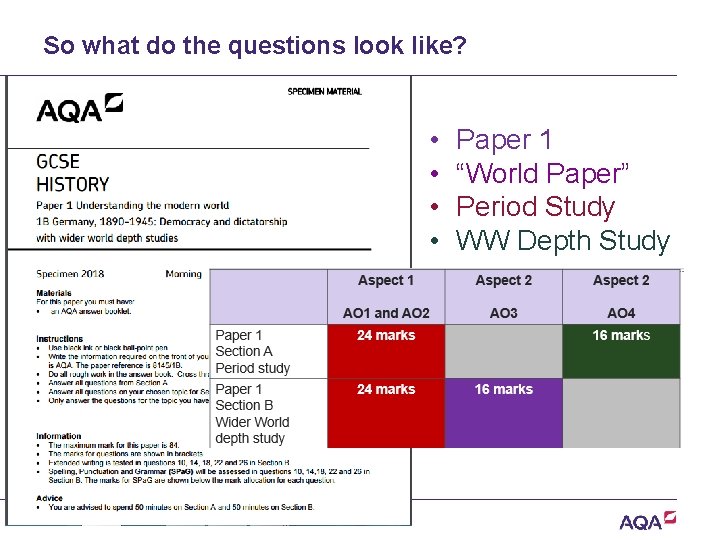
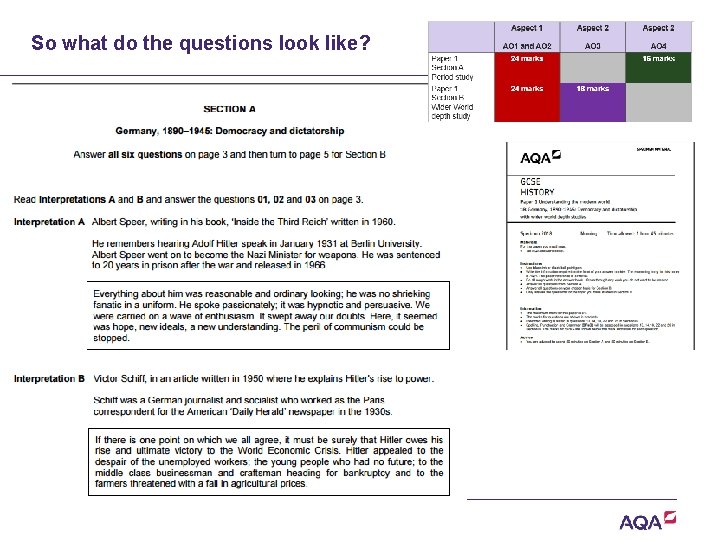
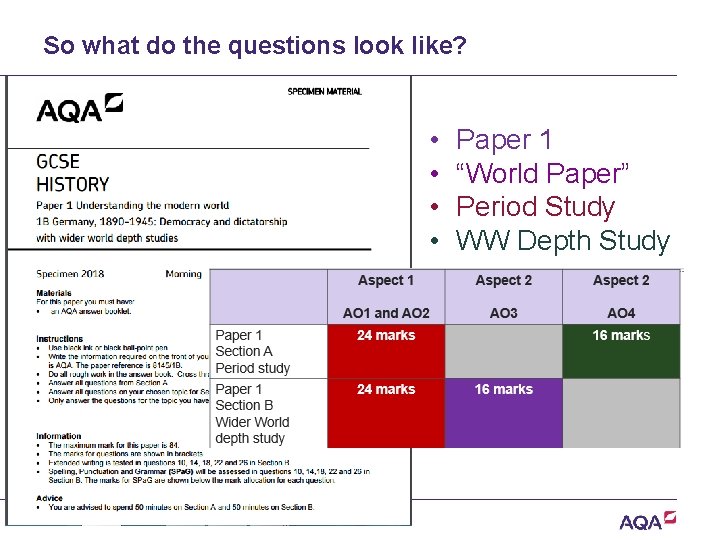
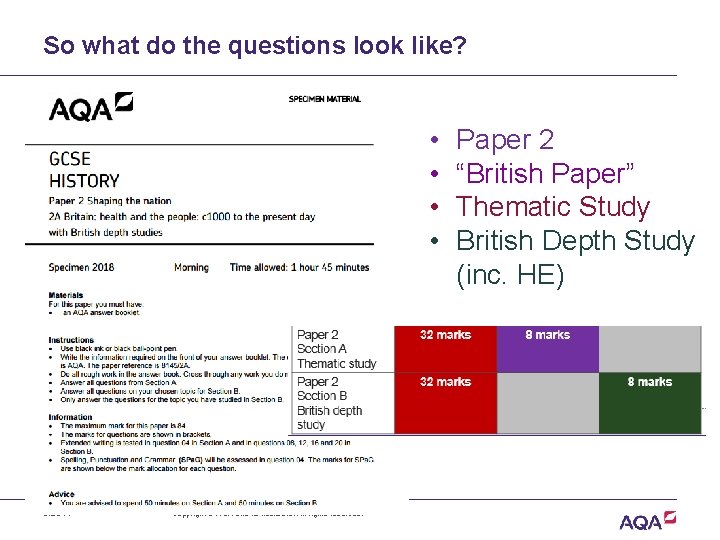
• Aspect 1: knowledge, understanding, analysis and explanation, key concepts Allocation of assessment objectives (AO 1 and AO 2) • Aspect 2: sources and interpretations (AO 3 and AO 4) Aspect 1 Aspect 2 AO 1 and AO 2 AO 3 AO 4 Paper 1 Section A Period study 24 marks 16 marks Paper 1 Section B Wider World depth study 24 marks 16 marks Paper 2 Section A Thematic study 32 marks 8 marks Paper 2 Section B British depth study 32 marks Copyright © AQA and its licensors. All rights reserved. 8 marks
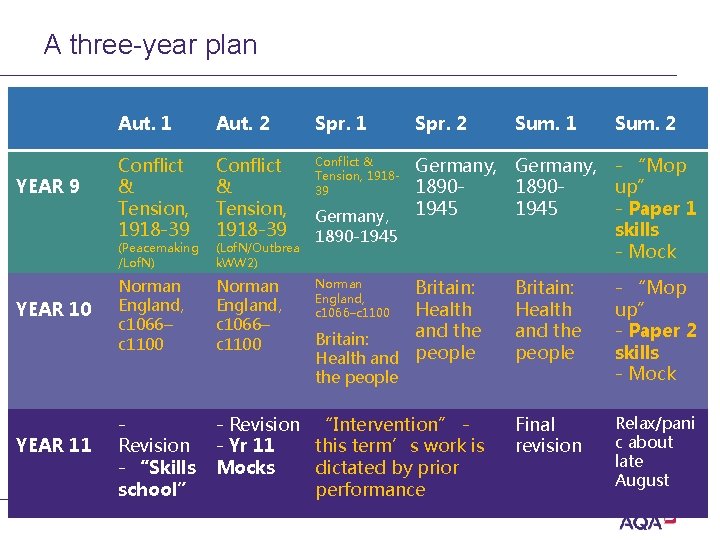
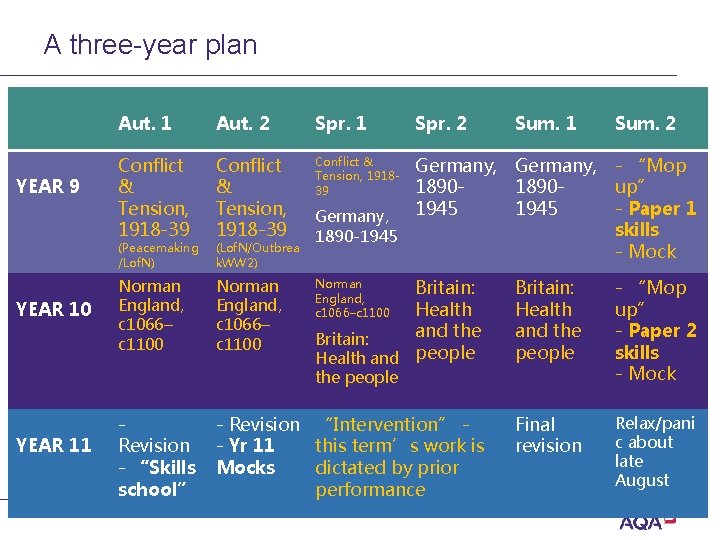
A three-year plan YEAR 9 Aut. 1 Aut. 2 Spr. 1 Conflict & Tension, 1918 -39 Conflict & Tension, 191839 Norman England, c 1066– c 1100 Norman England, c 1066–c 1100 (Peacemaking /Lof. N) YEAR 10 (Lof. N/Outbrea k. WW 2) Spr. 2 Sum. 1 Germany, - “Mop 1890 up” 1945 - Paper 1 Germany, 1945 skills 1890 -1945 - Mock Britain: Health and the Britain: Health and people Britain: Health and the people - “Mop up” - Paper 2 skills - Mock - Revision “Intervention” - - Yr 11 this term’s work is Mocks dictated by prior performance Final revision Relax/pani c about late August the people YEAR 11 - Revision - “Skills school” Sum. 2 Copyright © AQA and its licensors. All rights reserved.
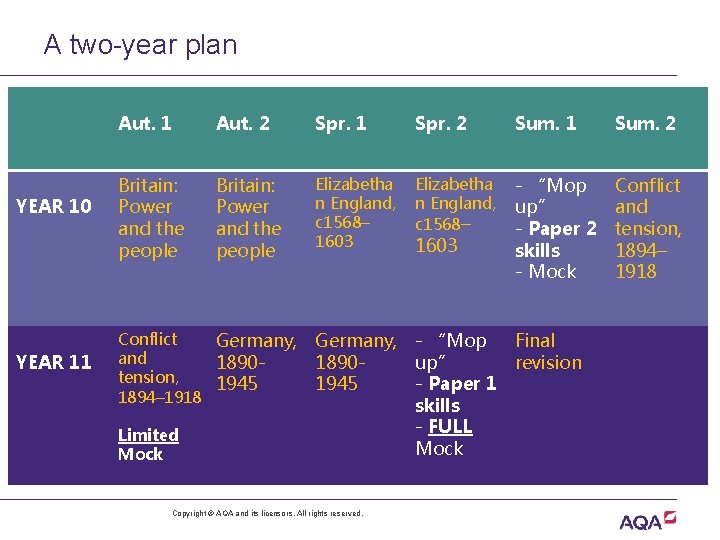
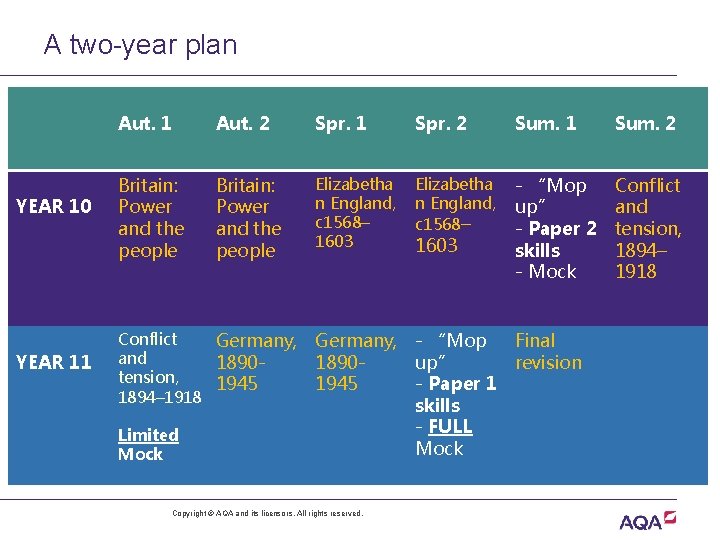
A two-year plan YEAR 10 YEAR 11 Aut. 2 Spr. 1 Spr. 2 Britain: Power and the people Elizabetha n England, c 1568– 1603 Elizabetha - “Mop n England, up” c 1568– - Paper 2 1603 Conflict Germany, - “Mop and 1890 up” tension, 1945 - Paper 1 1894– 1918 Limited Mock Copyright © AQA and its licensors. All rights reserved. skills - FULL Mock Sum. 1 skills - Mock Final revision Sum. 2 Conflict and tension, 1894– 1918
So what do the questions look like? • • Copyright © AQA and its licensors. All rights reserved. Paper 1 “World Paper” Period Study WW Depth Study
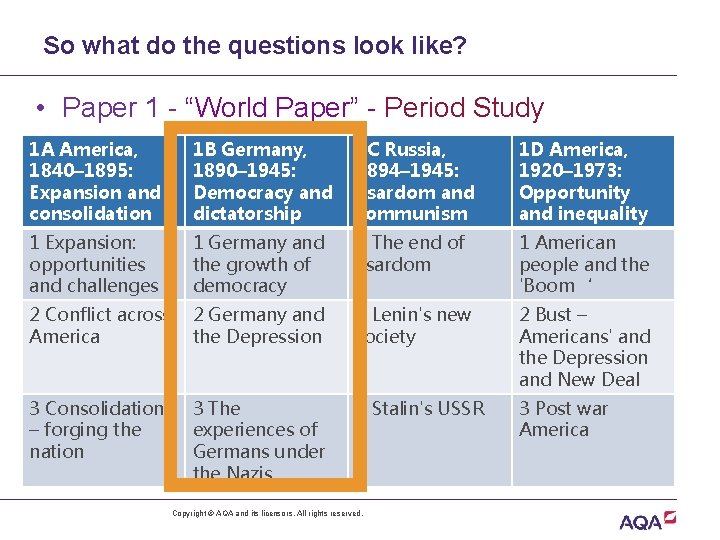
So what do the questions look like? • Paper 1 - “World Paper” - Period Study 1 A America, 1840– 1895: Expansion and consolidation 1 B Germany, 1890– 1945: Democracy and dictatorship 1 C Russia, 1894– 1945: Tsardom and communism 1 D America, 1920– 1973: Opportunity and inequality 1 Expansion: opportunities and challenges 1 Germany and the growth of democracy 1 The end of Tsardom 1 American people and the 'Boom‘ 2 Conflict across 2 Germany and America the Depression 2 Lenin's new society 2 Bust – Americans' and the Depression and New Deal 3 Consolidation – forging the nation 3 Stalin's USSR 3 Post war America 3 The experiences of Germans under the Nazis Copyright © AQA and its licensors. All rights reserved.
So what do the questions look like? Copyright © AQA and its licensors. All rights reserved.
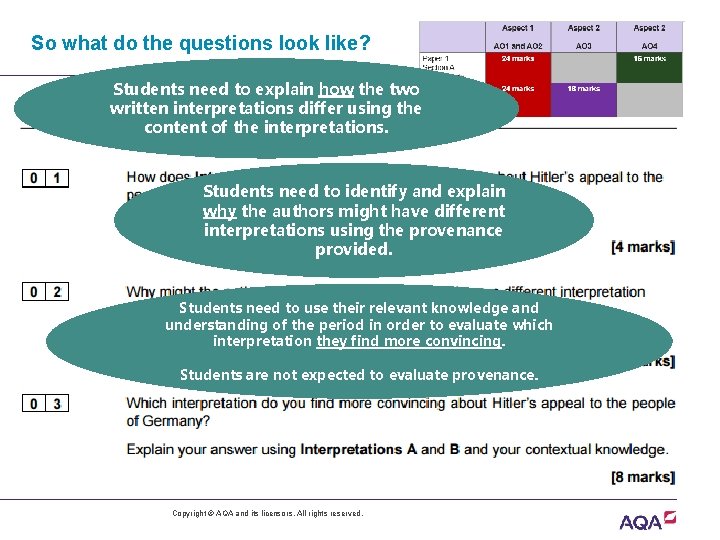
So what do the questions look like? Students need to explain how the two written interpretations differ using the content of the interpretations. Students need to identify and explain why the authors might have different interpretations using the provenance provided. Students need to use their relevant knowledge and understanding of the period in order to evaluate which interpretation they find more convincing. Students are not expected to evaluate provenance. Copyright © AQA and its licensors. All rights reserved.
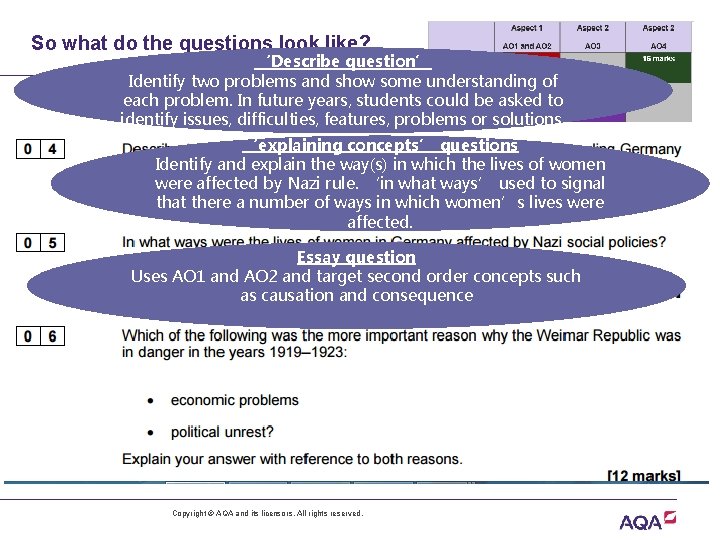
So what do the questions look like? ‘Describe question’ Identify two problems and show some understanding of each problem. In future years, students could be asked to identify issues, difficulties, features, problems or solutions. ‘explaining concepts’ questions Identify and explain the way(s) in which the lives of women were affected by Nazi rule. ‘in what ways’ used to signal that there a number of ways in which women’s lives were affected. Essay question Uses AO 1 and AO 2 and target second order concepts such as causation and consequence Copyright © AQA and its licensors. All rights reserved.
So what do the questions look like? • • Copyright © AQA and its licensors. All rights reserved. Paper 1 “World Paper” Period Study WW Depth Study
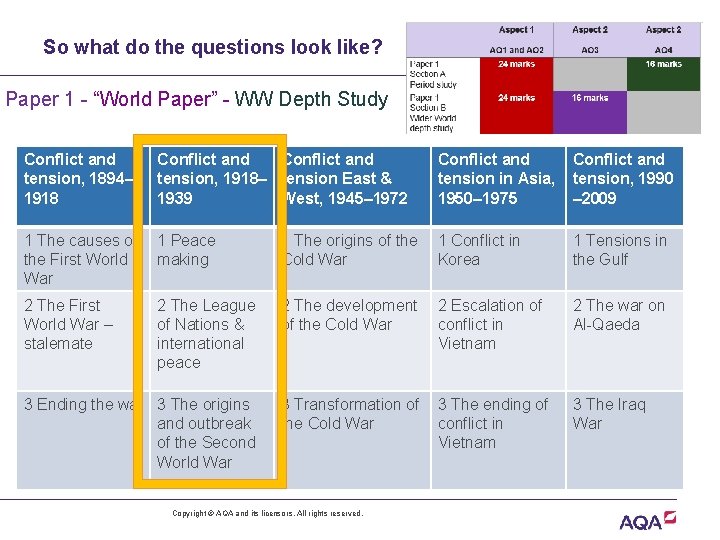
So what do the questions look like? Paper 1 - “World Paper” - WW Depth Study Conflict and tension, 1894– 1918 Conflict and tension, 1918– tension East & 1939 West, 1945– 1972 Conflict and tension in Asia, 1950– 1975 Conflict and tension, 1990 – 2009 1 The causes of 1 Peace the First World making War 1 The origins of the 1 Conflict in Cold War Korea 1 Tensions in the Gulf 2 The First World War – stalemate 2 The development 2 Escalation of of the Cold War conflict in Vietnam 2 The war on Al-Qaeda 3 Transformation of 3 The ending of the Cold War conflict in Vietnam 3 The Iraq War 2 The League of Nations & international peace 3 Ending the war 3 The origins and outbreak of the Second World War Copyright © AQA and its licensors. All rights reserved.
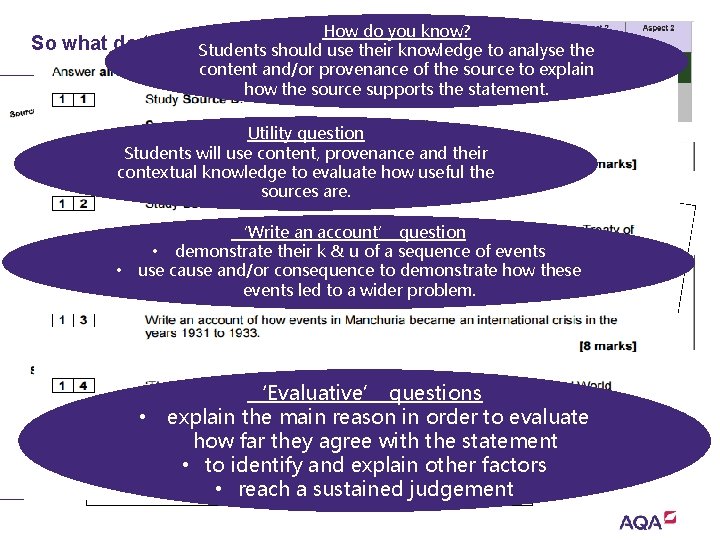
How do you know? So what do the questions look like? Students should use their knowledge to analyse the content and/or provenance of the source to explain how the source supports the statement. Utility question Students will use content, provenance and their contextual knowledge to evaluate how useful the sources are. • ‘Write an account’ question • demonstrate their k & u of a sequence of events use cause and/or consequence to demonstrate how these events led to a wider problem. ‘Evaluative’ questions • explain the main reason in order to evaluate how far they agree with the statement • to identify and explain other factors • reach a sustained judgement Slide 11 Copyright © AQA and its licensors. All rights reserved.
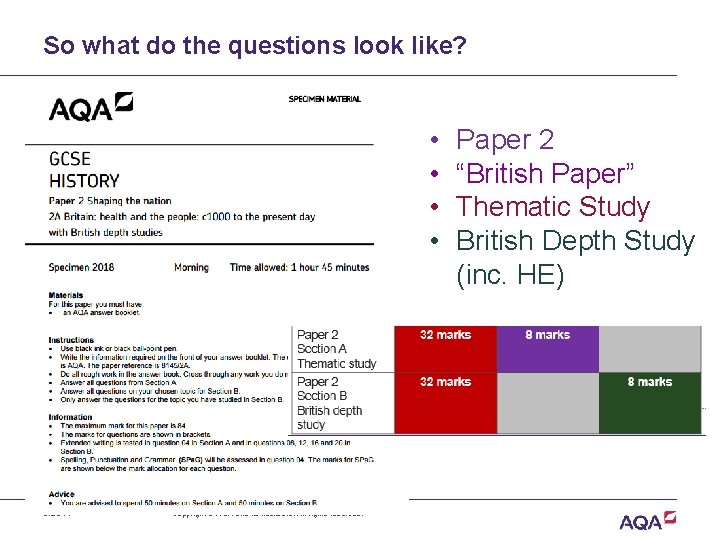
So what do the questions look like? • • Slide 11 Copyright © AQA and its licensors. All rights reserved. Paper 2 “British Paper” Thematic Study British Depth Study (inc. HE)
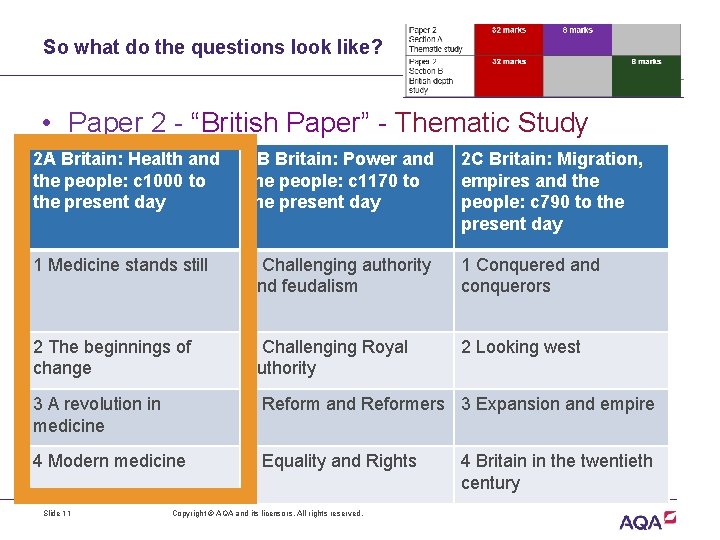
So what do the questions look like? • Paper 2 - “British Paper” - Thematic Study 2 A Britain: Health and the people: c 1000 to the present day 2 B Britain: Power and the people: c 1170 to the present day 2 C Britain: Migration, empires and the people: c 790 to the present day 1 Medicine stands still 1 Challenging authority and feudalism 1 Conquered and conquerors 2 The beginnings of change 2 Challenging Royal authority 2 Looking west 3 A revolution in medicine 3 Reform and Reformers 3 Expansion and empire 4 Modern medicine 4 Equality and Rights Slide 11 Copyright © AQA and its licensors. All rights reserved. 4 Britain in the twentieth century
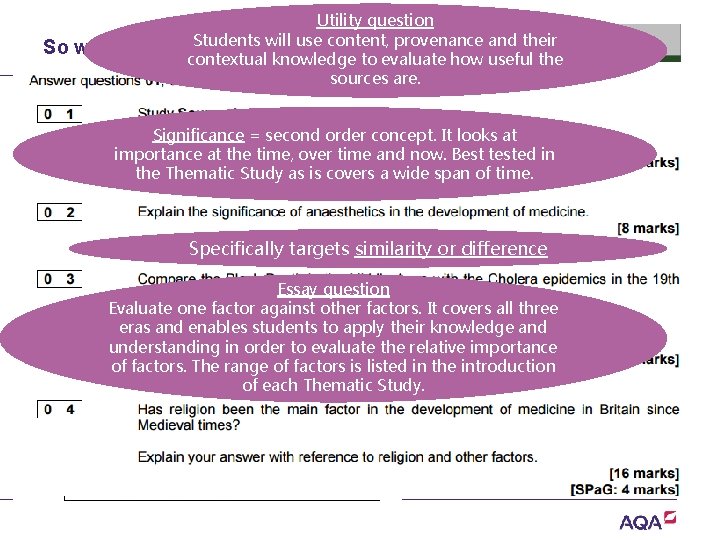
So what do Utility question Students will use content, provenance and their the questions look like? contextual knowledge to evaluate how useful the sources are. • Paper 2 - “British Paper” - Thematic Study Significance = second order concept. It looks at importance at the time, over time and now. Best tested in the Thematic Study as is covers a wide span of time. Specifically targets similarity or difference Essay question Evaluate one factor against other factors. It covers all three eras and enables students to apply their knowledge and understanding in order to evaluate the relative importance of factors. The range of factors is listed in the introduction of each Thematic Study. Slide 11 Copyright © AQA and its licensors. All rights reserved.
So what do the questions look like? • • Slide 11 Copyright © AQA and its licensors. All rights reserved. Paper 2 “British Paper” Thematic Study British Depth Study (inc. HE)
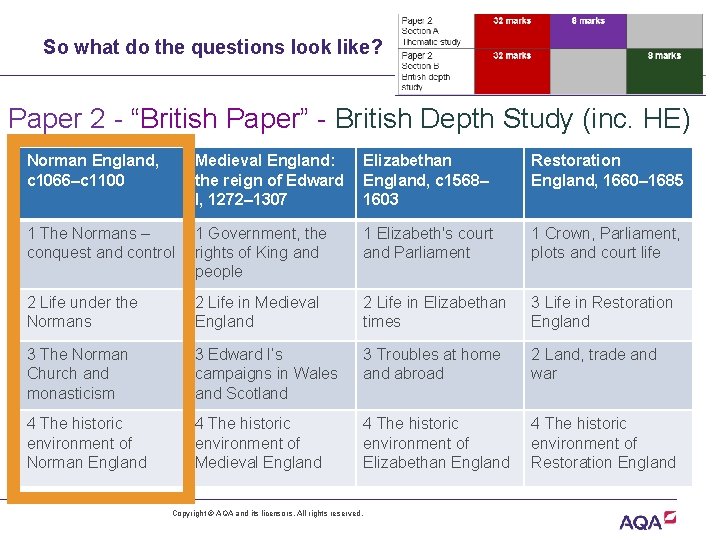
So what do the questions look like? Paper 2 - “British Paper” - British Depth Study (inc. HE) Norman England, c 1066–c 1100 Medieval England: the reign of Edward I, 1272– 1307 Elizabethan England, c 1568– 1603 Restoration England, 1660– 1685 1 The Normans – conquest and control 1 Government, the rights of King and people 1 Elizabeth's court and Parliament 1 Crown, Parliament, plots and court life 2 Life under the Normans 2 Life in Medieval England 2 Life in Elizabethan times 3 Life in Restoration England 3 The Norman Church and monasticism 3 Edward I’s campaigns in Wales and Scotland 3 Troubles at home and abroad 2 Land, trade and war 4 The historic environment of Norman England 4 The historic environment of Medieval England 4 The historic environment of Elizabethan England 4 The historic environment of Restoration England Copyright © AQA and its licensors. All rights reserved.
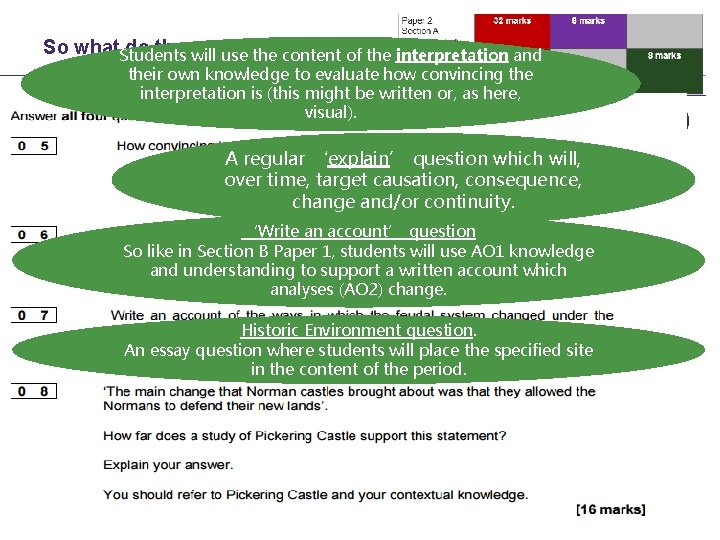
So what. Students will use the content of the interpretation and do the questions look like? their own knowledge to evaluate how convincing the interpretation is (this might be written or, as here, visual). Paper 2 - “British Paper” - British Depth Study (inc. HE) A regular ‘explain’ question which will, over time, target causation, consequence, change and/or continuity. ‘Write an account’ question So like in Section B Paper 1, students will use AO 1 knowledge and understanding to support a written account which analyses (AO 2) change. Historic Environment question. An essay question where students will place the specified site in the content of the period. Copyright © AQA and its licensors. All rights reserved.
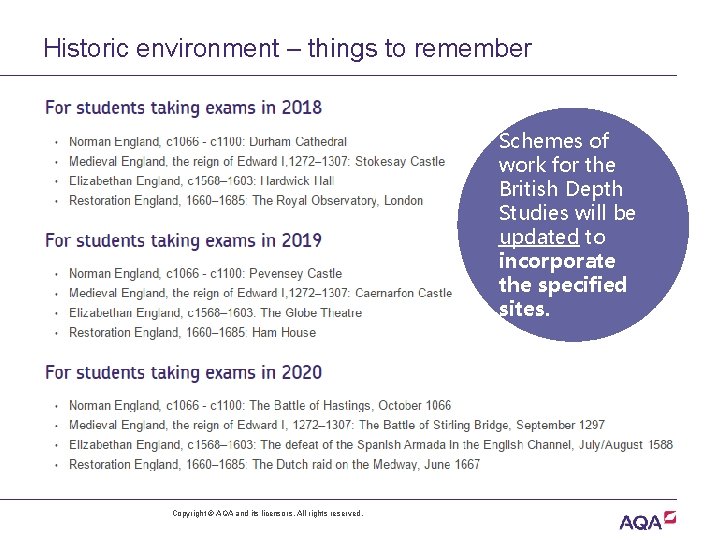
Historic environment – things to remember • The specified sites to be studied have been identified by AQA Schemes of • The sites for 2018, 2019 and 2020 have been released and are on work for the AQA website British Depth Studies will be updated to • There is still no requirement to visit the site. incorporate the specified • If you wish to visit the site or a similar one, you are welcome to do sites. so as part of your delivery of the course, however, no credit is given in the exam. • Free resource packs for each site will be available. They will include teachers’ notes, schemes of work and resources you can use with your students. Copyright © AQA and its licensors. All rights reserved.
A three-year plan YEAR 9 Aut. 1 Aut. 2 Spr. 1 Conflict & Tension, 1918 -39 Conflict & Tension, 191839 Norman England, c 1066– c 1100 Norman England, c 1066–c 1100 (Peacemaking /Lof. N) YEAR 10 (Lof. N/Outbrea k. WW 2) Spr. 2 Sum. 1 Germany, - “Mop 1890 up” 1945 - Paper 1 Germany, 1945 skills 1890 -1945 - Mock Britain: Health and the Britain: Health and people Britain: Health and the people - “Mop up” - Paper 2 skills - Mock - Revision “Intervention” - - Yr 11 this term’s work is Mocks dictated by prior performance Final revision Relax/pani c about late August the people YEAR 11 - Revision - “Skills school” Sum. 2 Copyright © AQA and its licensors. All rights reserved.
A two-year plan YEAR 10 YEAR 11 Aut. 2 Spr. 1 Spr. 2 Britain: Power and the people Elizabetha n England, c 1568– 1603 Elizabetha - “Mop n England, up” c 1568– - Paper 2 1603 Conflict Germany, - “Mop and 1890 up” tension, 1945 - Paper 1 1894– 1918 Limited Mock Copyright © AQA and its licensors. All rights reserved. skills - FULL Mock Sum. 1 skills - Mock Final revision Sum. 2 Conflict and tension, 1894– 1918
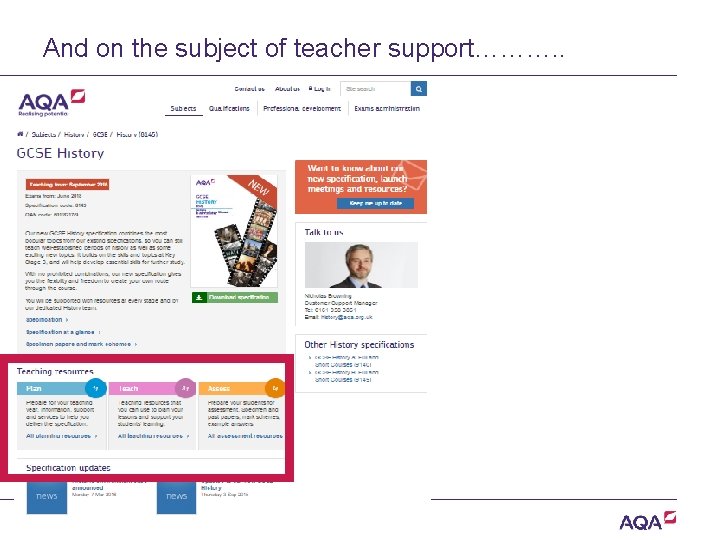
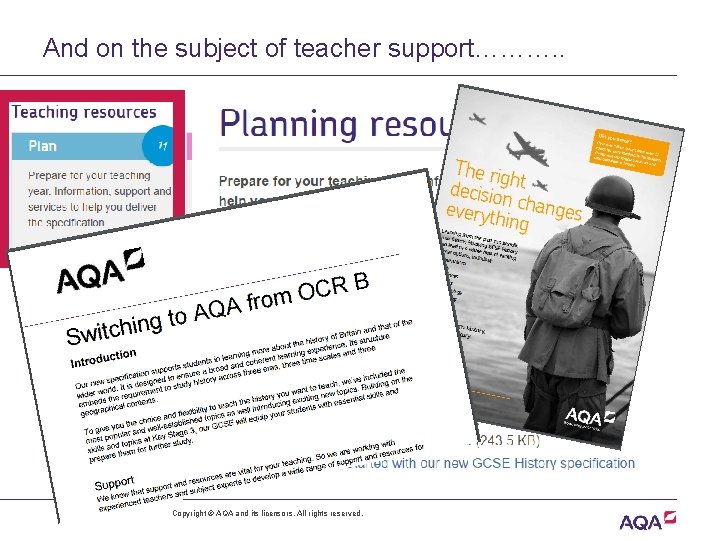
And on the subject of teacher support………. . Slide 30 Copyright © AQA and its licensors. All rights reserved.
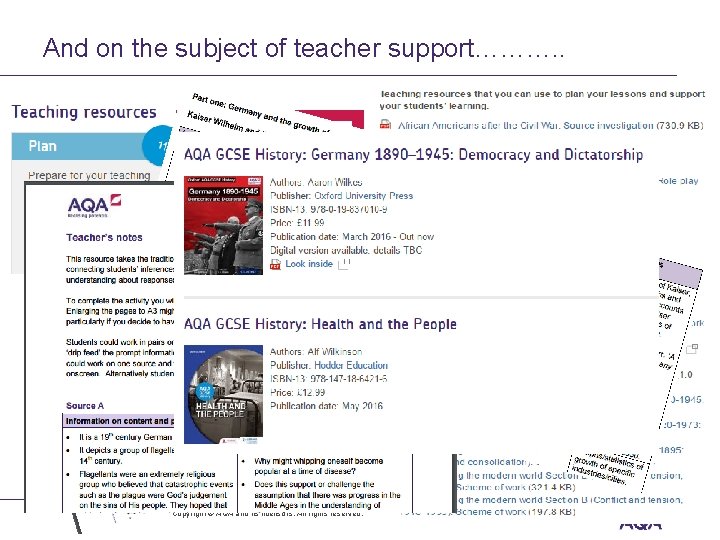
And on the subject of teacher support………. . Copyright © AQA and its licensors. All rights reserved.
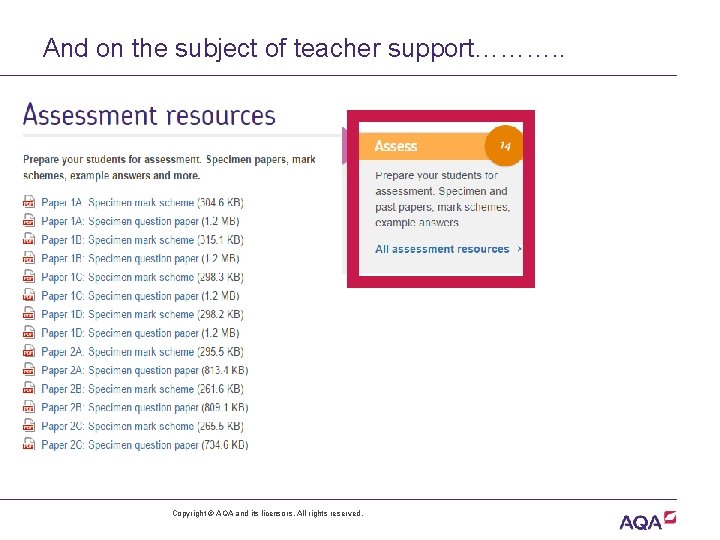
And on the subject of teacher support………. . Copyright © AQA and its licensors. All rights reserved.
And on the subject of teacher support………. . Copyright © AQA and its licensors. All rights reserved.
Contact points for more information and guidance History Support Team Tel: 0161 958 3861 Email: history@aqa. org. uk ‘Preparing to Teach’ Teacher Support Manager: Robert Kirkham Tel: 0161 957 3646 teachercpd@aqa. org. uk Copyright © AQA and its licensors. All rights reserved.
Any questions?
Thank you We are an independent education charity and the largest provider of academic qualifications for all abilities taught in schools and colleges. Our aim is to enable students to realise their potential and provide teachers with the support and resources they need so that they can focus on inspiring learning. http: //www. aqa. org. uk/ Follow us on Twitter @AQACPD.